Test-launched in May 2026 amid ceasefire talks in Ukraine. Putin’s claims are extraordinary. Independent data tells a more complicated story.
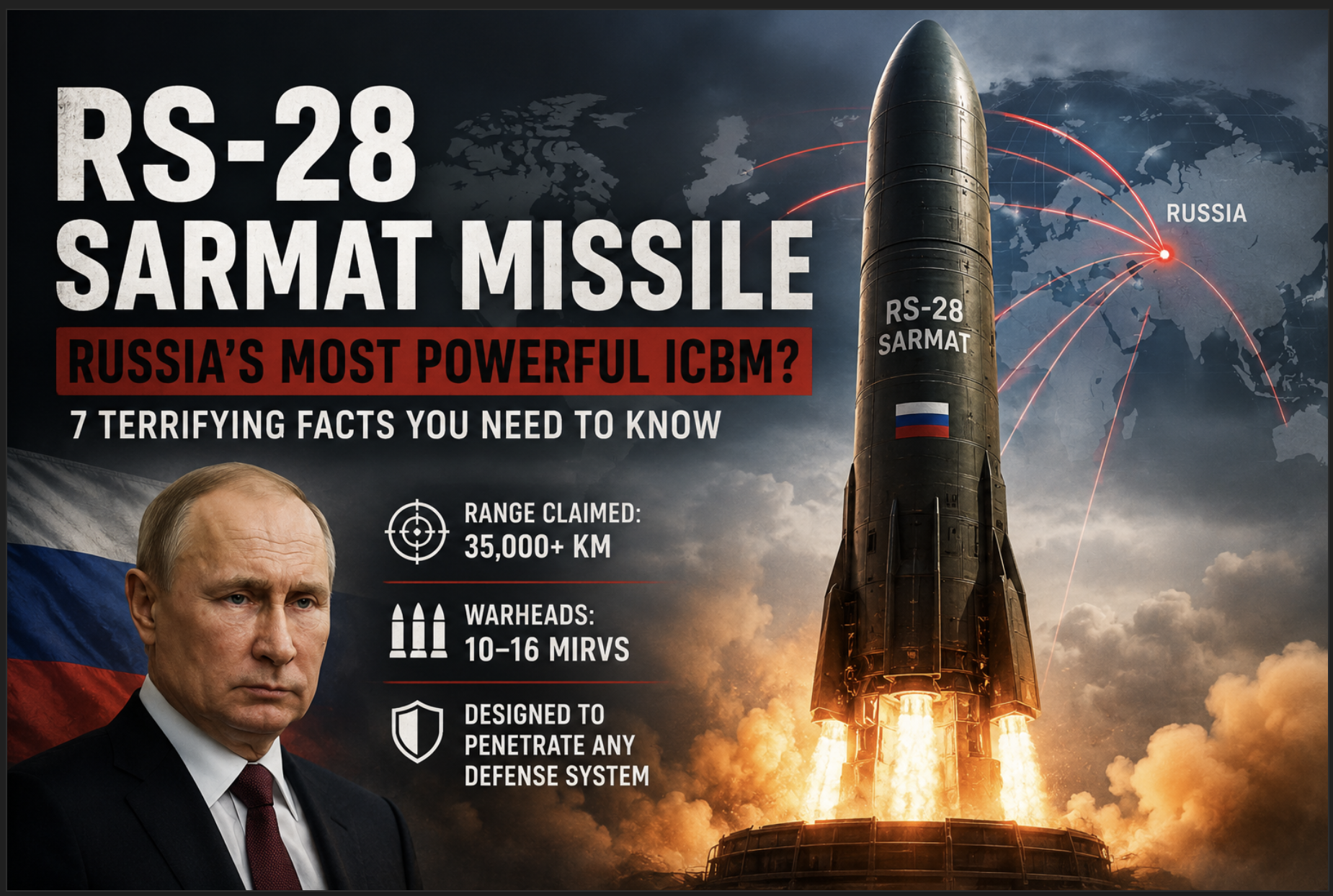
Table of Contents
- What Happened During the RS-28 Sarmat Missile Test on May 13, 2026?
- What Is the RS-28 Sarmat Missile?
- How Far Can the RS-28 Sarmat missile Reach?
- RS-28 Sarmat Missile Comparison Table
- Why liquid fuel matters more than Putin thinks
- RS-28 Sarmat Missile Failures, Delays, and Crater Incident
- Why the RS-28 Sarmat missile Matters in 2026
- FAQs
- External references
The RS-28 Sarmat missile, known by NATO as “Satan II,” returned to global headlines after Russia confirmed a fresh test launch in May 2026. Vladimir Putin called it “the most powerful missile in the world,” but independent analysts say the reality is far more complex. From disputed range claims to repeated delays and failed tests, the RS-28 Sarmat missile remains one of the most controversial nuclear weapons in Russia’s arsenal.
The launch came days after a strikingly stripped-back Victory Day parade in Moscow’s Red Square — the most scaled down since 2008 — where no military hardware was displayed for the first time in nearly twenty years. So a missile test, broadcast loudly to international media, did a lot of political heavy lifting. But the RS-28 Sarmat missile is worth examining on its own terms: what the numbers show, where the claims diverge sharply from independent analysis, and what the weapon’s actual status is.
1. What Happened During the RS-28 Sarmat Missile Test on May 13, 2026?
Russia’s Strategic Missile Forces commander, Sergei Karakayev, reported to Putin following what Russian state media described as a successful test launch. The Sarmat missile was fired from Plesetsk, a closed military cosmodrome about 800 kilometres north of Moscow that Russia uses for both space launches and ballistic missile tests.
Putin made several specific claims during and after the test. First: the missile’s combined warhead yield is more than four times that of any Western counterpart. Second: the Sarmat will enter combat service before the end of 2026. Third: the missile is capable of penetrating “all existing and future antimissile defence systems.” He also claimed the missile is capable of suborbital flight — reaching outer space without achieving the velocity needed to orbit.
Russian Telegram channel Astra, designated a foreign agent by Russian authorities, offered a pointed footnote: Putin has announced the Sarmat’s imminent readiness at least ten times since 2021. The missile still has not formally entered service.
2. What Is the RS-28 Sarmat Missile?
The RS-28 Sarmat is a heavy, silo-launched intercontinental ballistic missile designed to deliver nuclear warheads across intercontinental distances. In NATO classification it carries the label “SS-X-30 Satan 2” — the “X” denoting that it remains in experimental, not operational status.
Its key physical characteristics, as documented by the Center for Strategic and International Studies (CSIS) in April 2024:
- Length: 35.3 metres (roughly the height of a 12-storey building)
- Diameter: 3 metres
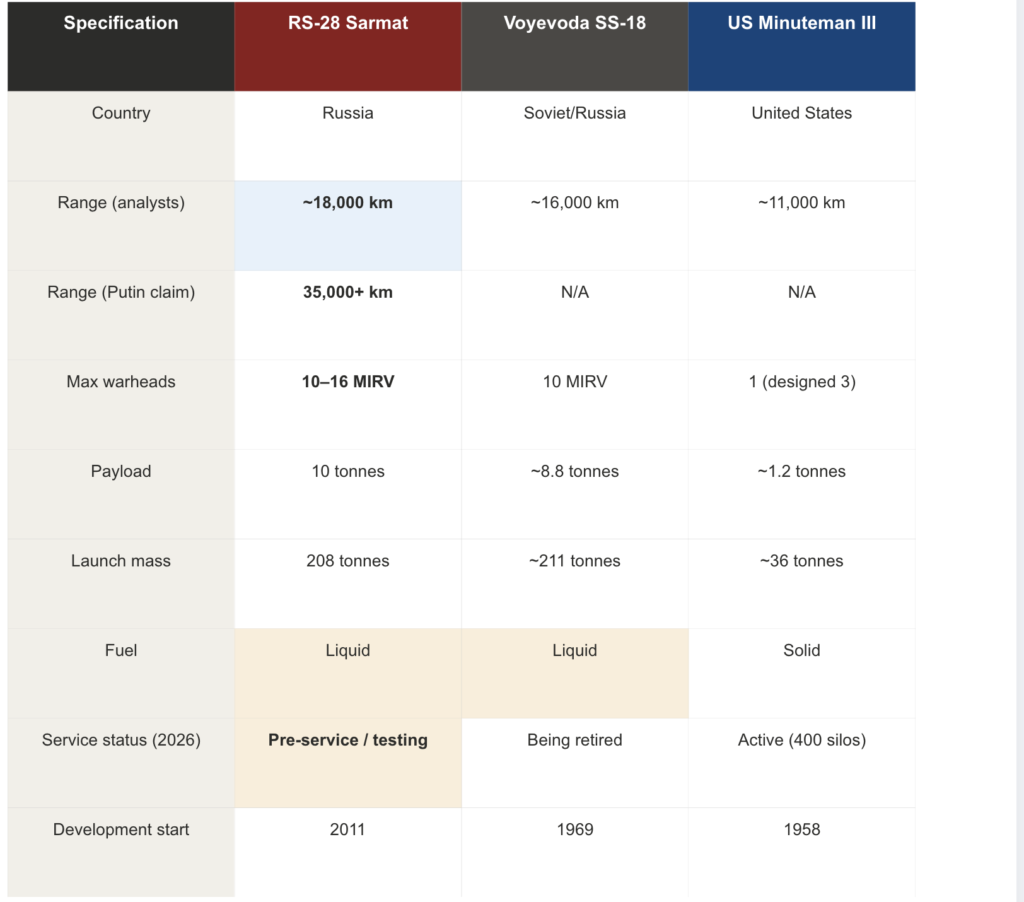
- Launch mass: 208.1 tonnes
- Maximum payload: 10 tonnes
- Warheads: between 10 and 16 independently targetable re-entry vehicles (MIRVs)
- Fuel: liquid (a notable tactical disadvantage — see section 5)
- Launch platform: underground silo
The Sarmat is the designated replacement for Russia’s Soviet-era Voyevoda missiles, known in NATO nomenclature as “Satan” (hence the successor designation “Satan II”). About 40 Voyevoda missiles are set to be retired as Sarmat units take their place. Development began in 2011. Original plans had the weapon entering service in 2018. It is now 2026.
3. How Far Can the RS-28 Sarmat missile Reach?
Putin’s claim: more than 35,000 kilometres. For reference, the circumference of Earth at the equator is approximately 40,075 kilometres. A range of 35,000 km is, geometrically speaking, nearly a complete lap of the planet. The implication would be that the missile could reach virtually any point on Earth from Russian territory, taking the longer route if necessary.
Western analysts’ estimate: approximately 18,000 kilometres. This is the figure cited by the CSIS in its April 2024 assessment, and it represents the consensus view among independent researchers. For context, the Voyevoda — the missile the Sarmat replaces — was estimated to have a range of around 16,000 kilometres.
Even the lower, more credible figure is strategically significant. Moscow to New York is approximately 7,500 kilometres. Moscow to Phoenix, Arizona — the farthest major US city — is about 9,700 kilometres. At 18,000 kilometres of range, the Sarmat easily covers the entire continental United States, all of Europe, and extends into Asia-Pacific territories. The question of whether it can travel 35,000 kilometres or 18,000 kilometres is, for practical deterrence purposes, largely academic: both ranges dwarf the distance to any target in the Western alliance.
A higher range claim does serve one purpose: it feeds the narrative that the Sarmat could reach targets via the South Pole, bypassing missile defence radars oriented to track trajectories over the North Pole. Putin’s language about penetrating “all existing and future” defences is aimed at that story.
4. RS-28 Sarmat Missile Comparison Table
The table below places the RS-28 Sarmat against the missile it replaces and the primary US land-based ICBM, the LGM-30 Minuteman III.
5. Why Liquid Fuel Matters More Than Putin Thinks
One technical detail in most coverage of the Sarmat gets less attention than it deserves: the missile runs on liquid fuel. That sounds like a minor engineering specification. It carries significant strategic implications.
A liquid-fuelled ICBM cannot be kept in launch-ready status. The fuel is corrosive to the missile’s internals and must be loaded shortly before a planned launch. This means Russia’s adversaries would, in theory, have an observable window in which fuelling operations precede launch — a tactical disadvantage compared with solid-fuelled missiles like the US Minuteman III, which can be held at near-instantaneous readiness for years without maintenance fuelling.
The Soviet-era Voyevoda had the same limitation. It was a design trade-off accepted in the 1970s in exchange for the ability to carry heavier payloads. The Sarmat inherits that trade-off. Putin’s own 2018 boast — that the Sarmat reaches high speed quickly, giving defence systems less time to detect and track it — does not fully compensate for the pre-launch preparation window.
Russia’s newer Avangard hypersonic glide vehicle, which can reportedly be mounted on Sarmat, is itself solid-fuelled at the boost phase. Whether that combination resolves the readiness gap is a matter of active debate among missile defence specialists.
6.RS-28 Sarmat Missile Failures, Delays, and Crater Incident
The May 2026 launch was not the first attempt. In September 2024, a test of the RS-28 Sarmat reportedly ended in catastrophic failure. Satellite imagery reviewed by independent researchers showed a crater roughly 200 feet wide (about 60 metres) at the launch complex at Plesetsk. The Russian government offered no official comment.
The history of delays is striking in itself. The Sarmat was originally scheduled to enter service in 2018 — the year Putin unveiled it at a presentation alongside footage of the missile obliterating what appeared to be the state of Florida. It was 2022 before Russia conducted its first test launch. It is now 2026 and the missile still has not formally entered combat service, despite Putin’s repeated announcements of imminent deployment.
This does not mean the weapon is without capability. Russia’s Strategic Missile Forces are sophisticated, and development setbacks with liquid-fuelled heavy ICBMs are historically common — the US encountered similar difficulties with the Titan II programme in the 1960s. But it does complicate the narrative of seamless military modernisation that surrounds each announcement.
7. Why the RS-28 Sarmat missile Matters in 2026
The test’s timing was not chosen at random. It came in the immediate aftermath of Russia’s most subdued Victory Day parade since the event was revived as an annual spectacle in 2008. For the first time in roughly two decades, no military hardware rolled through Red Square. Russian authorities cited security concerns following Ukrainian drone strikes deep into Russian territory, including on oil refineries.
Putin himself acknowledged the stripped-down parade was by choice — he told journalists the armed forces “should focus on the decisive defeat of the enemy.” A missile test, broadcast prominently on state television, effectively substituted for the hardware display the parade could not safely hold.
Analysts from the Institute for the Study of War described the Sarmat display as part of a broader pattern of nuclear sabre-rattling intended to project military strength at a moment when Russia’s battlefield performance in Ukraine has come under pressure. The Russian spring-summer 2026 offensive has faced mounting difficulty. Ukrainian forces recently advanced in the Slovyansk direction and around the Kostyantynivka-Druzhkivka tactical area. Russian forces launched 216 drones toward Ukraine in a single overnight window, an indicator of continuing high-intensity operations.
A European intelligence agency report, obtained by multiple news organisations including CNN, stated that the Kremlin has dramatically increased personal security around Putin and reduced the number of locations he regularly visits — a detail the Kremlin dismissed, but which circulated widely during the same week as the missile test.
Russia maintains the world’s largest inventory of nuclear warheads — estimated at more than 5,500 by the International Campaign to Abolish Nuclear Weapons. The United States holds just over 5,000. The Sarmat, when it does enter service, would add a new generation of delivery vehicle to that stockpile. But its political utility in 2026 appears to be as much about image management as about actual military readiness.
Frequently Asked Questions (FAQs)
Q1: What does ‘Satan II’ mean and who gave the Sarmat that name?
The nickname “Satan II” was assigned by NATO’s intelligence community as a reporting designation for the RS-28, building on the fact that its predecessor, the Voyevoda, was already known as “Satan.” Russia does not use the name officially and considers it Western propaganda framing. The formal Russian designation is RS-28 Sarmat, named after the ancient Sarmatian nomadic people of the Pontic steppe.
Q2: Could the Sarmat actually reach the entire United States?
Yes — at either the claimed or analyst-estimated range. At 18,000 kilometres, the missile can reach any point in the continental United States from Russian silos. Moscow to the most distant major US city (Phoenix) is approximately 9,700 kilometres, well within Sarmat’s estimated capability. At Putin’s claimed 35,000 km, the missile could theoretically fly south over Antarctica and approach targets from below, evading north-facing radar systems.
Q3: How many nuclear warheads can the Sarmat carry?
Estimates vary. Russia has claimed up to 16 independently targeted warheads (MIRVs). The Missile Defense Advocacy Alliance puts the figure at up to 16. CSIS’s April 2024 report uses a more conservative number of approximately 10. The discrepancy reflects the fact that maximum theoretical payload capacity and actual configured warhead count are different things, and Russia has not publicly confirmed its warhead configuration.
Q4: Is the Sarmat missile currently operational?
As of May 2026, no. The Sarmat remains in a pre-service testing phase despite multiple Russian announcements of imminent deployment going back to 2021. Putin stated following the May 2026 test that it would enter combat service by the end of the year. Independent analysts treat this timeline with scepticism given the history of delays and the September 2024 test failure.
Q5: How does the Sarmat compare to the US Minuteman III?
The two missiles reflect fundamentally different design philosophies. The Minuteman III is a solid-fuelled, single-warhead (in current configuration) missile with an 11,000 km range and near-instant readiness. The Sarmat is liquid-fuelled, much heavier, carries more warheads, and has greater range but requires pre-launch fuelling. The US has also been developing its replacement for Minuteman III, the LGM-35A Sentinel, which has faced its own programme challenges.
Q6: What happened in the September 2024 Sarmat test?
A test in September 2024 ended in what researchers described as a catastrophic failure. Satellite images showed a crater approximately 200 feet wide (roughly 60 metres) at the Plesetsk launch facility. Russia did not officially acknowledge the failure. It was one of the factors that pushed the weapon’s service entry date well past earlier predictions.
Q7: Why did Russia test the Sarmat now, in May 2026?
The timing coincided with a period of heightened signalling around the Ukraine conflict. Russia’s 2026 Victory Day parade was stripped of military hardware for the first time in nearly two decades, prompting questions about security vulnerabilities. Ukrainian forces had conducted drone strikes deep into Russian territory. The missile test served as a public demonstration of Russian strategic capability at a moment when its conventional military narrative was under pressure.
External Authority Links
- Center for Strategic and International Studies (CSIS) – RS-28 Sarmat Missile Threat Database
- Missile Defense Advocacy Alliance – RS-28 Satan II Profile
- Al Jazeera – Putin Hails Russia’s Sarmat Test Launch
- International Campaign to Abolish Nuclear Weapons (ICANW) – Global Nuclear Warhead Data
- CNN – RS-28 Sarmat Explainer
There is a peculiar tension in how Russia communicates about the Sarmat. The missile is, by any measure, a formidable weapons system, even at the analyst-estimated range of 18,000 kilometres, it represents a significant upgrade in Russia’s strategic delivery capability. The warhead count and payload capacity exceed those of the Minuteman III by a wide margin. Its claimed ability to approach targets via unusual trajectories, potentially bypassing existing radar architecture, gives Western defence planners something real to consider.
Yet the accompanying messaging strains credibility. The 35,000 kilometre range claim would require physics that do not appear consistent with a vehicle of this mass and fuel configuration. The repeated announcements of imminent service entry, stretching back five years, have produced an unusual dynamic where the strategic community must take the weapon seriously while simultaneously discounting much of what Russia officially says about it.
What the Sarmat test of May 2026 most clearly demonstrates is that Russia’s nuclear modernisation programme is real and ongoing — even if the timeline is slower, the performance figures are lower, and the technical hurdles are greater than any Kremlin press release would suggest. That gap between claim and reality does not make the weapon less dangerous. It just makes the political performance around it easier to read.