
That Expose India’s Most Dangerous Digital Paradox
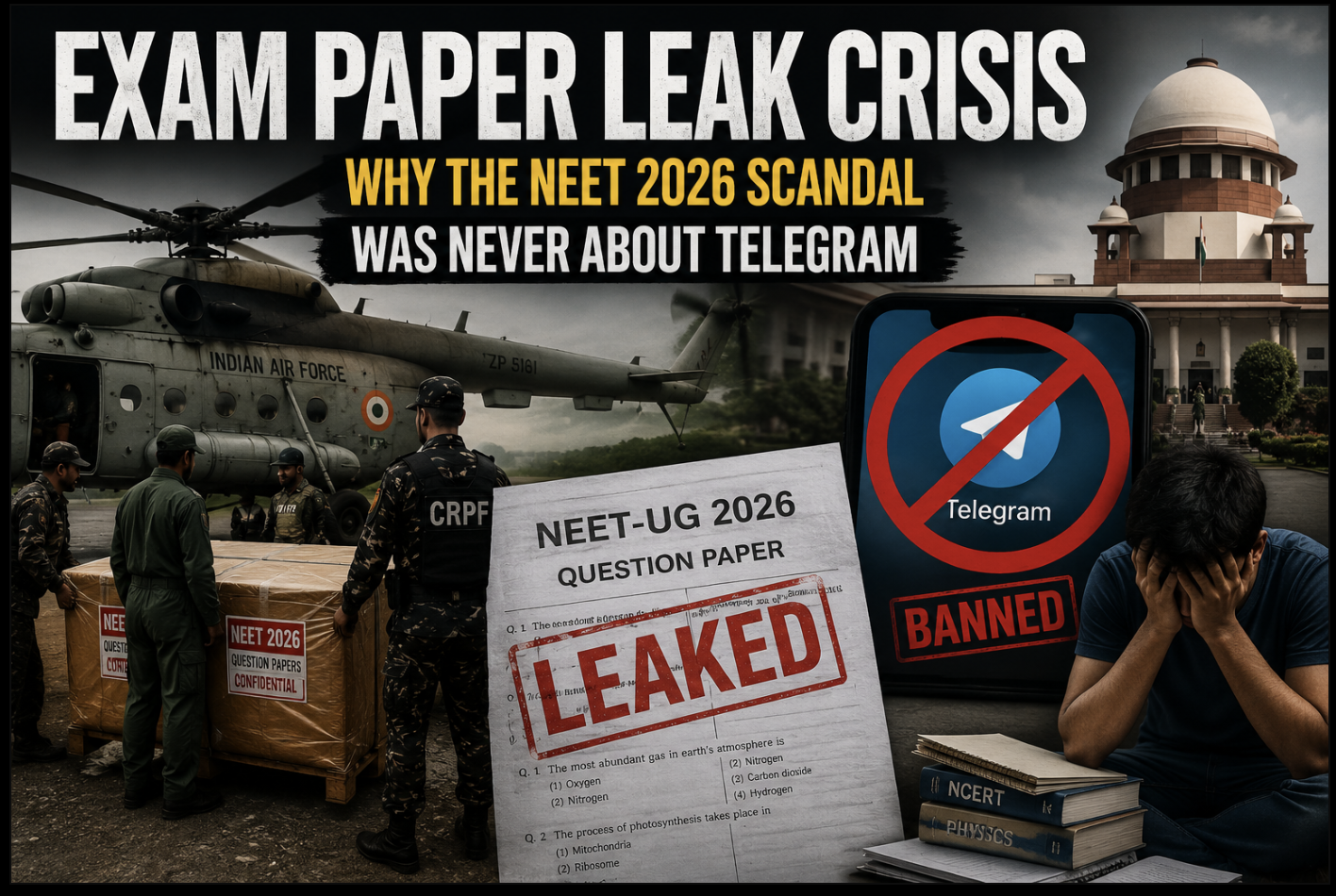
The NEET 2026 Paper Leak has reignited concerns about India’s examination system. On June 16, an Indian Air Force Mi-17 helicopter touched down at the Tirunelveli Armed Reserve Ground in Tamil Nadu. Its cargo wasn’t ammunition or relief supplies. It was sealed packets of paper — question papers for the NEET-UG 2026 re-examination, flown in under armed escort because the government had stopped trusting ordinary transport to get them there intact. The NEET 2026 Paper Leak has exposed major weaknesses in India’s examination system.
Two days later, the Ministry of Electronics and Information Technology ordered telecom operators to block Telegram across the country. Somewhere between those two decisions sits the real story of India’s exam paper leak crisis, and it has surprisingly little to do with either helicopters or messaging apps.
| The platform is not the problem. The platform is where the problem becomes visible. |
More than 22 lakh students had written the original NEET-UG exam on May 3, 2026. Nine days later, the National Testing Agency cancelled it, after investigators flagged a circulating “guess paper” that matched the real one with uncomfortable precision. Unlike earlier controversies, the NEET 2026 Paper Leak triggered nationwide scrutiny of exam security.
A re-test was fixed for June 21. By the time exam day arrived, the government had deployed close to five lakh security personnel, blocked a messaging platform used by over 150 million Indians, and pressed military aircraft into service just to move stationery between cities. That is the scale of distrust one leak scandal can generate. India’s exam paper leak crisis has reached a point where extraordinary security measures are becoming routine.
It also leaves a question hanging that nobody in government seems keen to answer directly. If the real problem is a fragile examination system, does flying papers around in Air Force choppers actually fix anything — or does it just look like action while the underlying weak points stay exactly where they were?
When Helicopters Start Delivering Exam Papers, Something Upstream Already Failed
Officially, the operation that moved NEET-UG 2026 papers this June was almost mundane: aircraft and helicopters picking up sealed material from two central hubs and dropping it across roughly 20 zones, with the Central Reserve Police Force and Central Industrial Security Force guarding every handover. Unofficially, it was the Indian state admitting, in the most visible way possible, that it no longer trusted roads, trains or ordinary couriers to carry a stack of paper without someone tampering with it.
More than 200 sorties were flown over four days. One leg of the route had papers travelling by air from Delhi to Madurai, then switching to an Indian Army helicopter for the final stretch to Tirunelveli, with Air Force personnel supervising the handover. The Defence Ministry, the Home Ministry, the Postal Department and state governments were all coordinating under a framework run out of the Ministry of Education. For a single entrance test, that is an extraordinary amount of machinery.
Delhi chief minister Arvind Kejriwal, never one to miss a jab at the Centre, argued on social media that transporting papers by military aircraft and shutting down Telegram in the same week was proof the government had no real strategy against paper leaks — just a need to look like it was doing something dramatic. Whatever one makes of the politics, the underlying point is hard to dismiss outright. Visible muscle and actual security are not automatically the same thing, and the gap between the two is where a lot of public trust quietly leaks away.
Does Banning Telegram Actually Stop the NEET 2026 Paper Leak?
The Telegram restriction took effect on June 16 under Section 69A of the Information Technology Act, 2000, and was set to lift on June 22 — one day after the re-exam. A second, narrower order kept Telegram’s message-editing feature switched off in India until June 30. The National Testing Agency had recommended the action after flagging channels with names like ‘PAPER LEAKED NEET’ and ‘Re-NEET 2026 Private Mafia,’ which were soliciting frightened students and their families for sums running into thousands of rupees in exchange for papers that, by NTA’s own repeated statements, did not exist.
| You cannot lead the digital economy of the 21st century by periodically disconnecting your citizens from it. |
WhatsApp, used by roughly as many Indians, was left completely untouched. The official reasoning hinges on architecture, not popularity. Telegram lets a user hide their phone number entirely and run public channels with unlimited subscribers under nothing more than a username, which makes anonymous, large-scale fraud easy to run and hard to trace. WhatsApp ties every account to a phone number, and its editing window is short and doesn’t allow swapping in a different file.
Telegram’s edit feature, by contrast, let someone post an ordinary message before the exam and quietly swap in a real or fake question paper afterward, while the original timestamp stayed untouched — manufacturing ‘evidence’ of a leak that never happened.
Telegram’s founder, Pavel Durov, pushed back hard, pointing out that the platform had already pulled down hundreds of leak-related channels in the weeks before the block and arguing that shutting the app doesn’t eliminate fraudsters, it just sends them somewhere else. The Internet Freedom Foundation called the order disproportionate, noting that millions of students, teachers and small businesses use Telegram for entirely legitimate reasons and were paying the price for a problem created by a much smaller group.
Both points land, because in nearly every confirmed NEET leak — 2024 included — the breach happened at a school, a printing press or a transport vehicle, long before any photograph reached a Telegram channel. The app was where rumours spread fastest. It was rarely where the actual theft occurred. The NEET controversy is only the latest example of the wider exam paper leak crisis facing India.
An Exam Built for the Twentieth Century, Tested by Smartphones
NEET-UG isn’t new to scandal. The 2024 edition was cancelled in parts and reconducted after a leak traced to Hazaribagh in Jharkhand. The 2026 edition was cancelled outright. Two cycles, two years apart, same basic failure pattern. That repetition says less about bad luck and more about a design problem that reform announcements haven’t actually touched.
The exam itself is a single mega-event: one paper, one day, more than 20 lakh candidates simultaneously. That structure means one compromised link anywhere in the chain — a printing press, a warehouse, a transport vehicle, a single school’s strong room — can taint the result for the entire country.
Add to that a chain where printing, warehousing and last-mile transport are routinely outsourced to private vendors, and where many exam centres are ordinary private schools and colleges without standardised CCTV coverage or signal jammers, and you get a system with a lot of human touchpoints between the press and the hall.
The National Testing Agency itself is registered as a society under an 1860-era law, not as a statutory body with the kind of permanent staff and direct accountability that, say, the Union Public Service Commission has. It leans heavily on deputed officials and contract staff.
A High-Level Committee headed by Dr K. Radhakrishnan submitted recommendations after the 2024 episode; the Public Examinations Act, 2024 exists on paper to criminalise leaks. Enforcement across states, where most of the actual printing, transport and invigilation happens, has been far slower than the legislation.
Hazaribagh to Pune: Tracing Where Leaks Actually Begin
Go back to May 2024. At Oasis Public School in Hazaribagh, an accused identified as Pankaj Kumar entered the strong room at 8:02 am, broke the seal on a question paper, photographed it, and resealed the envelope with a lighter. By 9:23 am the photos had reached a guest house in the same town.
Seven or eight solvers finished the biology sections by 10:15 am and the physics and chemistry sections by 10:40, before the answers were relayed to hostels in Patna where some candidates were made to memorise them overnight, reportedly for ₹30 lakh to ₹50 lakh each. The Bihar Economic Offences Unit later found that prescribed protocols for transporting the sealed trunks had not been fully followed, which is a fairly dry way of describing how a national medical entrance exam got compromised before sunrise.
Fast-forward to the 2026 cycle, and the names change but the pattern doesn’t. The Central Bureau of Investigation arrested Manisha Havaldar, a Pune school headmistress who had been appointed as an NTA subject expert and who admitted to recalling physics questions from memory and passing them on. Chemistry professor P.V. Kulkarni and biology professor Manisha Mandhare allegedly ran coaching sessions where leaked content was dictated to students. A Nashik resident, Shubham Khairnar, allegedly sold access to leaked material for roughly ₹15 lakh. A coaching institute owner in Latur, Shivaraj Motegaonkar, reportedly received chemistry questions weeks before the exam even took place.
None of these people hacked an encrypted app or broke into a server farm. They were a headmistress, subject-matter experts, coaching operators — people the system itself had handed a measure of trust and access to. That is the thread connecting 2024 and 2026, and it has nothing to do with which messaging platform happened to be operating at the time.
What Switching Things Off Actually Costs
There’s a price tag attached to every one of these emergency measures, and it doesn’t show up in a press release. Students who had mentally closed the chapter after the May exam had to restart months of preparation for June. Results, counselling and admission timelines all slid further down the calendar, which has knock-on effects for hostel bookings, course schedules and a candidate’s entire academic year.
Telegram’s India user base runs well over 150 million people, and the overwhelming majority of them have nothing to do with exam fraud — students in coaching hubs like Kota and Sikar use channels to share legitimate study material, small businesses use it for customer communication, journalists and researchers use it for source material. All of that traffic stopped for six days because a comparatively small fraud ring was operating on the same platform.
Before the blanket order, the Indian Cyber Crime Coordination Centre had been trying channel-by-channel takedowns, and by the government’s own account, that approach simply wasn’t fast enough heading into exam week. That’s a telling admission in itself — it suggests an enforcement-capacity problem at least as much as a platform-design problem, and a full block was the faster lever to pull, not necessarily the more precise one.
What Happens When AI Joins the Cheating Game?
The part that should worry exam administrators more than any messaging app. The lessons from the NEET 2026 Paper Leak extend beyond traditional paper-based examinations. If a headmistress with photographic recall and a smartphone camera can already compromise a national exam, what happens once a candidate doesn’t need a leaked paper at all — just a phone camera pointed at a question and an AI model generating a solved answer in seconds, fed through an earpiece in real time?
| If Indian authorities struggle to secure examinations against a WhatsApp leak, what happens when the threat is an AI in a candidate’s pocket? |
Right now, the entire security apparatus — jammers, CCTV, frisking, biometric checks — is built to stop a physical leak or a hidden device. None of it is designed around the idea that the ‘cheating’ might not require any leaked content in advance, because the model doing the solving has never seen this specific paper and doesn’t need to. Authorities that needed a military airlift just to move sealed paper safely are, by their own evident struggle, not obviously ready for a threat that doesn’t travel through Telegram, doesn’t need an insider, and updates itself faster than any single ban ever could.
Are We Stuck Banning a New App Every Year?
Telegram is not the platform it was even two years ago. Following founder Pavel Durov’s 2024 arrest in France, the company says it removed more than 43.5 million channels and groups globally that year alone, and daily takedowns have reportedly climbed from a range of 10,000–30,000 to somewhere between 80,000 and 140,000 by 2026. That’s a platform under real pressure to clean itself up — just not, in the NTA’s judgement, fast enough for one specific exam window.
Which raises the obvious next question. If Telegram disappears from the list of usable apps tomorrow, fraud rings simply migrate to Discord, Signal, or whatever app nobody’s heard of yet. Each migration likely triggers its own emergency order, its own legal challenge — reports suggest Telegram’s restriction is already headed toward the Delhi High Court — and its own news cycle, without the underlying weak point in the exam chain ever being addressed. That’s not a strategy so much as a recurring fire drill.
This Isn’t the First Technology India Has Tried to Outrun
None of this is a new instinct. The printing press was once treated as a vehicle for sedition and tightly licensed. Telephone lines were monitored and restricted for decades on security grounds. Radio broadcasting in India stayed under heavy government control well into the television era, partly out of fear of what an uncontrolled signal might do. Television itself was kept at arm’s length by policymakers for years before Doordarshan fully embraced it. Dial-up internet access through cybercafes drew its own wave of moral panic in the late 1990s.
Not one of those technologies vanished because a government restricted it. They each got absorbed into the machinery of governance once institutions built the capacity — legal, technical and administrative — to live alongside them rather than periodically switch them off. There’s no obvious reason to expect Telegram, or its eventual replacement, to behave any differently.
What an Exam That Doesn’t Need an Airlift Might Look Like
Union Education Minister Dharmendra Pradhan has already signalled that NEET will shift to a computer-based format from 2027, after acknowledging what he called a breach in the command chain around the 2026 leak. That’s a quieter but more consequential admission than anything said about Telegram — it suggests the single-paper, single-day, pan-India model is itself the structural weakness, not just the transport or the messaging layer around it.
| The question is not whether security matters. It is whether internet shutdowns deliver it—or merely perform it. |
Computer-based testing run across multiple shifts — the model UPSC, SSC and several banking exams already use — shrinks the prize available from any one leak, since no single paper covers every candidate. Question banks generated uniquely per candidate, distribution chains that are cryptographically timestamped so any tampering becomes provable rather than deniable, and assessment models that lean more on continuous evaluation than a single make-or-break day are all on the table technically. None of it is a magic fix; India’s own CBT exams have had server crashes and access failures of their own, so the bar for reliability has to be at least as high as the bar currently demanded of paper security.
The Way Forward Probably Isn’t a Bigger Ban
If insiders, contractors and outsourced vendors are the recurring weak link, the obvious fix isn’t a longer list of restricted apps — it’s accountability and audits applied to the people and processes actually handling the papers. Preventing another NEET 2026 Paper Leak will require structural reforms rather than temporary platform bans. Converting the NTA from a society into a body with genuine regulatory teeth, a permanent cadre instead of deputation staff, and routine, independent security audits would address the part of the chain that has failed twice in three years.
There’s also a cooperation argument that doesn’t get much airtime in the political back-and-forth. Telegram’s own takedown numbers climbed sharply once it came under sustained international pressure, which suggests platforms respond better to consistent engagement than to occasional emergency blocks. Treating technology companies as partners in tightening enforcement, rather than purely as threats to be switched off when convenient, is the less photogenic option — but it’s also the one that doesn’t require a military aircraft every time an exam goes wrong.
Where This Leaves Things
The Telegram block was due to lift on June 22, the day after the re-test. The message-editing restriction stays in place until June 30, just in case. Whether the re-exam itself came off clean won’t really be settled for weeks — results, verification, and quite possibly a fresh round of court petitions are still ahead. Somewhere in Hazaribagh, Patna, Pune or a town nobody’s heard of yet, the next entrance exam’s papers are already being printed, packed into a trunk, and handed to a courier.
Ultimately, the NEET 2026 Paper Leak is a reminder that institutional weaknesses cannot be solved through technology restrictions alone. Whether that trunk travels by road, rail or another Air Force sortie next time, the question of who gets to be near it before the seal breaks hasn’t actually changed.
Frequently Asked Questions
Why did India temporarily restrict Telegram during the NEET-UG 2026 re-exam?
The National Testing Agency recommended the action after identifying Telegram channels that were defrauding anxious candidates with fake claims of leaked papers, and after flagging the app’s message-editing feature as a tool for fabricating after-the-fact ‘evidence’ of a leak. The order, issued under Section 69A of the IT Act, ran from June 16 to June 22, 2026.
Did the Indian Air Force really fly NEET question papers across the country?
Yes. The IAF flew more than 200 sorties using transport aircraft and Mi-17 helicopters over several days in June 2026, moving sealed question papers to roughly 20 locations, with CRPF and CISF personnel securing the handovers on the ground.
Is the exam paper leak crisis unique to 2026?
No. NEET-UG was also cancelled and partly reconducted in 2024 after a leak traced to a school in Hazaribagh, Jharkhand. The recurrence across two cycles is one reason critics argue the problem sits with the exam’s design and oversight, not with any single platform or year.
Would banning Telegram alone have prevented the 2026 leak allegations?
In the confirmed leak cases from both 2024 and 2026, the breach originated with insiders — school staff, subject experts, coaching operators — well before any content reached a messaging app. Telegram’s role was mostly in spreading claims and rumours rapidly, including a number that NTA and the PIB Fact Check unit later confirmed were fabricated. Banning platforms may address symptoms, but it does not solve the underlying exam paper leak crisis.
Will NEET move away from the paper-based exam format?
The Education Ministry has indicated NEET-UG will shift to a computer-based testing format from 2027, a change officials have linked directly to the structural weaknesses exposed by the 2026 leak controversy.
A Note on What Comes Next
The next major examination leak in India will happen. That is not cynicism. It is a statistical near-certainty given the current state of accountability infrastructure. When it does, there will be calls to ban whatever platform was used to distribute the material. There will be internet shutdowns in affected districts. There will be an inquiry committee. There will be a report.
Whether anyone uses that report to fix the pipes—that is the open question. The K. Radhakrishnan committee’s recommendations are sitting on desks in New Delhi right now. Some of them are excellent. Some are unimplemented. Whether they become structural reform or shelf furniture depends entirely on political will and administrative capacity that has, historically, been thin.
India’s examination crisis is, at its core, an institutional design problem dressed up as a technology problem. The technology—Telegram, WhatsApp, whatever comes next—is just the mirror. What it reflects is a governance architecture that was built for the twentieth century and has not been meaningfully updated for the twenty-first. The reflection is uncomfortable. The instinct is to cover the mirror. The alternative—redesigning what the mirror shows—is harder, slower, and less televisually satisfying. But it is the only approach that has ever actually worked.
External Links which are been refereed :
- National Testing Agency — official notices and statements: https://nta.ac.in
- Ministry of Electronics and Information Technology: https://www.meity.gov.in
- PIB Fact Check unit: https://factcheck.pib.gov.in
- Internet Freedom Foundation — commentary on platform-level blocks: https://internetfreedom.in
- Press Information Bureau — NEET-UG 2026 cancellation release: https://pib.gov.in

I will be all the time looking to remain updated with the
most recently released health-related data about
motherhood, given my position in everyday life is as a pregnancy
massage specialist. In cooperating with this adult population, I just
know that you can find little which any individual two women share
away from the undeniable fact they are surely currently
pregnant. Suffice to say, pregnancy massage, prenatal yoga, as
well as working with a birth and labor doula perhaps
may be guidelines which appear to be just about globally relevant to achieve the best
achievable birth experience.