What is the India-Indonesia BrahMos Deal?
The India-Indonesia BrahMos Deal marks one of the most significant developments in India’s defence diplomacy and strategic engagement with Southeast Asia. Somewhere off Sumatra’s coast, in the next few years, an Indonesian coastal battery will be able to put a warship on the seafloor from nearly 300 kilometres out — with a missile that came from neither Beijing, Washington nor Moscow. It came from New Delhi.
That’s the short version of what happened in Jakarta this week. Prime Minister Narendra Modi and Indonesian President Prabowo Subianto put their names to a defence agreement three years in the making, and the India Indonesia BrahMos deal instantly became the loudest headline out of a three-day state visit that also produced roughly twenty other agreements — a business school opening a campus in East Java, India helping Indonesia design its own voting machines, and a Rabindranath Tagore anniversary thrown in for good measure.
None of that second batch is small news, either. But missiles travel faster than trade pacts, in coverage as much as in flight, so that’s where most of the attention has gone.
Why the India-Indonesia BrahMos Deal Matters for the Indo-Pacific
Modi’s visit ran from July 6 to 8, and it was his first standalone trip to Indonesia since 2018, when the two countries upgraded ties to what diplomats call a Comprehensive Strategic Partnership. Everything since then had happened on the sidelines of summits, or through Prabowo’s own visit to Delhi as chief guest at India’s Republic Day parade last year. This was the first time either leader made the trip specifically for the other. The India-Indonesia BrahMos Deal will strengthen Indonesia’s coastal defence capabilities while expanding India’s defence export footprint.
The paperwork stack is thick enough that even the two governments don’t fully agree on how to count it. India’s foreign ministry lists 20 outcomes. One wire agency counted 14.
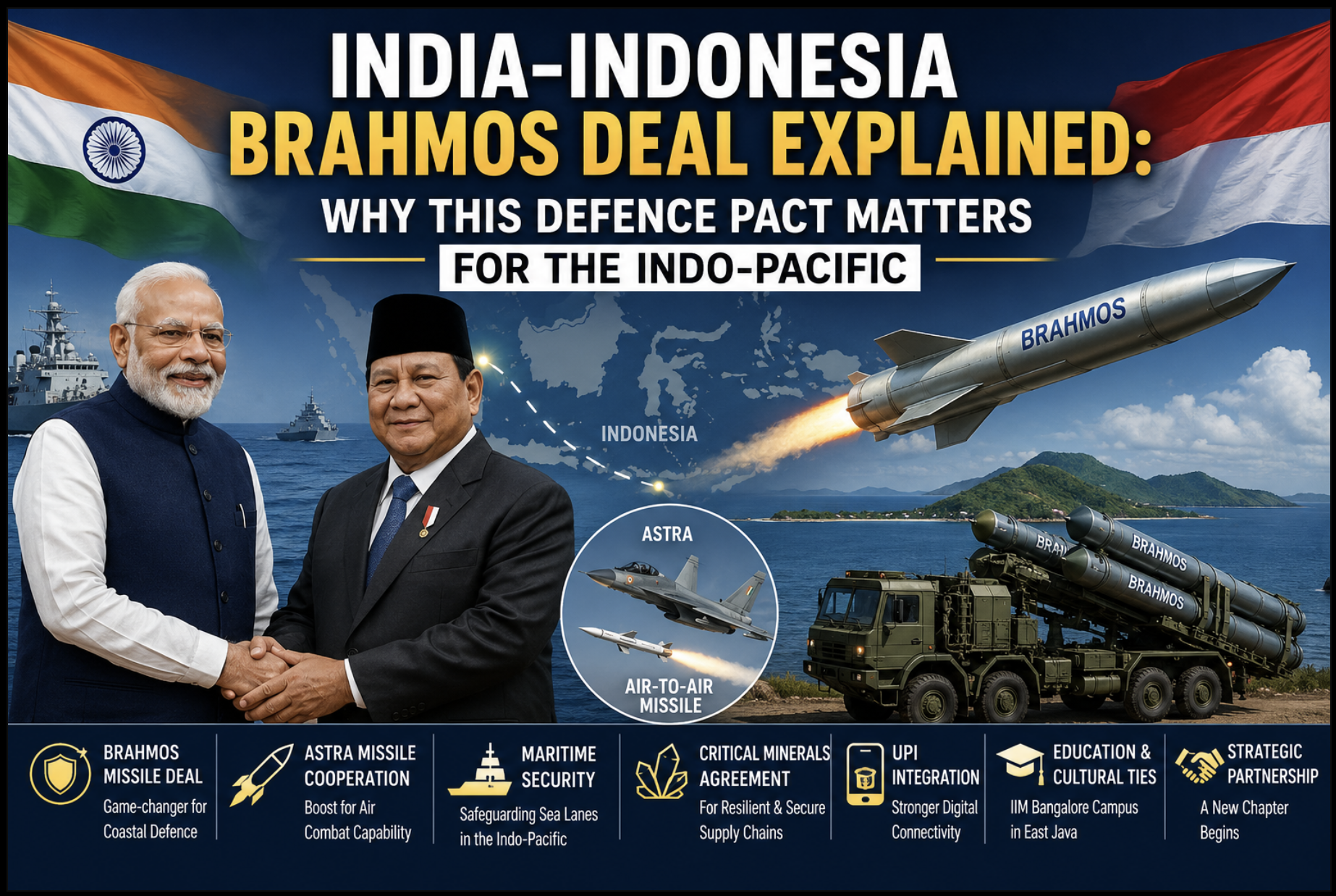
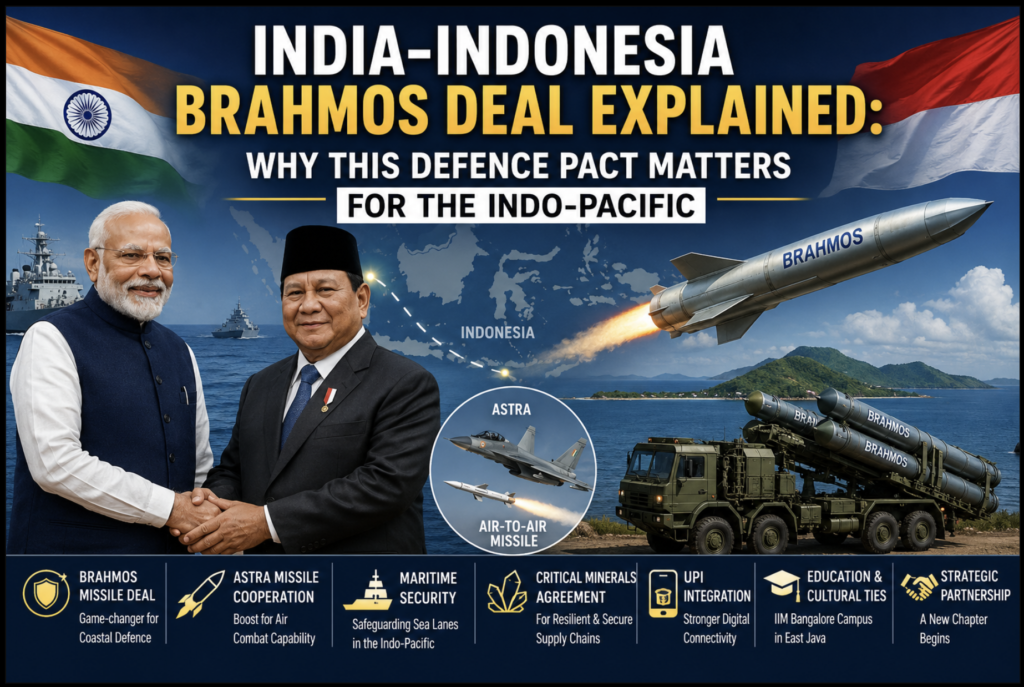
Most headlines just say “more than a dozen.” Strip away the ambiguity and here’s what’s actually in there: a system-cooperation agreement on the BrahMos missile between Indonesia’s defence ministry and BrahMos Aerospace, a separate pact on India’s Astra air-to-air missile between Bharat Dynamics Limited and an Indonesian firm called Republikorp, a maritime security framework, a critical minerals agreement aimed at Indonesia’s nickel reserves, a UPI payment linkup, a health regulators’ pact, an overseas campus for IIM Bangalore, and an election commission tie-up that will see India help Indonesia build its own voting machines.
Prabowo also pinned Indonesia’s highest civilian honour, the Bintang Adipurna, on Modi during the visit — an award only one other Indian prime minister has received, Jawaharlal Nehru, and that was thirty-one years ago. State visits generate a lot of ceremonial noise, but that particular detail tends to stick with people who follow this relationship closely.
The BrahMos Deal: Why Everyone’s Talking About It
BrahMos isn’t new technology. It’s been in Indian service since the early 2000s, built through a joint venture between India’s DRDO and Russia’s NPO Mashinostroyeniya that dates back to 1998. What’s newer is India’s willingness to sell it abroad. The Philippines broke that seal in 2022 with a $375 million order for shore-based batteries. Vietnam followed at some point after. Indonesia is reportedly next in line — and unlike its neighbours, it’s doing so as Southeast Asia’s largest economy, which changes the optics considerably.
The missile itself is a two-stage cruise weapon that reaches somewhere around Mach 2.8 to 3, skims low over the water for most of its flight, and switches to an active radar seeker in the final seconds before impact. Export versions are capped at 290 kilometres of range under an international missile-technology framework India joined in 2016.
India’s own forces use longer-range versions, but what’s headed to Jakarta, at least on paper, stays inside that limit. This is coastal defence, in other words, not a long-range strike system — whatever the more excitable headlines might imply.
Why Indonesia wants it isn’t much of a mystery. It already operates Chinese-made CM-302 anti-ship missiles worth close to a billion dollars, and several defence analysts have pointed out that BrahMos does a similar job faster, and for less money per unit. President Prabowo has also been on something of a shopping spree since taking office in late 2024 — Turkish fighter jets, an aircraft-carrier deal with Italy, a defence budget pushing $20 billion this year. A missile capable of keeping an adversary’s navy at arm’s length from 17,000-odd islands fits that pattern well enough that nobody in Jakarta seems to be pretending otherwise.
The Quieter Astra Missile Agreement
The Astra agreement got a fraction of the coverage BrahMos did, which feels a little unfair given what it represents. Astra is India’s first home-designed beyond-visual-range air-to-air missile — the kind fighter jets use to shoot each other down before either pilot can actually see the other plane. DRDO designed it, Bharat Dynamics Limited builds it, and the version already in Indian service can reportedly hit a target somewhere past 100 kilometres out, depending on altitude and the geometry of the engagement.
What actually got signed this week is closer to a framework than a finished order. Reports describe it as a cooperation agreement between Bharat Dynamics and Republikorp, an Indonesian defence firm, with “detailed technical discussions” still to come before any money changes hands. Republikorp is worth knowing about in its own right — a privately held company that already runs parallel partnerships with Turkey’s drone maker Baykar, South Korea’s LIG Nex1, and Qatar’s Barzan Holdings.
Adding an Indian missile partner to that list looks less like a one-off purchase and more like a deliberate strategy: spread your suppliers wide enough, and no single country ends up holding leverage over your air force.
Why a String of Islands Matters This Much
Indonesia isn’t just any customer. It’s the world’s largest archipelago, and three of its straits — Malacca, Sunda and Lombok — carry a share of global shipping traffic large enough that disrupting any one of them would show up in fuel prices from Rotterdam to Los Angeles within weeks. A meaningful chunk of the oil moving from the Gulf to East Asia has, practically speaking, no alternative route around this geography.
This visit added some less flashy but arguably more consequential agreements on top of the missile deals. There’s a renewed coast guard cooperation pact, an updated maritime safety framework, and Indonesia’s agreement to station a liaison officer at India’s naval intelligence hub outside Delhi, which pools real-time shipping data across the wider Indian Ocean.
There’s also fresh talk of developing Sabang, a port at the northern tip of Sumatra that sits almost directly across the strait from India’s own port project on Great Nicobar Island. Put those two ports on a map and they start to look less like coincidence and more like bookends. The India-Indonesia BrahMos Deal demonstrates India’s growing role as a trusted defence partner in the Indo-Pacific region.
Beyond the Weapons
Missiles get the headlines, but several of the other agreements probably matter more to how ordinary people in both countries experience this relationship over the next decade.
Indonesia sits on the world’s largest nickel reserves — estimates vary depending on which geological survey you trust, but nobody disputes it holds first place — and mines more than half the global supply. That dominance came with a catch. After Jakarta banned raw nickel exports in 2020 to force domestic processing, Chinese firms moved in fast, reportedly backing something close to three-quarters of the smelters in the country’s biggest industrial park. India’s new critical minerals pact, built around rare-earth magnets and steel, is a modest attempt to prise that door open a little wider for someone other than Beijing.
On the more consumer-facing side, India’s UPI payment system is set to link up with Indonesia’s own QR-code standard, meaning an Indian tourist in Bali could eventually pay through an app they already have installed. IIM Bangalore is opening its first campus outside India, at a special economic zone in East Java. Drug regulators from both countries signed a fresh cooperation pact aimed at getting Indian medicines onto Indonesian shelves faster. And India’s Election Commission agreed to help Indonesia — which still runs the largest single-day paper-ballot election on the planet — build its own electronic voting machines ahead of its 2029 polls.
Then there’s the cultural layer, which sounds like an afterthought until you notice how much airtime it actually got. Modi visited Prambanan, the ninth-century Hindu temple complex outside Yogyakarta, and announced Indian support for its restoration. The two countries also declared 2026 and 2027 the “Tagore-Dewantara Year,” marking a century since the poet Rabindranath Tagore visited Indonesia and struck up a friendship with Ki Hajar Dewantara, the country’s most revered educationist.
It’s the kind of detail that rarely survives into a headline but says something about how this relationship is being pitched at home — not as a transaction, but, at least in the official telling, as an old friendship picking back up. The India-Indonesia BrahMos Deal is another milestone in India’s ambition to become a major global defence exporter.
The China Question Nobody’s Saying Out Loud
Nobody in either government used the word “China” in their public remarks this week, and that omission is doing some work of its own.
The missile agreements were signed a day after China test-fired a long-range ballistic missile — reportedly its first submarine-launched test of that particular kind since 1980 — which wire services described as coincidental timing rather than a deliberate signal. Indonesia has its own running friction with Chinese vessels near the Natuna Islands, but it also counts China as its largest trading partner and the single biggest source of investment in its nickel industry. Buying an Indian missile doesn’t change either of those facts.
What it does is add a name to Indonesia’s supplier list, which already runs through Turkey, South Korea, Qatar and, yes, China itself. Some regional analysts read India’s broader outreach — its MAHASAGAR vision, unveiled last year, is explicitly framed around deepening ties across the Global South — as a quiet counterweight to Beijing’s influence. Indian officials, for their part, avoid that framing entirely in public, sticking to language about shared prosperity and capacity-building. Both readings can be true at once, and probably are.
What Could Still Go Sideways
Worth remembering: neither missile deal came with a disclosed price tag, which is normal at this stage but also a reminder that “cooperation agreement” and “signed contract” aren’t the same document. The Astra pact in particular is still described as a framework awaiting further technical talks — a polite way of saying the real negotiating hasn’t started yet.
History offers a reason for caution, too. The Philippines’ second battery of BrahMos missiles, ordered years ago, is still being delivered. Indonesia’s own path to this agreement took nearly two years from an initial factory visit to an actual signature, and reportedly grew in scope somewhere along the way, from a single coastal battery to something larger. None of that means the deal falls apart. It just means the gap between a joint statement and missiles actually sitting in an Indonesian battery tends to be measured in years, not months.
Indonesia, meanwhile, keeps shopping. Malaysia is reportedly having its own early conversations about BrahMos, and if that goes anywhere, the missile’s footprint along the southern edge of the South China Sea will start to look less like a series of one-off sales and more like a pattern somebody in New Delhi is drawing on purpose. The India-Indonesia BrahMos Deal is more than a missile agreement. It represents a long-term strategic partnership built on defence cooperation, maritime security, and regional stability.
FAQs
What is the India-Indonesia BrahMos deal?
It’s a system-cooperation agreement signed on July 7, 2026, between Indonesia’s Ministry of Defence and BrahMos Aerospace for the supply of BrahMos supersonic cruise missiles. Indonesia becomes the third country to buy the system, after the Philippines and Vietnam. No contract value has been made public.
Has Indonesia bought BrahMos missiles before?
No. This is Indonesia’s first confirmed agreement for the system, following roughly two years of talks that started with a factory visit in 2024.
What’s the difference between the BrahMos and Astra deals signed this week?
BrahMos is a ship-killing cruise missile for coastal defence, agreed directly between Indonesia’s government and BrahMos Aerospace. Astra is a much shorter-range air-to-air missile, and that agreement is between Bharat Dynamics Limited and an Indonesian company, Republikorp — described in reporting as an early cooperation framework rather than a firm order.
Why does Indonesia’s geography matter so much to this deal?
Indonesia controls the Malacca, Sunda and Lombok straits, three of the busiest maritime chokepoints on Earth. A large share of the world’s shipping, including oil bound for East Asia, has effectively no alternative route around them.
Is this deal aimed at China?
Neither government frames it that way publicly. Indonesia still counts China as its largest trading partner, and this looks more like supplier diversification than a change of allegiance — though some analysts do read India’s wider regional push as an implicit counterweight to Chinese influence.
How many agreements did India and Indonesia actually sign?
Reports vary. India’s Ministry of External Affairs lists 20 outcomes; other outlets have counted 14 or simply said “more than a dozen,” depending on what’s being tallied.
External Authority Links
- India-Indonesia Joint Statement — Ministry of External Affairs / PIB
- BrahMos Aerospace — official specifications
- Bharat Dynamics Limited — Astra Weapon System
- CSIS Missile Threat — BrahMos profile
- India Brand Equity Foundation — India-Indonesia trade data