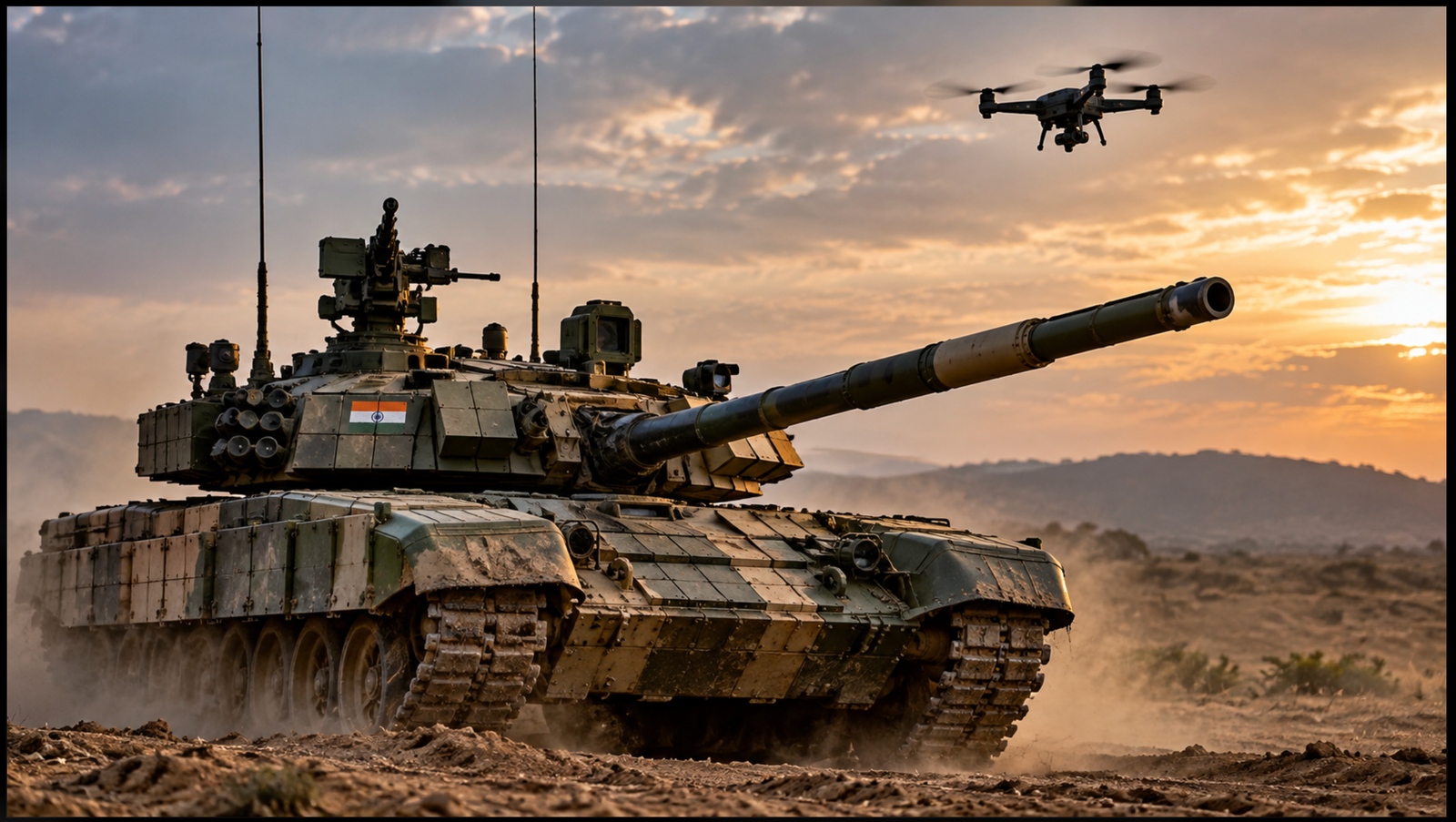
India has started the process of procuring counter-drone systems for tanks it already owns, according to reports. The announcement is thin on numbers, which is why the reasoning behind it deserves a closer look.
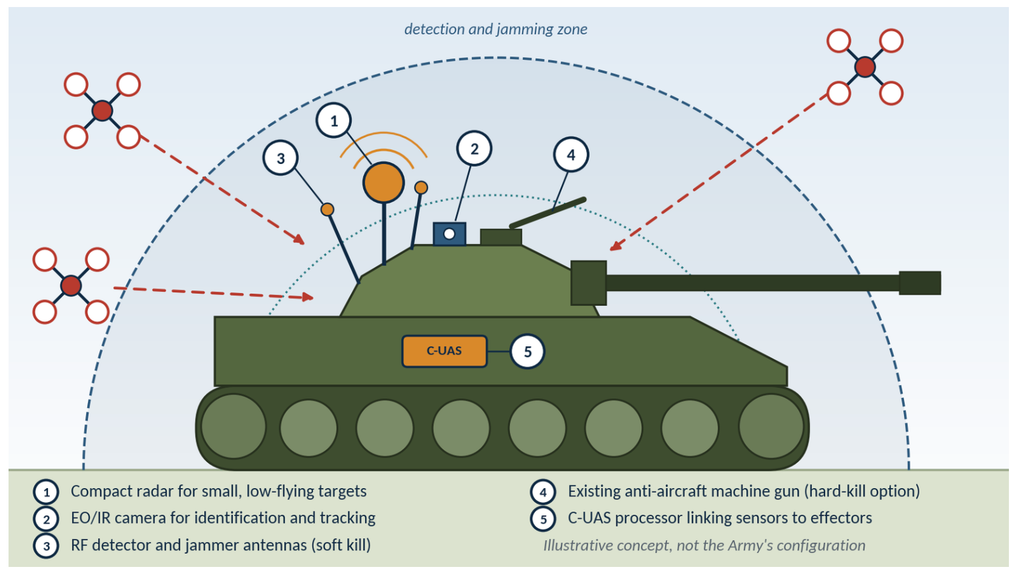
Figure 1. An illustrative concept of a tank fitted with counter-UAS sensors and effectors. The Army has not published its configuration.
Indian Army anti-drone tanks are becoming an important consideration as unmanned aerial systems challenge the survivability of armoured vehicles on the modern battlefield. Look at photographs of Russian tanks from the war in Ukraine and you will spot something that never appeared in a design brief: a roof. Welded grilles, steel mesh, sometimes a shed-like canopy over the whole turret. Mostly they were improvised, bolted on by crews and workshops because the threat had changed, and the same shift now sits behind a push for Indian Army anti-drone tanks.
Reports published on 28 September said Defence Secretary Rajesh Kumar Singh had confirmed that the Ministry of Defence has started the process of procuring integrated counter-UAS systems for the Army’s main battle tanks. The systems are to be fitted on tanks already in service, not held back for a future design. That is the news. The reports gave no price, no vendor list and no delivery schedule.
The thinking underneath is the more interesting part. For a long time an armoured force treated drones as somebody else’s problem: a nuisance for air-defence units, something that watched tanks rather than hit them. The Army’s own paperwork has moved on. A request for information issued in April 2025 said the anti-tank threat is no longer confined to the frontal arc and that unmanned aircraft have made it omnidirectional. A tank has little room left for extra armour, so protection has to come in layers: sensors that see the drone, electronics that confuse it, and something physical for when confusion fails.
The larger story is simpler to state, and it is the one this piece follows. India is trying to adapt the armoured fleet it already owns to a drone-dominated battlefield without waiting for a new generation of combat vehicles. Whether that works depends on details nobody has published yet.
Key takeaways: seven facts to know
- The focus is on tanks the Army already has. Reports say procurement of counter-drone systems for in-service tanks has started. The April 2025 RFI named the T-72 and T-90; some reports also list the Arjun.
- Armour was built for threats from the front. Drones come from above, behind and the flanks, and they watch everything too.
- Counter-UAS is a chain, not a gadget. Detect, identify, track, decide, defeat. It is only as strong as its weakest step.
- Jamming alone won’t do it. Soft kill and hard kill cover each other’s gaps, and fibre-optic drones show why.
- Retrofitting offers a potential near-term route to improve the survivability of existing tanks while next-generation platforms remain in development.
- It is a test for India’s defence-electronics sector. Radars, jammers, sensors and effectors all have to fit on old hulls.
- Key details are still unpublished. Tank numbers, cost, vendors, specifications and delivery dates have not been disclosed.
Why Indian Army Anti-Drone Tanks Matter
Start with who said what. According to reports published on 28 September 2026, Defence Secretary Rajesh Kumar Singh said the Ministry of Defence has begun the process of procuring integrated counter-UAS systems for the Army’s main battle tanks, for tanks in operational service and not only newly built ones. At the time of writing there was no official press release or transcript of the remarks, so everything about the announcement rests on press reports, chiefly idrw.org and outlets following it.
The idea has a paper trail. On 5 April 2025 the ministry issued a request for information, or RFI, for platform-based counter-UAS systems for T-72 and T-90 tanks, according to The Tribune: an initial lot of about 75 systems, a 36-month project, soft-kill and hard-kill options, and integration with the anti-aircraft machine gun already on the tanks as one route to the second. An RFI is the earliest rung of procurement, the Army asking industry what is possible. It is not an order.
Two other decisions sit close by and are easy to mix up with it.
| Decision | Date | Scope as reported | What it does not say |
| Tank counter-UAS RFI | 5 April 2025 | About 75 platform-based counter-UAS systems for T-72 and T-90 tanks, over 36 months (The Tribune) | No vendor, contract or final fleet size |
| T-90 active protection RFI | 3 February 2025 | Active protection for the T-90S/SK with soft-kill, hard-kill and counter-UAS elements (Janes) | Whether it will merge with the counter-UAS purchase |
| DAC Acceptance of Necessity | 3 July 2026 | Active protection for tanks and the Akash Tarang anti-UAV EW system, in a package worth about ₹52,000 crore (official release) | It does not name the tank-mounted counter-UAS purchase |
The July release doesn’t say how, or whether, those approvals connect to the tank counter-drone purchase, so this article keeps them apart. Acceptance of Necessity is only the first in-principle step in procurement, not a contract. The official wording is on All India Radio News.
Which tanks? The 2025 RFI named the T-72 and T-90. Coverage of the latest announcement speaks of main battle tanks in general, and some outlets list the Arjun too, but no official statement confirming the Arjun had been published at the time of writing. Treat that as reported, not settled.
The programme sits somewhere between requirement and procurement. The reported phrase is that procurement has started, and nothing public points to a completed trial or a signed contract.
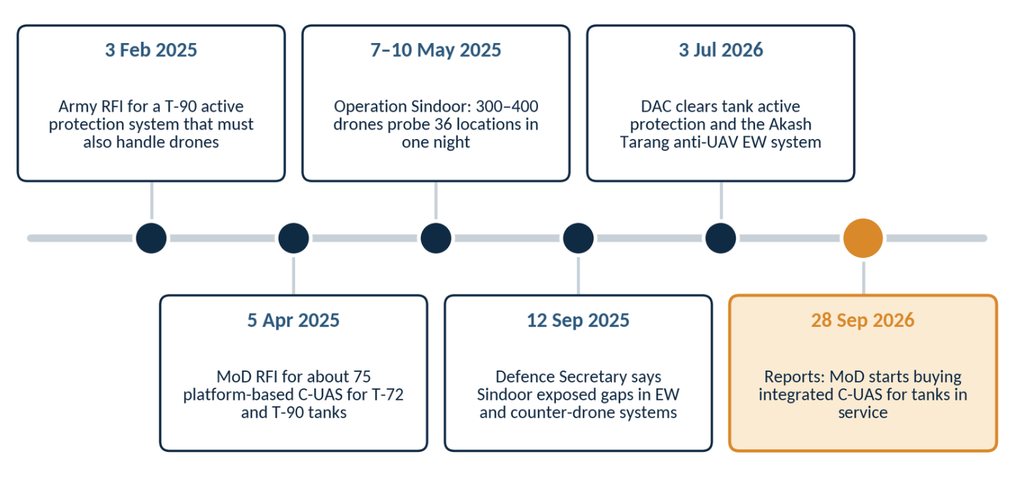
Figure 2. How the tank counter-drone effort got here. Dates come from the official releases and press reports listed under Sources.
| What is known | What is not yet disclosed |
| Procurement of integrated counter-UAS for Army tanks has started, according to reports of the Defence Secretary’s remarks (28 September 2026) The systems are to be fitted on tanks already in service: retrofit, not replacementThe purpose is to protect armoured units from drone threatsThe April 2025 RFI sought about 75 initial systems for the T-72 and T-90 | Which system or vendor is leadingThe final number of tanks, and the costRadar, EO/IR and RF sensor specificationsThe hard-kill mechanism, beyond the machine-gun idea in the RFIA delivery timeline for the new procurementExact tank variants, and whether the Arjun is included |
Why drones are such a serious threat to tanks
A main battle tank is built to survive tank rounds, missiles and rockets that mostly arrive from the front. Drones don’t follow that script.
Small commercial drones: the eyes
The first problem isn’t an explosion. It is being seen. Cheap quadcopters scout positions and correct artillery fire, and RUSI’s study of the war’s third year describes a dense network of drones over the front that gives something close to transparency within about 3 km of the line of contact.
FPV drones: the cheap hammer
First-person-view drones are small quadcopters with a camera and a warhead, steered by an operator in goggles. Reported prices run from a few hundred dollars to under US$1,000, and they can be flown into thinner armour on the roof and rear. They are not magic. RUSI reported that between 60 and 80 per cent of Ukrainian FPVs fail to reach their target, and that most of those that hit an armoured vehicle fail to destroy it.
Loitering munitions and armed UAVs: the hunters
Loitering munitions circle an area and dive onto a target they have chosen. Azerbaijan used Israeli-made Harops in 2020, and Russia’s Lancet is a well-known example in Ukraine. Larger armed drones such as Turkey’s Bayraktar TB2 add long-endurance surveillance and guided munitions.
Put those together and you get the problem the Army’s own RFI describes. A tank can shrug off a round on its front slope and still be vulnerable to a drone coming from above, behind or a flank, the directions its armour was never primarily designed for. The cost arithmetic makes it worse, and that gets a section of its own.
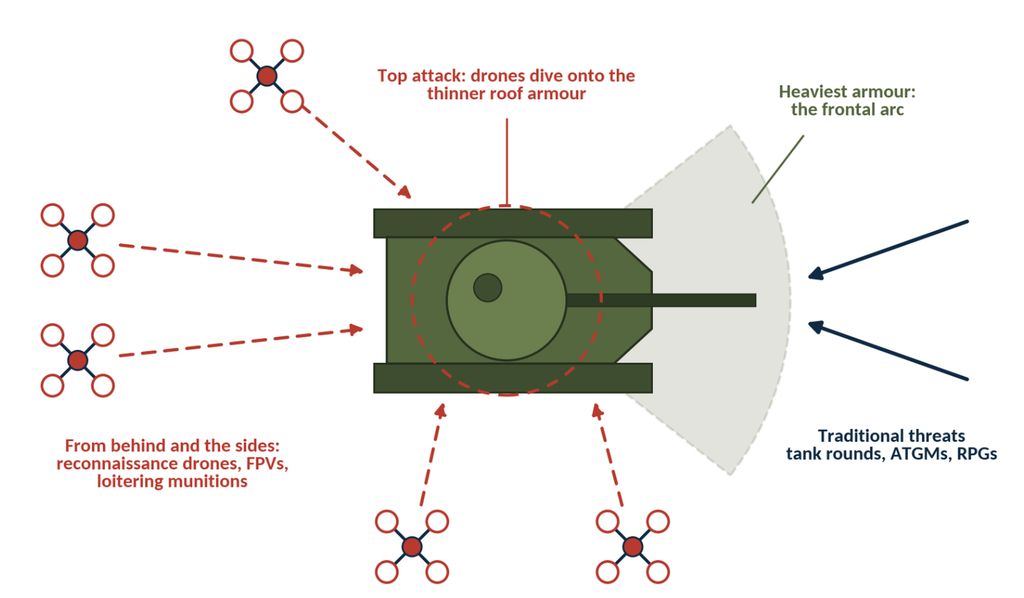
Figure 3. Plan-view schematic, not to scale. Armour is concentrated in the frontal arc, while drones can arrive from any direction, including straight down.
How the main drone types compare. The danger ratings are editorial judgements for orientation, not official assessments.
| Drone type | What it does | Danger to a tank | Possible counters |
| Reconnaissance drone | Surveillance, target location, artillery spotting | Indirect: reveals the tank’s position | Camouflage, electronic warfare, C-UAS detection and defeat |
| FPV drone | Direct attack with an explosive warhead | High | Electronic warfare plus hard kill |
| Loitering munition | Searches an area, then makes a precision attack | High | C-UAS plus wider air defence |
| Armed UAV | Surveillance and stand-off strike | High | Layered air defence |
| Drone swarm | Saturation attack from many directions | Very high | Networked, layered C-UAS |
What Ukraine, Karabakh, Gaza and Operation Sindoor taught armoured forces
Nobody serious is arguing that drones have made tanks obsolete. The more defensible reading is narrower: drones have changed the conditions under which a tank can survive and do its job. The evidence also differs by conflict, period and type of vehicle, so each case below carries its own caveat.
Ukraine: the biggest laboratory
RUSI’s February 2025 report on tactical developments in the war’s third year, broadly 2024, is the most careful public account. It concluded that tactical drones accounted for 60 to 70 per cent of damaged and destroyed Russian systems. That is a figure for all kinds of Russian equipment in one war over one period, not a measure for tanks specifically or a universal rule, and the report stresses that drones worked best alongside artillery.
The changes in behaviour tell you more. Tanks and infantry fighting vehicles in the combat zone have to be hidden and, if possible, dug in, then come out briefly for direct-fire missions. Most carry jammers aimed at command links and video feeds. The counter-move was FPVs flown on a spool of wire or fibre-optic cable, which can’t be jammed. RUSI lists the drawbacks, among them a range of roughly 10 km and the risk of snagging, but the effect is that every jammer on a tank is useful against some drones and useless against others.
Nagorno-Karabakh: armour without air cover
In 2020, Azerbaijan used Turkish Bayraktar TB2s and Israeli loitering munitions against Armenian forces. CSIS’s review of open-source reporting concluded that drones contributed to disabling a huge number of Armenian tanks, fighting vehicles, artillery pieces and air-defence units. The lesson was less that tanks can’t survive and more that armour without air defence, concealment and a good picture of the airspace is exposed.
Israel and Gaza: cheap drones, expensive tanks
On 7 October 2023, Hamas used cheap drones to drop explosives on towers and observation posts along the Gaza border, and videos showed a converted commercial quadcopter hitting at least one Merkava Mark 4 tank, according to Israel’s INSS, whose analysts said Hamas had borrowed the tactics from Ukraine. Within days, Israeli tanks were photographed with improvised “cope cages” like those on Russian vehicles.
Operation Sindoor: India’s own data point
In its 9 May 2025 briefing during Operation Sindoor, the Ministry of External Affairs said drone intrusions had been attempted at 36 locations from Leh to Sir Creek, with roughly 300 to 400 drones, and that the armed forces brought down several using kinetic and non-kinetic means. In September 2025 the Defence Secretary said the four-day conflict had exposed capability gaps in electronic warfare, counter-unmanned systems and low-level radars, among others. None of that is tank-specific. It does explain the appetite.
None of this proves tanks are finished. RUSI notes that tank-on-tank engagements in Ukraine have actually become more frequent, because vehicles that spend most of their time hiding have to fight quickly when they do come out.
Why upgrade existing tanks instead of waiting for new ones?
The fleet runs to thousands of tanks: The Tribune’s 2025 reporting put the Army’s total above 3,500, counting the T-72, T-90 and Arjun. Exact counts vary by source, and the platform table later in this piece shows how widely.
The replacement is a long way off. The Future Ready Combat Vehicle, meant to take over from the T-72, has been cleared at the Acceptance of Necessity stage. Janes says its first phase is intended to cover 590 vehicles and judges that it is unlikely to enter service before the mid-2030s.
Replacing thousands of tanks is slow and expensive for reasons beyond the price of the vehicle: crews to retrain, spares chains to rebuild, workshops to re-equip. A retrofit keeps crews on platforms they know and adds a capability on top, in stages. Upgrade the fleet you already have, and let the new tank arrive when it arrives.
Counter-drone kit will also compete with other upgrades. In March 2025 the ministry signed a US$248 million contract for 1,000 hp T-72 engines, and The Tribune reported thermal sights and fire-control upgrades as part of the same push. Money and hull space will not stretch to everything.
What is a counter-UAS system, in plain terms?
C-UAS stands for counter-unmanned aircraft system, which is what most people mean by an anti-drone system. Nearly every design follows the same sequence: detect, identify, track, decide, defeat. In practice the steps overlap and loop. The US Congressional Research Service has published a primer for readers who want the wider background.
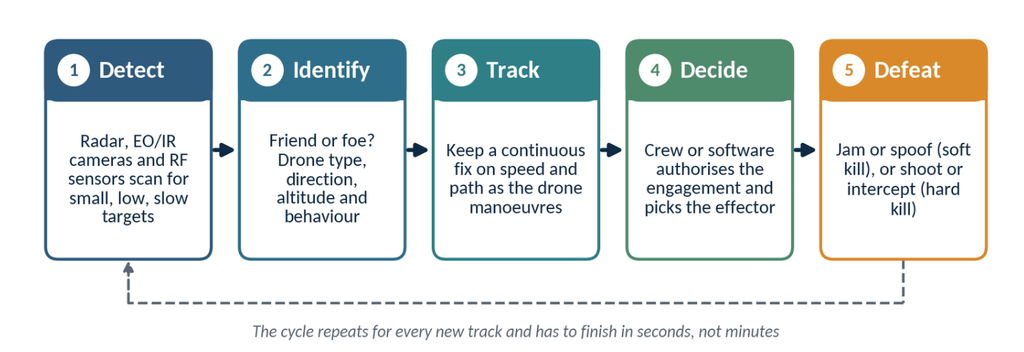
Figure 4. C-UAS explained: from first detection to defeat.
Detection. Small drones are low, slow and have tiny radar signatures, so systems combine radar, electro-optical and infrared cameras and RF detectors that listen for control and video links. Each has blind spots.
Identification. Friend or foe, reconnaissance quadcopter or FPV, hovering or diving? A tank column has drones of its own and birds cause false alarms, so a mistake here means jamming your own side or wasting ammunition.
Tracking. Hold a continuous fix on something small and agile while the tank itself bounces across rough ground.
Decide. Someone or something must authorise the engagement. RUSI reports Ukrainian experiments in which automated turrets engaged drones reliably with very little ammunition, while human gunners defending a position managed roughly 25 per cent efficiency. That puts the decision step at the centre of the design debate.
Defeat. Soft kill (electronic warfare, RF jamming, satellite-navigation and command-link disruption) or hard kill (guns, dedicated interceptors, other physical means), covered below.
How a tank-mounted counter-UAS system could work
A caution before the diagram. Nobody outside the ministry knows the final configuration, so what follows describes how such systems typically work and what the 2025 RFI asked for. It is not a description of a chosen product.
In outline: sensors pick up the drone, software classifies it and holds a track, and a processor picks an effector. The first attempt is usually soft kill. If the drone keeps coming, because it is autonomous or on a fibre-optic tether, a hard-kill option takes over, and the RFI named the anti-aircraft machine gun already on the tanks as one such option. All of it has to happen in seconds, ideally with the tank still moving.
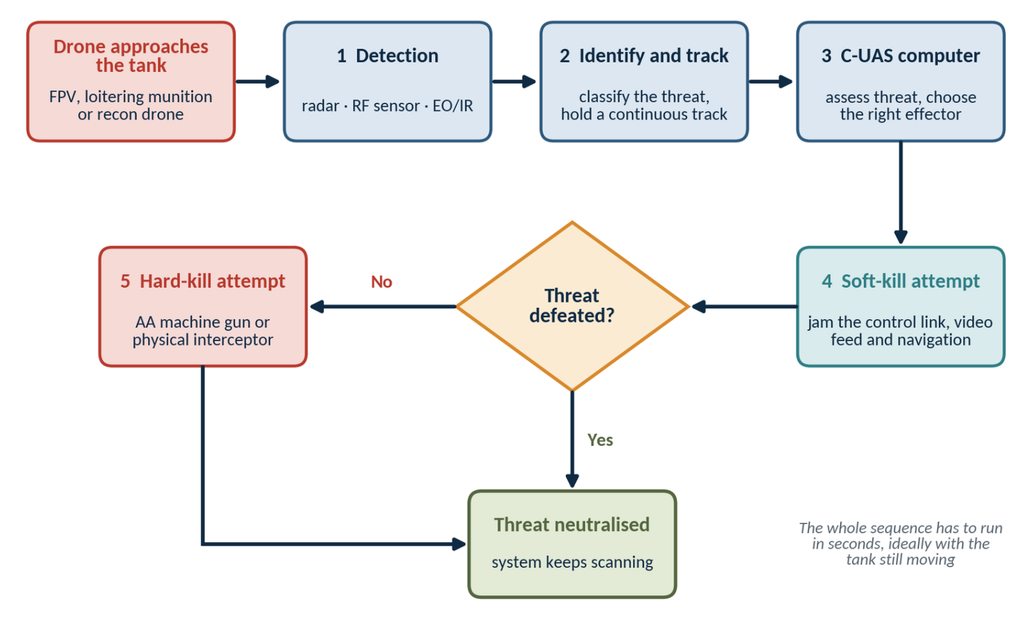
Figure 5. A plausible engagement sequence for a tank-mounted C-UAS. The Indian configuration has not been disclosed.
The RFI’s language is revealing. It asked for detection of FPV, swarm, loitering and kamikaze drones by active, passive or hybrid means, and for kit that is lightweight and modular, works in deserts, plains and high altitude in all weather, needs no removal of existing fittings and keeps the crew clear of harmful radiation. Demanding requirements for a vehicle whose basic design is decades old.
| Confirmed (as reported) | Reported in the April 2025 RFI | Expected, not confirmed |
| The Army is pursuing counter-UAS integration on tanks in serviceProcurement has started, according to reports of the Defence Secretary’s remarksFitting is on existing tanks, not only new builds | About 75 initial systems for the T-72 and T-90, over 36 monthsDetection of FPV, swarm, loitering and kamikaze dronesSoft kill and hard kill, including machine-gun integrationLightweight, modular; no removal of existing fittings | A compact radar, EO/IR cameras and RF detectionJammers for control, video and navigation linksPossibly effectors beyond the machine gunVendors, indigenous content and fleet scaleWhether the Arjun gets the same kit |
Soft kill vs hard kill: the difference that matters
People mix these two up constantly. Soft kill goes after a drone’s nervous system. Hard kill goes after its body.
Soft kill: attacking the link
Soft kill covers electronic warfare, jamming and spoofing of satellite navigation, and cutting or confusing the command link between drone and operator. It needs no ammunition, can affect several drones at once and costs little per use. It only works on drones that depend on the signals being jammed, which is why fibre-optic and autonomous drones matter so much.
Hard kill: destroying the drone
Hard kill means physical destruction: guns, interceptors, micro-missiles or, in some programmes, lasers. It works against threats jamming can’t touch, at the price of complexity and a finite magazine. Every shot at one small, fast drone is a shot not available for the next, and a kill very close to the vehicle can leave a warhead falling nearby.
Why layered defence matters
The sensible design isn’t one or the other. Detection, electronic warfare, a hard-kill option, passive protection such as armour and cages, and a link into the wider battlefield network each catch some of what the others miss.
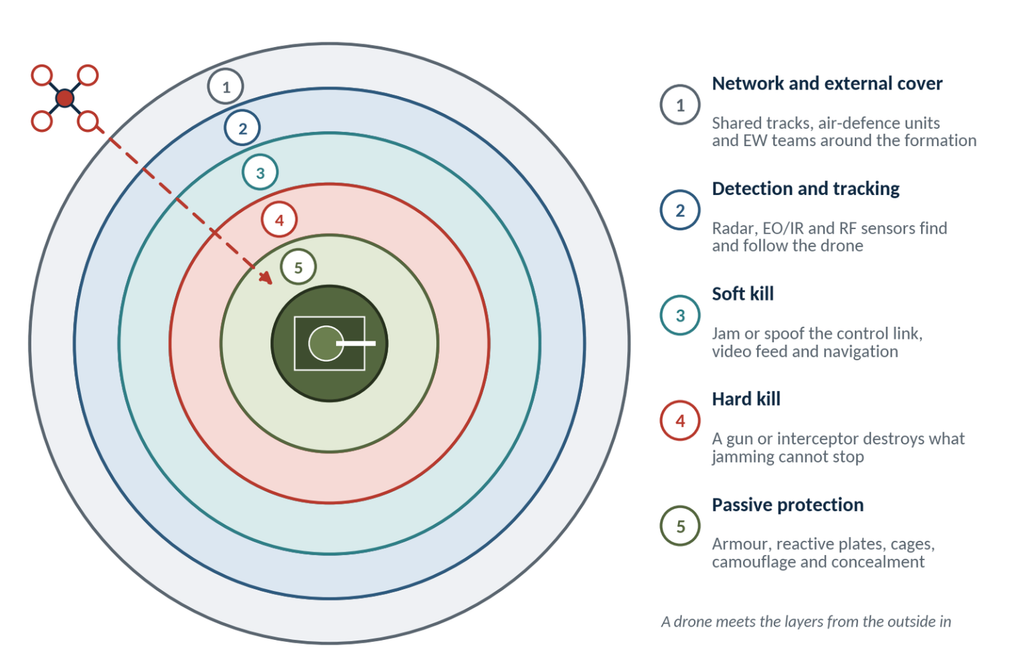
Figure 6. Layered protection around a tank. No single ring is expected to stop every drone.
Why putting C-UAS directly on the tank changes the equation
Tank formations don’t move alone. They normally lean on short-range air-defence guns and missiles, electronic warfare detachments and, increasingly, dedicated counter-drone vehicles, and that support can be kilometres away or stretched thin when a drone shows up. A system on the tank gives each vehicle its own local defence: it can detect, classify and engage without waiting for another unit to cue it, and reaction time is what a drone attack punishes most.
Movement is the hardest case. A tank is most exposed travelling between positions, manoeuvring, or operating ahead of its supporting elements, exactly when external cover is least likely to be in the right place. Ukrainian crews have adapted by staying hidden and coming out only briefly. An armoured regiment expected to manoeuvre fast across plains or desert has less room for that, and that is where an organic system could earn its keep. The catch is that a moving tank is a hostile place to mount delicate electronics.
Anti-drone kit will not make a tank invulnerable
Announcements like this tend to get compressed into “tanks will now be safe from drones.” They won’t. A tank still has a long list of other enemies:
- Artillery, including precision-guided shells.
- Anti-tank guided missiles and rockets, the threats active protection systems are designed for.
- Mines, other tanks and direct-fire weapons.
- Air strikes and glide bombs, which carry far more explosive than any FPV.
- Large loitering munitions and long-range one-way attack drones, which a small tank-mounted system isn’t built to stop.
- Saturation attacks that exhaust a limited magazine.
- Electronic attack and reconnaissance, including the sensor networks that find the tank in the first place.
So a C-UAS system should be read as one more layer of survivability. It does not replace armour, camouflage, air defence or combined-arms protection, and it is the layer most likely to be oversold.
The engineering problem of retrofitting old tanks
Fitting new electronics to a vehicle whose basic design is decades old is harder than it sounds. The RFI’s own wish list shows the Army knows it.
Weight. Radar, antennas, computers, batteries and cabling all add mass to a vehicle whose weight budget is already set by its suspension, its engine and the bridges and rail wagons it has to cross.
Power. Sensors, processors and jammers draw electricity, and older tanks weren’t designed around today’s loads. The kit may need its own power source.
Space. Hull and turret-roof space is already crowded with sights, reactive-armour blocks, smoke dischargers, hatches and the anti-aircraft gun, and radars need a clear view, which means high, exposed positions.
The main gun and the turret. The system must not obstruct turret traverse, ammunition handling, gun elevation or existing sights. A radar that blocks the gunner’s view has failed, however well it spots drones.
Electromagnetic compatibility. A powerful jammer a metre from the tank’s own radio can degrade it, so the C-UAS has to coexist with radios, fire control, navigation and any electronic warfare already on board.
Durability. Desert dust and heat, high-altitude cold, track vibration and the shock of the main gun firing all land on the sensors. Trials on real tanks, rather than brochure specifications, will decide which systems qualify.
T-72 Ajeya, T-90 Bhishma and Arjun: three tanks, three problems
Public information treats the three platforms very differently, and the ministry hasn’t said every variant will get the same system. Fleet figures below are approximate, dated and sourced, and they differ between reports.
| Platform | In service (reported) | Ordered or in the pipeline | Counter-drone status |
| T-72 Ajeya | More than 2,400 (The Tribune, Apr 2025); about 2,300 (The Tribune, Mar 2025) | None; being upgraded with new engines and thermal sights | Named in the April 2025 RFI |
| T-90 Bhishma | About 1,000 (Janes, 2025); about 1,200 (The Tribune, Mar 2025); about 1,650 (The Tribune, Apr 2025) | About 450 to 460 more reported (The Tribune, 2025) | Named in the April 2025 RFI; separate active protection RFI (Feb 2025) |
| Arjun | 124 Mk-1 (Business Today, 2019) | 118 Mk-1A ordered Sep 2021 for ₹7,523 crore (PIB); delivery status not confirmed here | Not named in the April 2025 RFI; listed in some 2026 coverage |
T-72 Ajeya
A very large fleet of a design that goes back decades, with new 1,000 hp engines and thermal sights already on the way. A counter-drone retrofit is both most valuable here (a big, exposed fleet) and most awkward (little spare capacity for weight and electricity).
T-90 Bhishma
The backbone of India’s current armoured force, and the subject of the Army’s active protection RFI, which asked for soft kill, hard kill and counter-UAS measures in one package. If the two efforts end up integrated, the T-90 is where that could happen first.
Arjun
The one tank of the three designed in India, which could make integration easier since the design authority is local. Nothing public says it will get the kit, and reports that assume all three tanks will carry identical systems are running ahead of the evidence.
Where tank-mounted C-UAS fits in India’s layered air defence
A tank-mounted system shouldn’t be pictured in isolation. The airspace above an armoured formation is covered in layers, each handling threats the others can’t, and the tank-mounted kit is the innermost active layer.
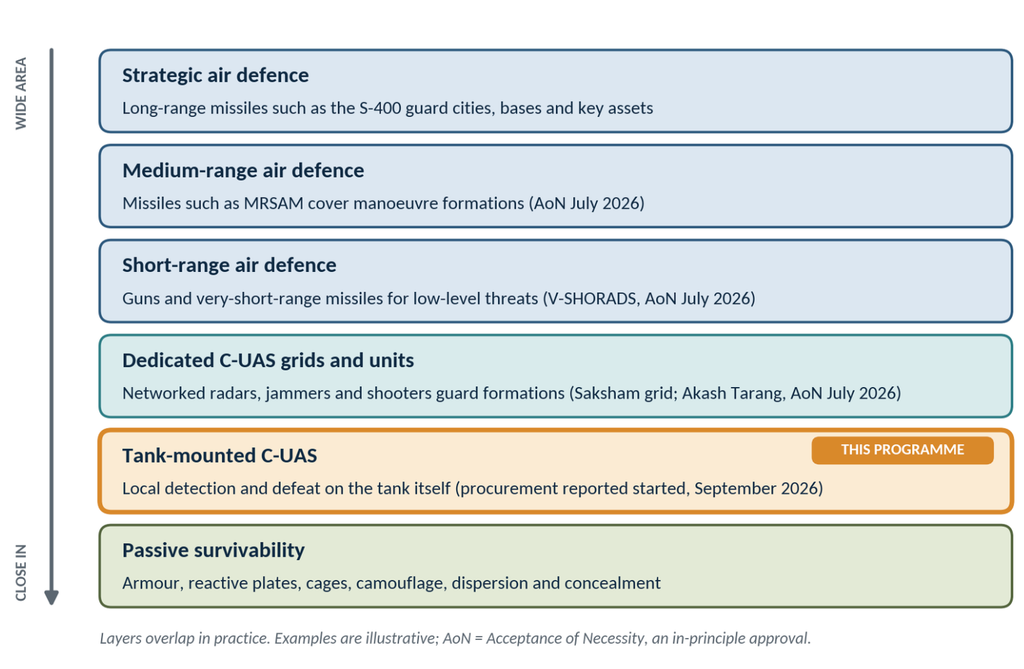
Figure 7. Where tank-mounted C-UAS sits among the layers of India’s air defence. AoN means Acceptance of Necessity, an in-principle approval.
The July 2026 approvals read like a map of those layers. For the Army, the DAC cleared at Acceptance of Necessity stage a medium-range surface-to-air missile system, a very-short-range air defence system, an anti-UAV electronic warfare system for formations and an active protection system for tanks. A counter-UAS grid called Saksham, developed by BEL, had its procurement initiated in October 2025, according to reports carried by Deccan Herald. Layers only help when they are connected, and RUSI’s conclusion from Ukraine is that counter-UAS has become an all-arms requirement for survivability, not something left to air-defence units alone.
The role of electronic warfare in protecting tanks
Electronic warfare is the invisible half of this fight, and it cuts both ways. Passive RF sensors can listen for a drone’s control and video links without emitting anything, while jammers disturb those links or the satellite-navigation signals a drone relies on. But a tank’s own radios, radars and jammers can be located by direction-finding, so a vehicle that shouts is a vehicle that can be found, and managing that electronic signature becomes part of the job.
Jamming also interferes with friends. RUSI notes that in Ukraine widespread electronic warfare has caused deconfliction and fratricide problems, which make a side’s own drone operations periodic rather than continuous. None of this argues for giving up on jamming, which still handles many threats. It argues for pairing it with sensor fusion and a hard-kill option so the system has something to fall back on.
The drone-versus-tank cost equation
The arithmetic is where this gets uncomfortable. The Defence Ministry ordered 118 Arjun Mk-1A tanks in September 2021 for ₹7,523 crore, according to PIB, which works out to roughly ₹63.8 crore a tank. Treat that as an average, not a price tag. The contract value may include associated equipment, spares and support, so it isn’t necessarily what one standalone tank costs.
Against that, reported FPV prices run from a few hundred dollars to under US$1,000. A Ukrainian volunteer put the price at US$500 to 600 in 2023, and an open-access 2025 study describes unit costs as often under US$1,000. For illustration, assume a deliberately generous ₹1 lakh per drone. That is a round figure above the reports, not a representative price for every FPV. On those assumptions, one tank’s average contract value equals about 6,400 drones.
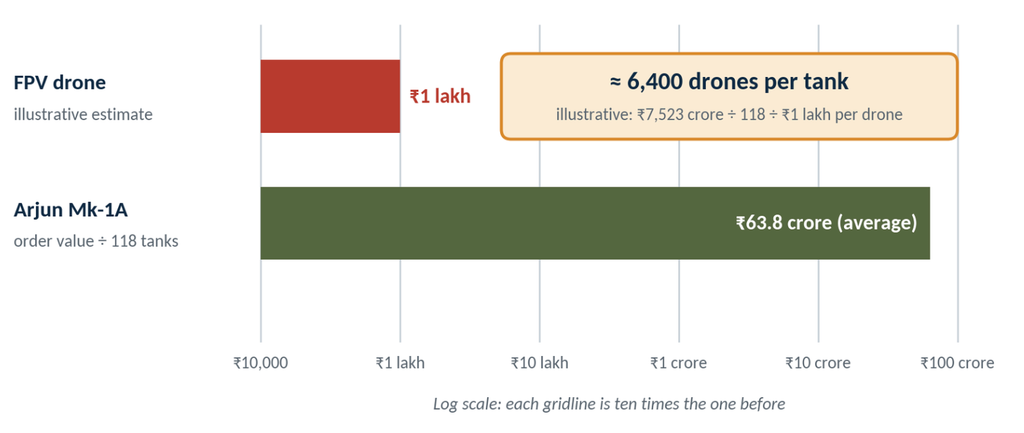
Figure 8. Illustrative comparison on a log scale. The tank figure is the 2021 Arjun Mk-1A order value divided by 118, not the standalone price of one tank. The ₹1 lakh drone figure is a deliberately round estimate, not a representative price for every FPV drone.
The comparison flatters the drone in one respect and cuts against it in another. RUSI’s finding that most Ukrainian FPVs never reach their target means the real cost per hit is higher than the sticker price suggests. The ratio still stays heavily one-sided, and an adversary able to threaten high-value tanks again and again with cheap unmanned systems can impose costs out of all proportion to its own spending.
That puts pressure on the defender’s side of the ledger. Spending a missile worth more than the drone it kills is a losing trade, so planners look at cheap interceptors, electronic warfare that costs next to nothing per use and layered protection. India has also tested a 30 kW vehicle-mounted laser that DRDO says defeated fixed-wing drones and swarm targets, though a truck-sized system is a long way from something that fits on a tank.
What it means for Indian armoured warfare
The Army hasn’t published anything on doctrine yet, so what follows is analysis, not policy.
Armoured manoeuvre. A tank that can look after itself against drones can operate with more confidence in a drone-contested environment, spending less time hiding. It changes how much of the risk falls to the formation and how much to the individual vehicle.
Reconnaissance and awareness. The sensors that find drones also build a picture of what is overhead, which is useful beyond the drone fight.
Combined arms and networking. Armour will increasingly work alongside infantry, artillery, engineers, electronic warfare, air defence and drone units, with tracks from one vehicle’s radar shared across a company. The downside is a bigger electronic signature and more to defend.
What it means for future Indian tank design
Retrofits teach designers what an old hull cannot take, and that experience will feed the next platform, the Future Ready Combat Vehicle among them. The ministry has described the FRCV in terms of multilayered protection and real-time situational awareness, without publishing a counter-drone specification. What follows are analytical expectations for a tank fielded in the mid-2030s, not announced requirements:
- integrated C-UAS sensors and effectors
- active protection against missiles and rockets
- better sensors and AI-assisted threat detection
- electronic warfare and battlefield networking
- a modular architecture that accepts new kit without a redesign
- far more on-board electrical power than an older hull provides
- stronger top-attack protection
India isn’t alone in thinking this way. According to the Congressional Research Service’s April 2026 summary, reports suggest the US Army’s M1E3 Abrams will include an active protection system and integrated counter-UAS capability, and an early prototype has been shown publicly. Counter-drone protection is moving from an optional add-on towards a core part of how armoured vehicles survive.
The opportunity for India’s defence industry
Reports on the announcement describe the systems as indigenous, and the 2025 RFI was reported to be open to OEMs, public-sector undertakings and private firms under Make in India. Potential areas for Indian industry include:
- AESA and other compact radars, EO/IR sensors and RF detection
- electronic warfare suites and jammers
- AI-based target recognition and fire-control software
- counter-drone interceptors and other effectors
- vehicle electronics, power management and sensor fusion
Some of the ground has been tested, though every performance figure here is a claim by DRDO or a company, not an independently verified result. In April 2025 DRDO said it had demonstrated a 30 kW vehicle-mounted laser against drones. In May 2025 Solar Defence and Aerospace test-fired its Bhargavastra micro-rocket counter-swarm system and says it can engage small drones out to about 2.5 km. In May 2026 Zen Technologies launched a modular AI-driven counter-drone system that the company says detects drones beyond 15 km and tracks more than 100 at once. None of these has been publicly described as a tank-integrated suite.
It would be easy to read all this as a straightforward Atmanirbhar Bharat success story. A fairer reading is that India has a growing base in radars, jammers and sensors and less proven experience in packaging them for a tracked vehicle that also has to fire its main gun. “Indigenous” in a headline isn’t the same as indigenous content in the box, and the Army’s final requirement hasn’t been published.
Unanswered questions about the Indian Army’s tank C-UAS plan
The announcement leaves a lot open. Some questions have partial answers in the 2025 RFI, and where they do, that is noted.
Scale and standardisation
- How many tanks will be upgraded, beyond the initial 75 in the RFI?
- Will every tank get a system, or only selected vehicles?
- Will one system be standardised across the T-72, T-90 and Arjun?
Design
- Soft kill only, or soft and hard kill? (The RFI asked for both.)
- How will it handle autonomous drones?
- How will it cope with swarms, or several drones attacking at once?
Integration
- How much weight will it add, and how will power be managed?
- Can it operate while the tank is moving?
- How will it interact with the electronic warfare equipment already on board?
Cost and time
- What will it cost per tank?
- How quickly can the fleet be upgraded? (The RFI mentioned 36 months for the first lot.)
Drone swarms: the harder problem
One drone is one problem. Dozens arriving together are a different problem, because the limit stops being whether the system works and starts being how many things it can do at once.
Every stage has a capacity: targets the sensors can detect, tracks the processor can hold, engagements the effectors can handle, ammunition on board, electronic-warfare bandwidth and reaction time. A radar tracking one FPV and a radar tracking thirty are not the same system. The RFI lists swarm drones among the targets, but not how large a swarm.
The scale isn’t hypothetical: India’s own 9 May 2025 briefing described roughly 300 to 400 drones across 36 locations in a single night. A tank facing even a handful of simultaneous attackers would be asking a great deal of any single effector, particularly a machine gun with a limited ammunition load. Hence the case for networked, layered C-UAS, with tanks, dedicated counter-drone vehicles and the wider air-defence network sharing tracks and dividing up targets.
What happens next for Indian Army anti-drone tanks
Zoom out and the battlefield looks less like tank against tank and more like a contest between armour, drones, electronic warfare, sensors, artificial intelligence and precision fires. RUSI’s Ukraine research reads that way: drones and artillery working together, electronic protection as a condition of survival, concealment as a daily chore, and heavy armour still there but mostly hiding.
For India, which keeps large armoured formations on its western plains and desert borders, the immediate need is modest. The tanks that exist today need some protection against a threat that matured faster than their design. Retrofitting offers a way to start without waiting for new platforms, and it produces evidence the next tank programme will need about what works on a real hull in real dust and heat. Future Indian tanks will probably need counter-drone sensors, electronic warfare and hard-kill options built in from the start, though that is an expectation, not an announced specification.
The strategic shift sits underneath all of it. Drone defence used to be somebody else’s job, handled by air-defence units and electronic warfare detachments around the tanks. Putting sensors and effectors on the vehicle turns it into part of the tank’s own survivability, and that raises questions the announcement doesn’t touch: who maintains the kit, how crews train to use it, how the tank’s own emissions are managed, and what a commander does when one vehicle’s sensors see a drone that the next vehicle’s can’t. Those are doctrine questions rather than procurement ones, and nobody has published answers yet.
FAQs: Indian Army anti-drone tanks
What is C-UAS?
C-UAS stands for counter-unmanned aircraft system, what most people call an anti-drone system. It detects, identifies and tracks a drone and then defeats it, either by jamming its signals (soft kill) or by physically destroying it (hard kill).
Why are drones a threat to tanks?
Drones can watch a tank from above, direct artillery onto it and, as FPVs and loitering munitions, fly an explosive charge into it, often from directions armour wasn’t designed to cover. RUSI found drones accounted for 60 to 70 per cent of damaged and destroyed Russian systems in Ukraine’s third year, though the figure covers all equipment, not tanks alone, and most FPVs never reach their targets.
Which Indian tanks may receive anti-drone systems?
The April 2025 RFI named the T-72 and T-90. Reports on the September 2026 announcement also mention the Arjun, but the Defence Secretary’s reported remarks refer to main battle tanks in general, and no official confirmation of variants had been published at the time of writing.
What is the difference between soft kill and hard kill?
Soft kill disrupts a drone electronically, for example by jamming its control link or satellite navigation. Hard kill destroys it physically with a gun or interceptor. Soft kill is cheap but fails against autonomous and fibre-optic drones. Hard kill works against them but has a limited magazine.
Can anti-drone systems protect tanks from FPV drones?
They can reduce the risk, and the RFI lists FPV drones among the threats the system must detect. Jamming works on radio-controlled FPVs but not on fibre-optic or autonomously guided ones, so a hard-kill option is needed too. Performance against real FPVs hasn’t been publicly demonstrated for the Indian programme.
Will C-UAS make Indian tanks immune to drone attacks?
No. It adds one layer of protection. Tanks remain vulnerable to artillery, anti-tank missiles, mines, other tanks, air strikes, large loitering munitions and saturation attacks.
Why is India upgrading existing tanks instead of replacing them?
The fleet runs to thousands of tanks, and the Future Ready Combat Vehicle is unlikely to enter service before the mid-2030s, according to Janes. A retrofit offers a potential near-term route to better survivability without waiting for new platforms.
What role will Indian defence companies play?
Reports describe the systems as indigenous, and the 2025 RFI was reported to be open to OEMs, public-sector units and private firms under Make in India. DRDO, Zen Technologies and Solar Defence and Aerospace have shown counter-drone products, but none has been publicly confirmed as selected for the tank programme.
Official records
- All India Radio News: DAC approves ₹52,000 crore capital acquisition (3 Jul 2026) Acceptance of Necessity for tank active protection and Akash Tarang
- PIB release on the same DAC decision (GlobalSecurity mirror) Full wording; mirror of the PIB text
- PIB: Arjun Mk-1A order for 118 tanks (Sep 2021) ₹7,523 crore order value
- MEA special briefing on Operation Sindoor, 9 May 2025 (copy hosted on the Indian Embassy, Rabat site) 36 locations, roughly 300 to 400 drones
Reporting on the tank counter-drone programme
- idrw.org: Operational Indian Army tanks to get indigenous counter-UAS suites, Defence Secretary (28 Sep 2026) The September 2026 announcement as reported
- The Tribune: Army to equip T-72, T-90 tanks with self-protection systems to detect, destroy attack drones (Apr 2025) April 2025 RFI: about 75 systems, 36 months, soft and hard kill
- Unmanned Airspace: Indian Army seeks tank-mounted C-UAS (7 Apr 2025) Independent report of the same RFI
- Janes: India issues RFI to procure active protection systems for T-90 tanks (Feb 2025) The 3 February 2025 active protection RFI
- The Tribune: Army to use sensor-based protection system on tanks to counter swarm drones (Feb 2025) Active protection RFI; tank strength
- The Tribune: Army’s T-72 tanks to get more powerful engines from Russia (Mar 2025) T-72 engine contract; alternative fleet counts
- Raksha Anirveda: Indian Army embarks on tank fleet overhaul T-90 upgrades quoted from Army officers
- Deccan Herald: Operation Sindoor was a reality check, says Defence Secretary (12 Sep 2025) Capability gaps named by the Defence Secretary
- Deccan Herald: Army begins induction of indigenous Saksham counter-UAS grid (9 Oct 2025) Dedicated counter-UAS grid layer
- Business Today: Indian Army to acquire 464 Russian-origin battle tanks (2019) Older fleet counts, including 124 Arjun
Research and analysis
- RUSI: Tactical Developments During the Third Year of the Russo-Ukrainian War (Feb 2025) Drone share of losses, FPV hit rates, tank behaviour
- CSIS Missile Threat: The Air and Missile War in Nagorno-Karabakh Drones and Armenian armour in 2020
- INSS: The drones used by Hamas Hamas drone attacks, 7 October 2023
- Vice: Israeli tanks spotted with anti-drone cope cages used by Russia in Ukraine Cage-style protection on Israeli tanks
- Janes: India progresses future tank programme FRCV status and mid-2030s outlook
- Janes: India approves plans to procure Future Ready Combat Vehicles FRCV first phase of 590; 1,770 sought in 2021
- Congressional Research Service: DoD counter-unmanned aircraft systems Background reading on C-UAS
- Congressional Research Service (via EveryCRSReport): The Army’s M1E3 Abrams programme Reported active protection and C-UAS on the M1E3
- Bojor and Mandache (2025): The $500 drone that kills a $3M tank FPV unit costs, reported as often under US$1,000
- Ukrainska Pravda: Ukrainian volunteer on FPV costs (27 Oct 2023) FPV price of US$500 to 600 (single source)
Company and developer claims (not independently verified)
- The Week: DRDO laser weapon that can shoot down drones (14 Apr 2025) DRDO statement on a 30 kW vehicle-mounted laser test
- Business Today: Bhargavastra counter-swarm test (14 May 2025) Developer claims for a micro-rocket system
- The Week: Zen Technologies AI-powered anti-drone system (5 May 2026) Company claims on range and tracking