Operation Amistad wrapped up on a Monday afternoon in Caracas — no send-off, no ceremony, just an Army field hospital coming down tent by tent after a week that Venezuelan officials keep describing, almost word for word, as a show of brotherhood between the two countries.
The mission had been India’s answer to the twin earthquakes that hit Venezuela on June 24 — a 7.2 followed by a more punishing 7.5 roughly half an hour later — killing more than 3,300 people and flattening entire blocks across the coastal state of La Guairá. By the time the Indian Embassy in Caracas posted about the shutdown on X, the field hospital at La Rinconada had already been treating hundreds of patients a day for the better part of a week, and Venezuela’s own foreign minister had walked through it in person to say thank you.
That gratitude is the easy part of this story to tell. The harder, more interesting part is everything that had to happen before a single Indian doctor set foot in Caracas — and what this mission quietly says about where India-Venezuela relations are headed next.
Table of Contents
- The Earthquake That Started It
- How India Got a Field Hospital to Caracas in Four Days
- Inside the Field Hospital at La Rinconada
- The Human Stories Behind Operation Amistad
- What Venezuela’s Government Had to Say
- The Diplomacy Sitting Just Beneath the Surface
- How India’s Response Compares Globally
- A Familiar Pattern in India’s Foreign Policy
- What Happens Now
- FAQs
The Earthquake That Started It
Venezuela had never seen anything quite like June 24. The first quake, magnitude 7.2, struck off the coast west of Caracas in the early evening. Roughly half an hour later came the second, magnitude 7.5, and this one did most of the damage. Venezuelan officials have called it the strongest earthquake the country has recorded since its 1811 independence — which tells you more than any casualty figure could.
Except the casualty figures matter too, and they kept climbing for weeks. The World Health Organization put the toll at just over 2,300 dead in the first days of July, with more than 5,000 injured and close to 16,000 people left homeless. By the time Operation Amistad closed its doors, Venezuela’s National Assembly president was citing a death toll above 3,300, with close to 30,000 rescue workers — including thousands of international responders — still combing through the rubble.
Whole neighborhoods in La Guairá, the coastal state closest to the epicenter, were reduced to debris. Local hospitals, already stretched thin by years of economic crisis, buckled almost immediately, which is precisely the gap foreign field hospitals are built to fill.
How India Got a Field Hospital to Caracas in Four Days
India was one of the first countries to get boots on the ground. Within a day of the quakes, the order went out to mobilize what would become Operation Amistad, and by June 27, two Indian Air Force C-17 Globemaster aircraft had touched down outside Caracas after a journey stretching nearly 14,000 kilometres and crossing three oceans.
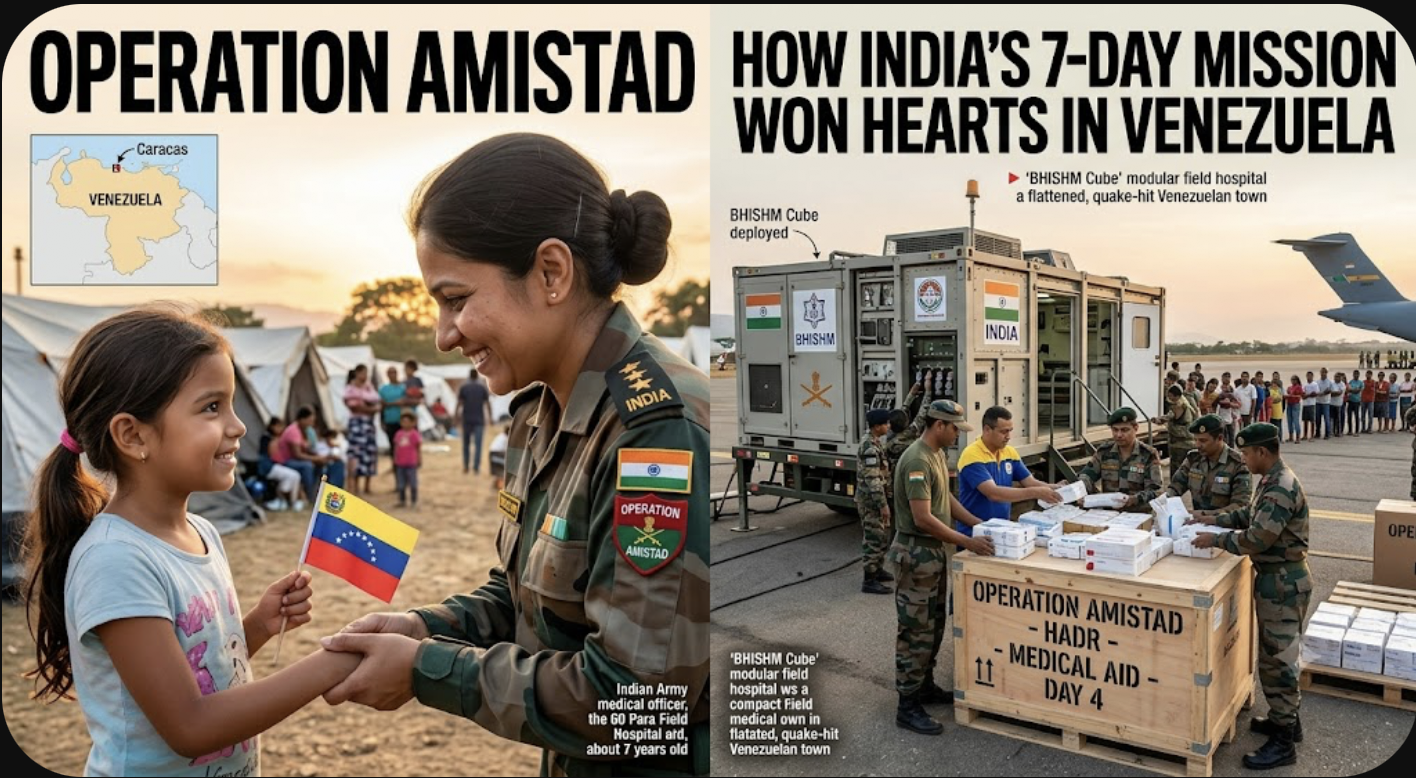
On board: a 41-member Army contingent built around a self-contained medical task force, 30 tonnes of relief supplies, six tonnes of medicines and medical equipment, and two BHISHM Cube units — India’s modular, rapidly deployable field-hospital pods designed to be functional within hours of landing. External Affairs Minister S. Jaishankar announced the deployment on X, saying he was confident the equipment and personnel would strengthen Venezuela’s post-earthquake response.
That confidence turned out to be reasonably well placed. Within roughly a day of arrival, the field hospital was operational at La Rinconada, home to Caracas’s old horse-racing track, working alongside Venezuela’s National Hippodrome Institute, which handled logistics on the ground.
Inside the Field Hospital at La Rinconada
What actually happened inside those tents is arguably the more interesting part of this story.
Who Was on the Team
Maitrey Kulkarni, described in an interview with Venezuelan broadcaster TeleSUR as the mission’s director, said the medical contingent included 41 doctors spanning multiple specialities — enough to run something closer to a small general hospital than a basic aid post. Some of that team had done this kind of work before. Kulkarni pointed to earlier deployments after Cyclone Ditwah in Sri Lanka and an earthquake in Myanmar as evidence the unit already knew how to stand up a functioning hospital in a disaster zone within days rather than weeks.
A Typical Day
By the first week of July, Venezuela’s foreign minister, Yvan Gil, said the hospital was seeing close to 400 patients a day. Fractures and hematomas from the earthquake made up a large share of the caseload, but the team was also running dental care, X-rays and minor surgeries — and treating Venezuelan rescue workers who’d been injured pulling their own neighbours out of the rubble. It wasn’t only an earthquake ward by that point. For a week, it had become one of the more functional hospitals in Caracas, full stop.
The Human Stories Behind Operation Amistad
Numbers explain the scale of an operation like this. They don’t explain why a mother named Lizzet Rodríguez stood outside the hospital and thanked, by name, the doctors and interpreters who treated her son.
Her son, Anthony Aguilarte, had a fractured femur. She brought him to the Indian-run field hospital rather than an overwhelmed local one, and by her own account, he came through it fine. She wasn’t the only Venezuelan telling that kind of story that week — the Indian Army’s own social media accounts documented treating a 79-year-old woman pulled from collapsed rubble with a fractured leg, whose case was complicated by an existing arterial condition that had worsened into a dangerous ulcer before anyone reached her. The team stabilised the fracture, started wound care, and kept her on a daily follow-up schedule most short-term aid missions wouldn’t have the bandwidth for.
These are the stories that end up in embassy press releases, and there’s an obvious reason for that. They’re genuinely useful evidence that the mission worked, in a way that tonnage figures and aircraft counts can’t really convey on their own.
What Venezuela’s Government Had to Say
Foreign Minister Gil didn’t just release a statement — he showed up. Alongside India’s ambassador to Venezuela, P.K. Ashok Babu, Gil toured the field hospital in person during the first week of July and called it an emotional show of goodwill between the two nations, tying it explicitly to the broader relationship between the countries.
He wasn’t shy about naming names, either — thanking Prime Minister Narendra Modi directly and crediting Venezuela’s Acting President, Delcy Rodríguez, with coordinating the country’s overall disaster response. On India’s side, Modi used the occasion of India’s Doctors’ Day, July 1, to publicly praise the medical team working in Venezuela, holding their work up as an example of what medical professionals can do under genuinely difficult conditions.
None of this is unusual as far as disaster diplomacy goes — countries that send aid tend to get thanked publicly, and countries that receive it tend to make sure the thanks are visible. What’s more interesting is what these particular thanks were layered on top of.
The Diplomacy Sitting Just Beneath the Surface
Operation Amistad didn’t happen in a vacuum. Barely three weeks before the earthquake, Delcy Rodríguez made her first visit to India as Venezuela’s Acting President, meeting Modi in New Delhi from June 3 to June 7. No formal agreements were signed, but Indian officials described the talks as substantive, touching on energy, mining, pharmaceuticals and the automotive sector.
That visit itself sat on top of a much bigger, messier story. Rodríguez has only held the title of Acting President since January 2026, after a US military operation captured then-President Nicolás Maduro and flew him to New York to face drug-trafficking charges — an operation whose legality is still disputed by legal scholars and several governments. Venezuela’s Supreme Court ordered Rodríguez, then vice president, to assume presidential powers days later, and the country’s political situation has stayed unsettled since, even as some sanctions have eased and foreign oil buyers have started circling back.
Against that backdrop, a field hospital full of Indian doctors treating Venezuelan patients reads a little differently. It’s genuine humanitarian aid, and the gratitude from patients like Lizzet Rodríguez is real. It’s also the kind of goodwill that tends to get remembered the next time two governments sit down to talk about oil contracts.
How India’s Response Compares Globally
India wasn’t the only country that showed up. It’s worth putting the field hospital in some context before deciding how impressive it actually was.
Who Else Sent Help
The United States pledged what Secretary of State Marco Rubio called a whole-of-government response, including warships, transport aircraft and roughly $150 million in aid. Brazil sent its own field hospital along with dozens of firefighters aboard a military transport plane. China’s government and the Red Cross Society of China sent emergency aid, and Chinese-funded companies already operating in Venezuela pitched in with heavy machinery and supplies of their own. Turkey sent a 67-strong search-and-rescue team, and Spain, Germany and Switzerland each sent rescue personnel or equipment. The World Health Organization coordinated emergency medical teams on the ground and released contingency funding on top of the medical supplies it shipped in.
The Real Difference
What set India’s contribution apart wasn’t necessarily its size — the US pledge, in dollar terms, dwarfs anything India sent. It was the shape of it. Most countries sent search-and-rescue teams built for the first 72 hours after a disaster. India sent a hospital built to still be running a full week later, treating dental problems and hematomas alongside collapsed-building injuries. That’s a different kind of commitment, and Venezuelan officials clearly noticed the difference.
A Familiar Pattern in India’s Foreign Policy
Field hospitals like this one have become something close to a signature move in Indian foreign policy over the past decade — Operation Maitri after Nepal’s 2015 earthquake, Operation Dost after the Turkey-Syria earthquakes in 2023, and more recently, deployments after Cyclone Ditwah in Sri Lanka and an earthquake in Myanmar, both cited by Operation Amistad’s own leadership as direct experience the team drew on.
There’s a term for this in foreign-policy circles: disaster diplomacy. Sending doctors and medicine costs a government far less, politically and financially, than most other forms of foreign engagement, and the goodwill it buys tends to outlast the news cycle around the disaster itself. Whether that goodwill converts into anything more concrete — oil contracts, mineral deals, diplomatic support at the UN — is a separate question, and one that plays out over years, not weeks.
What Happens Now
The Indian medical team is headed home, and the BHISHM Cubes will presumably get packed up for whatever comes next on India’s disaster-response calendar. Venezuela’s own recovery is nowhere close to finished — displaced families are still in temporary shelters, aftershocks were still being recorded well into July, and reconstruction across La Guairá alone will likely take years, not months.
The bigger question Rodríguez raised in New Delhi back in June — what an actual energy and minerals partnership between India and Venezuela might look like, now that sanctions have eased and Venezuelan oil is back on the table for buyers who mostly stepped away after 2019 — is still sitting there, unanswered. Operation Amistad didn’t resolve it. If anything, it just gave both governments one more reason to pick that conversation back up.
FAQs
What is Operation Amistad?
Operation Amistad is the name India gave to its Humanitarian Assistance and Disaster Relief (HADR) mission to Venezuela, launched within days of the twin earthquakes that struck the country on June 24, 2026. It centred on an Indian Army field hospital set up in Caracas.
Why did India send a field hospital instead of just relief supplies?
India’s HADR approach, built up over missions in Nepal, Turkey, Sri Lanka and Myanmar, favours self-contained medical units that can function independently in a disaster zone rather than leaning on the host country’s already-strained hospitals. The BHISHM Cube system — India’s term for it is Bharat Health Initiative for Sahyog, Hita and Maitri — was built specifically for this kind of rapid, modular deployment.
How many people died in the Venezuela earthquake?
Estimates rose steadily through late June and early July. The World Health Organization cited more than 2,300 deaths in early July, while Venezuela’s National Assembly president later put the toll above 3,300, with thousands more injured or displaced.
Where exactly was India’s field hospital located?
The hospital was set up at La Rinconada, home to Caracas’s Hipódromo (racetrack), working alongside Venezuela’s National Hippodrome Institute.
How long did Operation Amistad run?
The field hospital was operational for roughly a week, from late June until its closure in the first week of July.
Did other countries send help too?
Yes. The United States, Brazil, China, Turkey, Spain, Germany, Switzerland and the World Health Organization all sent aid, rescue teams, or medical support in the days following the earthquake.
Is this India’s first disaster relief mission abroad?
No. India has a track record of similar missions, including Operation Maitri after Nepal’s 2015 earthquake and Operation Dost after the 2023 Turkey-Syria earthquakes.
What is a BHISHM Cube?
BHISHM Cubes are India’s modular, portable field-hospital units, designed to be airlifted and made operational within hours and capable of handling a large number of trauma cases in a disaster setting.
External Links (Authoritative Sources)
- Government of India (All India Radio) — Operation Amistad launch announcement: https://newsonair.gov.in/india-launches-operation-amistad-to-assist-earthquake-hit-venezuela/
- US Department of State — Responding to Venezuela Earthquakes: https://www.state.gov/responding-to-venezuela-earthquakes/
- Al Jazeera — Which countries have pledged aid to Venezuela: https://www.aljazeera.com/news/2026/6/26/which-countries-have-pledged-aid-to-venezuela-after-powerful-earthquakes
- UK Parliament, House of Commons Library — The US capture of Nicolás Maduro: https://commonslibrary.parliament.uk/research-briefings/cbp-10452/
- Wikipedia — India–Venezuela Relations: https://en.wikipedia.org/wiki/India%E2%80%93Venezuela_relations