
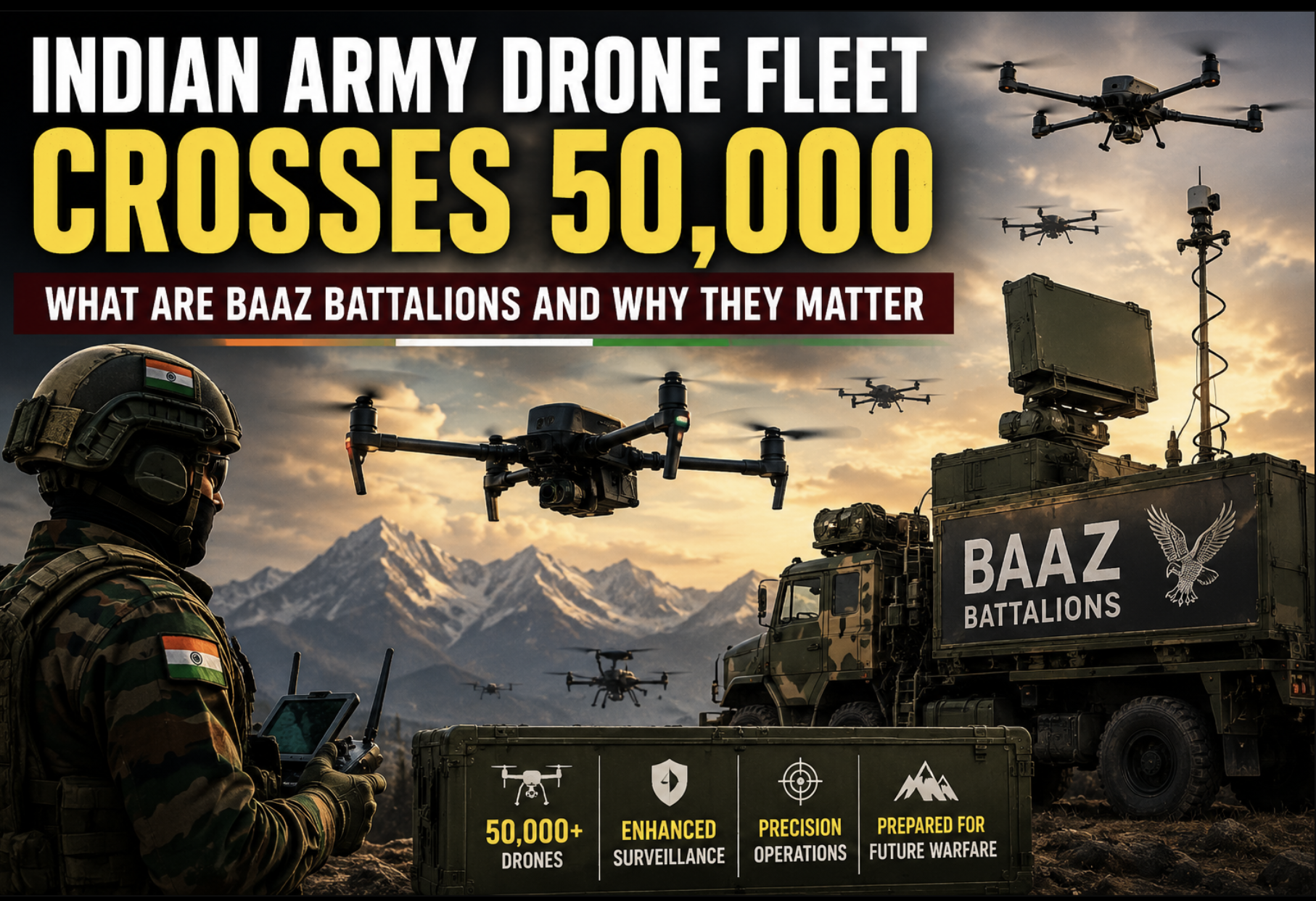
Indian Army Drone Fleet expansion has become one of the most significant military developments in recent years. General Upendra Dwivedi revealed that the Army now operates more than 50,000 drones and plans to expand this capability further through specialised Baaz Battalions. General Upendra Dwivedi picked an unusual moment to drop a very large number. It was 29 June, a Monday, and by his own service calendar he had roughly a day and a half left as India’s Army Chief.
Speaking to reporters in New Delhi, he said the Indian Army’s drone fleet now stands above 50,000 — up from a few hundred just two years earlier. He added that the figure could nearly double, to close to one lakh, within two to three years. And he announced the formation meant to take charge of managing it: the Baaz Battalions. The Indian Army Drone Fleet has emerged as one of the fastest-growing military drone inventories in the world.
Most of what followed in the news cycle was a faithful retelling of that press interaction, quote for quote, outlet for outlet. Fair enough, as far as it goes — it was a genuinely newsworthy briefing. But a fleet that grew roughly a hundredfold in about two years, announced on literally the second-to-last working day of a chief’s tenure, deserves a closer look than a same-day rewrite usually allows.
A few things got left out of most versions of the story. China’s role in prompting this build-up barely featured, even though several outlets tracking the Baaz Battalion decision separately note it drew on lessons from the Line of Actual Control standoff as much as from anything else. Operation Sindoor — the actual operational trigger behind most of this — went largely unnamed. And almost nobody connected the drone announcement to the fact that a brand-new Army Chief, General Dhiraj Seth, took charge the very next morning.
At a glance
| Metric | Figure |
| Fleet size, two years ago (2024) | A few hundred drones |
| Current fleet size (announced 29 June 2026) | 50,000+ drones |
| Projected fleet, within 2-3 years | Approaching 1,00,000 (one lakh) |
| Operating capacity, western theatre (Pakistan-facing) | ~10,000 (separately reported) |
| Operating capacity, LAC (China-facing, ~3,488 km) | 20,000+ (separately reported) |
| New formation announced | Baaz Battalions, under Army Aviation Corps |
| New Army Chief, took charge | General Dhiraj Seth, 30 June 2026 |
Indian Army Drone Fleet: What Does the 50,000 Figure Really Mean?
The Indian Army Drone Fleet is expected to expand significantly over the next three years. Start with the number that gets repeated everywhere: 50,000-plus drones today, potentially 1,00,000 within two to three years. Dwivedi didn’t break that figure down by category in his remarks, and none of the reporting off his press interaction did either. That gap matters more than it sounds like it should.
A fleet of 50,000 nano and first-person-view quadcopters — the palm-sized, largely disposable kind the Army has been buying by the thousand since Operation Sindoor — tells one story.
A fleet where a meaningful share is long-endurance ISR platforms like the Heron Mk-II, capable of days of persistent surveillance, tells a different one entirely. Public reporting on the Army’s holdings suggests it leans heavily toward the former: a few dozen Heron-class medium-altitude platforms, alongside tens of thousands of tactical, mini and FPV systems from vendors like ideaForge, plus a growing stock of loitering munitions such as the Nagastra-1. The 50,000 figure is real. What it’s actually made of is doing a lot of unstated work in every headline built around it.
Then there’s a reconciliation problem. Reporting from earlier this year — separate from Dwivedi’s June remarks — described the Army building capacity to operate around 10,000 drones in the western theatre facing Pakistan, and more than 20,000 along the 3,488-km Line of Actual Control with China. Add those together and the total comes to roughly 30,000, against a stated fleet north of 50,000. Neither figure arrives with a footnote explaining the gap.
It’s possible the 30,000 refers narrowly to a border-airspace-control initiative rather than the Army’s entire inventory, which would also include drones sitting at training establishments, depots and formations well behind the line. It’s equally possible the two figures were simply never meant to reconcile, because inventory counts in a force this size shift week to week and get quoted by different officials at different points for different purposes. Both explanations are plausible. Neither has actually been offered.
There’s a second, separate one-lakh figure floating around, and it isn’t obviously the same one Dwivedi cited. Open-source defence trackers describe an “Ashni Drone Platoon Programme” — the initiative equipping roughly 380 infantry battalions with dedicated drone platoons — as targeting more than 1,00,000 UAVs in total.
Whether that’s the identical projection the Army Chief gave reporters, a subset of it, or a parallel count that happens to land on a similar round number isn’t clear from anything in the public domain. Two different one-lakh figures circulating in the same broad conversation, with nobody connecting them, is the kind of detail that tends to get smoothed over in daily coverage.
Indian Army Drone Fleet and Operation Sindoor: Lessons Learned
Modernisation of the Indian Army Drone Fleet has accelerated following Operation Sindoor. None of this expansion happened in a vacuum, and the timing traces back to one specific stretch of days.
On 22 April 2025, gunmen killed 26 tourists in Pahalgam, in Jammu and Kashmir. India blamed Pakistan-backed militant groups. In the early hours of 7 May, the Indian military launched Operation Sindoor — coordinated strikes on nine sites across Pakistan and Pakistan-occupied Kashmir linked to Jaish-e-Mohammed and Lashkar-e-Taiba, using Rafale jets carrying SCALP missiles and AASM Hammer bombs. By most accounts, the strike itself was over in about 23 minutes.
What Pakistan’s Drone Barrage Actually Showed
Pakistan’s retaliation is where the drone story really begins. Over the night of 7-8 May, Pakistani forces launched somewhere between 300 and 400 Turkish-origin Songar and Yiha-series drones at 36 locations across India, stretching from Leh down to Sir Creek. Indian assessments afterward described most of them as cheap, low-quality platforms — less precision weapons than expendable clutter, meant to overload radar coverage and pull attention away from higher-value threats. India’s layered air defence, including the newly inducted Akashteer control system, intercepted the bulk of the swarm.
On India’s side, SkyStriker and Harop loitering munitions were used against Pakistani air-defence radars and military infrastructure, and Indian officials say debris recovered afterward included Turkish-origin drone parts alongside fragments of Chinese-made PL-15 missiles.
Operation Sindoor gets described, accurately, as the first real drone-on-drone exchange between two nuclear-armed neighbours. What it demonstrated to Indian planners wasn’t that drones are some kind of decisive wonder-weapon.
It was closer to the opposite — that even basic, low-cost drones, thrown at a target in bulk, can strain an air-defence network on their own, and that a modern force needs both enough interceptors and enough of its own attritable platforms to fight that kind of exchange without burning through expensive answers to cheap problems. That lesson, more than any single procurement file, is what sits behind the numbers Dwivedi cited in June.
Baaz Battalions and the Rest of the Alphabet
Baaz Battalions didn’t arrive as a standalone idea, and treating them as one flattens what’s actually happening inside the Army’s structure.
They sit under the Army Aviation Corps, built on existing Remotely Piloted Aircraft Flights, and their job — per the Army’s own framing — is operational depth: persistent long-range ISR, deep-area monitoring, target designation, and managing the flood of data that comes with all of it. That’s a specific slot in a structure that already has several other new formations doing adjacent, but distinct, jobs.
The new formations, side by side
| Formation | Sits Within | Primary Role |
| Baaz Battalions | Army Aviation Corps | Long-range ISR, deep-area surveillance, target designation |
| Ashni Platoons | Infantry battalions (~380 raised) | Close-in tactical surveillance and strike |
| Divyastra Batteries | Regiment of Artillery | Loitering munitions, one-way strike |
| Shaktibaan Regiments | Artillery, corps level and below | UAS + counter-drone + loitering munitions |
| Bhairav Battalions | Light commando (~21 raised) | High-tempo, multi-domain operations |
| Rudra All-Arms Brigades | Combined arms (~2 raised) | Multi-domain combined operations |
Ashni platoons, embedded at the infantry-battalion level — roughly 380 battalions now have one, each with around 20 to 25 personnel — handle close-in tactical surveillance and strike in the immediate vicinity of a unit’s own position. Divyastra batteries, sitting within the Regiment of Artillery, operate loitering munitions as one-way strike assets. Shaktibaan Regiments, also artillery-linked, combine UAS, counter-drone systems and loitering munitions at the corps level and below.
Bhairav Battalions and Rudra All-Arms Brigades handle high-tempo, multi-domain combined operations more broadly, with drones as one component among several — reportedly 21 Bhairav battalions and two Rudra brigades raised so far. Baaz sits above all of them, doing the long-range, persistent-surveillance job none of the others are built for.
Underneath the formations sits a training push that’s arguably the more consequential story, even if it gets a fraction of the coverage. The Army Training Command has set a target of training roughly five lakh soldiers in drone operations over five years, with about 50,000 already trained in the year before that target was announced. Nineteen training hubs — including the Indian Military Academy at Dehradun, the Infantry School at Mhow, and Officers Training Academies at Chennai and Gaya — were stood up with roughly a thousand training drones and 600 simulators, largely procured through emergency routes built for speed rather than the usual multi-year cycle.
The doctrine behind it has its own name: “Eagle on the Arm,” the idea that every soldier, not just specialists, should be able to fly a basic drone. The informal deadline attached to that ambition is 2027.
Indian Army Drone Fleet vs China: Understanding the Strategic Challenge
Training and doctrine will determine how effectively the Indian Army Drone Fleet performs in future conflicts. Everything above centres on Pakistan, which is where the 29 June press interaction spent most of its time — Dwivedi was asked directly about Pakistan’s drone investments and answered at length. China barely came up, at least in what made it into print. That’s worth sitting with, because several outlets covering the Baaz Battalion decision separately note it drew as much from the LAC standoff with China as from Operation Sindoor.
The PLA already flies drones — Wing Loong (GJ-2) and Rainbow-series (CH-4) platforms among them — over the Western Theatre Command opposite India, largely for reconnaissance along the same line where the two armies have faced off since 2020. More specific to Sindoor: reporting on India’s post-conflict procurement reforms has pointed to Chinese-supplied electronic-warfare and drone-integration architecture, acquired by Pakistan since 2021, as the likely source of GPS jamming that degraded Indian navigation systems across a roughly 150-kilometre radius during the operation. If that holds up, China’s fingerprints on the India-Pakistan drone exchange went well beyond simply selling Islamabad hardware.
Then there’s the swarm demonstration. In March 2026, Chinese state broadcaster footage showed a system called Atlas — built around a launch vehicle called Swarm-2 — releasing 48 fixed-wing drones from a single ground platform, with a command vehicle capable of coordinating up to 96 in the air simultaneously, fully airborne within roughly five minutes. It’s a real, filmed demonstration, not vapourware. It’s also worth being precise about what it isn’t: independently verified in combat, and documented entirely through Chinese state media, which has an obvious interest in making the capability look further along than it might actually be.
The “Million Drones” Claim, Checked Against SIPRI and IISS
The number that gets repeated most often in this conversation — that the PLA has ordered “over a million drones” — deserves the most caution of all. That figure traces back to industry and market-research write-ups, not to SIPRI’s arms transfer database or the IISS Military Balance, and neither of those primary trackers publishes a confirmed total for China’s military drone inventory. More sourced, if still unofficial, analyst estimates cluster closer to five to fifteen thousand military platforms, with the millions-scale figures actually describing China’s civilian drone production capacity — output that could theoretically be repurposed, rather than an existing military stockpile. Worth knowing before it gets repeated as settled fact on either side of the border.
How Indigenous Is “Indigenous”, Really
Indigenous manufacturing remains central to the long-term growth of the Indian Army Drone Fleet. Self-reliance comes up in almost every official account of this expansion, and there’s real substance behind some of it. There’s also a fair amount doing more rhetorical work than technical work, and the difference matters for anyone trying to judge how self-sufficient India’s drone fleet actually is.
Start with the money. The original Production-Linked Incentive scheme for drones, notified in 2021, carried a total outlay of just ₹120 crore over three years, capped at ₹30 crore per manufacturer — a modest sum for an industry the Army now wants supplying tens of thousands of units a year. A larger PLI 2.0, alongside a proposed ₹10,000-crore “Drone Shakti” incentive aligned with the 16th Finance Commission cycle, has been under consideration for the 2026-27 budget, aimed at pushing local content up from its current baseline. That baseline is the uncomfortable part: India still imports an estimated 50 to 60 percent of drone components by value, even on platforms marketed as indigenous.
The Drishti-10 illustrates the nuance well. It’s an Adani Defence-built, Elbit Systems-designed platform based on the Israeli Hermes-900 airframe, assembled in Hyderabad with roughly 70 percent indigenous content by Adani’s own account. That’s genuine local manufacturing capability, and it isn’t nothing. But at its core, it’s an Israeli design being built under licence — final assembly with substantial imported critical systems, rather than a platform designed in India from the ground up.
The Army’s own trials reportedly found the airframe underperforming at high altitude, precisely the environment its LAC-facing units need most, even as the Navy stayed satisfied with it for maritime use. Both services are now said to be pursuing a fresh, dedicated MALE UAV tender rather than resting the high-altitude requirement on Drishti-10 alone.
Set against that, Nagastra-1 looks like the more genuinely indigenous success story — a man-portable loitering munition built by Solar Industries and Z-Motion, used in actual combat during Operation Sindoor, with several hundred units inducted and more on order since. DRDO’s Ghatak stealth UCAV programme is the longer bet: cleared for the development phase in March 2026, with an eventual order of roughly 60 to 70 airframes worth ₹39,000 crore, it’s a serious push toward a fully indigenous flying-wing combat drone.
DRDO’s own chairman, though, puts full operational readiness seven to eight years away — meaning the capability gap in fully indigenous MALE-class and stealth-strike platforms isn’t closing this decade.
The Pushback: Is More Drones Even the Right Goal
Not everyone inside the defence-commentary world is convinced that a bigger inventory number is the thing worth chasing, and an analytical piece probably owes that view as much room as the official one.
Retired officers writing in outlets like ThePrint have pointed to a structural issue sitting underneath the induction speed: most tactical drones are being bought fast, through the special financial powers held by Army Commanders and the Vice Chief’s emergency financial powers, precisely because that route skips the years-long formal procurement cycle. It works, in the sense that equipment reaches units quickly.
It also produces roughly what you’d expect from dozens of commands buying independently under time pressure — little standardisation across platforms, wide price variation, fragmented maintenance contracts, and, by some accounts, exposure to vendors chasing a fast contract rather than a durable one. The same critique flags a lowest-bidder procurement culture that can favour price over reliability, plus an unclear line between what belongs at the tactical, operational and strategic level of drone employment.
There’s also a tension sitting inside Dwivedi’s own remarks that’s easy to miss on a first read. Asked about Pakistan’s drone buildup, he argued that raw inventory numbers matter less than the ability to find, track, disable and ultimately control the drone battlespace — a point made in the same breath as leading his own announcement with 50,000 and 1,00,000 as the headline figures for India’s fleet. Applied evenly, that logic would suggest inventory size isn’t the whole story on either side of the border, which sits a little oddly next to how the announcement was actually framed.
History offers a specific cautionary data point here. The Indian Army already had Heron drones giving 14 Corps meaningful visibility across the LAC well before June 2020. That sensor coverage didn’t prevent the Galwan clash, where at least 20 Indian soldiers were killed. Researchers who’ve studied that episode closely — including work published through the University of Pennsylvania’s Center for the Advanced Study of India — argue it wasn’t primarily an intelligence failure at all; warnings about PLA troop movements reportedly reached the Army roughly three months in advance.
What failed was the response: converting available warning into a credible posture in time. More drones, on their own, don’t fix a response problem, and that’s a distinction the current expansion doesn’t obviously grapple with in its public messaging.
One more perspective worth naming, even if it’s more provocative than settled: an academic reading published via Small Wars Journal in January frames part of the Army’s aggressive drone push as something close to institutional self-preservation — land-centric forces watching aerial and naval domains take on outsized relevance in recent conflicts, and moving fast into unmanned systems partly to stay operationally central. It’s a reading the Army would almost certainly reject. It’s also not an unreasonable one to leave on the table.
Who’s Watching the Watchers: India’s Counter-Drone Grid
A fleet this size creates a problem that gets far less attention than the acquisition numbers: someone has to manage the airspace all these friendly drones now share, and tell them apart from hostile ones in real time.
Akashteer, the AI-enabled air defence control system built by Bharat Electronics with DRDO and ISRO, is the backbone of that effort. Inducted in 2024 under a ₹1,982-crore contract, it was live as part of India’s air-defence network during Operation Sindoor, where it’s credited with intercepting drones, missiles, micro-UAVs and loitering munitions while classifying airspace users as friendly, neutral or hostile. Full delivery of all 455 planned units is targeted for April 2027.
Sitting alongside it is SAKSHAM — Situational Awareness for Kinetic Soft and Hard Kill Assets Management — a newer, dedicated counter-UAS grid approved under fast-track procurement in October 2025 and designed to secure what the Army calls the “Tactical Battlefield Space,” the airspace up to 3,000 metres above the ground. It draws on Akashteer’s classification data and is meant to give field commanders automated options for neutralising a hostile drone, whether by kinetic shot or directed radio interference. Rollout to all field formations was targeted within roughly a year of approval.
There’s a private-sector layer worth naming honestly, too. Hyderabad-based Grene Robotics has demonstrated Indrajaal, a wide-area counter-drone system it says can protect up to 4,000 square kilometres using a stack of proprietary technologies. It’s a genuinely notable domestic capability. It’s also, as far as the public record shows, still at the demonstration and trial stage rather than a confirmed, Army-wide induction — a distinction that tends to get lost when it’s mentioned in the same breath as Akashteer and SAKSHAM.
None of these systems fully answers the fratricide question as friendly drone density keeps climbing. IFF — identify-friend-or-foe — standardisation across drones, helicopters and manned aircraft sharing the same low-altitude airspace gets flagged repeatedly by military commentators as unfinished business rather than a solved problem. Fifty thousand additional friendly aircraft, even small ones, is fifty thousand additional objects a ground gunner or an automated system now has to correctly classify in the seconds that matter.
The Ukraine Comparison, Minus the Hype
Ukraine gets invoked constantly in these conversations as proof that drones now decide wars, and the comparison isn’t wrong so much as it’s frequently made without the numbers that would make it an honest one.
Ukraine’s defence industry produced an estimated four million drones in 2025 and is on track for somewhere between five and seven million in 2026, according to figures cited by the Council on Foreign Relations and Ukrainian officials themselves. The overwhelming majority are cheap, expendable first-person-view types, consumed in active combat at a rate that would be unrecognisable to any peacetime procurement office — entire brigades reportedly burning through several hundred to a few thousand FPVs a month just to sustain current operations.
Set next to that, an Indian fleet of 50,000 to a possible 1,00,000, built up as standing inventory over roughly two to three years of peacetime procurement, is describing a different kind of situation entirely. One is an annual wartime replacement rate for a force taking daily losses on an active front. The other is a stockpile being assembled ahead of a conflict that, as of now, isn’t happening. Neither framing makes India’s build-up less serious — it just means the two numbers shouldn’t really sit in the same sentence as though they’re measuring the same thing.
What does genuinely transfer from Ukraine’s experience is the underlying economics: a few hundred dollars’ worth of expendable drone can force an adversary to spend vastly more defending against it, and attritable, mass-producible design should probably be the default rather than the exception. Indian officers involved in the training push have made almost exactly that argument in public, pointing to a low-cost drone taking out a far more expensive system as the calculus now driving procurement. What doesn’t transfer is the production tempo itself, or the compressed, under-fire innovation cycle that comes from iterating a drone design against real battlefield feedback every few weeks. India’s build-up, fast by its own historical standards, is still happening on a peacetime clock.
The Unglamorous Part: Training, Retention and Money
The parts of this story that get announced least are usually the parts that decide whether it actually works — who operates all this equipment, and what it costs to keep them doing it well.
On training throughput, the public figures — roughly five lakh soldiers over five years, around 50,000 trained in the preceding year — suggest a pace that’s genuinely ambitious relative to where the Army started. Nobody in official channels has said explicitly, though, whether that rate is keeping up with hardware induction or trailing behind it. Given that the fleet reportedly grew close to a hundredfold in about two years, matching that pace with trained operators, maintainers and data analysts would be an unusual achievement for any large military bureaucracy, and it’s a fair question to leave open rather than assume answered.
Retention sits quietly behind that one. A soldier trained to fly, maintain and interpret data from a modern UAS has skills that translate directly into a private drone or robotics industry currently offering salaries a service career can’t easily match. Nothing in the public record confirms this is already pulling trained personnel out of uniform at scale — but it’s the kind of structural risk that tends to surface years after the training numbers get announced, not at the briefing where they’re unveiled.
On money specifically for Baaz Battalions — manpower costs, base infrastructure, sustainment and spares over the life of the formation — there’s no publicly disclosed figure anywhere in the reporting around the 29 June announcement. That’s not unusual for a newly raised Indian military formation, where unit-level budgets rarely get itemised in public. It does mean anyone trying to judge whether this expansion is adequately funded, rather than simply announced, is working without the one number that would actually settle it.
A New Chief Inherits an Old Question
General Dhiraj Seth took over as the Army’s 31st Chief of the Army Staff on 30 June, the morning after Dwivedi’s press interaction, in a change-of-command ceremony on the South Block lawns. He’s the first Armoured Corps officer to lead the Army since General Shankar Roy Chowdhary in 1997, and he arrives with a background heavy on strategic planning and capability development from his time at Army Headquarters, plus the rarer distinction of having commanded two operational Army commands — South Western and Southern — along the western front. He was also the Southern Army Commander during Operation Sindoor, for which he received the Uttam Yudh Seva Medal.
Nothing in his public record so far suggests he intends to slow any of this down. If anything, the official framing around his appointment points toward continued emphasis on autonomous systems, drone warfare and the broader modernisation agenda, alongside the parallel push toward integrated theatre commands. But a change of command is exactly the moment institutional priorities quietly shift, even when nobody announces a reversal. Whether Baaz Battalions get raised on the timeline Dwivedi described, at the scale he described, is now partly a question about a chief who, at the time of writing, has held the job for a matter of days.
A harder question sits underneath the whole expansion and doesn’t have a public answer yet. As loitering munitions and strike-capable drones move down to lower echelons — Ashni platoons at battalion level, Divyastra batteries, eventually whatever Baaz Battalions end up authorised to do independently — the chain of command for actually pulling the trigger gets correspondingly more distributed. Between two nuclear-armed states that have already fought one drone exchange, who signs off on a strike launched from a platoon-level asset, and what safeguards sit between that authorisation and an escalation nobody intended, isn’t something any of the public announcements around this build-up have addressed so far.
What success looks like three to five years out is, in the end, a more useful question than the headline inventory figure. Fewer surveillance gaps along both borders. Faster time between a sensor spotting something and a shooter acting on it. Fewer episodes like Galwan, where the sensors were present and the response still lagged behind them. A fleet count, taken alone, answers none of that — which is roughly the same point General Dwivedi made about Pakistan’s drones on his way out the door, about an inventory that, as of that Monday afternoon, happened to be his own.
Frequently Asked Questions
What are Baaz Battalions in the Indian Army?
Baaz Battalions are specialised drone units the Indian Army announced on 29 June 2026, sitting under the Army Aviation Corps and built on existing Remotely Piloted Aircraft Flights. Their focus is long-range intelligence, surveillance and reconnaissance, deep-area monitoring and target designation — a different job from the shorter-range Ashni platoons already embedded in infantry battalions.
How many drones does the Indian Army actually have?
Chief of Army Staff General Upendra Dwivedi said in June 2026 that the fleet had crossed 50,000, up from a few hundred two years earlier, with a potential doubling to nearly 1,00,000 within two to three years. Public reporting doesn’t break this figure down by drone category, and it doesn’t fully reconcile with separately reported operating-capacity figures of roughly 10,000 in the western theatre and 20,000-plus along the LAC.
What’s the difference between Baaz Battalions, Ashni platoons, Divyastra batteries and Shaktibaan regiments?
They sit at different levels of the Army’s structure. Ashni platoons handle close-range tactical surveillance at the infantry-battalion level. Divyastra batteries, within the Regiment of Artillery, operate loitering munitions. Shaktibaan regiments combine UAS, counter-drone systems and loitering munitions at the corps level. Baaz Battalions, under Army Aviation Corps, are meant for longer-range, persistent ISR above all of these.
Why did the Indian Army expand its drone fleet so quickly?
The immediate trigger was Operation Sindoor in May 2025, India’s response to the Pahalgam terror attack, during which Pakistan launched hundreds of drones across the border and India used loitering munitions and ISR platforms extensively in return. The military standoff with China along the LAC is cited as a parallel, longer-running driver.
Is India’s drone fleet comparable to China’s or Ukraine’s?
Not directly. Ukraine’s wartime drone production runs into the millions annually — a replacement rate for daily combat losses on an active front. China’s actual military drone inventory isn’t confirmed by primary sources like SIPRI or IISS, and widely repeated “over a million” figures trace to industry estimates rather than verified military data. India’s 50,000-to-100,000 figure is a peacetime standing inventory, built over roughly two to three years, which makes direct comparisons with either country misleading without context.
Who is General Dhiraj Seth, India’s new Army Chief?
General Dhiraj Seth took over as the Indian Army’s 31st Chief of the Army Staff on 30 June 2026, succeeding General Upendra Dwivedi. An Armoured Corps officer commissioned in December 1986, he’s the first officer from that arm to lead the Army since 1997, and previously commanded both South Western and Southern Commands — the latter during Operation Sindoor, for which he received the Uttam Yudh Seva Medal.
How indigenous is India’s drone fleet, really?
It’s mixed. India still imports an estimated 50 to 60 percent of drone components by value even on platforms marketed as indigenous, such as the Drishti-10 (built on Israel’s Hermes-900 airframe with roughly 70 percent local content). Fully indigenous programmes like the Nagastra-1 loitering munition have seen genuine combat use, while larger ambitions like DRDO’s Ghatak stealth drone remain, by the developing agency’s own estimate, seven to eight years from operational service.
Internal Link Suggestions
Suggested cross-links for the publisher’s own site — anchor text paired with the topic the linked page should cover.
- “Operation Sindoor” → a dedicated timeline/explainer on Operation Sindoor and its outcomes
- “Ashni platoons” → an explainer on infantry-level drone platoons and how they operate
- “Akashteer” → a deep-dive on India’s AI-enabled air defence control system
- “General Dhiraj Seth” → a full profile of the new Army Chief and his priorities
- “DRDO’s Ghatak stealth UCAV” → a standalone piece tracking the Ghatak programme’s timeline
- “2020 Galwan clash” → a retrospective explainer on the Galwan standoff and its aftermath
External Authority Links
Primary and authoritative sources used:
- Wikipedia — General Dhiraj Seth
- Bharat Shakti — Army raises specialised Baaz Battalions
- Bharat Shakti — Post-Sindoor drone transformation drive
- WION — Army assumes control of low-altitude airspace
- Drone Federation India — Operation Sindoor’s drone doctrine
- ThePrint — Opinion: closing the drone-warfare gap with the PLA
- ThePrint — General Dhiraj Seth and the modernisation challenge
- Council on Foreign Relations — Ukraine’s drone production data
- Small Wars Journal — How India is integrating drones in war-fighting
- Whalesbook — India’s Drone PLI 2.0 scheme