Table of Contents
- A launch that signals a shift in ambition
- What NIDAR 2.0 actually asks students to build
- Track 1: Swarm drones, no network, no GPS
- Track 2: An Indian autopilot on an Indian chip
- The VEGA processor and the DIR-V bet
- What the first edition tells us
- SwaYaan: the machinery behind the challenge
- The larger context: import bans, PLI and the China problem
- Dual-use technology and the defence angle
- The open questions
- FAQs
A Launch That Signals a Shift in Ambition
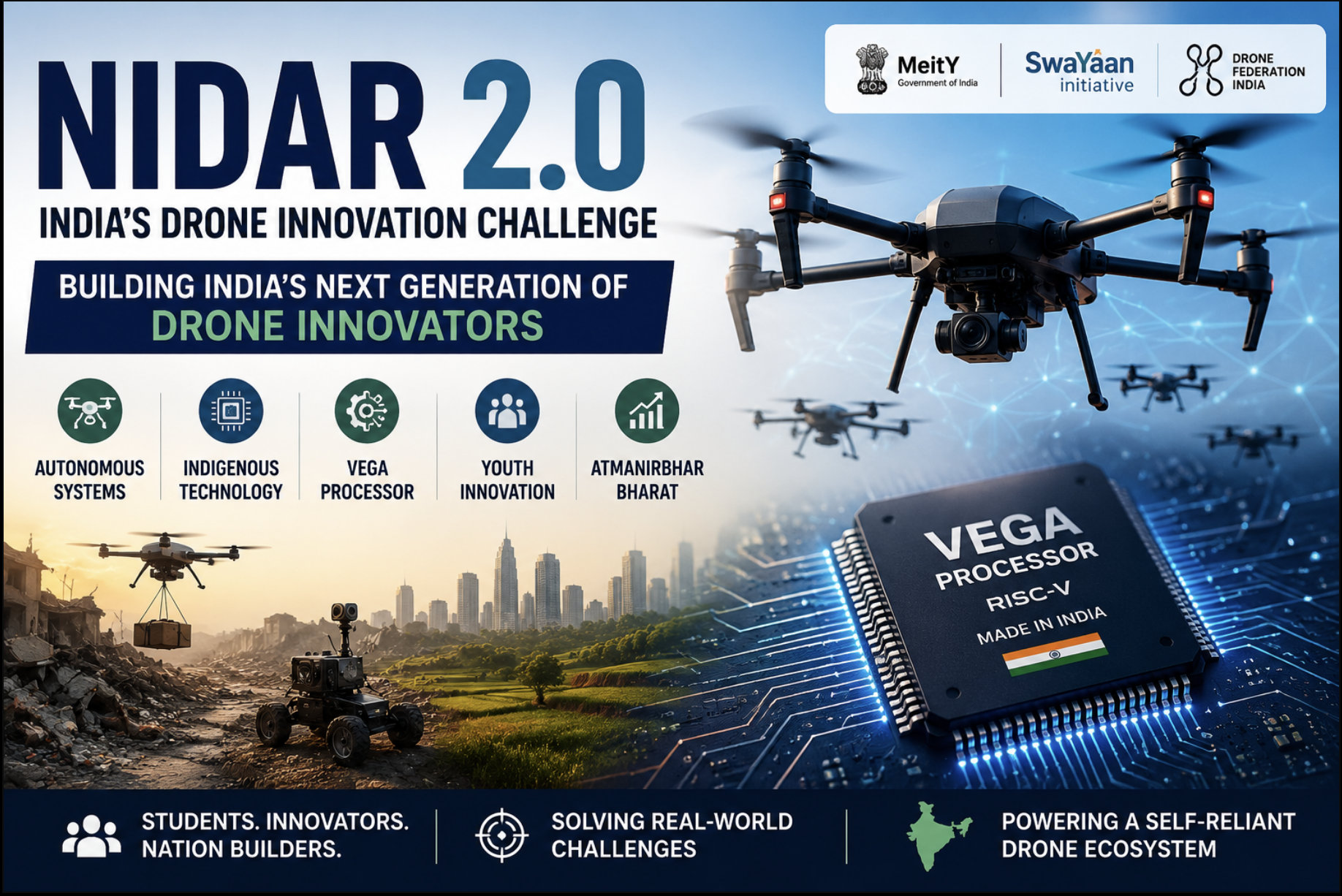
NIDAR 2.0 is the second edition of the National Innovation Challenge for Drone Application and Research launched by MeitY. On Monday evening at Electronics Niketan in New Delhi, MeitY Secretary S. Krishnan released a rulebook, a poster and a set of problem statements. On paper, a routine government launch. But the second edition of the National Innovation Challenge for Drone Application and Research, NIDAR 2.0, carries a heavier brief than its predecessor, and the language around it made that clear.
Krishnan framed the change bluntly: the challenge, he said, takes students “from just flying drones to building the drone’s brain.” That single line captures what separates NIDAR 2.0 from the 2025 edition. The first round asked students to apply drones to real problems. This one asks them to build the intelligence and the electronics inside the machine, on Indian silicon.
The launch, held in hybrid mode under the SwaYaan initiative and organised with Drone Federation India (DFI), drew an unusually broad official crowd. Alongside MeitY leadership, Amitesh Kumar Sinha (Additional Secretary and CEO of the India Semiconductor Mission), Tulika Pandey (Scientist G, MeitY) and DFI President Smit Shah, there were representatives from the Ministries of Civil Aviation, Defence and Home Affairs, the DGCA and the armed forces. When three security-adjacent ministries and the aviation regulator show up for a student competition, the competition is being read as more than a student competition.
What NIDAR 2.0 Actually Asks Students to Build
NIDAR 2.0 runs for the 2026-27 cycle across two tracks, and the difference between them is worth spelling out, because most early coverage has glossed over it.
Track 1: Swarm Drones, No Network, No GPS
The Drone Innovation track sets two problems that mirror genuinely hard real-world constraints. The first asks teams to build fully autonomous swarm drones that can locate survivors in a disaster zone and deliver medical parcels, without relying on any external communication network. That last condition is the difficult part. In an actual earthquake or flood, cell towers are often the first casualty, so a drone that needs connectivity is a drone that fails precisely when it is needed.
The second problem is a GPS-denied drone that can navigate confined indoor spaces for industrial inspection. Satellite positioning does not work inside factories, tunnels or collapsed structures, which forces teams towards onboard perception, visual odometry and sensor fusion, the same techniques that separate hobbyist drones from serious autonomous systems. The mission names on the official NIDAR portal, RescueSwarm and AirMouse, hint at both problems.
Track 2: An Indian Autopilot on an Indian Chip
The Component Innovation track is where the policy ambition sits. Teams must design an indigenous flight controller and autopilot built around the VEGA processor, using Indian electronic components wherever possible. After a technical evaluation, the top 100 teams will each receive two VEGA processor kits for development, testing and integration.
Flight controllers are the least glamorous and most strategic part of a drone. Most Indian drone makers today assemble airframes around imported autopilots and imported chips. If even a handful of NIDAR teams produce a credible VEGA-based controller, the country gains something it currently lacks: a domestic reference design for the component that actually decides how a drone behaves.
The VEGA Processor and the DIR-V Bet
VEGA is a family of microprocessors designed by the Centre for Development of Advanced Computing (C-DAC) under MeitY’s Microprocessor Development Programme. It is built on RISC-V, an open-standard instruction set architecture that anyone can use without paying licence fees to companies such as Arm. The Digital India RISC-V (DIR-V) programme exists precisely to exploit that opening, reducing dependence on foreign chip designs and the recurring licensing costs that come with them.
Placing VEGA at the centre of a national student competition is a deliberate seeding strategy. Chips do not gain adoption through press releases; they gain it when engineers learn the toolchain early and carry that familiarity into industry. A hundred teams working hands-on with VEGA kits is, in effect, a hundred small design bureaus stress-testing an Indian processor for free, and reporting back what breaks.
There is a candid subtext here too. RISC-V ecosystems worldwide still trail Arm in software maturity, documentation and community support. Whether student teams find the VEGA toolchain workable under competition pressure will be one of the more revealing outcomes of this edition, arguably more revealing than who wins.
What the First Edition Tells Us
The inaugural NIDAR, launched in March 2025, gives a usable baseline. It attracted 3,448 students from 22 states, four Union Territories and 109 cities. Teams built autonomous drone solutions for disaster management and precision agriculture; 93 reached the grand finale and 24 shared prizes worth Rs 40 lakh.
Those numbers say two things. First, the geographic spread, 109 cities, suggests interest well beyond the usual IIT circuit, which matters if the goal is a broad talent pipeline rather than a trophy for elite institutions. Second, a 93-team finale from thousands of participants points to a steep filter, and NIDAR 2.0 has made the filter steeper by raising the technical bar from application-building to systems and component engineering.
The incentives have grown to match. The prize pool now exceeds Rs 65 lakh, up from Rs 40 lakh, and winning teams also get corporate internships, incubation support and cloud computing credits, a package clearly designed to push prototypes towards commercialisation rather than letting them die in college labs, which is where most student hardware projects historically go.
SwaYaan: The Machinery Behind the Challenge
NIDAR does not stand alone. It is the flagship innovation platform of SwaYaan, a capacity-building programme MeitY approved in July 2022 with an outlay of roughly Rs 89.87 crore over five years. SwaYaan runs on a hub-and-spoke model across 30 premier institutions, including IISc, the IITs, IIITs, NITs, C-DAC and NIELIT, and organises its work under five themes: aeromechanics, drone electronics, GNC (guidance, navigation and control) algorithms and simulation, drone applications, and allied UAS technologies.
By the government’s count, SwaYaan has trained more than 51,000 people so far, and has fed M.Tech programmes, minor degrees, retrofitted electives, online courses, research papers and patents. Read together, SwaYaan is the classroom and NIDAR is the exam, an arrangement that gives the competition a supply of prepared participants rather than leaving it to self-taught enthusiasts.
The Larger Context: Import Bans, PLI and the China Problem
NIDAR 2.0 lands in a policy environment that has been reshaped several times since 2021. The liberalised Drone Rules of August 2021 removed much of the licensing friction that had suffocated the sector. In February 2022, the government banned the import of foreign drones (with exceptions for R&D, defence and security), effectively reserving the domestic market for Indian assemblers. A production-linked incentive scheme for drones and components followed, and the stated ambition has been to make India a global drone hub by 2030.
The uncomfortable gap in that story has always been components. Banning finished drones did not ban the flight controllers, motors, cameras and sensors inside them, a large share of which still arrive from China and other East Asian suppliers. Industry bodies and defence commentators have repeatedly flagged this as the sector’s soft underbelly, both economically and from a security standpoint, since firmware and chips of uncertain provenance sit inside machines that fly over Indian infrastructure. Track 2 of NIDAR 2.0 is a direct, if long-horizon, answer to exactly that gap.
Dual-Use Technology and the Defence Angle
The official release makes the dual-use point explicitly: civilian and defence drones share much of the same core technology, and ideas emerging from NIDAR can strengthen both, in line with Atmanirbhar Bharat and the Viksit Bharat 2047 vision. The presence of the armed forces and the Home and Defence ministries at a student event underscores it.
Recent history explains the urgency. Cross-border drone incursions along the Punjab and Jammu frontiers, and the visible role of small autonomous systems in conflicts from Ukraine to West Asia, have made swarm autonomy and GPS-denied navigation, the very skills Track 1 tests, priority capabilities for militaries everywhere. A student who can make five drones cooperate without a network in a mock disaster zone is working on the same mathematics that matters in contested airspace. Nobody at the launch needed to say that part out loud.
The Open Questions
A few things are worth watching as the 2026-27 cycle unfolds. Can student teams realistically deliver a flight-worthy autopilot on a processor whose developer ecosystem is still young? Will the incubation and internship pipeline actually convert prototypes into products, something the first edition has not yet had time to demonstrate? And will the component-level push survive contact with economics, given that mature imported autopilots remain cheap and well-documented?
There is also the quieter institutional test. SwaYaan’s five-year outlay window, approved in 2022, is approaching its horizon, and programmes of this kind live or die by whether their funding is renewed and scaled. The 3,448 students of the first edition were a proof of interest. NIDAR 2.0 has to prove something harder: that a competition can shift where India’s drone value chain actually sits. Registrations on the NIDAR portal are already live, and the answer will start taking shape when those hundred VEGA kits reach the shortlisted teams.
FAQs
What is NIDAR 2.0?
NIDAR 2.0 is the second edition of the National Innovation Challenge for Drone Application and Research, launched by MeitY and Drone Federation India for 2026-27 under the SwaYaan initiative. It focuses on autonomous drone systems, indigenous avionics and core drone components.
How is NIDAR 2.0 different from the first edition?
The first edition (2025-26) centred on drone applications in disaster management and precision agriculture. NIDAR 2.0 raises the difficulty: teams must build autonomous swarm drones that work without communication networks, GPS-denied indoor drones, and indigenous flight controllers built on the Indian VEGA processor.
What is the VEGA processor?
VEGA is a family of indigenous microprocessors designed by C-DAC under MeitY’s Microprocessor Development Programme, based on the open-standard RISC-V architecture. It is promoted under the Digital India RISC-V (DIR-V) programme to cut dependence on foreign chip designs and licensing costs.
What is the prize pool for NIDAR 2.0?
The total prize pool exceeds Rs 65 lakh, up from Rs 40 lakh in the first edition. Winners also receive corporate internships, startup incubation support and cloud computing credits. The top 100 teams in the Component Innovation track each get two VEGA processor kits.
Who can participate in NIDAR 2.0?
The challenge is aimed at students and researchers from academic institutions across India. Registrations and the official rulebook are available on the NIDAR portal at nidar.org.in.
What is the SwaYaan initiative?
SwaYaan is MeitY’s capacity-building programme for unmanned aircraft systems, approved in July 2022 with an outlay of about Rs 89.87 crore over five years. It runs through 30 institutions, including IISc, IITs, NITs, C-DAC and NIELIT, and has trained more than 51,000 people. NIDAR is its flagship innovation platform.
External Authority Links
- Official PIB press release on the NIDAR 2.0 launch: pib.gov.in (Release ID 2284236)
- NIDAR official portal, rulebook and registration: nidar.org.in
- SwaYaan initiative: swayaan.meity.gov.in
- Digital India RISC-V (DIR-V) programme: dirv.meity.gov.in
- Drone Federation India: dronefederation.in
- DGCA Digital Sky platform (drone regulations): digitalsky.dgca.gov.in