Table of Contents
- The Decision That Changes India’s Airspace Math
- How India Got Here: Background of the India S-400 Expansion Programme
- Why Five More Squadrons, and Why Now
- S-400 Technical Specifications
- The Missile Family, Explained Properly
- How an India S-400 Expansion Battery Actually Works
- Inside One Squadron: Organisation and Assets
- Coverage Map: What Ten Squadrons Can See and Strike
- Current Deployments and the Logic Behind Them
- Plugging Into IACCS: India’s Layered Air Defence Network
- Mission Sudarshan Chakra: The 2035 Shield
- Lessons from Operation Sindoor
- S-400 vs Patriot, THAAD, HQ-9 and the Rest
- Strategic Importance for India
- What This Does to Pakistan
- What This Does to China
- The Global India S-400 Expansion Club
- The Hard Part: Risks and Challenges
- Indigenous Alternatives: Kusha, Akash NG and Friends
- Defence Industrial Benefits
- The Road to 2035
- Key Facts Box
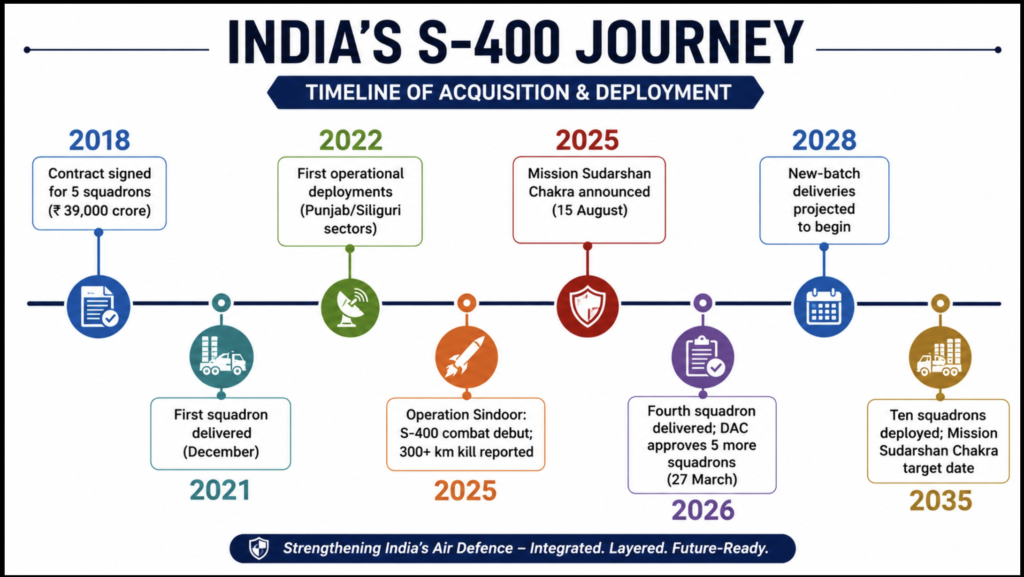
- Timeline
- The Bigger Picture
- FAQs
The Decision That Changes India’s Airspace Math
India S-400 Expansion Explained: Complete Guide to India’s Air Defence Shield
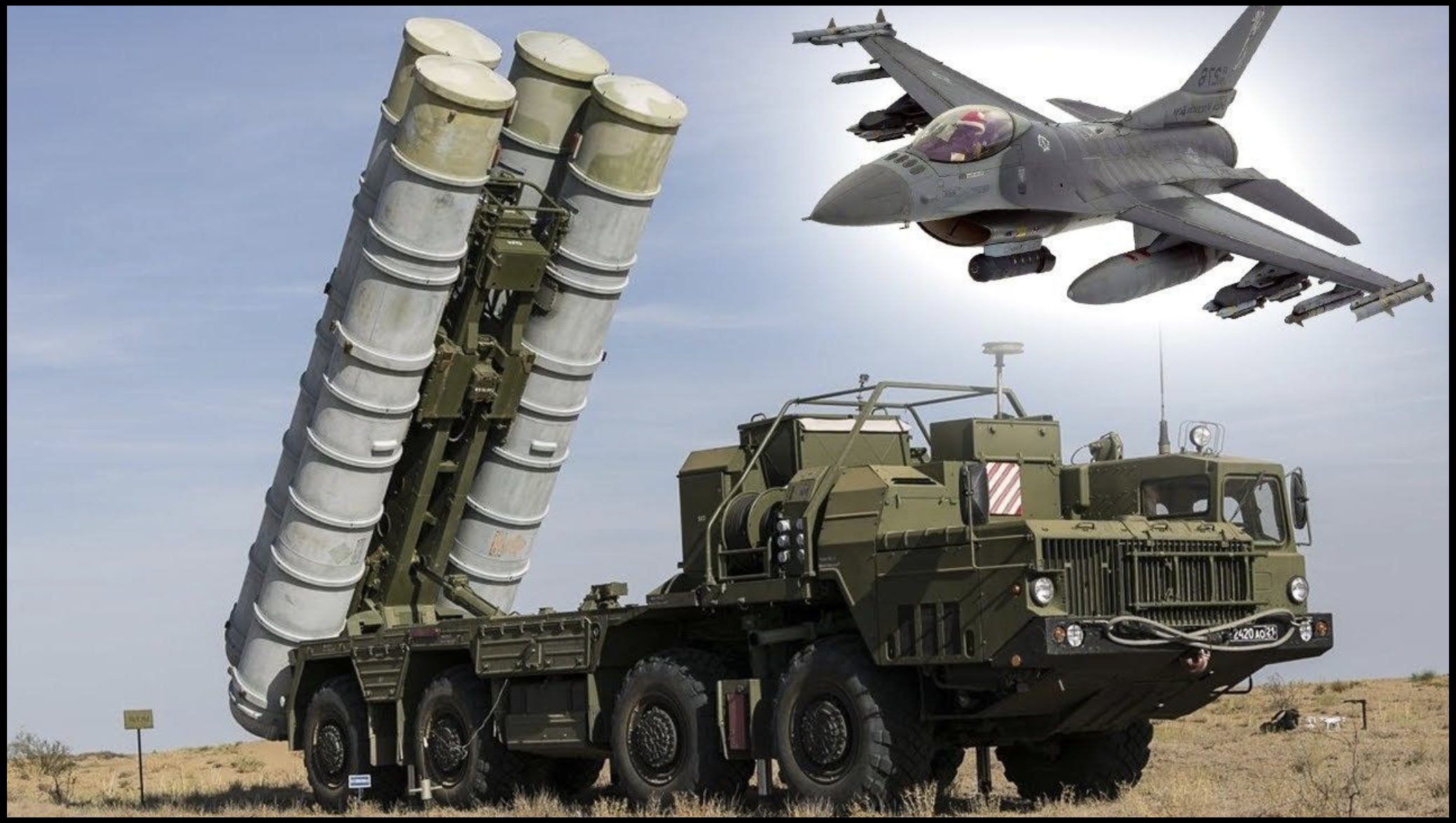
India S-400 Expansion marks one of the biggest upgrades to India’s integrated air and missile defence network in recent years. By approving five additional India S-400 Expansion Triumf squadrons under Mission Sudarshan Chakra, India is expanding its fleet to ten squadrons, strengthening its capability against aircraft, drones, cruise missiles and ballistic missiles. By approving five additional S-400 Triumf squadrons under Mission Sudarshan Chakra, India is expanding its fleet to ten squadrons, strengthening its capability against aircraft, drones, cruise missiles and ballistic missiles.
On 27 March 2026, India’s Defence Acquisition Council quietly signed off on one of the largest air defence commitments in the country’s history. Chaired by Defence Minister Rajnath Singh, the council granted Acceptance of Necessity for five additional S-400 Triumf squadrons from Russia — a decision that will double India’s fleet to ten and make it the largest operator of the system outside Russia itself.
The India S-400 Expansion sits inside a much bigger ₹2.38 lakh crore procurement package. That package also covers 60 medium transport aircraft to replace the geriatric AN-32 fleet, four squadrons of remotely piloted strike aircraft, roughly 300 Dhanush artillery guns, Su-30MKI engine overhauls, and advanced tracked air defence systems built to plug into the Army’s AkashTeer network. But the S-400 tranche — pegged anywhere between ₹50,000 crore and ₹1 lakh crore depending on how negotiations with Moscow land — is the centrepiece.
There is a reason this approval came now rather than in 2027 or 2030. In May 2025, during Operation Sindoor, the S-400 reportedly achieved a kill against a Pakistani surveillance aircraft at a range exceeding 300 kilometres — among the longest surface-to-air engagements ever recorded in combat. Pakistani jets spent the rest of that short conflict operating well inside their own airspace. Militaries notice things like that. So do procurement councils.
Deliveries of the new squadrons are projected to begin in 2028, with the full ten-squadron fleet deployed by around 2035 — the same year Mission Sudarshan Chakra, India’s national air defence shield project, is supposed to reach maturity. The overlap is not a coincidence.
How India Got Here: Background of the S-400 Programme
The India S-400 Expansion story doesn’t start in 2018. It starts, in a sense, at Kargil in 1999, when India discovered how thin its air defence umbrella really was at high altitude and how badly its ground-based radars, fighters and missile batteries talked to each other. The conflict pushed the IAF toward what eventually became the Integrated Air Command and Control System (IACCS) — a network that fuses radar pictures from military and civilian sources into a single recognised air picture.
But a network is only as good as the weapons hanging off it. Through the 2000s and 2010s, India’s longest-reaching surface-to-air missile was of comparatively modest range, while the threat picture kept getting worse on two fronts at once. China began deploying its own S-400 regiments and HQ-9 batteries on the Tibetan plateau, putting Indian airbases in the northern sector under a long-range missile shadow. Pakistan, meanwhile, invested heavily in stand-off weapons — cruise missiles like the Babur and Ra’ad that could be launched from well inside Pakistani airspace. India needed something that could reach out and touch launch platforms before they released their weapons, not just swat the weapons afterwards.
That logic led to the October 2018 contract: five S-400 squadrons for roughly ₹39,000 crore (about $5.43 billion), signed during President Vladimir Putin’s visit to New Delhi. Washington was openly unhappy. The deal fell squarely within the scope of CAATSA — the Countering America’s Adversaries Through Sanctions Act — which had already been used to sanction Turkey for the same purchase. India proceeded anyway, betting that its strategic weight, its usefulness as a counterbalance to China, and some patient diplomacy would keep sanctions at bay. The bet paid off. The US never imposed CAATSA measures on India, and the US House of Representatives even passed a waiver amendment in India’s favour in 2022.
Deliveries began in December 2021. Three squadrons were operational within a few years, positioned to cover both the western and northern borders. The fourth squadron — delayed repeatedly by Russia’s war in Ukraine and the resulting production crunch — arrived in 2026, and the fifth is expected by the end of the year. Sources within the establishment have argued that the new order should face no fresh CAATSA complications either, since it is structured as a follow-on to the original 2018 contract rather than a new programme.
Why Five More Squadrons, and Why Now
Five squadrons were always going to be a stretched resource for a country with a 15,000-kilometre land border, two hostile nuclear neighbours, and a coastline studded with high-value energy and naval infrastructure. The operational case for doubling the fleet rests on several converging pressures.
The two-front problem. India’s planners no longer treat a Pakistan contingency and a China contingency as separate problems. A crisis on one border invites opportunism on the other. Five squadrons force painful choices — cover Punjab or cover Arunachal, but not both in depth. Ten squadrons ease that arithmetic considerably.
PLAAF modernisation. China’s air force is fielding J-20 stealth fighters, H-6 bombers with long-range cruise missiles, and a growing tanker and AWACS fleet operating from upgraded Tibetan airfields. The 400-km reach of the S-400’s longest missile is one of the few tools India has to hold those enablers at risk from the ground.
The stand-off weapon and drone problem. Operation Sindoor was, among other things, a saturation test. Pakistan threw drones and loitering munitions at Indian airspace in waves, alongside cruise missile threats. Layered defences held, but the experience underlined how quickly interceptor inventories can drain during a sustained drone campaign. More squadrons mean more launchers, more radars and more magazine depth.
Ballistic missiles and what comes after. Pakistan’s ballistic missile arsenal is growing, and hypersonic glide vehicles are moving from Chinese test ranges toward deployment. The S-400 is not a silver bullet against hypersonics — nothing currently fielded is — but its 48N6 series gives India a credible terminal-phase option against conventional ballistic threats while indigenous BMD layers mature.
Protecting the crown jewels. Nuclear command-and-control nodes, strategic airbases, naval headquarters, and critical economic infrastructure all demand persistent, not rotational, coverage. Persistent coverage across a country India’s size is a numbers game. Five was never the final number; it was the down payment.
S-400 Technical Specifications
| Parameter | Details |
| Origin | Russia |
| NATO Reporting Name | SA-21 Growler |
| Manufacturer | Almaz-Antey |
| Surveillance Radar Range | ~600 km (Big Bird 91N6E) |
| Maximum Engagement Range | 400 km (with 40N6E missile) |
| Maximum Engagement Altitude | ~30 km |
| Simultaneous Targets Engaged | Up to 80 |
| Missiles Guided Simultaneously | Up to 160 |
| Missile Types | 40N6E, 48N6DM, 9M96E2, 9M96E |
| Reaction Time | Under 10 seconds |
| Deployment Time | ~5 minutes from march to firing |
| Mobility | Fully road-mobile, shoot-and-scoot capable |
Two of those numbers deserve a pause. A reaction time under ten seconds means the system can go from track to launch faster than most pilots can register a radar warning and react. And the ability to guide 160 missiles at 80 targets simultaneously is what separates the S-400 from point-defence systems — it is built for saturation raids, not one-on-one duels.
The Missile Family, Explained Properly
The India S-400 Expansion real trick is not any single missile. It is that one launcher ecosystem fires four different interceptors, each tuned to a different slice of the threat spectrum, and the command post decides which to spend on what.
40N6E — the 400 km sniper. This is the missile that changes air campaigns. Its targets are not fighters; they are the big, slow, irreplaceable enablers — AWACS aircraft, aerial refuelling tankers, stand-off jammers, strategic bombers. Kill the AWACS and an enemy strike package flies half-blind. The Operation Sindoor engagement at 300-plus kilometres is widely believed to have involved this missile.
48N6DM — the workhorse. Effective out to roughly 250 km, this is the missile for fighter aircraft and, in its anti-ballistic mode, for terminal interception of ballistic missiles. Most of an S-400 squadron’s day-to-day deterrence value rides on this round.
9M96E2 — the agile one. A smaller, hit-to-kill capable missile with extreme manoeuvrability, designed for the hardest targets: low-observable aircraft, sea-skimming and terrain-hugging cruise missiles, and fast, jinking threats at medium range.
9M96E — the economical one. Shorter-ranged, and the sensible choice against drones, UAVs and precision-guided munitions, where firing a 40N6E would be like using a sniper rifle on a housefly — effective, but ruinously expensive. Four 9M96-series missiles can be quad-packed into a single launch tube, multiplying magazine depth against swarm attacks.
This mix-and-match economy matters more than raw range. Air defence in the drone era is as much a cost-exchange problem as a physics problem.
How an India S-400 Expansion Battery Actually Works
Strip away the jargon and an India S-400 Expansion engagement is a fast, brutal decision chain:
Detection → The 91N6E “Big Bird” acquisition radar sweeps out to 600 km, picking up everything from airliners to cruise missiles.
Target Identification → IFF (identification friend-or-foe) interrogation and track correlation with the wider IACCS picture sort friendlies and civil traffic from hostiles.
Threat Evaluation → The 55K6E command post ranks threats: an inbound ballistic missile outranks a loitering drone; an AWACS at 350 km may outrank both.
Missile Allocation → The command post assigns the cheapest missile that can reliably make the kill, and hands the target to a specific battery.
Launch → Missiles cold-launch vertically — ejected by gas pressure before the motor ignites — so a single launcher can engage threats from any direction without turning.
Mid-course Guidance → The 92N6E “Grave Stone” engagement radar uplinks corrections as the missile flies out.
Terminal Homing → The seeker (active or semi-active depending on missile type) takes over for the endgame.
Kill Assessment → Radar confirms the intercept; if the target survives, a second missile is already tracking. Standard practice is to allocate two missiles per high-value target.
The entire chain, from first detection to missile away, can compress into seconds. That compression — not the 400-km headline range — is what pilots on the other side actually fear.
Inside One Squadron: Organisation and Assets
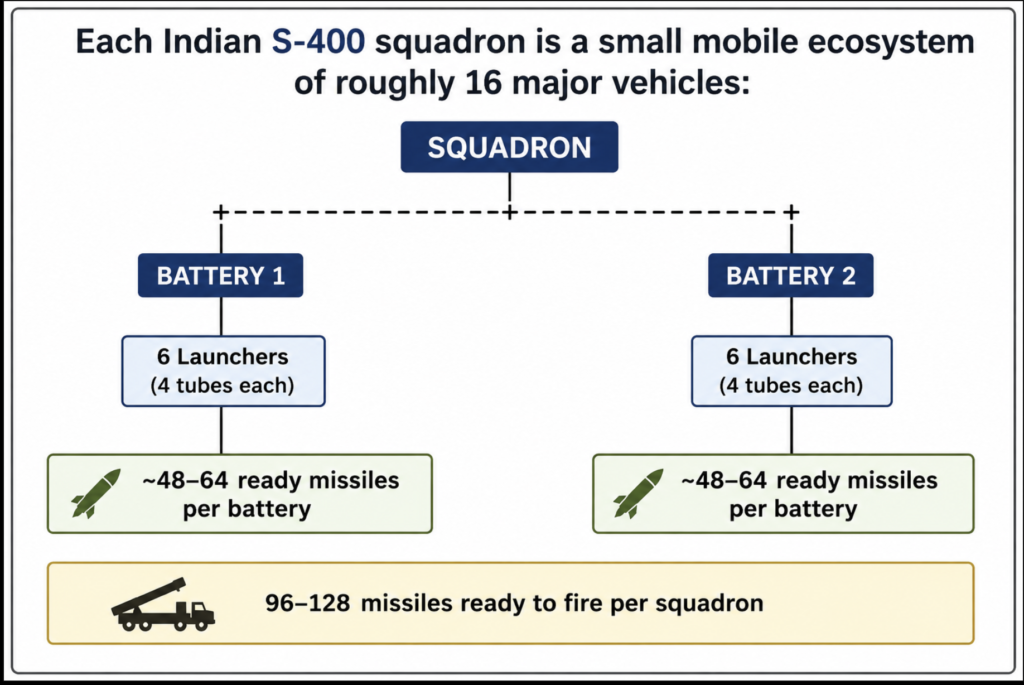
Around the launchers sit the supporting cast, each element as essential as the missiles themselves:
- Acquisition radar (91N6E Big Bird) — the long-range eyes, mounted on an 8×8 chassis.
- Engagement radar (92N6E Grave Stone) — the fire-control brain for each battery.
- Command post (55K6E) — where threat evaluation and missile allocation happen.
- Reload/transloader vehicles — because a squadron that has fired its 128 missiles is just expensive scrap until it reloads.
- Power generators and support vehicles — the unglamorous logistics tail that keeps radars spinning through week-long alerts.
What Ten Squadrons Can See and Strike
Ranges on a map tell the strategic story better than any press release:
- From Punjab (Pathankot–Adampur belt): the 400-km envelope reaches past Lahore and Islamabad deep into northern Pakistan. Pakistani aircraft taking off from bases like Sargodha are, in principle, trackable from the moment their wheels leave the runway.
- From Rajasthan: coverage extends across Sindh, threatening Pakistani air operations over its own southern heartland and approaches to Karachi.
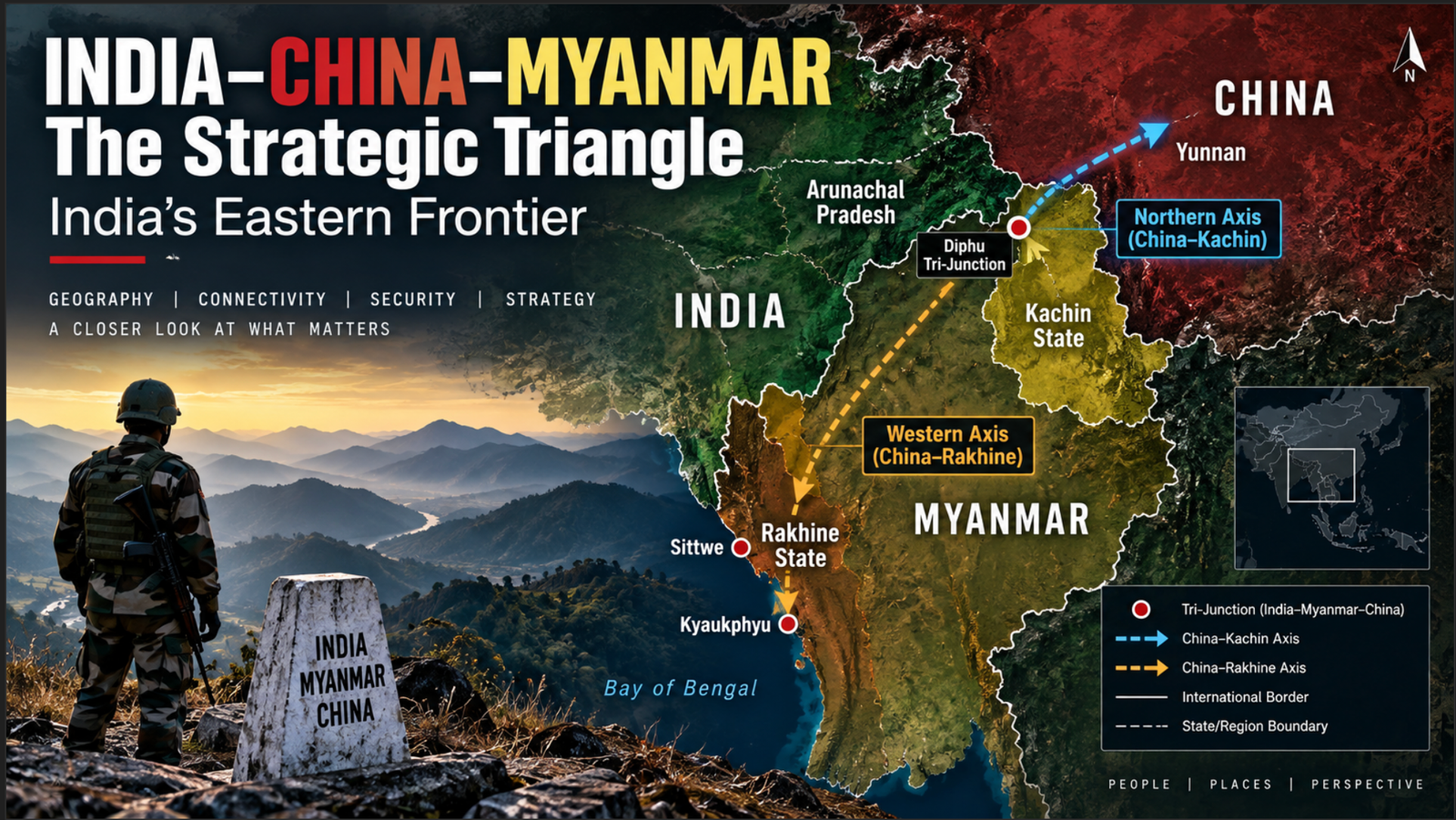
- From the Siliguri Corridor: the umbrella stretches over the Chumbi Valley and into Tibetan airspace, complicating Chinese air activity near the trijunction.
- From Arunachal/the eastern sector (future squadrons): engagement envelopes would extend over significant stretches of Tibet’s military airfields.
- From Gujarat: the system watches over the Arabian Sea approaches, covering naval assets, the Jamnagar refinery complex and western energy infrastructure.
None of this means every aircraft inside those circles dies on cue — terrain masking, radar horizon and electronic warfare all shave the real envelope. But the circles change behaviour. That is the point.
Current Deployments and the Logic Behind Them
Pathankot sector. The first operational squadron went here, and the choice was almost self-explanatory. It shields Jammu, the Punjab plains, and the Western Air Command’s densest cluster of airbases — the same geography Pakistani drones and missiles targeted during Operation Sindoor.
Siliguri Corridor. The “Chicken’s Neck” — the 22-km-wide strip connecting the Northeast to the rest of India — is the single most sensitive piece of real estate in Indian defence planning. A squadron here covers the corridor itself and pushes an engagement bubble toward the Chumbi Valley, where Chinese, Indian and Bhutanese interests collide.
Rajasthan. The western desert squadron counters southern Pakistan, covering the axis toward Sindh and protecting forward airbases that would carry much of the weight in any western contingency.
Gujarat / western seaboard. Coverage here is less about enemy fighters and more about protecting naval assets, ports and the energy jugular — refineries and terminals whose loss would hurt the economy far more than any single military target.
The fourth squadron, delivered in 2026, reinforces the western sector. Squadrons six through ten will fill the gaps this map still shows: the central sector, the eastern seaboard, deeper coverage of the northern front, and — critically — reserves, because a system with no reserve is a system one lucky strike away from a hole in the shield.
Plugging Into IACCS: India’s Layered Air Defence Network
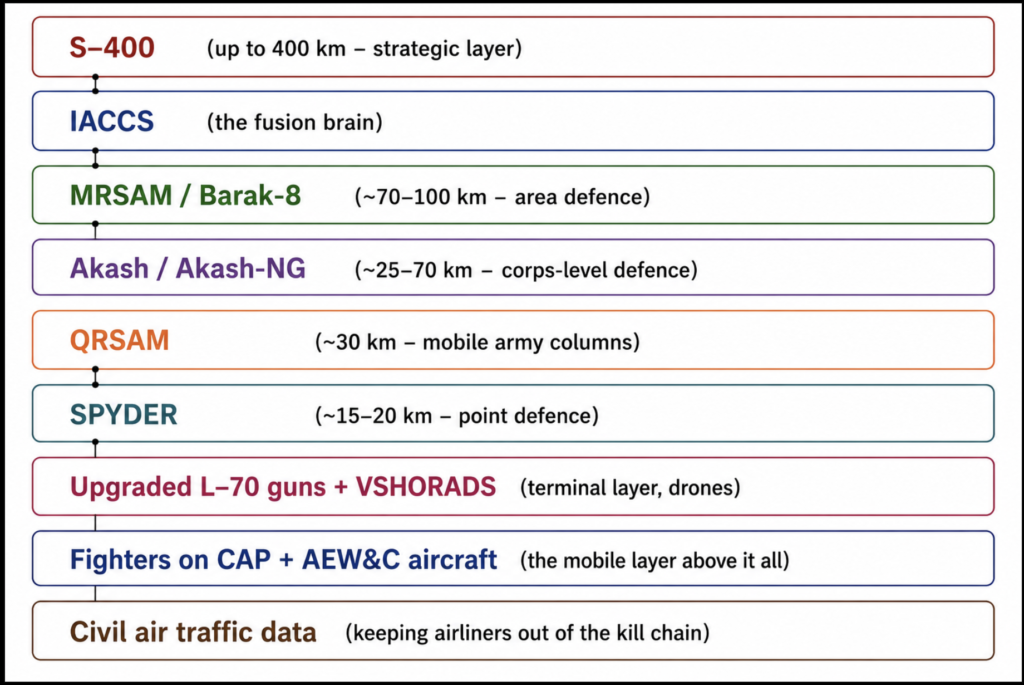
The S-400 does not fight alone, and treating it as a standalone wonder-weapon misses how Indian air defence actually works. The architecture is a stack, and every layer hands targets to the one below it:
IACCS is the quiet hero of this story. It fuses feeds from military radars, civilian ATC radars, AEW&C aircraft and now AkashTeer (the Army’s automated air defence control network) into one picture, then allocates targets so that a ₹100-crore-class 40N6E is never wasted on a drone that an L-70 gun can shred for the price of a few shells. During saturation attacks, that allocation discipline is the difference between a shield that holds and a shield that runs dry.
Mission Sudarshan Chakra: The 2035 Shield
Announced by Prime Minister Narendra Modi from the Red Fort on 15 August 2025, Mission Sudarshan Chakra is India’s answer to the question every military planner asked after watching Israel’s Iron Dome and the missile wars over Ukraine: what does a national shield look like for a country of India’s size?
The name is deliberate. The Sudarshan Chakra of mythology is both a protective and a retaliatory weapon — and the mission’s architecture mirrors that duality. It is not merely a missile-interception project.
Objectives: protect strategic, military and civilian installations — nuclear command nodes, airbases, cities, refineries, ports, even major religious and cultural sites — against the full spectrum of air threats, while building in the capacity to strike back at the sources of attack.
Architecture: a federated system-of-systems. Imported top cover (the S-400 fleet, and whatever succeeds it), indigenous mid and lower tiers (Project Kusha, Akash-NG, QRSAM, VSHORADS, anti-drone systems), the two-layer Ballistic Missile Defence programme, space-based early warning, and an AI-assisted command layer evolved from IACCS and AkashTeer to run it all at machine speed.
Timeline: operational maturity targeted by 2035 — the same year the last of the new S-400 squadrons is expected to be in place. The sequencing is explicit: the S-400 is the backbone around which the indigenous shield grows, not a stopgap to be discarded.
Strategic vision: reduce foreign dependence over time. Plans for a localised S-400 maintenance, repair and overhaul hub in India, along with growing indigenous interceptor production, are meant to ensure the shield can be sustained through a long war even if external supply lines are squeezed.
Lessons from Operation Sindoor
The four-day clash of May 2025 was the first real combat audit of India’s modern air defence network, and the S-400 — which the IAF itself calls “Sudarshan Chakra” — passed with distinction.
Air defence performance. The system’s radars tracked and its missiles engaged targets at ranges Pakistani planners appear not to have fully priced in. The reported 300-plus-kilometre kill against a surveillance aircraft was the headline, but the quieter effect mattered more: Pakistani fighters began holding station far inside their own airspace, effectively ceding the forward air battle.
Drone attacks. Pakistan’s use of drone swarms and loitering munitions validated India’s layered approach. Expensive interceptors handled the high-end threats; guns, VSHORADS and electronic warfare handled the cheap ones. The cost-exchange lesson has directly shaped the new procurement — note the tracked air defence systems and AkashTeer integration in the same ₹2.38 lakh crore package.
Cruise missile interception. Low-flying, terrain-hugging threats stressed the radar network and reinforced the case for more AEW&C aircraft and aerostat radars to see over the horizon.
Electronic warfare. Both sides jammed, spoofed and deceived. India’s systems held up, but the episode confirmed that EW resilience — frequency agility, decoys, emission discipline — will decide future duels as much as missile kinematics.
Network-centric operations. The single biggest institutional lesson: IACCS-AkashTeer fusion worked, and everything in Mission Sudarshan Chakra doubles down on it. Platforms win engagements; networks win campaigns.
S-400 vs Patriot, THAAD, HQ-9 and the Rest
| System | Country | Max Engagement Range | Primary Role |
| S-400 Triumf | Russia | 400 km | Multi-role area/strategic air defence |
| Patriot PAC-3 MSE | USA | ~120-160 km | Air & missile defence, hit-to-kill |
| THAAD | USA | ~200 km | High-altitude ballistic missile defence |
| HQ-9B | China | ~250-300 km | Area air defence |
| David’s Sling | Israel | ~300 km | Missiles, rockets, aircraft |
| SAMP/T | France/Italy | ~120-150 km | Area air & missile defence |
Each of these systems beats the India S-400 Expansion at something. PAC-3’s hit-to-kill record against ballistic missiles is battle-proven in ways the S-400’s is not. THAAD intercepts at altitudes the S-400 cannot touch. But no fielded Western system matches the S-400’s combination of engagement range, target capacity, missile variety and road mobility in a single package — and none of the Western options was realistically on the table for India at comparable cost and timelines, with full operational autonomy and no end-use restrictions. That last part rarely makes the spec sheets, but it drives decisions in Delhi.
Strategic Importance for India
Anti-Access/Area Denial, Indian style. Ten S-400 squadrons let India run the A2/AD playbook that China perfected — making large volumes of airspace prohibitively dangerous for enemy aircraft. Over Punjab and Kashmir, this compresses the usable depth of Pakistani airspace to a sliver.
Air superiority by subtraction. The IAF’s fighter squadron strength remains below sanctioned levels. Ground-based systems that neutralise enemy air power free up fighters for offensive tasks — the S-400 is, in effect, several fighter squadrons’ worth of defensive counter-air that never needs to land.
Deterrence and nuclear stability. Credible protection of nuclear command infrastructure and second-strike assets underwrites India’s no-first-use posture. An adversary who cannot be confident of a disarming first strike is an adversary with fewer reasons to try.
Two-front preparedness and the Indo-Pacific balance. Doubling the fleet is what allows simultaneous, rather than sequential, coverage of both fronts. And in the wider Indo-Pacific contest, a subcontinent under a dense IAMD umbrella changes Chinese planning assumptions about horizontal escalation.
Force multiplication. Every asset the S-400 protects — an airbase, a carrier in port, a command centre — becomes more survivable, which makes every offensive plan built on those assets more credible.
What This Does to Pakistan
For the Pakistan Air Force, the S-400 expansion is close to a structural crisis. Its doctrine leans heavily on a small number of force multipliers — Saab Erieye AWACS and IL-78 tankers — and on stand-off weapon launches from within its own airspace. The 40N6E puts every one of those enablers at risk the moment they climb to operating altitude, even hundreds of kilometres from the border. Operation Sindoor offered a preview, and losing an AWACS in a country that operates only a handful is not an attritable loss.
The stand-off playbook suffers too. Launch points must move deeper, which shortens weapon reach and shrinks target sets. The rational responses — more electronic warfare, more low-level penetration, more cheap drones to drain Indian magazines, and more Chinese help across all of it — are already visible. Each response is expensive for an economy with little slack, and each deepens Rawalpindi’s dependence on Beijing. Whether that dependence is a solution or another problem is a question Pakistani planners will be living with for a decade.
What This Does to China
China’s calculus is different — the PLA has watched the India S-400 Expansion up close as an operator since 2018, and it fields dense air defences of its own across the Western Theatre Command. What the Indian expansion changes is the air picture over Tibet and Eastern Ladakh.
Tibetan airbases operate at altitudes that already tax aircraft performance; add Indian engagement envelopes reaching over the plateau from Siliguri and the eastern sector, and PLAAF sortie planning near the LAC becomes a far more constrained exercise. H-6 bomber operations, tanker tracks and AWACS orbits supporting any southern contingency would have to be pushed back, thinning the air support available at the line of actual contact. Beijing will respond — with stealth, stand-off range, electronic attack and sheer numbers — and it has the resources to respond seriously. The India-China air balance is not settled by this purchase. It is, however, no longer drifting in one direction.
The Global S-400 Club
Russia remains the largest operator and the only one with sustained high-intensity combat data — including confirmed interceptions of ATACMS ballistic missiles in the Ukraine war, alongside sobering losses of S-400 batteries to the same missiles and to drones when positioning or layering failed. Both halves of that record are instructive.
China was the first export customer, deploying regiments along coastal sectors facing Taiwan and reverse-engineering lessons into its own HQ-9B programme.
Turkey bought the system in defiance of NATO, was expelled from the F-35 programme and sanctioned under CAATSA for its trouble — the cautionary tale India managed to avoid becoming.
Belarus operates the system in close integration with Russian forces.
India, with ten squadrons on order, becomes the largest operator outside Russia and — after Operation Sindoor — arguably the operator with the most consequential combat employment of the system outside Ukraine.
Saudi Arabia and Qatar have flirted with the system in past years, and Iran has long been discussed as a potential recipient, though Israeli strikes in 2024-25 exposed the limits of Iran’s Russian-supplied air defences. Interest, in this market, rises and falls with every war’s evening news.
The Hard Part: Risks and Challenges
An honest analysis has to sit with the uncomfortable parts, because there are several.
CAATSA has not disappeared. India escaped sanctions on the first deal through diplomacy and geopolitical timing. A fresh ₹1 lakh crore transfer to Russia’s largest defence firm, in whatever year the contract is signed, will test that indulgence again — even if Delhi frames it as a follow-on order.
Russian delivery risk is real, not theoretical. The original five squadrons ran years late because Ukraine consumed Almaz-Antey’s production and Russia’s own forces needed replacements for combat losses. A 2028 delivery start for the new batch assumes a Russian defence industry with spare capacity that it may not have.
Payment plumbing. Sanctions on Russian banks forced the original deal into rupee-rouble workarounds. Those channels function, but they add friction, cost and vulnerability to every future tranche and every spares shipment.
Sustainment dependence. Missiles age out. Radars need parts. Until the planned Indian maintenance hub and any local missile production materialise, the shield’s long-term health runs through Moscow — a single point of failure India is paying to reduce, but has not yet eliminated.
The EW and hypersonic problem. Ukraine demonstrated that S-400 batteries can be found, jammed and killed by a competent enemy using ATACMS, decoys and drones. China is a far more competent enemy than Ukraine’s adversary assumptions allow for, and hypersonic glide vehicles stress every existing interceptor’s kinematics. The S-400 buys time against these threats; it does not solve them.
Opportunity cost. ₹1 lakh crore is roughly the cost of two or three squadrons of modern fighters, or a very large slice of the indigenous defence ecosystem. The counter-argument — that nothing indigenous delivers 400-km coverage before the mid-2030s — is strong, but the trade-off deserves acknowledgment rather than denial.
Indigenous Alternatives: Kusha, Akash NG and Friends
The S-400 expansion makes sense only alongside what DRDO is building underneath it.
Project Kusha (XRSAM/LR-SAM) is the flagship — a three-interceptor family (roughly 150 km, 250 km and 350 km class missiles) explicitly designed as an Indian analogue to the S-400, with first deliveries hoped for around the end of this decade. When mature, it promises comparable area coverage at significantly lower per-round cost, with a fully sovereign supply chain. The stated plan is for Kusha batteries to slot into the same IACCS/Sudarshan Chakra architecture the S-400 anchors today.
Akash-NG modernises the medium layer with a canisterised, faster, longer-reaching evolution of the proven Akash. MRSAM (Barak-8), co-developed with Israel, holds the 70-100 km band for both the Army and Navy. QRSAM protects mobile armoured columns, and the two-layer BMD programme (PAD/AAD and its successors) addresses ballistic threats above the S-400’s envelope.
Tying it together is the move toward an integrated air defence command structure under theaterisation — so that Kusha, S-400, Akash and a fighter on CAP all appear as interchangeable arrows in one quiver rather than three services’ separate inventories. The S-400 is the bridge; the indigenous stack is the destination.
Defence Industrial Benefits
The follow-on deal is being negotiated with a heavier Indian industrial footprint than the 2018 contract carried. The planned S-400 maintenance, repair and overhaul hub in India is the headline item — it would cut turnaround times from months to weeks and build a cadre of Indian engineers fluent in the system’s guts.
Around that hub, expect work for the usual ecosystem: BEL on radar components, IACCS integration and communications; Bharat Dynamics positioning for any future licensed missile assembly; HAL on associated aviation support; and a widening ring of private firms supplying vehicles, power systems, simulators and infrastructure. Training pipelines, simulator centres and base construction spread employment well beyond the big names. None of this makes the S-400 a Make-in-India product — it is not and will not be — but the technology absorption from operating, maintaining and networking a system this complex feeds directly into Project Kusha’s design maturity. India learned radar and missile integration lessons from the Su-30 and BrahMos ecosystems the same way.
The Road to 2035
The decade ahead sketches roughly like this: contract signature with Moscow expected by late 2026 or 2027, first new-batch deliveries from 2028, Project Kusha entering service in overlapping years, and the full ten-squadron S-400 fleet plus indigenous layers converging on Mission Sudarshan Chakra’s 2035 milestone.
Beyond the hardware, the interesting developments are architectural: AI-enabled threat evaluation inside IACCS to handle drone swarms at machine speed; counter-hypersonic work spanning new interceptors and, eventually, directed energy weapons for cheap terminal drone defence; space-based surveillance constellations to extend early warning beyond the radar horizon; and integrated theatre commands to erase the seams between Army, Navy and Air Force air defence. Each of these is a programme with its own risks and delays. Together they describe an India that has decided air and missile defence is a first-order national priority rather than a support function — a quiet doctrinal shift that may matter more than any single squadron.
The Bigger Picture
The S-400 expansion is best read not as a shopping decision but as a doctrinal statement. India has looked at Ukraine’s missile war, at Israel’s layered shields, at Operation Sindoor’s drone swarms, and concluded that the ability to deny one’s airspace is now as central to national power as the ability to project force into someone else’s. Ten squadrons of Russian hardware, wrapped in an Indian network and eventually flanked by Indian interceptors, is how Delhi has chosen to buy that ability on the timeline the threat demands rather than the timeline indigenous industry can offer.
The unresolved questions are the interesting ones. Whether Almaz-Antey can actually deliver from 2028 while feeding its own war. Whether Washington’s patience with rupee-denominated billion-dollar transfers to Russia survives the next turn in great-power politics. Whether Project Kusha arrives close enough to schedule that squadrons eleven and twelve, if they are ever needed, wear an Indian nameplate. The shield is being built either way — but whose factories sustain it in 2040 is still an open contest.
FAQs
How many S-400 squadrons will India have in total? Ten. Five were ordered in October 2018 (three operational, the fourth delivered in 2026, the fifth due by year-end), and the Defence Acquisition Council approved five more on 27 March 2026, with deliveries projected from 2028 and full deployment by around 2035.
How much does India’s S-400 expansion cost? The new batch is estimated at ₹50,000 crore to ₹1 lakh crore, pending final negotiations with Russia. It sits within a broader ₹2.38 lakh crore DAC-approved package. The original 2018 deal was worth about ₹39,000 crore.
What is the range of the S-400? Engagement range is up to 400 km with the 40N6E missile, at altitudes up to about 30 km. Its surveillance radar sees out to roughly 600 km. Shorter-range missiles in the family handle fighters, cruise missiles, drones and precision-guided munitions.
Did the S-400 perform in real combat for India? Yes. During Operation Sindoor in May 2025, the system intercepted Pakistani drones and missiles and reportedly downed a surveillance aircraft at over 300 km — among the longest surface-to-air kills ever recorded — pushing Pakistani aircraft deep into their own airspace.
What is Mission Sudarshan Chakra? A national air and missile defence shield programme announced on 15 August 2025, targeting maturity by 2035. It combines the S-400 fleet with indigenous systems (Project Kusha, Akash-NG, QRSAM, BMD) under an AI-assisted, IACCS-based command network protecting military and civilian infrastructure.
Will the US impose CAATSA sanctions on India for this purchase? India avoided sanctions on the 2018 deal, and officials expect the new order to be treated as a follow-on rather than a fresh contract. That said, CAATSA remains on the books, and the risk is managed rather than eliminated.
How is the S-400 different from Project Kusha? Project Kusha is DRDO’s indigenous long-range SAM programme with interceptors in the 150-350 km class, designed to complement and eventually reduce dependence on the S-400 at lower cost, within the same IACCS network.
Suggested External Authority Links
- Ministry of Defence / PIB press releases on DAC approvals — pib.gov.in
- ThePrint report on the ₹2.38 lakh crore DAC clearance — theprint.in
- CSIS Missile Defense Project: S-400 Triumf profile — missilethreat.csis.org
- SIPRI Arms Transfers Database (India-Russia trade) — sipri.org
- IDSA / MP-IDSA commentary on Indian air defence modernisation — idsa.in
- Congressional Research Service brief on CAATSA and India — crsreports.congress.gov