
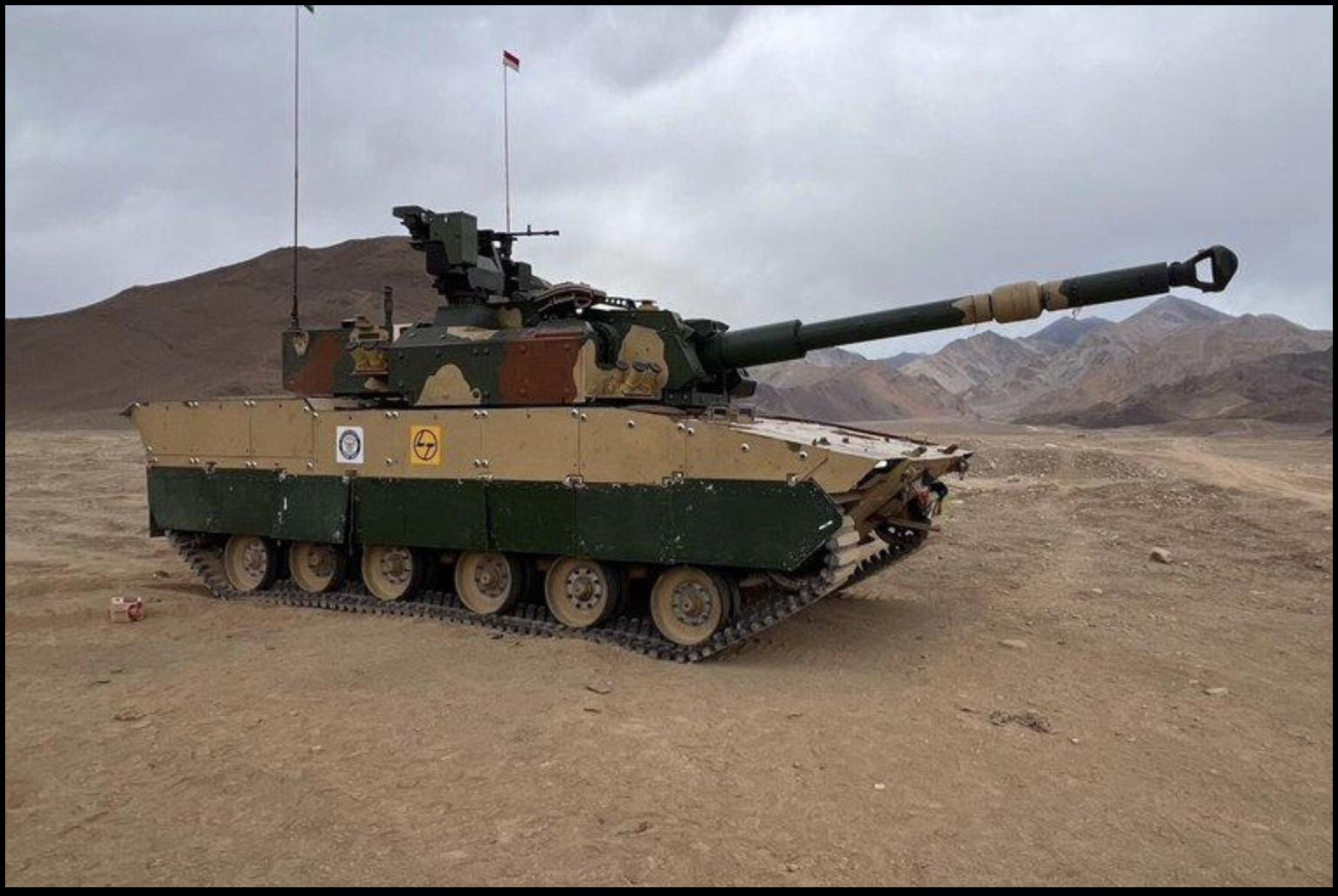
Zorawar Light Tank: 10 Powerful Roles Driving India’s Himalayan War Machine
Somewhere above 14,000 feet near Nyoma in eastern Ladakh, a 25-tonne tracked vehicle has spent the early months of 2026 doing something India’s heavier T-72 and T-90 fleets were never quite built for — moving fast across broken, oxygen-starved ground without the engine choking on itself. That vehicle is the Zorawar Light Tank, and the Indian Army’s formal user trials, which began in February, are only part of the story.
What started four years ago as a single armoured prototype is quietly turning into something larger: an entire family of tracked combat vehicles, all built on one chassis, all designed for one stretch of disputed, freezing border. The Defence Research and Development Organisation and Larsen & Toubro didn’t just design a tank.
They designed a base platform that can become a tank, a missile carrier, an air-defence gun, a command post, or a troop carrier depending on what gets bolted on top. That distinction matters more than it sounds, and it’s worth understanding why the programme exists in the first place.
Why Was the Zorawar Light Tank Needed?
Go back to June 2020. Indian and Chinese soldiers fought with rocks, rods and improvised clubs in the Galwan Valley, not because either side lacked tanks, but because neither side could get heavy armour up to that altitude fast enough for it to matter. India’s T-72 and T-90 main battle tanks, each weighing somewhere around 45 to 46 tonnes, were designed for the plains of Punjab and the deserts of Rajasthan. Above 14,000 feet, with the air thin and the ground a mix of scree and ice, that weight becomes a liability rather than an advantage.
The Chinese army didn’t have that problem to the same degree. By the time the 2020 standoff was unfolding, the People’s Liberation Army had already begun fielding its Type 15 light tank — sometimes referred to as the ZTQ-15 — specifically for the Tibetan plateau and other high-altitude frontiers. Photographs and satellite imagery placed these vehicles in forward positions opposite Ladakh within months of the clash, and Beijing’s broader build-up along the Line of Actual Control — new roads, all-weather garrisons, expanded airstrips — made it fairly obvious that this wasn’t a one-off deployment.
India’s response took shape almost immediately afterward. The Zorawar Light Tank programme was fast-tracked under DRDO’s Combat Vehicles Research and Development Establishment, with L&T brought in as the production and integration partner at its Hazira facility in Gujarat.
Track trials began in early 2024, followed by desert evaluations near Bikaner and then high-altitude testing in Ladakh’s Nyoma sector, at heights exceeding 4,200 metres. None of this happened because someone in Delhi decided India needed a new tank for its own sake — it happened because a specific gap had opened up on a specific stretch of border, and that gap is essentially what the whole programme is trying to close.
Inside the Zorawar Light Tank: What 25 Tonnes of Mountain Armour Actually Looks Like
Strip away the variants and the missile pods for a moment, and the base Zorawar Light Tank is a fairly straightforward piece of engineering logic. It weighs around 25 tonnes — roughly half of a T-90 — and runs on a Cummins diesel engine rated between 750 and 760 horsepower, with some reports suggesting a higher-output version could follow later. That gives it a power-to-weight ratio in the 30-to-40 horsepower-per-tonne range, which is the figure that actually decides whether a tank can climb a mountain pass or simply sits there burning fuel.
The suspension is hydropneumatic, which sounds technical but really just means the tank can absorb the kind of jarring, uneven terrain that would shake a conventional torsion-bar system apart over time. It’s also amphibious, with sealing designed for river and lake crossings such as Pangong Tso — a detail that matters more in eastern Ladakh than almost anywhere else on earth.
Armour-wise, the tank currently carries STANAG 4569 Level 4 protection at the front and Level 2 on the sides, while DRDO’s Defence Metallurgical Research Laboratory is reportedly working on newer composite armour rated for Level 6 and Level 5B standards. The main armament is a 105mm gun built around a Belgian John Cockerill turret — a foreign-sourced component that, depending on how you look at it, is either a pragmatic shortcut or a dependency India will need to indigenise eventually.
Two Zorawars can be airlifted in a single C-17 Globemaster, which is the kind of detail that doesn’t show up in a brochure but matters enormously to an army trying to reinforce a forward sector within days rather than weeks.
Zorawar vs China’s Type-15: How the Numbers Actually Stack Up
This is the comparison that rarely gets made properly, mostly because reliable data on Chinese military hardware is harder to pin down than Indian procurement documents. Still, based on open-source estimates from defence analysts and reporting on both platforms, the broad picture looks like this:
| Parameter | Zorawar Light Tank | Chinese Type-15 (ZTQ-15) |
| Weight | ~25 tonnes | 33–36 tonnes |
| Engine Output | 750–760 hp | ~1,000 hp (estimated) |
| Main Gun | 105 mm | 105 mm |
| Primary Altitude Role | Himalayan / LAC operations | Tibetan plateau |
| Amphibious Capability | Yes | Limited |
| Indigenous Content | Increasing (DRDO/L&T-led) | High (domestic Chinese supply chain) |
A few things stand out here. China’s Type-15 is heavier and more powerful on paper, but it has also been operationally deployed in Tibet since around 2018 and was already forward-positioned during the 2020 standoff. Zorawar, by contrast, is still working through Army user trials in 2026. This isn’t really a story about India leapfrogging China’s mountain armour — it’s a story about India closing a gap that opened up six years ago and has been sitting open since.
That distinction matters strategically. Restoring a degree of tactical parity along the LAC reduces India’s reliance on dragging T-72s and T-90s into terrain they were never designed for, which has always been less a tactical choice than a lack of alternatives. Whether Zorawar achieves genuine parity once it’s fielded in regiment strength is a separate question — one that depends heavily on how the 2026 trials go and how quickly the larger order of 295 additional units, on top of the initial 59, actually materialises.
From a Single Tank to an Entire Combat Family
Older Indian armoured fleets have always carried a hidden cost: every distinct vehicle type — tanks, recovery vehicles, air-defence guns, command vehicles — needs its own spare parts pipeline, its own trained mechanics, its own maintenance manuals. The Zorawar programme is built around avoiding exactly that. The idea is a single tracked base, sharing engines, transmission and suspension components, that gets reconfigured into different roles depending on what module sits on top of the hull.
Twin Nag Mk2 Missiles: Turning the Tank Into a Dual-Threat System
One of the more advanced configurations under evaluation bolts twin launchers for the indigenous Nag Mk2 anti-tank guided missile onto the existing 105mm turret. The missile was reportedly test-fired from the platform in late 2025, and what it gives the Zorawar is the ability to engage enemy armour from 7 to 10 kilometres away, striking from above where conventional armour is thinnest.
The tank doesn’t lose its gun in the process — it simply gains a second way to kill something it can’t necessarily see with the naked eye. This mirrors a pattern showing up in several modern armies, where cannon and missile are no longer treated as competing choices but as complementary layers against increasingly well-protected targets.
Drones on the Turret: The Lessons India Is Borrowing From Ukraine
A second configuration being explored involves mounting pods for micro-drones or loitering munitions directly onto the turret. In mountainous terrain, ridgelines and folds in the ground block line of sight constantly — a tank crew can be a few hundred metres from a target and still not see it. A built-in drone gives that crew its own reconnaissance asset, capable of flying over a ridge, spotting whatever’s hiding on the other side, and either guiding a strike or delivering one itself.
This isn’t an abstract idea borrowed from a defence journal. The war in Ukraine has made a few things brutally clear: drones are now the primary way armour gets located on the battlefield, FPV drones have become one of the most efficient tank-killing tools in existence, and loitering munitions increasingly decide engagements before either side’s main guns even get a clean shot. Any modern armoured platform that ignores this is building for the last war, not the next one.
Why Active Protection Systems Can’t Be an Afterthought
Which leads to the obvious follow-up question: if drones are this dangerous to armour, what protects the Zorawar from them? Right now, the honest answer is — not enough, yet. The base vehicle’s STANAG 4569 protection levels are respectable against small-arms fire and shrapnel, but they say nothing about survivability against a top-attack missile or a loitering munition diving onto the engine deck.
DRDO has indicated that an active protection system is planned, alongside laser warning receivers and smoke-grenade launchers already fitted to some prototypes, but a hard-kill system — one that physically intercepts an incoming projectile — and a soft-kill system that jams or spoofs the seeker, are not the same as being announced versus being integrated and proven in the field.
Given that a light tank trades armour thickness for mobility almost by definition, this isn’t a minor design footnote. It’s arguably the single biggest survivability question hanging over the entire programme.
SPAD-G: An Air-Defence Gun Built for the Death Zone
Mountain warfare has a problem that flat terrain doesn’t: narrow valleys and passes funnel everything — troops, supply convoys, armour — into predictable corridors that are extremely easy for attack helicopters, drone swarms or low-flying cruise missiles to hit. India’s existing heavy air-defence vehicles tend to struggle at altitude, where thinner air causes engines to overheat and mobility drops off sharply on soft or broken ground.
The proposed Self-Propelled Air Defence Gun variant, built on the Zorawar chassis, would swap the 105mm cannon for twin rapid-firing 30mm or 35mm autocannons paired with short-range surface-to-air missiles. Because the base platform already has a strong power-to-weight ratio and low ground pressure, this variant could realistically keep pace with a fast-moving armoured column through a mountain pass — something none of India’s current air-defence vehicles can reliably do above a certain altitude.
Eyes on the Ridge: The Command and Reconnaissance Variant
A command and reconnaissance version is also on the drawing board, and arguably it’s the one with the least glamour and the most operational value. Picture a Zorawar hull with a telescoping surveillance mast, battlefield radar, satellite communications, and controls for operating drones locally — essentially a mobile nerve centre that can keep commanders aware of what’s happening even when mountain ranges are cutting off line-of-sight radio and creating communication dead zones, which happens constantly in Ladakh and Sikkim.
This variant is also expected to carry electronic warfare equipment and anti-drone interceptors, protecting the rest of the formation from surveillance drones and aerial strikes. In a sector where commanders have historically had to rely on couriers and relay stations when radios go dead in a valley, that alone would be a meaningful shift.
A Troop Carrier Built for Rivers and Ridgelines
Finally, there’s a high-altitude troop carrier variant under consideration — the same chassis, stripped of the turret and fitted instead with a remote-controlled 30mm weapon station, carrying six to eight soldiers across terrain where wheeled vehicles routinely get stuck. Rivers, scree slopes, soft snow — conditions that would strand an armoured personnel carrier on wheels are exactly what this platform is meant to cross without much drama.
Ten More Variants Waiting in the Wings
None of the variants above exhaust what a shared chassis can theoretically support. Indian defence planners and analysts following the programme have floated a longer list of logical extensions, several of which would close real capability gaps the Army has lived with for decades:
- Armoured Recovery Vehicle (ARV) — to drag disabled tanks out of high-altitude terrain where towing equipment is currently scarce.
- Armoured Engineer Vehicle (AEV) — for obstacle clearance and combat engineering tasks under fire.
- Mine Clearance Vehicle — fitted with ploughs or rollers to breach minefields ahead of an advance.
- Self-Propelled Mortar Carrier — giving forward units organic indirect-fire support without waiting on towed artillery.
- Battlefield Ambulance — an armoured casualty evacuation platform for terrain where helicopter extraction isn’t always possible.
- Electronic Warfare Vehicle — dedicated jamming and signals-intercept capability riding with the formation rather than trailing behind it.
- Command Post Vehicle — a heavier, more permanent staff and planning node than the lighter recon variant.
- UAV Control Vehicle — a mobile ground station for operating swarms of reconnaissance or strike drones.
- CBRN Reconnaissance Vehicle — sensors for detecting chemical, biological, radiological or nuclear contamination ahead of an advance.
- Precision Strike Missile Carrier — a longer-range strike option riding on the same mobility base as everything else.
Most of these remain concepts rather than funded programmes. But the fact that they’re even being discussed says something about how DRDO and L&T are pitching this platform internally — not as a tank replacement programme, but as the foundation for an entire generation of mountain-capable armour.
How the Army Actually Plans to Fight With It
Equipment is one conversation. How it gets used in an actual engagement is a separate one, and it’s the part that tends to get skipped in coverage of new hardware.
Offensive Operations
- Breaking through enemy defensive lines in narrow mountain corridors where heavier armour can’t manoeuvre.
- Seizing and holding mountain passes ahead of follow-on infantry.
- Providing direct fire support to mechanised infantry pushing into contested high-altitude ground.
Defensive Operations
- Counter-penetration missions, blocking enemy armour that breaks through a forward position.
- Acting as a mobile reserve that can be redirected quickly to whichever sector is under the most pressure.
- Setting up anti-armour ambushes in terrain that channels an attacking force into predictable kill zones.
Rapid Reaction Roles
- Reinforcing vulnerable sectors within hours rather than days, aided by C-17 airlift.
- Maintaining mobility across dispersed, non-contiguous fronts — a description that fits much of the eastern Ladakh sector quite literally.
Zorawar Light Tank and the Integrated Battle Group Concept
This is where the programme starts to connect with the Indian Army’s broader restructuring plans. The Army has been moving, gradually and not without internal debate, toward Integrated Battle Groups — brigade-sized formations built around combined arms rather than single-arm units operating in loose coordination. An IBG typically brings together armour, infantry, artillery, air defence and engineers under one tactical commander, designed to mobilise and respond faster than the older divisional structure ever could.
Zorawar fits into that model almost by design. A light tank variant, a reconnaissance variant, an air-defence variant and a command variant — all sharing the same engine, suspension and spares — give an IBG commander a self-contained mountain warfare toolkit that doesn’t depend on requisitioning support from outside the formation.
Faster mobilisation, tighter integration between infantry and armour, and a direct line to drone and air-defence assets within the same battle group are the practical payoffs being discussed by Indian military planners, even if the IBG concept itself is still being worked out across multiple corps.
Networked, Not Just Armoured
Armoured warfare stopped being purely about the thickness of a hull a while ago. What increasingly decides outcomes is how fast a platform can pass information to the people who need it — a sensor-to-shooter chain, in military jargon, that’s only as fast as its slowest link.
Indian planners have spoken about integrating the Zorawar family with tactical communication networks, a Battlefield Management System, satellite communications, wider ISR networks, and eventually AI-assisted targeting tools.
None of this is unique to India — it’s the direction every serious armoured force is heading — but it does mean the value of the Zorawar programme can’t really be judged by the tank alone. A beautifully engineered chassis with no data link back to artillery, drones or higher command is still a slower, less effective version of what it could be.
Joint Operations: Tanks That Talk to Helicopters and Drones
The Zorawar family is also being positioned to operate alongside other branches rather than in isolation — attack helicopters providing close air support, armed UAVs handling deep reconnaissance and strike, artillery batteries firing in coordination with ground movement, and air-defence units shielding the formation from above. That kind of jointness has historically been a weak point across most militaries, India’s included, simply because different services and arms have grown up using incompatible communications and planning systems.
Whether Zorawar actually manages to operate this way in a real engagement, rather than just on a procurement slide, will likely depend more on doctrine, training and exercises than on the hardware itself.
The Unrestricted Warfare Angle
There’s a broader theoretical frame worth mentioning here, even briefly. Modern military thinking — often discussed under the banner of unrestricted or hybrid warfare — treats victory as something achieved through the integration of kinetic and non-kinetic tools, rather than firepower alone. Armour, drones, electronic warfare, precision missiles, networked communications and counter-drone systems, all riding on a common platform, are meant to add up to something closer to information dominance and faster decision-making than any single weapon system could deliver on its own.
The Zorawar ecosystem, at least on paper, is reaching toward that idea rather than simply building a better tank. Whether the Indian Army’s acquisition timelines, budgets and training pipelines can actually deliver that level of integration in the Himalayan theatre is a separate and much harder question.
Atmanirbhar Bharat and the Business of Building Tanks at Home
There’s also a domestic industrial story running underneath all of this. The Zorawar Light Tank programme is regularly cited as a flagship example of the Atmanirbhar Bharat push toward self-reliant defence manufacturing, with DRDO’s CVRDE handling design and L&T running production at its Hazira plant, alongside contributions from a number of smaller Indian firms and MSMEs feeding into the supply chain.
It’s worth being clear-eyed about how indigenous this actually is at present. The engine is sourced from the American firm Cummins, and the main gun sits inside a turret of Belgian design from John Cockerill. DRDO has said it intends to develop an indigenous version of the ammunition and, eventually, more of the powerpack, but for now the tank is best described as Indian-integrated rather than fully Indian-built.
That’s a normal stage for a programme this young, and not necessarily a criticism — most light tank and IFV programmes elsewhere in the world lean on a similar mix of domestic and imported components early on. There’s also a quieter export ambition floating around the programme, on the logic that a proven high-altitude light tank could find buyers among other mountain-bordered nations, though that’s speculative until Zorawar actually clears induction.
The Logistics Argument Nobody Talks About Enough
Buried under all the talk of missiles and drone pods is what might actually be the most consequential part of the Zorawar programme: logistics. A single platform family sharing engines, tracks, electronics and spare parts across multiple roles means the Army doesn’t need to stock five different sets of spares, train five different repair crews, or run five different supply chains for what is functionally one base vehicle wearing different hats.
That sounds like a dry procurement detail until you remember how much of military effectiveness in mountain terrain comes down to whether a broken-down vehicle can be fixed in three days or three weeks. Common components mean common repair facilities, lower lifecycle costs, and — in theory — higher operational availability, which is the metric that actually decides how many vehicles are combat-ready on any given morning rather than sitting in a workshop.
This isn’t a new idea globally. Sweden’s CV90 family, the US Army’s Bradley Fighting Vehicle line, and Germany’s Puma infantry fighting vehicle have all leaned on platform commonality to varying degrees, each spinning multiple variants off a shared base to simplify exactly the kind of sustainment headache the Indian Army has historically dealt with by simply running more depots and stocking more spare parts. Zorawar is India’s attempt to apply the same logic to the harshest terrain its army operates in.
What Could Still Go Wrong
None of this is guaranteed to work out the way the slides suggest, and a fair accounting of the programme has to include where it could stumble.
- High-altitude engine performance — thin air affects combustion efficiency, and sustained operation above 14,000 feet puts real strain on any diesel powerpack.
- Cold-weather reliability — sub-zero starts, battery performance and hydraulic fluid viscosity all behave differently in Ladakh winters than in factory testing conditions.
- Electronic warfare vulnerability — a more networked, drone-integrated platform also has a wider attack surface for jamming and spoofing.
- Drone threats — the active protection question raised earlier remains genuinely unresolved.
- Infrastructure limitations — roads, fuel supply and maintenance facilities across Ladakh and Sikkim still lag behind what a large mechanised fleet would need.
- Cost of fleet expansion — scaling from 59 tanks to a planned 354, and then potentially funding a dozen variant types on top, is a very different budget conversation.
- Dependence on imported subsystems — the Cummins engine and Cockerill turret are reminders that ‘indigenous’ is currently more aspiration than fact.
- Sustainment at extreme altitude — keeping any fleet combat-ready year-round in this terrain has defeated simpler plans before.
Where This Leaves the LAC
What happens next depends largely on how the Army’s 2026 user trials hold up across Ladakh’s cold months and the Rajasthan desert heat that follows. The chassis exists and has been tested. The Nag Mk2 missile has reportedly been fired from it once. The drone pods, the air-defence variant, the command vehicle and the troop carrier remain configurations on paper rather than vehicles rolling off L&T’s production line at Hazira. An active protection system is promised but not yet proven in the field.
Whether all of that eventually becomes seven regiments of an actual mountain-warfare family, or whether budget pressure and the kind of trial delays that have shadowed most Indian armoured procurement over the past two decades slow it down again, is still an open question sitting somewhere on the cold flats near Nyoma this winter, waiting on the next round of trial results to answer it. The Zorawar Light Tank represents far more than a new armoured vehicle. As the Zorawar Light Tank evolves into a family of combat platforms, it could become the backbone of India’s future mountain warfare capability along the LAC.
Frequently Asked Questions About the Zorawar Light Tank
Why was the Zorawar Light Tank developed?
The Zorawar Light Tank is a 25-tonne class armoured vehicle developed by DRDO’s Combat Vehicles Research and Development Establishment along with Larsen & Toubro, designed specifically for high-altitude operations along the Line of Actual Control in Ladakh and Sikkim.
When will the Zorawar Light Tank be inducted into the Indian Army?
Army user trials began in early 2026, with an initial order of 59 tanks expected once those trials conclude. A larger follow-on order of around 295 more tanks, taking the total to roughly 354, is planned for later. Current projections point to induction by around 2027–2028, though defence procurement timelines in India have historically slipped before.
How does the Zorawar Light Tank compare to China’s Type-15 tank?
China’s Type-15 is heavier, at an estimated 33 to 36 tonnes against Zorawar’s 25 tonnes, and reportedly more powerful. China has also had the Type-15 operationally deployed in Tibet since around 2018. Zorawar is designed to restore a degree of tactical parity rather than outright superiority, while offering amphibious capability the Type-15 is not widely reported to match.
What weapons does the Zorawar Light Tank carry?
The base configuration carries a 105mm gun in a Belgian-designed John Cockerill turret. A variant fitted with twin Nag Mk2 anti-tank guided missile launchers has been test-fired, and configurations involving turret-mounted drone or loitering-munition pods are also under evaluation.
Who is manufacturing the Zorawar Light Tank?
DRDO’s CVRDE leads design and development, with Larsen & Toubro responsible for production at its Hazira facility in Gujarat. A number of smaller Indian firms and MSMEs contribute components, and the programme is frequently cited as a flagship project under the Atmanirbhar Bharat self-reliance initiative.
Will the Zorawar Light Tank have drone capability?
Drone and loitering-munition integration is being explored as a turret-mounted module rather than a confirmed production feature. The reasoning draws directly on lessons from the war in Ukraine, where drones have become central to locating and destroying armoured vehicles.
External Authority Links
Sources and authority references used to ground the reporting in this piece:
- DRDO — official site
- Zorawar (tank) — Wikipedia overview
- Defence Blog — India prepares to field new Zorawar light tank
- Business Standard — DRDO, L&T begin advanced stage trials of Zorawar
- IDRW — Army user trials of Zorawar light tank to begin in 2026