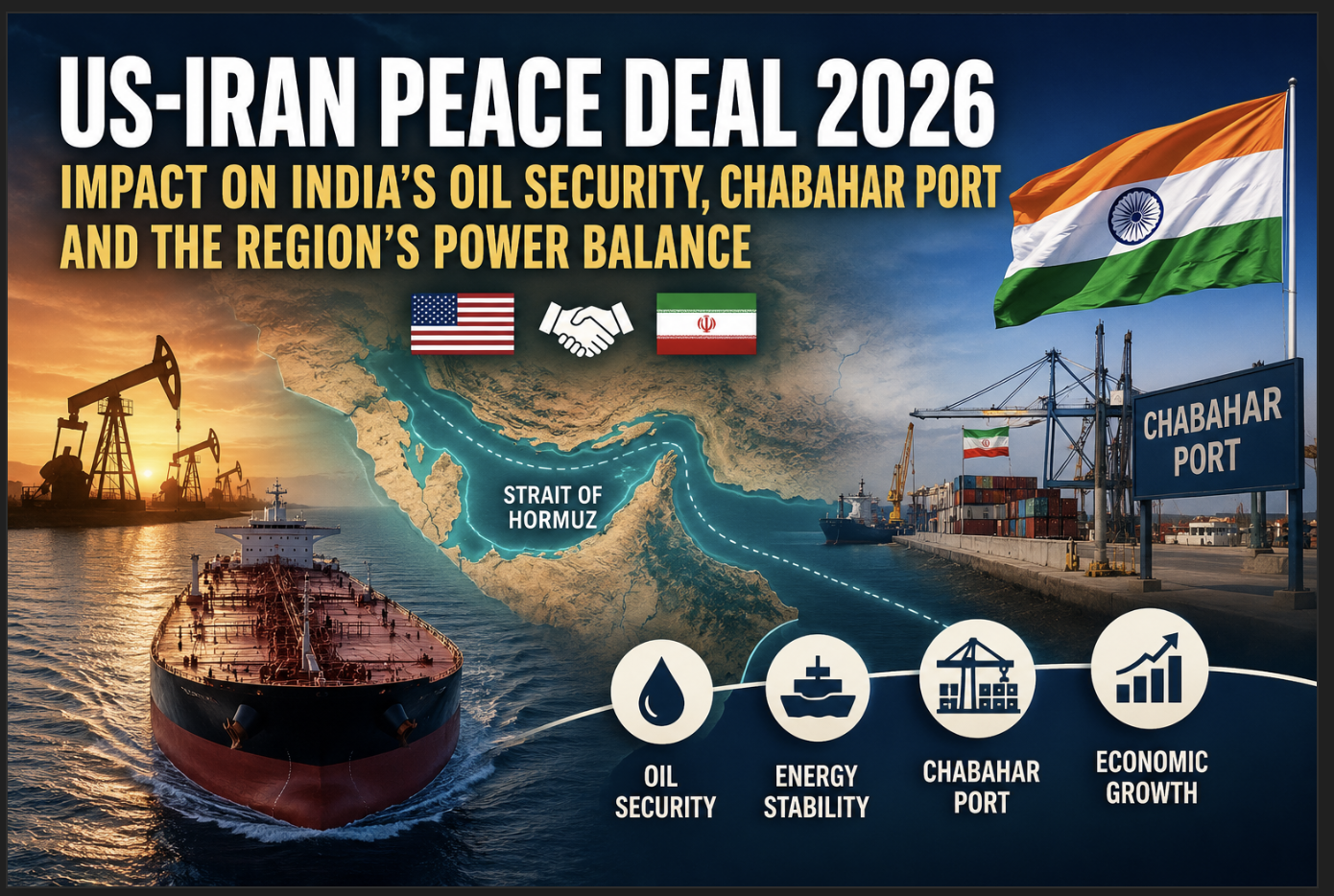
The US-Iran Peace Deal announced in June 2026 could significantly impact India’s oil security, Chabahar Port ambitions, energy imports, trade routes and geopolitical strategy. As tensions ease around the Strait of Hormuz, India may benefit from lower oil prices, improved maritime security and renewed regional connectivity. Three days before Eid, a tanker captain somewhere off Fujairah got the message every shipowner in the Gulf had been waiting four months for: the toll-free, blockade-free Strait of Hormuz was open again.
Donald Trump put it his own way on Truth Social — “Ships of the World, start your engines” — and within hours, Brent crude gave up some of the war premium it had carried since February. That single sentence, more than any diplomatic communiqué, told the market the US-Iran deal was real, or at least real enough to trade on.
For India, sitting roughly 2,000 nautical miles from that strait but utterly dependent on what flows through it, the US-Iran deal isn’t really a Middle East story. It’s a kitchen-gas-cylinder story, a fuel-pump story, and — if New Delhi plays its cards right — a Chabahar Port story that has been gathering dust since an American sanctions waiver lapsed in April. None of that is settled yet. Israel, notably, wants no part of the bargain.
What Is the US-Iran Peace Deal and What Does It Include?
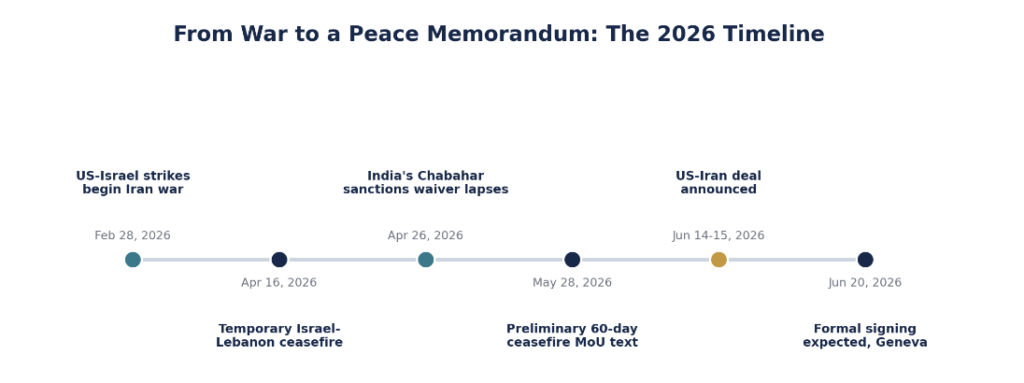
Start with what’s confirmed, because plenty isn’t. The memorandum of understanding reached in mid-June runs to roughly fourteen points, according to officials who briefed reporters in Washington and Tehran, though the full text still hadn’t been made public as both sides prepared for a formal signing ceremony in Geneva. The headline items: an immediate and supposedly permanent halt to direct US-Iran hostilities, removal of the American naval blockade on Iranian ports, and a phased reopening of the Strait of Hormuz within thirty days.
Buried further down is the harder stuff — partial unfreezing of Iranian assets, suspension of certain oil sanctions, and a commitment from Tehran that it will never build a nuclear weapon, with its existing stockpile of enriched material brought under International Atomic Energy Agency-supervised down-blending. A senior US official told reporters the administration remains “clear-eyed” about Iranian compliance and is prepared to resume strikes if Tehran doesn’t follow through, which gives you a sense of how provisional this still feels even after a deal was struck.
This is also where the story stops being tidy. The war that this memorandum is meant to end began on February 28, when American and Israeli strikes killed Iran’s supreme leader, Ali Khamenei, and a string of senior commanders, triggering retaliatory missile and drone barrages against Israel. What followed was nearly four months of fighting across multiple fronts — Iran directly, and Lebanon through Hezbollah — and it’s the Lebanon piece that now threatens to unravel everything.
What Pushed Washington and Tehran to the Table?
Exhaustion, mostly, on both sides, dressed up as strategy. Iran’s regime survived the initial assassination of its leadership and, according to analysts at the Atlantic Council, came out of the war strategically stronger in one narrow sense — countries across the region began quietly courting Tehran again rather than isolating it. The US, meanwhile, was paying a steep economic price: oil above $100 a barrel for stretches, jittery markets, and a president who, by his own admission, expected the Iranian regime to collapse quickly and watched it not happen.
Add to that the toll-collection threat. When US Treasury Secretary Scott Bessent reportedly warned Oman against charging tolls on Hormuz shipping in May, it signalled Washington wanted the strait functioning normally again, not as someone else’s revenue stream. That single episode probably tells you more about why the deal happened than any of the formal communiqués.
Why the Strait of Hormuz Became the World’s Most Expensive Chokepoint
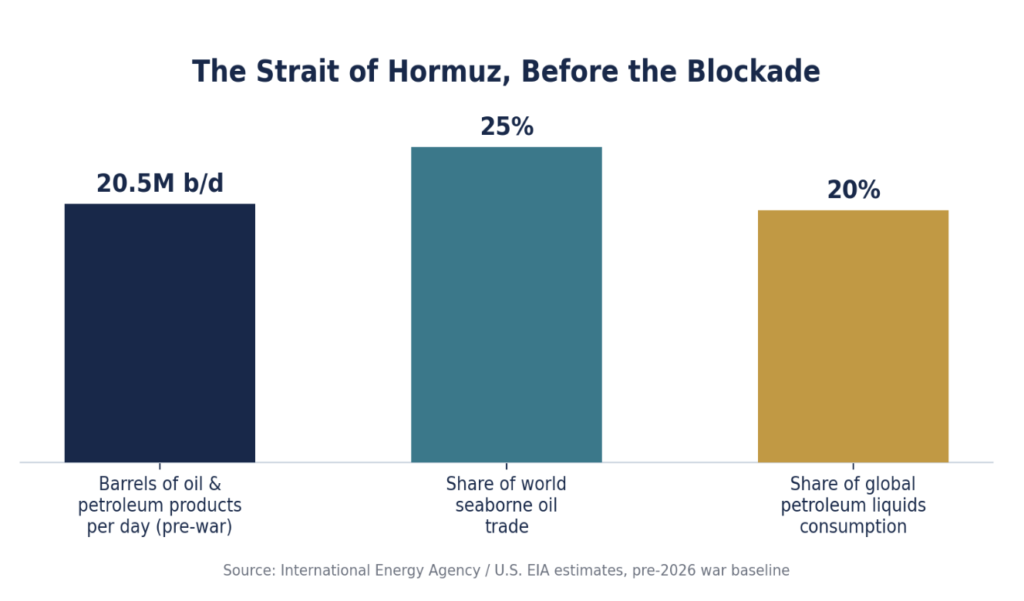
Geography did this. The strait narrows to about 21 nautical miles at its tightest point between Iran and Oman, with usable shipping lanes barely two miles wide in each direction. There is no real detour for tankers loading at Gulf terminals — not without adding thousands of nautical miles and weeks to a voyage. Iran’s near-total blockade during the war choked roughly 20 to 21 million barrels a day of oil and petroleum products that the International Energy Agency had been tracking through the strait before hostilities began, a volume equal to about a quarter of all seaborne oil trade on the planet.
That’s the number that made finance ministers nervous from Tokyo to New Delhi to Frankfurt. It’s also the number this deal is trying to put back on the table, assuming Iran actually lifts the blockade within the promised window and nobody on the Israeli front gives it a reason to reverse course.
India’s Energy Security Dimension
The biggest immediate impact of the US-Iran Peace Deal for India lies in the energy sector. India hasn’t bought a barrel of Iranian crude since 2018, when it suspended those imports under earlier American pressure. That history makes it easy to assume New Delhi sat this war out unaffected. It didn’t. Iraq, Saudi Arabia and Kuwait — India’s biggest crude suppliers — all ship through the same strait Iran was blockading, as do Qatar’s LNG cargoes and the UAE’s gas exports. Geography doesn’t care who you’re buying from if the seller’s tanker still has to pass the same eleven-mile channel.
| Import category | Approx. share via Gulf / Hormuz route | Why it matters |
| LPG (cooking gas) | ~90% | Direct hit to household kitchens and subsidy bills |
| LNG (piped & city gas) | ~60% | Feeds power plants, fertiliser units, city gas networks |
| Crude oil | ~46–50% | Refinery throughput, fuel pump prices, inflation |
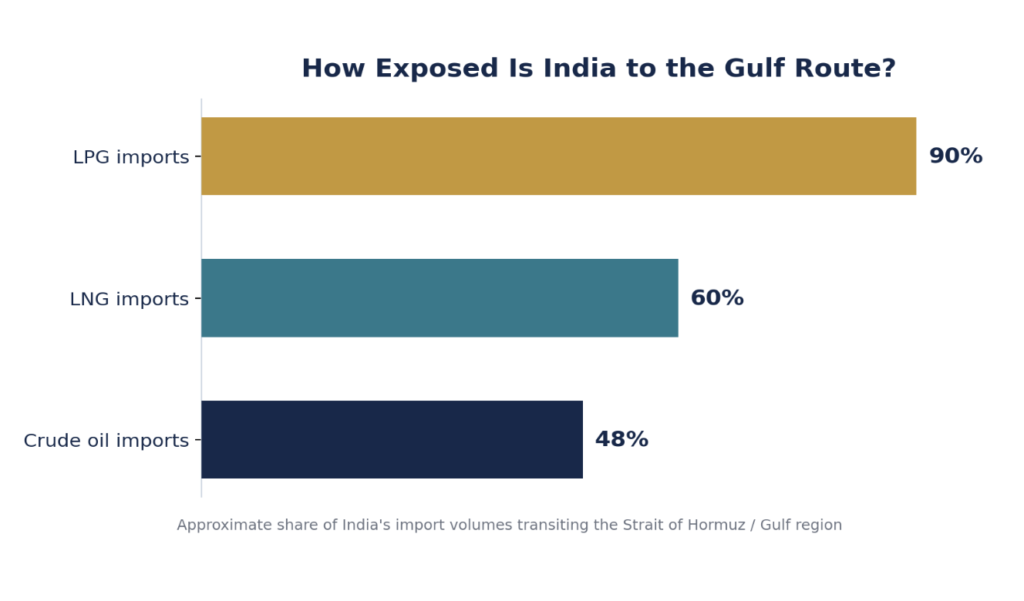
Put plainly, roughly nine in every ten LPG cylinders lit in Indian kitchens trace back to a tanker that passed through Hormuz. Reports from Indian and international outlets tracking the disruption pegged the hit at somewhere between 46 and 50 percent of India’s crude import volumes during the worst weeks of the blockade — numbers that explain why Indian oil marketing companies were quietly scouting alternative freight routes and longer-haul cargoes from West Africa and the Americas as a hedge.
A genuine, durable reopening changes that calculus back. Shipping insurance premiums on Gulf routes, which had spiked sharply once war risk entered underwriters’ models, would presumably ease. Freight rates calm down. And Indian refiners go back to buying on the basis of price and quality rather than which routes avoid a war zone — assuming, again, that the ceasefire actually holds past its first thirty days.
Could Iranian Oil Flow to India Again?
Possibly, eventually, if sanctions relief goes further than the current text suggests. India was once Iran’s third-largest oil buyer, importing close to 18 million tonnes of Iranian crude in a single ten-month stretch back in 2017-18, before Washington’s sanctions snapback forced New Delhi to zero that out. Reviving that trade would need Washington to extend a much broader waiver than anything currently on the table, and nobody in South Block is betting on that happening soon. It remains a long-shot upside, not a planning assumption.
What This Means for India’s Economy
Oil Prices, Inflation and the Household Wallet
The US-Iran Peace Deal could reduce oil price volatility and improve India’s macroeconomic outlook. Crude is a blunt instrument in India’s inflation arithmetic. A sustained reopening of Hormuz, paired with the removal of war-risk premiums, tends to soften global benchmark prices — and India passes a meaningful chunk of that through to retail diesel and petrol rates, eventually, with the usual lag that state oil marketing companies build in. Cheaper transport fuel filters into freight costs, then into the price of practically everything that travels by truck, which in India’s economy is most things.
Households feel this unevenly. Urban consumers with vehicles notice fuel prices first; everyone notices when LPG cylinder costs move, because that subsidy line item shows up on government balance sheets too. Sectors with heavy energy intensity — cement, fertiliser, aviation, paints — tend to see margin relief before consumers see price relief, which is its own quiet form of corporate earnings tailwind heading into quarterly results season.
The Fiscal and External Account Math
India runs one of the world’s largest net oil import bills, and every dollar shaved off the average import price compounds across roughly five million barrels a day of consumption. Lower oil import costs ease the current account deficit, which in turn takes pressure off the rupee — a currency that had been wobbling through the war months partly on energy-import worries and partly on broader risk-off sentiment toward emerging markets.
There’s a fiscal angle too, though it’s more indirect than dramatic. A calmer oil market gives the finance ministry more room to avoid emergency subsidy outlays on cooking gas and diesel, freeing up budget headroom that could, in theory, go toward capital expenditure instead of plugging fuel-subsidy gaps. Whether that materialises depends on how durable the price relief turns out to be — a few weeks of calm doesn’t rewrite a budget.
Growth, Investment and Market Sentiment
Indian equity markets, like most of their global peers, rallied on the news of the memorandum — stocks up, bond yields down, the standard reflex when a geopolitical risk premium gets priced out. Energy-intensive sectors and aviation stocks were among the early movers. Whether that translates into actual investment decisions — new capacity, deferred projects restarting — depends less on this week’s headlines and more on whether the ceasefire survives its first real test, which, as the Israel section below makes clear, is not a small if.
India-US Relations: A Quiet Irritant Removed, For Now
The US-Iran Peace Deal may also remove a long-standing irritant in India-US relations. Washington’s sanctions regime on Iran has been a recurring headache in the India-US relationship for the better part of a decade, going back to America’s 2018 withdrawal from the original nuclear deal. India’s energy ties with Tehran, and its decade-long investment in Chabahar Port, repeatedly put New Delhi in the position of explaining itself to Washington — a position Indian officials have never enjoyed, given how publicly India prizes its strategic autonomy.
With US-Iran tensions easing, at least on paper, some of that friction softens. India gets more room to pursue its own connectivity and energy diplomacy without each move being read in Washington as a sanctions-evasion question. That doesn’t mean the broader India-US relationship suddenly gets simpler — there are separate trade-deal negotiations and tariff disputes running on their own track — but one specific irritant, the Iran question, becomes less load-bearing.
India-Iran Relations and the Limits of Re-engagement
Iran has not been shy about its frustration with India over the years, including a 2018 episode where an Iranian diplomat publicly complained that New Delhi hadn’t followed through on Chabahar investment promises and warned India could lose “special privileges” if it sourced oil elsewhere. That history matters now because any revival of India-Iran economic engagement starts from a relationship that already has some scar tissue on it.
Sanctions relief, if it holds, opens a door — more trade, renewed energy diversification options, possibly even a fresh look at oil purchases down the line. But India also has to manage this relationship in the same room as its ties to Israel and the Gulf Arab states, all of whom watch New Delhi’s Iran moves closely. That’s always been India’s balancing act in West Asia; this deal doesn’t remove the tightrope, it just changes the wind conditions slightly.
Chabahar Port: India’s Stalled Bet Gets a Second Look
One of the most significant strategic opportunities arising from the US-Iran Peace Deal concerns Chabahar Port. The story gets genuinely interesting for Indian strategic planners. India signed a ten-year contract in May 2024 to operate the Shahid Beheshti Terminal at Chabahar, on Iran’s Sistan-Balochistan coast, committing $120 million in equipment and offering a further $250 million credit line. The pitch was always the same: a sea-and-land route into Afghanistan and Central Asia that doesn’t run through Pakistan, something India has wanted for decades.
Then came this year’s war, and Chabahar’s situation went from awkward to genuinely precarious. The American sanctions waiver that had shielded India’s investment lapsed on April 26, just over a month after fighting began, and India’s own Union Budget for the year reportedly allocated zero fresh funds to the project — a quiet but unmistakable signal of how uncertain New Delhi judged the port’s near-term future to be. Reports in late spring suggested Indian officials were even exploring a temporary transfer of India’s operating stake, essentially hedging against the possibility the whole arrangement could freeze.
Why Chabahar Matters Strategically
- It gives India a Pakistan-bypass route into landlocked Afghanistan and onward to Central Asia.
- It anchors India’s end of the International North-South Transport Corridor, linking Indian ports to Russia and Eurasia via Iran.
- It offers a counterweight, however modest, to Chinese-financed Gwadar Port roughly 100 kilometres away on the Pakistani coast.
- It preserves India’s ability to project commercial and strategic presence in the Indian Ocean region without depending on Pakistani transit goodwill.
The broader sanctions relief baked into the US-Iran memorandum doesn’t automatically fix Chabahar’s problems — India still needs its own bilateral clarity with Washington on the port specifically, the way it secured time-limited carve-outs in 2018 and again in late 2025. But a calmer overall US-Iran relationship removes one major source of uncertainty that had been freezing investment decisions, and that’s not nothing for a project that has limped along for a decade already.
The INSTC Corridor: Bigger Ambitions Riding on the Same Port
Chabahar was never meant to stand alone. It’s the Indian anchor for the International North-South Transport Corridor, a multimodal sea-rail-road network meant to connect Mumbai to Moscow in roughly a third of the time and cost of the traditional Suez route. For Indian exporters chasing Russian and Central Asian markets — particularly relevant given how Western sanctions have reshaped Russia’s trade patterns since 2022 — a working INSTC would matter more than most boardroom presentations let on.
None of that works without a functioning, sanctions-clear Chabahar at one end. So in a roundabout way, the success of a Geneva memorandum about nuclear inspections and naval blockades ends up determining whether an Indian containerised cargo bound for Astrakhan moves three weeks faster than it does today. That’s the kind of indirect linkage that rarely makes headlines but shows up in freight contracts.
Chabahar vs Gwadar: The Quiet Infrastructure Rivalry
China’s Gwadar Port, built under the Belt and Road Initiative and sitting just over the border in Pakistan’s Balochistan province, was always the unspoken reference point for Chabahar. Beijing has poured billions into Gwadar’s roads, power plants and the surrounding economic zone, and Indian strategists have watched that buildout as a marker of Chinese reach into the Arabian Sea, close to vital shipping lanes India also depends on.
Sanctions relief, if it sticks, gives Chabahar a better shot at functioning as the alternative it was designed to be — not a Gwadar-killer, nobody serious claims that, but a credible second option that keeps India’s connectivity options from depending entirely on routes Beijing or Islamabad control. Whether Indian ministries move fast enough to capitalise on the opening, after a year of treating the project as too risky to fund, is the open question nobody in Delhi seems eager to answer on record.
West Asia’s Wider Balance of Power
Saudi Arabia, the UAE, Qatar and the rest of the Gulf Cooperation Council watched this war with a mix of relief at not being directly targeted and anxiety about what a weakened-but-surviving Iran does next. Qatar’s foreign ministry was notably quick to welcome the memorandum, calling it a step toward sustainable peace and regional economic growth — language that reflects how badly Gulf economies, many running ambitious diversification plans, wanted the fighting to stop disrupting regional shipping and investment sentiment.
For India specifically, a calmer West Asia matters beyond energy. Millions of Indian workers live and remit money home from across the Gulf, and any prolonged instability there ripples through remittance flows that several Indian states depend on heavily. Kerala, Punjab and parts of Uttar Pradesh have household economies tied closely enough to Gulf labour markets that a regional flare-up isn’t an abstract foreign policy concern back home — it shows up in local bank deposits.
The Israel Factor — and Why It Could Unravel Everything
Here’s the part nobody negotiating in Geneva can fully control. Israel is not a party to this memorandum, and its officials have said so loudly and repeatedly. Itamar Ben-Gvir, Israel’s national security minister, posted bluntly that “Trump’s agreement does not bind us.” Prime Minister Benjamin Netanyahu, facing furious domestic criticism over how the deal sidelined Israeli input, told reporters that “with an agreement, without an agreement,” Iran will not get a nuclear weapon as long as he’s in office.
The immediate friction point is Lebanon. Iran insists the deal requires Israeli forces to withdraw from southern Lebanese territory occupied during the war; a senior US official has said the agreement does not actually call for that withdrawal. Israel’s defence minister, Israel Katz, has said troops are staying in what officials call security zones “as long as necessary.” Hezbollah, for its part, briefly paused attacks but is not formally bound by any of this — and an Israeli soldier was killed by a Hezbollah anti-tank missile within hours of an earlier ceasefire attempt taking effect.
Run the scenario forward: Israel keeps striking in Lebanon, Hezbollah resumes retaliation, Iran frames that as a violation of its core demand, and the broader US-Iran memorandum loses its political cover in Tehran. Analysts at the Atlantic Council have flagged exactly this risk — that renewed Israel-Hezbollah fighting could scupper the wider deal even though Lebanon was always the secondary front. Washington, bound to Israel by a relationship no administration walks away from, would then face an uncomfortable choice between protecting the memorandum it just signed and standing by an ally actively undermining it.
Maritime Security: The Lesson India Can’t Unlearn
Whatever happens with this specific memorandum, the blockade months exposed something India’s planners already suspected but hadn’t been forced to confront at scale: a huge share of the country’s energy security sits at the mercy of a single twenty-mile-wide channel it doesn’t control and can’t easily defend. The Indian Navy has expanded its presence in the western Indian Ocean over recent years, and convoy escort discussions reportedly picked up during the worst weeks of the crisis, but escort capacity is not the same as route redundancy.
That’s the argument for treating Chabahar, the INSTC, and even longer-shot ideas like expanded strategic petroleum reserves as insurance rather than nice-to-have connectivity projects. A reopened Hormuz solves today’s problem. It doesn’t solve the structural one — that India’s energy lifeline still runs through a strait Iran has now demonstrated, twice in recent memory, it’s willing to threaten when cornered.
Strategic Autonomy: Easier to Claim Than to Practise
The US-Iran Peace Deal gives India greater diplomatic space to pursue its policy of strategic autonomy. India’s foreign policy establishment has long described its approach as multi-alignment — close to Washington, historically warm with Tehran, increasingly tight with Israel on defence and technology, and economically entangled with Gulf monarchies that have their own complicated views on Iran. This deal, assuming it survives its first few months, gives that balancing act slightly more room to operate, because the binary pressure to choose sides between Washington and Tehran eases.
But multi-alignment was always easier in theory than in a live crisis, and this year tested it harder than most. India’s notably restrained public response to the February strikes — calling for de-escalation without naming an aggressor — drew criticism at home and abroad for tilting quietly toward Washington and Tel Aviv even while New Delhi avoided saying so outright. If the Israel-Hezbollah front reignites, India will face that same uncomfortable positioning question all over again, probably with even less room to stay vague.
Risks and Open Questions
- Israel is not bound by the memorandum and continues operations in Lebanon, which Iran considers a core violation.
- The full text of the agreement remains unpublished, and US and Iranian officials have already offered conflicting accounts of what it actually requires.
- The thirty-day window for fully reopening Hormuz hasn’t elapsed yet — toll-free transit was authorised, but a full return to pre-war shipping patterns is not yet confirmed on the water.
- Chabahar still needs a India-specific sanctions carve-out; broader US-Iran detente doesn’t automatically grant one.
- Iran’s nuclear stockpile down-blending depends on IAEA access that Tehran has resisted at points in the past.
- A second collapse would likely trigger snapback sanctions and could reopen the blockade question entirely.
None of this is unprecedented caution. India has watched promising US-Iran openings stall before — the 2015 nuclear deal that Washington walked away from in 2018 being the obvious example everyone in South Block remembers a little too well. Treating this memorandum as durable before it’s actually held for a few months would be its own kind of policy error. Despite the optimism, the US-Iran Peace Deal continues to face serious risks and uncertainties.
What Comes Next
The long-term success of the US-Iran Peace Deal will depend on developments in Iran, Israel and the wider West Asian region. The formal signing in Geneva, expected around June 20, will tell us more than the announcement did, assuming the actual text gets released rather than summarised through unnamed officials again.
For India, the practical next moves are fairly identifiable even if their timing isn’t: renewed conversations with Washington about a dedicated Chabahar waiver, a Commerce Ministry assessment of whether INSTC cargo volumes can realistically scale this year, and an Energy Ministry that will be watching Hormuz tanker traffic data with more attention than usual over the coming month.
Markets, for their part, have already done what markets do — priced in the good news fast and left the harder questions, the Lebanon front chief among them, for later. Whether that turns out to be premature optimism or accurate forward pricing depends on decisions being made right now in rooms in Jerusalem, Beirut and southern Lebanon that nobody at the Geneva signing table fully controls.
Overall, the US-Iran Peace Deal has the potential to strengthen India’s oil security, revive momentum behind Chabahar Port, improve regional connectivity and support economic stability. However, the durability of these gains will depend on whether the agreement survives regional geopolitical challenges.
Frequently Asked Questions
What is the US-Iran deal of June 2026?
It is a fourteen-point memorandum of understanding between Washington and Tehran intended to end roughly four months of war, reopen the Strait of Hormuz to toll-free shipping, lift the US naval blockade of Iranian ports, and begin technical talks on Iran’s nuclear stockpile, with a formal signing expected in Geneva.
How does the US-Iran deal affect India’s oil imports?
India hasn’t imported Iranian crude since 2018, but its major suppliers — Iraq, Saudi Arabia, Kuwait, Qatar and the UAE — all ship through the Strait of Hormuz. A genuine reopening eases shipping risk and insurance costs for roughly half of India’s crude imports and the bulk of its LPG and LNG cargoes.
What percentage of India’s energy imports pass through the Strait of Hormuz?
Estimates put it at around 90 percent of LPG imports, roughly 60 percent of LNG imports, and somewhere between 46 and 50 percent of crude oil imports, based on reporting during the 2026 blockade period.
Why is Israel against the US-Iran deal?
Israel was not a party to the negotiations and objects mainly because the agreement is seen as constraining its ongoing military campaign against Hezbollah in southern Lebanon, which Israeli officials consider unfinished business separate from the broader US-Iran file.
Will Chabahar Port reopen for Indian operations?
Broader US-Iran sanctions relief removes some uncertainty, but India still needs its own dedicated sanctions waiver for Chabahar specifically, since the previous one lapsed on April 26, 2026. That bilateral clarity hasn’t been confirmed yet.
What is the International North-South Transport Corridor?
It’s a multimodal sea, rail and road network meant to link India to Russia and Central Asia through Iran, using Chabahar Port as its southern anchor, as a faster and cheaper alternative to the traditional Suez Canal route.
Could the US-Iran deal collapse?
Yes. Officials on both sides have offered conflicting accounts of what the memorandum requires, the full text remains unpublished, and continued Israel-Hezbollah fighting in Lebanon is widely seen as the most likely trigger for the agreement falling apart.
How does the deal affect India-US relations?
It removes one recurring friction point — Washington’s sanctions pressure over India’s Iran ties — though separate trade and tariff negotiations between the two countries continue on their own track, unaffected by this memorandum.
External Sources:
- NBC News — U.S. and Iran reach framework deal to end war and reopen the Strait of Hormuz — https://www.nbcnews.com/news/us-news/deal-reached-united-states-iran-war-rcna350039
- Al Jazeera — US-Iran ‘peace deal’ announced; Trump says Strait of Hormuz to reopen — https://www.aljazeera.com/news/2026/6/14/us-iran-ceasefire-deal-announced-trump-says-strait-of-hormuz-reopening
- NPR — U.S. and Iran announce an initial deal to end the war and reopen the Strait of Hormuz — https://www.npr.org/2026/06/15/nx-s1-5858590/us-iran-deal-updates
- CNBC — U.S.-Iran deal explained: What we know — and what remains unresolved — https://www.cnbc.com/2026/06/15/us-iran-deal-hormuz-markets.html
- Atlantic Council — Experts react: the US and Iran just announced an interim peace deal — https://www.atlanticcouncil.org/dispatches/experts-react-the-us-and-iran-just-announced-an-interim-peace-deal-heres-what-we-know-so-far/
- TIME — Read the Full Text of the 14-Point Agreement Between the U.S. and Iran — https://time.com/article/2026/06/17/us-iran-peace-deal-agreement-leaked-draft-text/
- PBS News — Iran says the deal to end the war with the U.S. requires Israel to withdraw from Lebanon — https://www.pbs.org/newshour/world/iran-says-the-deal-to-end-the-war-with-the-u-s-requires-israel-to-withdraw-from-lebanon
- The Tribune India — US-Iran peace deal offers India oil import relief, strategic space — https://www.tribuneindia.com/news/india/us-iran-peace-deal-offers-india-oil-import-relief-strategic-space/
- Outlook India — Why India Is Closely Watching the US-Iran Deal and Strait of Hormuz Reopening — https://www.outlookindia.com/national/why-indias-security-establishment-is-watching-the-us-iran-deal-closely
- International Energy Agency — Oil Market Report (Strait of Hormuz flow data) — https://www.iea.org/topics/oil-market-report