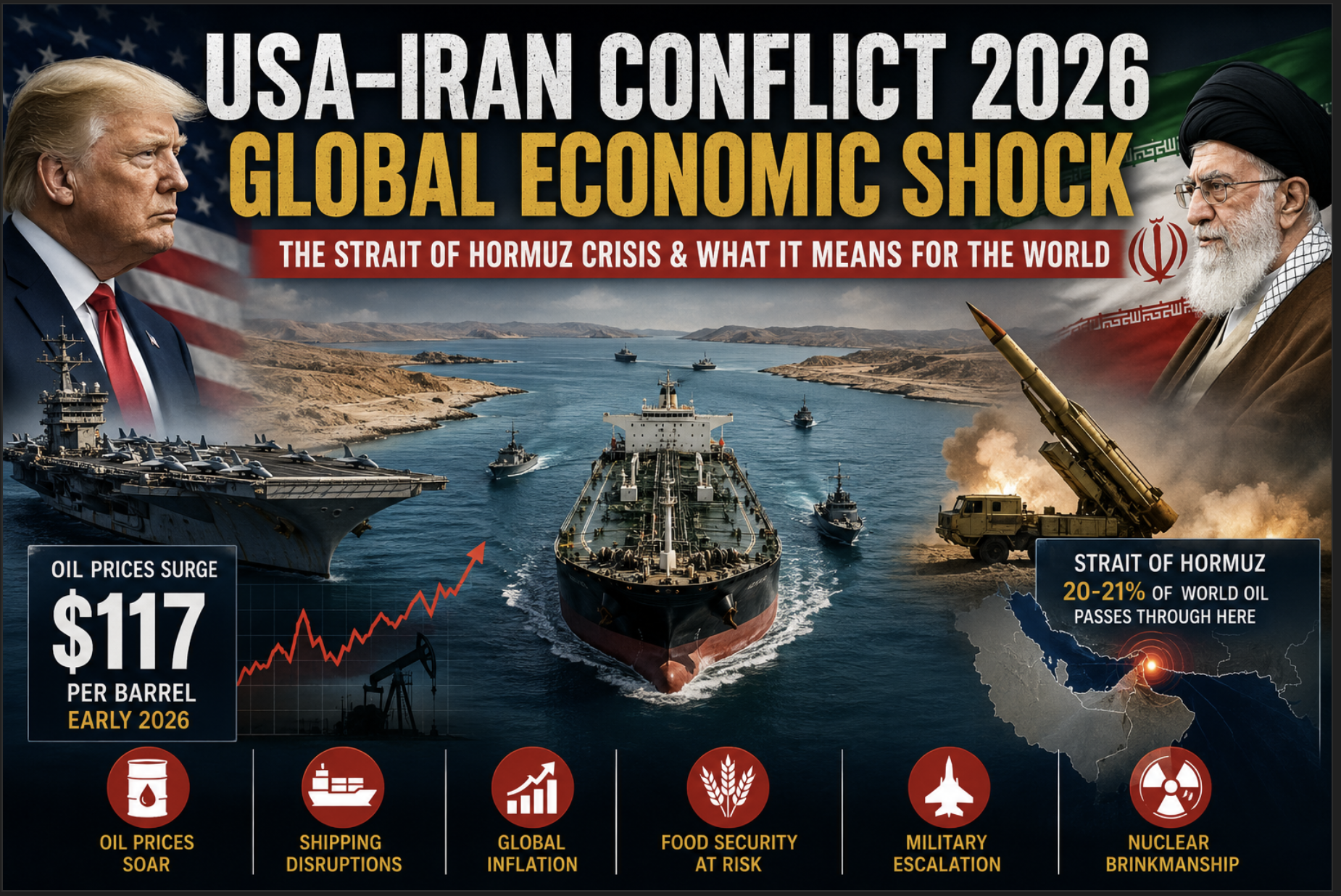
Usa iran conflict 2026 is rapidly reshaping global oil markets, trade routes, military strategy, and economic stability across the world.
Table of Contents
1. The Strait of Hormuz — World’s Most Dangerous Chokepoint
2. How usa iran conflict 2026 Is Reshaping Global Markets
3. Country-by-Country: Who Gets Hit the Hardest
4. Sector-by-Sector Impact Analysis
5. The Weapons Industry: Who Is Profiting From the Conflict
6. Nuclear Brinkmanship & Diplomatic Collapse
7. The UN, International Law & What Comes Next
8. FAQs
9. Internal Links | External Links |
Introduction
USA Iran conflict tensions are escalating rapidly in 2026 as oil prices surge, global shipping routes face disruption, and fears grow over a wider economic crisis linked to the Strait of Hormuz. Crude oil spiked to $117 a barrel in early 2026, tankers began rerouting around the Persian Gulf, and three aircraft carrier groups were deployed to the region — all within a single week. That sequence of events tells you almost everything you need to know about where the USA–Iran conflict stands right now, and why it is rattling governments from Tokyo to Berlin. The usa iran conflict 2026 is rapidly becoming a defining global geopolitical crisis.
The confrontation didn’t arrive out of nowhere. Decades of sanctions, proxy warfare, nuclear negotiations that never quite held, and a persistent American military footprint in the Middle East created the conditions. But 2026 has brought a qualitative shift. The language coming out of Washington and Tehran has hardened considerably, military incidents in the Persian Gulf have multiplied, and Iran’s nuclear programme has advanced to a point where diplomats are running out of plausible off-ramps.
What makes this iteration of the USA–Iran conflict genuinely dangerous for the rest of the world is its timing. Global supply chains are still fragile after years of pandemic disruption and post-Ukraine inflation. Energy markets were already jittery. And the major powers — the US, China, Russia — are further from consensus on how to manage Iran than at any point in recent memory. The crisis is not contained to two countries. It never was.
1. The Strait of Hormuz — The World’s Most Dangerous Chokepoint
Twenty-one miles at its narrowest point. That’s all that separates the Persian Gulf from the Gulf of Oman — and, by extension, 20.5 million barrels of oil per day from the rest of the global economy. The Strait of Hormuz is not just strategically important; it is essentially irreplaceable.
Approximately 20–21% of the world’s total petroleum liquids pass through the strait daily. Saudi Arabia alone exports roughly 6.5 million barrels per day through it. The UAE ships around 2.5 million. Iraq, Kuwait, and Qatar add millions more. Iran itself, despite US sanctions, uses the strait for the oil it continues to move through back channels.
| ⚡ KEY STATISTIC: If the Strait of Hormuz were fully blocked for just 30 days, the International Energy Agency estimates the economic damage to the global economy could exceed $1.5 trillion. |
Iran has threatened multiple times to close the strait — and unlike most geopolitical bluster, Tehran has the hardware to make life very difficult there. It possesses an arsenal of fast-attack boats, submarine capability, anti-ship missiles including the Noor and Qader systems, and mines. A full closure is considered unlikely, but even a partial disruption — a few tankers hit, a handful of maritime corridors declared unsafe — would trigger panic pricing in energy markets worldwide.
The US Fifth Fleet, headquartered in Bahrain, is permanently stationed to prevent exactly this. But its presence also guarantees that any Iranian action in the strait becomes a direct confrontation with the American military. That calculus has kept a lid on things for decades. The question in 2026 is whether that lid still holds.
2. How usa iran conflict 2026 Is Reshaping Global Markets
The price reaction to escalating USA–Iran tensions in early 2026 was swift and severe. Brent crude, which was trading around $82/barrel in January, broke through $110 in March and briefly touched $117 following reports of a naval incident near Abu Musa island. US gasoline prices followed: the national average crossed $4.80/gallon by April, the highest since the 2022 energy crisis.
Natural gas markets, already sensitive after Russia–Europe disruptions, compounded the problem. LNG spot prices in Asia rose 34% between January and April 2026. European gas futures hit their highest level since early 2023. The connection to Iran is indirect but real — when oil markets panic, every energy commodity feels it.
| Commodity | Jan 2026 Price | Apr 2026 Price | % Change | Primary Driver |
| Brent Crude Oil | $82/barrel | $117/barrel | +42.7% | Hormuz threat, sanctions tightening |
| WTI Crude | $79/barrel | $112/barrel | +41.7% | US naval deployment costs |
| Natural Gas (Henry Hub) | $2.90/MMBtu | $3.85/MMBtu | +32.7% | Energy market contagion |
| LNG (Asia Spot) | $12.40/MMBtu | $16.60/MMBtu | +33.8% | Rerouting fears, demand surge |
| US Gasoline Avg | $3.45/gallon | $4.80/gallon | +39.1% | Crude price pass-through |
| Jet Fuel (Gulf Region) | $95/barrel | $138/barrel | +45.2% | Regional war risk premium |
Source: Bloomberg Commodities Desk, IEA Monthly Oil Market Report Q1 2026, EIA Weekly Petroleum Status Report
The ripple effects extend well beyond petrol prices. Fertiliser costs, which are tightly linked to natural gas, climbed sharply — a development that has serious downstream consequences for food production costs across developing economies. Shipping insurance premiums for vessels transiting the Gulf tripled in the first quarter of 2026, adding a logistical tax on virtually everything that moves through the region. Oil traders remain highly sensitive to developments in the usa iran conflict 2026.
3. Country-by-Country: Who Gets Hit the Hardest
The USA–Iran conflict does not affect every country equally. Some face existential energy exposure. Others are caught in the middle diplomatically. A few are positioning themselves to benefit from the disruption. Here is the breakdown.
🇺🇸 United States
GDP at risk: Moderate. Military deployment cost: ~$4.2 billion per month for three-carrier-group operations. Domestic political pressure: High.
The US is far less dependent on Middle Eastern oil than it was in 2005, thanks to the shale revolution. American crude production sits at roughly 13.2 million barrels per day, making the US the world’s largest oil producer. But global oil prices are set by global markets — American consumers still feel the pain at the pump when Brent spikes, regardless of where the barrel comes from.
The greater exposure is fiscal and political. A prolonged military posture in the Gulf costs money at a time when US federal debt dynamics are already under strain. Domestic opposition to another Middle East war is substantial. And a conflict that drives oil prices above $120/barrel for more than a few months risks tipping the US economy into the stagflation territory it spent 2023–2024 climbing out of.
- US military spending in Middle East projected to exceed $58 billion in 2026
- American shale production cushions but does not eliminate price exposure
- Pentagon estimates a full naval conflict could cost $300 billion+ in first year
- US domestic gasoline demand fell 4.3% Q1 2026 as prices hit multi-year highs
- Defense contractor stocks: Raytheon +28%, Lockheed +31%, Northrop +26% YTD
🇮🇷 Iran
GDP contraction: -3.8% projected 2026. Currency: Rial at record lows. Inflation above 40%.
Iran enters this crisis with an economy already battered by decades of sanctions. The rial has lost more than 99% of its value since 2010. Oil exports, officially cut off by US sanctions, continue through what the US Treasury calls ‘shadow fleet’ operations — primarily to Chinese refineries willing to absorb the diplomatic cost. Estimates put Iranian oil exports at 1.2–1.5 million barrels per day despite sanctions, generating around $35 billion annually.
The population bears most of the burden. Food inflation ran at 47% annualised in Q1 2026. Youth unemployment sits above 28%. The government has sustained itself partly through military revenues, missile exports to proxy groups, and the kind of economic nationalism that tends to tighten its grip in crisis conditions rather than loosen.
- Iran’s oil revenue via shadow fleet: ~$35 billion/year (2025 estimate)
- GDP per capita (PPP): approximately $13,400 — below pre-2012 levels
- Rial exchange rate: ~650,000 IRR/USD (vs. 12,000 in 2012)
- Military budget: ~$10 billion/year, largest in region relative to economic size
- Unemployment: 16.8% official, estimated 22–28% real
🇨🇳 China
Oil import exposure: Critical. China is carefully monitoring the usa iran conflict 2026 for energy security reasons. China imports ~11 million barrels/day. ~40% originates in the Middle East.
No country watches the USA–Iran standoff more carefully than China. Beijing imports more crude from Iran than any other buyer — a figure estimated at 700,000–900,000 barrels per day in 2025-2026, most of it processed at independent ‘teapot’ refineries to obscure origin. Any serious disruption to that flow, or to broader Gulf supply, hits Chinese manufacturing costs directly. China is closely monitoring the usa iran conflict 2026 because of its heavy dependence on Gulf energy imports.
China has responded with strategic ambiguity: publicly calling for de-escalation while quietly expanding its naval presence in the Indian Ocean and deepening economic ties with Tehran through the 25-year Comprehensive Cooperation Agreement signed in 2021. Chinese state oil companies — CNOOC, CNPC, Sinopec — have collectively invested over $30 billion in Iranian energy infrastructure since 2010, complicating any clean extraction from the relationship.
- China imports ~40% of oil from Persian Gulf region
- Iran–China trade volume: $31.8 billion in 2025
- Strategic Petroleum Reserve: ~900 million barrels (90+ days of cover)
- Chinese yuan-denominated oil contracts reduce dollar exposure
- Belt & Road infrastructure in Gulf: $73 billion committed
India
Oil import bill surged 38% Q1 2026. India imports ~88% of its crude oil requirements.
India’s exposure to the USA–Iran conflict is acute and deeply personal. As the world’s third-largest oil importer, India has historically maintained a delicate balancing act — buying discounted Iranian crude when possible, maintaining strong US ties, and trying to keep both parties on speaking terms. That balancing act is becoming impossible. The usa iran conflict 2026 has already pushed global oil prices sharply higher.
Indian refineries — particularly Reliance’s Jamnagar complex, the world’s largest — are capable of processing a wide range of crudes. But price is everything. Every $10 rise in Brent crude costs India an additional $15 billion annually in its import bill, a direct hit to the current account deficit and the rupee. The rupee fell to Rs. 86.4/USD by April 2026, its lowest level in 18 months. India faces serious economic risks from the usa iran conflict 2026.
- India crude import dependency: 88% of total requirements
- Gulf region share of Indian oil imports: ~64%
- Indian diaspora in Gulf: 8.9 million workers — remittances at risk
- Rupee depreciation impact: estimated $22 billion additional annual cost
- India–Iran trade: ~$2.1 billion (down from $17 billion pre-sanctions in 2018)
European Union — Germany, France, UK
European industries are increasingly affected by the usa iran conflict 2026. EU energy import bill: Expected to rise €180 billion in 2026. Germany hardest hit due to industrial energy intensity.
Europe thought it had solved its energy vulnerability after 2022. It hadn’t — it had just shifted it. Russian gas dependence was replaced by LNG dependence, much of it from Qatar and other Gulf producers. A conflict affecting the Strait of Hormuz therefore hits European energy security through a different pipe but with similar force.
Germany, still heavily industrial, faced the sharpest exposure. German chemical companies — BASF, Lanxess — rely on affordable feedstocks from Gulf-origin LNG. France’s nuclear energy base provides more insulation, but French refineries import significant volumes of Middle Eastern crude. The UK, having now fully decoupled from European energy markets post-Brexit, faces its own North Sea limitations.
- Germany: Industrial energy costs up 22% Q1 2026; manufacturing PMI fell to 44.1
- France: CPI energy component +18% annualised Q1 2026
- UK: Average household energy bill up £340/year as market prices rise
- EU collective reserve: ~84 days of net oil imports (below 90-day target)
- European LNG import capacity: 260 bcm/year — rerouting strains this significantly
Japan & South Korea
Japan imports 95% of its oil; South Korea 98%. Both depend overwhelmingly on Gulf supply.
Japan and South Korea sit at the end of some of the longest energy supply chains in the world, and the Strait of Hormuz is the hinge they cannot avoid. Both countries have zero domestic oil production of significance. Both have extensive petrochemical and automotive industries that are extremely sensitive to energy costs.
Japan’s current account surplus, long a symbol of economic stability, narrowed sharply in 2024 and is under further pressure in 2026. South Korean conglomerates — Samsung, Hyundai, SK — have already begun assessing business continuity plans for a prolonged conflict scenario. The South Korean won and Japanese yen both weakened against the dollar as investors priced in higher import costs.
- Japan: Oil import bill projected at $145 billion in 2026 (vs $112 billion in 2024)
- South Korea: Energy import bill up 31% Q1 2026
- Japanese yen: 156/USD by April 2026 — near 34-year lows
- South Korea’s Aramco supply deal: 700,000 bpd at risk in conflict scenario
- Both nations have begun emergency stockpile releases
Saudi Arabia, UAE & Gulf Cooperation Council
Saudi oil revenue: $280 billion projected 2026 — a windfall. But security costs are rising simultaneously.
The Gulf monarchies occupy an uncomfortable position. Higher oil prices fill their sovereign wealth funds and government budgets. But a war on their doorstep — or more accurately, in their backyard — is existential in a different sense. Iran and Saudi Arabia have spent decades in a cold war fought through proxies. A hot conflict between the US and Iran could easily drag Gulf capitals into its blast radius, literally and figuratively.
Saudi Aramco’s production capacity is approximately 12 million bpd, of which 10.5–11 million are actively exported. The Kingdom has quietly agreed to pump more to offset any Hormuz disruption — but Aramco pipelines bypassing the strait have a maximum capacity of around 7 million bpd, well below what the world needs. The UAE has a parallel bypass pipeline with 1.8 million bpd capacity. Neither covers the gap.
- Saudi Arabia Vision 2030 deficit narrows as oil revenue spikes
- Saudi military spending: $75 billion in 2026 — 5th largest globally
- UAE: Hosting US military at Al Dhafra Air Base; Jebel Ali port at risk
- Qatar: LNG exports pass through Gulf — world’s largest LNG exporter at risk
- Kuwait: 100% dependent on Gulf for exports; zero bypass capacity
Israel
Direct military threat: High. Iran has repeatedly threatened missile strikes on Israeli territory, and proxy forces — Hezbollah, Houthis — are already active.
Israel’s exposure to the USA–Iran conflict goes beyond economics. The Iranian nuclear programme is an existential threat from Israel’s perspective, and Israeli defence planners have long maintained that they cannot allow Iran to become a nuclear-armed state. Reports in early 2026 indicated Israel had updated its contingency plans for unilateral air strikes on Iranian nuclear facilities — a development that Washington views with significant unease.
- Iron Dome activations: up 340% Q1 2026 due to Hezbollah/Houthi activity
- Israeli shekel: Lost 8.2% against USD since January 2026
- Tel Aviv Stock Exchange: Down 14.3% YTD as of April 2026
- Defence budget: $28 billion — 5.3% of GDP, highest in Israeli history
- US military aid to Israel: $3.8 billion/year baseline, with emergency supplements
Russia
Beneficiary position: Ambiguous. Higher oil prices help Russia. But a Middle East war it cannot control creates strategic risk.
Russia is in an unusual spot. As a major oil exporter, it benefits from higher prices caused by Gulf instability. Every dollar that Brent rises above $80 adds roughly $1.7 billion to annual Russian oil revenues. But Moscow is also an ally of Iran under the JCPOA framework, has supplied Iranian drones technology (or vice versa), and has significant strategic interests in Middle East stability.
A US military victory over Iran would remove a major Russian ally and potentially open the door to regime change — something Moscow has spent years trying to prevent. A full conflict also risks drawing in Chinese resources that Russia needs for its own war economy. The Kremlin’s calculus is complex and not obviously tilted toward either war or peace.
- Russia additional oil revenue per $10 Brent rise: ~$17 billion/year
- Iran–Russia arms cooperation: estimated $5 billion in agreements 2022–2025
- Russia OPEC+ coordination: Complicates unified response to price shock
Pakistan & South Asia
Pakistan’s economic fragility makes energy shocks particularly dangerous. The country runs on IMF support and any additional import cost pressure threatens fiscal stability.
Pakistan imports roughly 100,000 barrels of oil per day, primarily from Gulf states, and is heavily dependent on Gulf remittances — Pakistani expatriate workers in Saudi Arabia, UAE, Qatar, and Kuwait send home approximately $14 billion annually. Any Gulf conflict that disrupts labour markets, deportations, or remittance infrastructure hits Pakistan’s foreign exchange reserves immediately.
- Pakistan remittances from Gulf: ~$14 billion/year
- Pakistani workers in Gulf: ~4.5 million
- Pakistan oil import bill: Up 29% Q1 2026
- IMF programme conditions already strained — energy shock risks programme derailment
Global Economic Impact Summary Table
| Country/Region | Oil Import Dependency | Projected GDP Impact | Inflation Spike | Strategic Position |
| USA | Low (net exporter) | -0.4% to +0.2% | +1.8–2.3% | Military lead, high fiscal cost |
| Iran | Oil exporter | -3.8% (recession) | +40%+ | Pressure, isolation |
| China | ~40% from Gulf | -0.8 to -1.2% | +2.1% | Strategic balance, Iran ally |
| India | 88% imported | -1.4 to -1.9% | +3.2% | Non-aligned, exposed |
| EU (avg) | ~30% from Gulf | -0.9 to -1.5% | +2.6% | Diplomatically passive |
| Germany | High industrial user | -1.6% | +2.9% | Industrial exposure acute |
| Japan | 95% imported | -1.7% | +3.4% | Deep Gulf dependency |
| South Korea | 98% imported | -1.5% | +3.1% | Aramco-dependent |
| Saudi Arabia | Net exporter | +3.2% | +1.1% | Windfall but security risk |
| Israel | Medium import | -2.1% | +4.2% | Existential threat from Iran |
| Pakistan | High import | -2.4% | +5.8% | Remittance & energy shock |
| Russia | Net exporter | +1.8% | +0.8% | Price windfall, ally risk |
4. Sector-by-Sector Impact Analysis
Energy & Oil
The usa iran conflict 2026 continues to pressure global energy markets. The most direct impact is on energy. The fear premium — the extra price embedded in oil futures simply because of conflict risk — has added an estimated $18–22/barrel to crude prices since January 2026. Oil majors including ExxonMobil, Shell, BP, and TotalEnergies have seen stock prices rise sharply. Their quarterly earnings for Q1 2026 showed windfall profits that rival the 2022 Ukraine-shock peak. Analysts believe the usa iran conflict 2026 could severely disrupt shipping through the Strait of Hormuz. India remains one of the most economically vulnerable countries in the usa iran conflict 2026 crisis.
Renewable energy adoption, paradoxically, is also accelerating. High oil prices make solar and wind more competitive in every market that runs the numbers. Germany accelerated offshore wind commissioning. India announced a fast-track approval process for new solar projects. The crisis is doing more for green energy economics in six months than five years of policy advocacy.
Aviation & Shipping
Airline fuel costs are the single largest operating expense for most carriers, and jet fuel rose 45% in the Gulf region in Q1 2026. Emirates, Etihad, and Qatar Airways are operationally headquartered in the conflict zone; their route networks and cost structures are acutely exposed. Long-haul rerouting — avoiding the Gulf or flying higher arcs — adds hours and fuel cost to routes connecting Asia and Europe. Global shipping companies are closely tracking the usa iran conflict 2026.
Maritime shipping is under even greater stress. The Houthi campaign against Red Sea shipping that began in late 2023 never fully ended, and the USA–Iran escalation has reignited it. Container shipping rates on Asia–Europe routes rose 68% between December 2025 and April 2026. Insurance premiums for vessels transiting the Gulf have tripled.
- Container shipping (Asia–Europe): Up 68% Q1 2026
- Gulf maritime war risk premium: 0.85% of vessel value/year (was 0.12%)
- Emirates airline fuel cost increase: ~$2.4 billion projected additional 2026 cost
- Maersk, MSC rerouting add 12–16 days to Asia–Europe transit via Cape of Good Hope
- Suez Canal transit volumes fell 38% Q1 2026 due to Houthi/conflict risk
Financial Markets & Currencies
Global investors are closely watching developments in the usa iran conflict 2026.. Stock markets don’t like war risk. The S&P 500 has seen elevated volatility throughout early 2026, with the VIX (fear index) averaging 28.3 — well above its long-term average of around 20. Emerging market currencies, particularly those of oil-importing economies, have weakened sharply against the dollar as investors crowd into safe-haven assets.
Gold broke $3,100/oz in March 2026 as investors sought non-correlated stores of value. US Treasury yields rose on inflation expectations. Credit default swap spreads widened for Gulf sovereign debt and for corporates with significant Gulf exposure. The usa iran conflict 2026 is forcing governments to rethink energy security strategies.
| Asset | Jan 2026 | Apr 2026 | Change |
| S&P 500 | 5,820 | 5,490 | -5.7% |
| Gold | $2,650/oz | $3,120/oz | +17.7% |
| VIX (Fear Index) | 16.2 | 28.3 | +74.7% |
| US 10-yr Treasury Yield | 4.42% | 4.91% | +49 bps |
| MSCI Emerging Markets | 1,095 | 988 | -9.8% |
| USD Index (DXY) | 104.2 | 108.6 | +4.2% |
Agriculture & Food Security
Food prices are already a global crisis — they didn’t need another catalyst. But the USA–Iran conflict is providing one. Fertiliser production depends heavily on natural gas (for ammonia synthesis), and natural gas prices have risen substantially. Urea prices, a key crop nutrient, rose 28% Q1 2026. Countries in sub-Saharan Africa, South Asia, and parts of Latin America that import both fuel and food face a compounding crisis.
The World Food Programme warned in April 2026 that an additional 23 million people could be pushed into acute food insecurity if the conflict continues through the Northern Hemisphere harvest season and commodity prices remain elevated. That number sits atop an already elevated global hunger figure.
- Global food price index (FAO): Up 14.3% since January 2026
- Wheat futures: Up 22% Q1 2026 (energy cost input factor)
- Urea (fertiliser): Up 28%, with shortages reported in East Africa and South Asia
- WFP: Additional 23 million people at acute food insecurity risk
- Pakistan, Bangladesh, Ethiopia — highest compound food/energy exposure
Technology & Supply Chains
The semiconductor industry has an indirect but real exposure to Gulf conflict. Taiwan Semiconductor Manufacturing Company (TSMC) and Samsung — which together produce roughly 80% of the world’s advanced chips — are both based in countries (Taiwan and South Korea) that depend overwhelmingly on Gulf oil. Any significant rise in their energy input costs flows into chip production costs, with downstream effects on every device manufacturer on the planet.
Shipping disruptions also affect component delivery timelines. Apple’s supply chain, which runs through China and Southeast Asia, has been absorbing extra costs since late 2025 due to Red Sea rerouting. The tech sector’s vulnerability is not about Iran per se — it’s about the logistical and energy infrastructure that underpins global manufacturing.
5. The Weapons Industry: Who Is Profiting From the Conflict
| 💰 GLOBAL ARMS MARKET SIZE: $2.2 trillion in 2025 — projected to reach $2.5 trillion by end of 2026, driven largely by Middle East escalation and European rearmament. |
Here is something that rarely appears in mainstream coverage of the USA–Iran crisis: while governments worry about oil prices and nuclear weapons, a specific set of corporations is having a historically profitable year. The global arms industry — defence contractors, missile manufacturers, electronic warfare firms — does well in precisely the conditions that currently exist: sustained threat, large-scale procurement, and governments willing to override normal budget constraints.
US Defence Contractors — The Primary Beneficiaries
Defence stocks surged as the usa iran conflict 2026 escalated further. The five largest US defence contractors — Lockheed Martin, Raytheon Technologies (RTX), Northrop Grumman, Boeing Defence, and General Dynamics — have a combined market capitalisation that has risen approximately $180 billion since January 2026. Their order books are full, their backlogs are at record levels, and the political environment in Washington makes it very difficult to cut defence budgets when aircraft carrier groups are deployed to the Gulf.
| Company | Stock Price Jan 2026 | Stock Price Apr 2026 | YTD Change | Key Iran-relevant product |
| Lockheed Martin (LMT) | $520 | $685 | +31.7% | F-35, HIMARS, Patriot PAC-3 |
| RTX (Raytheon) | $118 | $151 | +28.0% | Patriot missiles, Tomahawk, SM-3 |
| Northrop Grumman (NOC) | $495 | $624 | +26.0% | B-21 Raider, Triton drones |
| General Dynamics (GD) | $298 | $371 | +24.5% | Stryker, munitions, warships |
| Boeing Defence (BA) | $174 | $211 | +21.2% | F-18, Apache, P-8 Poseidon |
| L3Harris Technologies | $214 | $268 | +25.2% | Electronic warfare, SIGINT |
Raytheon’s Patriot missile system is particularly central to this story. With Iran possessing one of the largest ballistic missile arsenals in the Middle East — an estimated 3,000+ missiles of various ranges — every US ally in the region wants more Patriot batteries. Saudi Arabia has purchased $15 billion worth of Patriot systems since 2020. Israel’s Arrow 3 interceptor system, co-developed with Boeing, has seen upgrade funding doubled. Even Japan and South Korea, thousands of miles from Iran, are expanding their missile defence capabilities in response to the general militarisation of the region.
European Arms Manufacturers — Riding the Rearmament Wave
Global supply chains are under pressure because of the usa iran conflict 2026. Europe’s rearmament push, originally triggered by Russia’s 2022 invasion of Ukraine, has been supercharged by the USA–Iran situation. European NATO members are now under enormous pressure to hit 2% GDP defence spending — a target most have historically missed. That translates into enormous procurement contracts flowing to companies like Germany’s Rheinmetall, France’s Thales and MBDA, Italy’s Leonardo, and the UK’s BAE Systems.
- Rheinmetall (Germany): Revenue up 42% Q1 2026; order backlog exceeds €50 billion
- BAE Systems (UK): Order intake hit £9.2 billion in Q1 2026 alone
- Thales (France): Electronic warfare and naval systems backlog at record €22 billion
- MBDA (EU missile consortium): Backlog grew to €26 billion, 3x average five-year pace
- Leonardo (Italy): Revenue up 18%; drone and helicopter contracts driving growth
Iran’s Weapons Economy — The Other Side of the Market
Iran is not only a consumer of conflict — it is also, in a specific and important sense, a weapons economy. The Islamic Revolutionary Guard Corps (IRGC) controls a vast network of defence industries producing drones, missiles, fast-attack boats, and electronic warfare equipment. Iran has become the world’s largest exporter of low-cost drones for state and non-state actors.
Shahed-136 drones, originally sold to Russia for use in Ukraine, have been documented in conflicts across five countries. Iran reportedly charges between $50,000 and $80,000 per unit for export. At estimated production volumes of 1,500–2,000 units per year, this represents a multi-hundred-million-dollar revenue stream — modest by global standards, but significant for sanctions-constrained Iran.
- Iran estimated drone production: 1,500–2,000+ units/year
- Shahed-136 export price: ~$50,000–80,000/unit
- Countries confirmed to have received Iranian drones: Russia, Yemen (Houthis), Iraq, Syria, possibly Sudan
- IRGC defence industry revenues: Estimated $8–12 billion/year (opaque accounting)
- Iran ballistic missile stockpile: 3,000+ units across 15+ missile types
Why the Weapons Market Benefits From Prolonged — Not Resolved — Conflict
This is the uncomfortable structural reality of the defence industry: resolution is bad for business. Not war, necessarily, but threat. The sustained, unresolved nature of the USA–Iran conflict — years of escalation and de-escalation, occasional incidents, no clear endpoint — creates exactly the conditions under which defence procurement flourishes.
Governments operating under persistent threat buy weapons faster and with less scrutiny of cost. Maintenance contracts are extended. Research and development funding flows. Congress authorises supplemental defence budgets. Think tanks produce reports emphasising capability gaps. The entire ecosystem is calibrated for ‘managed tension’ rather than either peace or war. The Iran crisis, precisely because it has persisted for decades without resolution, has been extraordinarily good for the defence industrial complex on all sides.
6. Nuclear Brinkmanship & Diplomatic Collapse
The nuclear file is where the USA–Iran conflict becomes genuinely existential. Iran is not currently a nuclear-armed state, but it is closer than it has ever been. The IAEA reported in early 2026 that Iran had enriched uranium to 83.7% purity — fractionally below weapons-grade — and maintained a stockpile of approximately 1,000 kg of medium-enriched uranium. That represents a significant strategic reserve. The usa iran conflict 2026 has also intensified fears surrounding Iran’s nuclear ambitions.
The 2015 JCPOA, which briefly constrained Iran’s nuclear programme in exchange for sanctions relief, collapsed in 2018 when the Trump administration withdrew. Subsequent Biden-era negotiations failed to produce a replacement deal. The current trajectory has Iran within an estimated 1–2 weeks of enough enriched material for one nuclear device — though converting that to an actual weapon requires additional steps that would likely take 12–18 months and would be visible to intelligence services.
That assessment — ‘observable and stoppable’ — is the primary reason direct military action hasn’t happened yet. But the window of strategic comfort is narrowing. Israeli intelligence assessments, leaked to the press in March 2026, reportedly put the timeline for Iranian weaponisation at 18 months. American assessments are somewhat more conservative. The gap between those estimates is itself a source of tension between Washington and Jerusalem.
- Iran uranium enrichment: 83.7% purity (weapons-grade is ~90%)
- Iran enriched uranium stockpile: ~1,000 kg at medium/high enrichment
- IAEA inspections: Heavily restricted since 2021
- Estimated time to first device (material only): 1–2 weeks at current enrichment levels
- Weaponisation timeline (full bomb): 12–24 months estimated
- Countries with nuclear deterrent in region: Israel (undeclared), Pakistan
7. The UN, International Law & What Comes Next
The usa iran conflict 2026 is reshaping global geopolitics at an unprecedented pace. The United Nations Security Council has met seven times in 2026 to discuss the USA–Iran situation. It has passed zero binding resolutions. China and Russia have vetoed every draft that contained enforcement mechanisms, and the US has vetoed Iranian-backed resolutions characterising American naval deployments as aggressive. The result is a UN that is watching, commenting, and issuing statements — but not governing.
The UN Secretary-General has called for an immediate resumption of nuclear talks and urged restraint from both sides. UN Special Envoy for Iran has spent the first quarter of 2026 shuttling between Geneva, Muscat, and Doha, trying to construct a back-channel negotiation that avoids the optics of direct US–Iran talks. The gap between what diplomats say privately and what they say in press conferences remains wide.
Many analysts believe the usa iran conflict 2026 could define the global economy for years to come. International law is in an awkward position too. US sanctions on Iran are unilateral, not UN-mandated. Iran considers them illegal interference. The legal basis for potential US military strikes — preemptive action against nuclear facilities — is disputed under international law, though the US has previously justified similar actions under self-defence doctrines. None of this will be resolved in a Security Council chamber where the P5 cannot agree.
What’s actually driving events is not legal frameworks or UN resolutions — it’s the interplay of domestic politics in both Washington and Tehran, the strategic calculations of Israel, the economic interests of China, and the oil markets that connect all of it. The diplomats are working on the margins of forces they cannot entirely control, trying to create enough friction to slow a slide toward something nobody officially wants but few seem able to prevent.The usa iran conflict 2026 may ultimately become one of the defining geopolitical crises of the decade.
8. Frequently Asked Questions (FAQs)
Q1. What started the USA–Iran conflict in 2026?
The 2026 escalation did not have a single trigger — it was the product of years of accumulated tensions: the collapse of the JCPOA nuclear deal, continued US sanctions, Iranian proxy attacks on US forces in Iraq and Syria, Israeli air strikes on IRGC targets, and Iran’s continued nuclear enrichment beyond agreed limits. A naval incident in the Persian Gulf in January 2026, involving Iranian fast boats and a US destroyer, significantly raised the temperature.
Q2. Could Iran actually close the Strait of Hormuz?
Iran could disrupt the Strait of Hormuz significantly, but a complete closure would be extremely difficult to sustain. Iran has anti-ship missiles, mines, and fast-attack capability. A partial disruption — causing rerouting and risk premium — is more likely than a total blockade. The US Fifth Fleet is specifically positioned to prevent and respond to any such action. Even a partial disruption lasting 2–4 weeks would have severe global consequences.
Q3. Which countries are most economically vulnerable to the USA–Iran conflict?
Japan and South Korea face the deepest structural vulnerability, importing 95% and 98% of their oil respectively, mostly from the Gulf. India is also acutely exposed given its 88% import dependency and massive diaspora in the Gulf. Pakistan faces compounded risk through both energy imports and Gulf remittances. European industrial economies, especially Germany, face significant energy cost pressures.
Q4. Why are defence stocks rising during the conflict?
The usa iran conflict 2026 has boosted global defence spending significantly. Defence companies benefit from conflict-driven procurement. Governments facing perceived threats accelerate weapons purchases, approve supplemental defence budgets, and extend maintenance contracts. The USA–Iran standoff has specifically driven demand for air defence systems (Patriot, Arrow 3), precision munitions, naval vessels, surveillance technology, and cybersecurity capabilities. Raytheon, Lockheed Martin, Northrop Grumman, and European equivalents like Rheinmetall have all seen significant stock price appreciation.
Q5. Is Iran close to building a nuclear weapon?
Nuclear tensions continue rising during the usa iran conflict 2026. Iran has enriched uranium to approximately 83.7% purity and maintains a significant stockpile of enriched material. It could theoretically have enough material for one nuclear device within 1–2 weeks of a decision to proceed at current enrichment rates. However, converting that material into a functional nuclear weapon requires additional engineering steps that would take an estimated 12–24 months and would likely be detected by intelligence services. Iran is a nuclear threshold state — not yet nuclear-armed, but closer than at any prior point.
Q6. How is the conflict affecting global food prices?
Shipping insurance costs have surged during the usa iran conflict 2026. Food inflation risks are rising because of the usa iran conflict 2026. Oil and gas price spikes feed directly into fertiliser production costs (ammonia synthesis requires natural gas), transport costs, and mechanised agriculture costs. The FAO food price index rose 14.3% between January and April 2026. The World Food Programme estimates an additional 23 million people could face acute food insecurity if conflict-elevated commodity prices persist through the Northern Hemisphere harvest season. Energy analysts believe the usa iran conflict 2026 could worsen inflation worldwide.
Q7. What is China’s role in the USA–Iran conflict?
The usa iran conflict 2026 could reshape the world economy for years ahead. China occupies a strategic middle position. It is Iran’s largest trading partner and primary buyer of sanctioned Iranian oil, providing Tehran with the economic lifeline that makes full sanctions compliance difficult to enforce. Simultaneously, China has extensive trade relationships with the US and Gulf Arab states. Beijing has publicly called for de-escalation while quietly expanding economic and military ties with Iran. China’s leverage is significant, and US pressure on Beijing to use it is a major diplomatic subplot of the crisis. The usa iran conflict 2026 is increasing volatility across global financial markets.
9. Internal Link Suggestions
- ‘Strait of Hormuz’ →https://infowarfacts.com/trump-rejects-iran-ceasefire-deal/
- Project Freedom strait of Hormoz Crisis→ https://infowarfacts.com/project-freedom-hormuz-crisis-2026/
External Authority Links
International Energy Agency — Oil Market Report — https://www.iea.org/reports/oil-market-report
SIPRI — Military Expenditure Database — https://www.sipri.org/databases/milex
World Food Programme — Global Food Crisis — https://www.wfp.org/global-hunger-crisis
Reuters — Iran Sanctions Tracker — https://www.reuters.com/world/middle-east/