Table of Contents
- Trump-Xi Summit 2026: Two Summits, One Meeting
- Why Were All Those CEOs There? The Real Business Agenda
- The Boeing Bombshell: A Deal That Isn’t Confirmed
- Iran: Where the Two Sides Are Furthest Apart
- Taiwan: The Loudest Silence in American Diplomacy
- What China’s State Media Actually Said
- How the Trump-Xi Summit 2026 Affects India
- The Overlooked Angles That Everyone Missed
- FAQs
- Internal & External Reference Links
1. Trump-Xi Summit 2026: Two Summits, One Meeting
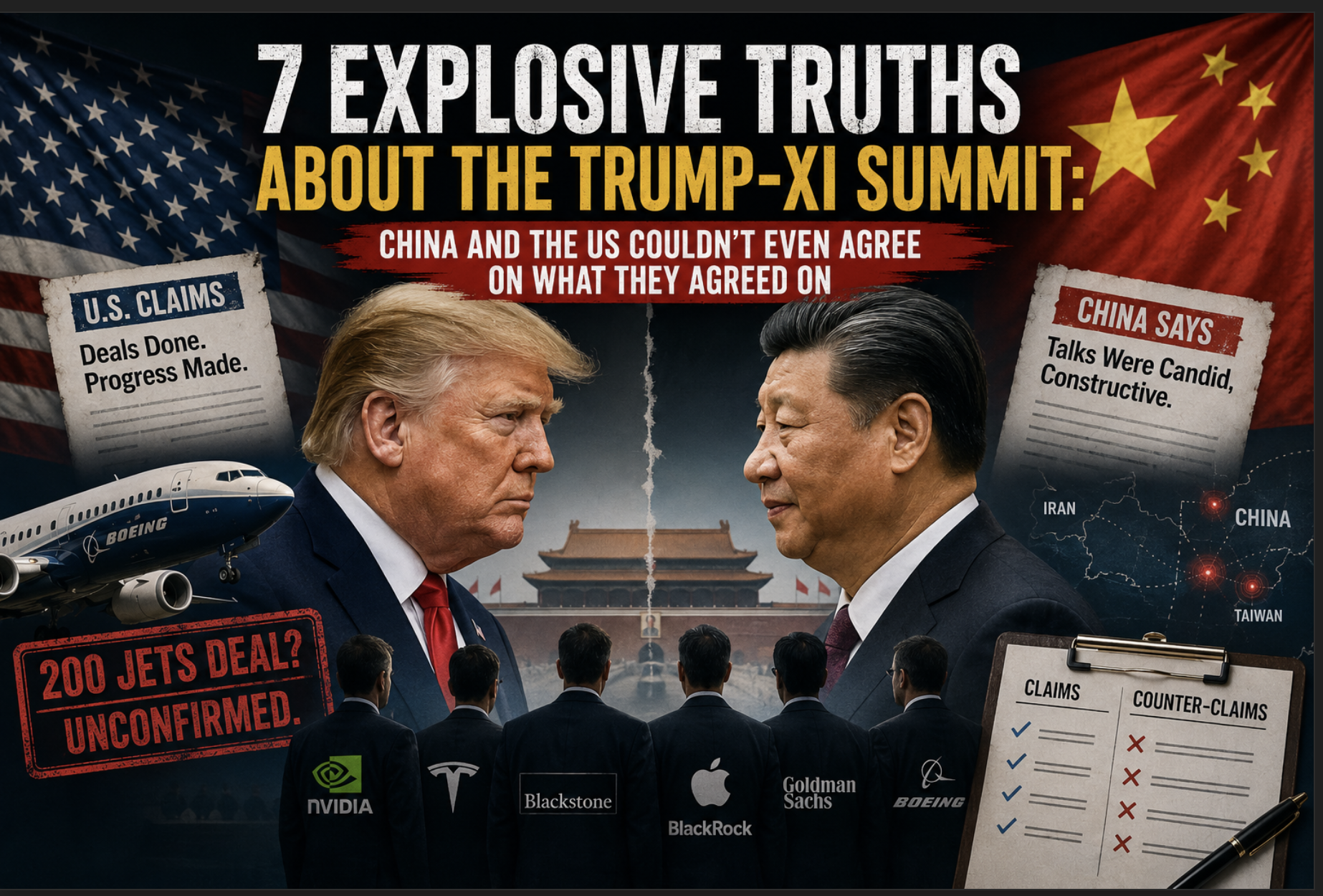
Donald Trump landed in Beijing on May 14 as the first sitting US president to visit China in years. He left two days later having, depending on which capital you consult, either accomplished a great deal or very little. The Trump-Xi Summit 2026 produced two parallel narratives, published almost simultaneously by Washington and Beijing, and the two accounts overlap in surprisingly few places.
The White House posted its readouts on X. China’s Ministry of Foreign Affairs did the same. Journalists who read both versions noticed something immediately: entire subjects that featured prominently in one statement were absent from the other. Not vaguely worded or diplomatically hedged — simply absent.
Washington said deals were done. Beijing said the talks went well. They weren’t necessarily describing the same conversation.
This kind of communicative gap isn’t unusual in great-power diplomacy. Leaders frequently return home and tell their domestic audiences what they want to hear. But the Beijing summit’s divergence is wider than most, covering not just tone but specific factual claims — including a 200-aircraft Boeing deal that China has not confirmed and may not have agreed to at all.
For analysts trying to assess what actually happened inside the Great Hall of the People, the exercise feels less like reading diplomatic summaries and more like studying two Rorschach tests held up to the same inkblot.
2. Why Were All Those CEOs There? The Real Business Agenda
The contingent that flew into Beijing with Trump was not a typical diplomatic delegation. Alongside the national security advisors and trade officials sat some of the most powerful corporate executives in the United States. Their presence was deliberate, and it told a story about what Washington really hoped to extract from the summit.
Who Was in the Room
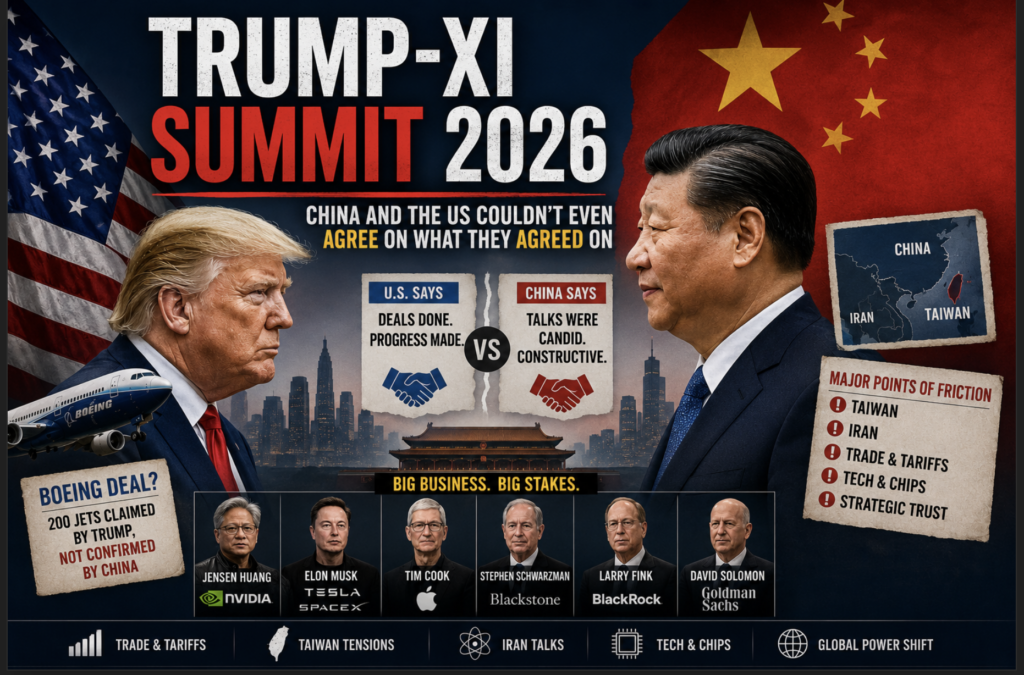
| CEO / Business Leader | Company | Sector | Interests in China |
| Jensen Huang | Nvidia | Semiconductors / AI | Chip sales ban reversal; access to Chinese AI market |
| Elon Musk (advisor) | Tesla / SpaceX | EV / Space | Tesla gigafactory expansion; supply chain access |
| Stephen Schwarzman | Blackstone | Private Equity / Finance | Chinese real estate distressed asset deals |
| Larry Fink | BlackRock | Asset Management | Chinese bond and equity market access |
| David Solomon | Goldman Sachs | Investment Banking | Expanded financial services licensing in China |
| Tim Cook | Apple | Consumer Tech | iPhone manufacturing supply chain, App Store in China |
| Various Boeing Reps | Boeing | Aerospace | 200-aircraft deal (claimed by Trump, unconfirmed by China) |
Jensen Huang of Nvidia was arguably the most watched figure on the trip. His addition to the delegation was described as ‘last-minute’ and ‘dramatic’ — and for good reason. Nvidia’s advanced AI chips have been banned from Chinese sale under US export controls, and the Chinese AI industry has been scrambling for alternatives. The prospect of even partial relaxation of those controls would have been worth hundreds of billions in market capitalisation to Nvidia.
Nothing publicly confirmed came of it. No chip deal was announced. Huang was photographed, noted, speculated about, and then the summit ended without any formal statement touching AI hardware.
Elon Musk’s role was more ambiguous, he attended in an advisory capacity rather than as a CEO seeking contracts. Tesla has enormous exposure in China, both as a market and a manufacturing base, so his interest in the summit outcome is commercial even if his formal role was political.
Blackstone’s Stephen Schwarzman has longstanding relationships in China stretching back decades. He’s funded academic exchanges, cultivated personal ties with Xi-era officials, and built significant real estate and private equity exposure in China. BlackRock’s Larry Fink similarly wants expanded access to Chinese capital markets, something Beijing controls through licensing and quota systems that can be opened or tightened at political will.
What unites all of these executives is that their companies face regulatory, licensing, or tariff barriers in China that only political negotiation at the highest level can shift. They weren’t in Beijing as window dressing. They were there as the actual point.
Trump-Xi Summit 2026 with these executives personally — a signal of seriousness, or perhaps a calculated move to keep American business interests aligned with diplomatic engagement rather than decoupling.
Xi’s decision to meet them directly is worth pausing on. China has used access to its market as geopolitical leverage for decades. By receiving America’s most powerful corporate representatives, Xi was sending a message, not necessarily to Trump, but to the American business lobby. The implicit offer was: there is money to be made here, if your government cooperates. The executives understood. They always do.
3. The Boeing Bombshell — A Deal That Isn’t Confirmed
Of all the specific claims Trump made after the summit, the Boeing deal was the most concrete and the most immediately testable. Trump told Fox News that China had agreed to purchase 200 commercial jets from Boeing, its first Chinese aircraft order in almost a decade, given that Beijing had informally boycotted Boeing purchases as part of trade tensions.
Markets moved fast. Boeing shares dropped more than 4 percent on Friday when the 200-jet figure emerged. Analysts and investors had been pricing in something closer to 500 aircraft. The delta between expectation and announcement was large enough to hit the stock.
But here is the more fundamental problem: China said nothing about it. The Chinese Foreign Ministry’s post-summit statement made no reference to Boeing, to aviation, or to any specific trade agreement at all. Boeing itself issued no confirmation. No purchase order was announced. No deal terms were disclosed.
It is possible that preliminary agreements were made in private, with formal announcements pending contract negotiations. It is also possible that Trump described a conversation about Boeing in more definitive terms than the underlying discussion warranted — a pattern that observers of his diplomacy will find familiar.
The fentanyl issue follows a similar structure. Washington said the two leaders ‘highlighted the need to build on progress in ending the flow of fentanyl precursors.’ China’s statement contained no reference to fentanyl at all. Trump spent much of his first term, and the opening months of his second, blaming China for the American opioid crisis and using it to justify sweeping tariffs. If Beijing agreed to cooperate on fentanyl enforcement in some meaningful way, it would represent a significant concession. But China’s silence makes it impossible to assess.
The Trump-Xi Summit 2026 — Claims vs Counter-Claims.
| US WHITE HOUSE CLAIM | CHINA MFA STATEMENT |
| Boeing 200-jet deal announced | No trade deals mentioned |
| Fentanyl progress highlighted | No mention of fentanyl |
| Iran can never have nuclear weapon | Iran conflict should never have happened |
| Xi opposed Strait militarisation & tolls | No mention of Strait tolls or US oil purchase |
| No mention of Taiwan | Taiwan is the most important issue |
| No three-year relationship timeline | Three-year strategic stability vision agreed |
Full Claim-by-Claim Breakdown
| Issue | US Said | China Said | Verdict |
| Boeing Deal | 200 jets agreed | Not mentioned | Unconfirmed |
| Fentanyl | Progress made | Not mentioned | Only US claim |
| Iran Nukes | Iran can never have nuclear weapon | Conflict should end; political settlement needed | Different positions |
| Hormuz Strait | Xi opposed tolls & militarisation | Not mentioned at all | Only US claim |
| Taiwan | Not mentioned | Most important issue; clashes possible | Only China claim |
| Strategic Timeline | Not mentioned | Three-year stability vision agreed | Only China claim |
4. Iran: Where the Two Sides Are Furthest Apart
The US-Israel war on Iran, ongoing since early 2026, dominated international attention during the summit and produced perhaps the sharpest public divergence between Washington and Beijing.
The White House said both leaders agreed that ‘Iran can never have a nuclear weapon.’ That is a clear, unambiguous statement of shared policy, if accurate.
China’s statement said no such thing. Instead, Beijing described the conflict as one that ‘should never have happened’ and ‘has no reason to continue.’ It called for ‘dialogue and consultation’ and a ‘political settlement’ that accommodates ‘the concerns of all parties.’ This is the language of a country that considers the war itself illegitimate, not simply a country seeking to prevent Iranian nuclearisation.
The Strait of Hormuz issue is similarly murky. The White House claimed Xi explicitly opposed the militarisation of the Strait and China’s interest in purchasing American oil to reduce dependence on it. China’s statement made no reference to any of this.
Iran currently holds roughly 440 kilograms of uranium enriched to 60 percent — significant, but still short of the 90 percent threshold needed for a weapon. Since early March, Tehran has restricted commercial shipping through the Strait, which historically carried around 20 percent of the world’s oil and LNG. Iran has proposed charging transit fees — something Washington has flatly rejected. In April, the US announced a naval blockade on Iranian ports, adding a further layer of disruption to global energy markets.
China imports a substantial share of its oil through the Gulf. If the Strait remains restricted, Beijing’s energy security deteriorates. The White House framing — that Xi acknowledged this problem and expressed interest in buying more American oil — would make logical sense from China’s perspective. But China has not confirmed it, and the politics of such a statement are delicate: publicly endorsing American oil purchases while condemning the US-led war against Iran would be diplomatically awkward for Beijing.
5. Taiwan: The Loudest Silence in American Diplomacy
When Chinese President Xi Jinping says something is ‘the most important issue’ in the entire bilateral relationship, it tends to be significant. Taiwan is that issue for Beijing, and it was, according to China’s post-summit statement, forcefully raised.
Xi’s statement — published by the Foreign Ministry — warned that if Taiwan is ‘not handled properly, the two countries will have clashes and even conflicts, putting the entire relationship in great jeopardy.’ That is not subtle language. That is Beijing drawing a line.
The White House statement makes no mention of Taiwan at all.
Trump also ignored a direct question from reporters about his position on Taiwan while in Beijing — a silence that was, for most diplomatic observers, more revealing than any official statement could be. The question of whether Washington still formally supports Taiwan’s status as a self-governing democracy, or whether Trump has tacitly softened that position in exchange for trade accommodation, remains unanswered.
Taiwan’s government maintains it is a sovereign state with 23 million people. China’s position is that it is a breakaway province. The US has long navigated this through ‘strategic ambiguity’ — officially acknowledging China’s position without endorsing it, and maintaining defence relations with Taipei under the Taiwan Relations Act. Any erosion of that ambiguity — or any quiet signal from Trump to Xi that Taiwan will not be defended — would have geopolitical consequences far beyond the bilateral relationship.
Trump ignored a reporter’s question about Taiwan while standing on Chinese soil. In diplomatic language, that silence is a message.
6. What China’s State Media Actually Said
Western coverage of the summit has largely focused on the Foreign Ministry readout and the White House’s X posts. But understanding how Beijing truly received the summit requires looking at what China’s state media, Xinhua, People’s Daily, CGTN, chose to emphasise.
Xinhua’s flagship coverage focused heavily on Xi’s vision of ‘strategic stability’ and the so-called ‘new vision’ for China-US relations over ‘the next three years and beyond.’ This three-year framing was presented as an agreed framework — but as noted, the White House never confirmed it.
People’s Daily ran commentaries describing the summit as a success for ‘responsible great-power diplomacy,’ pointedly avoiding any characterisation of specific deal-making. The tone was of a country that received a foreign leader on its own terms and emerged with its core positions intact.
CGTN’s English-language coverage, aimed at international audiences, was more restrained about economic deliverables and more focused on calling the Iran war a destabilising event that violated international norms. This framing aligns with Beijing’s broader effort to position itself as a responsible actor in opposition to US-led military action.
Notably, none of China’s major state outlets reported a Boeing deal, a fentanyl agreement, or any discussion of Hormuz transit fees. If these agreements existed in meaningful form, Beijing’s media apparatus would typically have been directed to report them — at minimum as evidence of constructive dialogue. The absence of any such coverage is, by itself, informative.
7. How the Trump-Xi Summit 2026 Affects India
For Indian policymakers and strategic analysts, the Beijing summit prompted quiet but intense assessment. India sits at the intersection of every major tension the summit touched — trade, China, the Strait of Hormuz, and US strategic credibility in Asia.
India’s Key Exposure Points
| Sector | Likely Impact on India | Analyst Outlook |
| Export Competitiveness | If China floods US market after tariff relief, Indian exporters in textiles, chemicals, pharma face margin pressure | Cautiously Negative |
| Supply Chain Shift | If US-China tech decoupling slows, India’s semiconductor and electronics manufacturing pitch weakens | Moderately Negative |
| Energy & Oil Prices | If Iran war de-escalates via Xi-Trump diplomacy, oil prices may ease — good for India’s import bill | Conditionally Positive |
| Taiwan Flashpoint | China’s aggressive Taiwan posture creates risk for Indian naval logistics in South China Sea | Risk — Watch |
| Geopolitical Space | India benefits from US-China friction (more US strategic attention to South Asia). Reduced friction could dilute this | Strategic Caution |
| BRICS / Trade Blocs | If China-US normalise, BRICS cohesion may fragment; India’s role in multipolarity narrative shifts | Uncertain |
How Indian Analysts Are Reading This
Brahma Chellaney, the New Delhi-based strategic analyst, has argued that any softening of the US position toward China constitutes a strategic windfall for Beijing and a net negative for India. His concern is structural: if Trump trades Taiwan ambiguity for market access, the precedent it sets for China’s behaviour in the eastern Himalayas, where India and China share a contested border, is worrying.
C. Raja Mohan, writing from the Observer Research Foundation’s lens, takes a more nuanced view. He has noted that India has navigated US-China friction deliberately, positioning itself as a manufacturing alternative to China through the ‘China plus one’ strategy that many global supply chains have adopted. If US-China relations normalise and the decoupling reverses, that opportunity — already partially realised through Apple’s iPhone assembly migration to India, could stall.
On the energy side, India imports roughly 85 percent of its oil, much of it from Gulf producers whose shipments pass through or near the Strait of Hormuz. Any de-escalation in the Iran conflict that reopens the Strait to normal commercial traffic would meaningfully reduce India’s import bill. New Delhi has maintained studied neutrality on the US-Israel-Iran war precisely because its energy interests pull in a different direction from its security alliances.
The Taiwan dimension is also worth watching from an Indian perspective. India and Taiwan have quietly deepened technology and semiconductor ties over the past three years. TSMC — the Taiwan Semiconductor Manufacturing Company — has been part of discussions around India’s own chip ambitions. If China-US tensions over Taiwan de-escalate in ways that reduce American attention to Taiwan’s security, India’s technology partnership with Taipei becomes politically more complicated.
8. The Overlooked Angles Nobody Talked About
The Three-Year Framework
China’s statement proposed a ‘three-year strategic stability vision’ for the bilateral relationship. That is an unusually precise timeframe, and it happens to align almost exactly with the remainder of Trump’s current term. Beijing appears to be seeking, in effect, a managed pause in hostility that lasts until the next American presidential election, after which its calculation of the relationship may change. Washington’s refusal to mention this timeline suggests either disagreement or deliberate non-commitment.
The Nvidia Non-Event
Jensen Huang’s presence at the summit generated enormous speculation about a potential easing of US export controls on advanced AI chips to China. Nothing happened. Or, more precisely, nothing was announced. The more interesting question is why Huang was invited at all if there was no deal on the table. One interpretation: his presence was leverage — a signal to Beijing that Washington could theoretically offer chip access as part of a broader deal, without actually doing so.
The Fentanyl Dog Whistle
Trump’s use of fentanyl as a pressure point against China has been a consistent feature of his second administration. The White House’s claim of ‘progress’ on fentanyl precursor flows — with no confirmation from Beijing — fits a pattern of Trump declaring wins on China’s drug cooperation that often evaporate under scrutiny. Chinese chemical companies have historically supplied precursor chemicals to Mexican cartels, but Beijing’s enforcement of its own export regulations has been inconsistent, and there is no independent verification mechanism in place.
The Hormuz-Oil Swap
The most intriguing unconfirmed claim from the White House is that Xi expressed interest in buying more American oil to reduce China’s dependence on Gulf supplies constrained by the Hormuz situation. If true, this would represent a significant shift — and one that would benefit the American energy sector considerably. But it also raises questions: the US naval blockade on Iran is contributing to the Strait’s disruption in the first place. Is Beijing contemplating paying Washington for oil in a crisis that Washington helped create?
The ‘Constructive Relationship’ Framing
China’s statement referred to a ‘constructive China-US relationship of strategic stability.’ In Chinese diplomatic vocabulary, this is a specific and relatively elevated formulation. It suggests Beijing is seeking to lock in a framework that constrains American escalatory options — in Taiwan, in the South China Sea, and on Taiwan arms sales — under the banner of a mutually agreed ‘stable’ relationship. Whether Washington understood or accepted this framing is, again, unclear, because the White House did not acknowledge it.
FAQs: Trump-Xi Summit 2026
Q1: Did the US and China reach any trade deals at the 2026 summit?
Trump claimed several deals were struck, including a Boeing aircraft purchase. China confirmed none of them publicly. Boeing has not confirmed any order. The existence of binding agreements remains unverified as of publication.
Q2: Why did so many American CEOs travel to Beijing with Trump?
Each company represented has significant commercial interests that require political-level negotiation with China — from Nvidia’s chip export restrictions to Apple’s manufacturing dependence to Goldman Sachs’s financial licensing needs. Their presence reflected the summit’s heavy commercial orientation.
Q3: Did China and the US agree on Iran’s nuclear weapons?
The White House said both sides agreed Iran can never have a nuclear weapon. China’s statement made no such declaration, instead calling for a political settlement and saying the war ‘should never have happened.’
Q4: Why didn’t Trump mention Taiwan?
Trump notably declined to answer questions about Taiwan while in Beijing. The White House’s post-summit readout contains no reference to Taiwan. China’s statement, by contrast, described Taiwan as ‘the most important issue’ in the relationship and warned of potential conflict if mishandled.
Q5: How does the Trump-Xi summit affect India?
India faces mixed signals. A potential easing of the Iran conflict could reduce oil prices — helpful for India’s import bill. But a US-China rapprochement could slow the supply chain diversification away from China that India has been benefiting from, and reduce American strategic attention to South Asia.
Q6: What did China’s state media report about the summit?
Xinhua and People’s Daily emphasised strategic stability, Xi’s framing of a ‘new vision’ for bilateral ties, and China’s condemnation of the Iran war. None of the major Chinese state outlets reported a Boeing deal, fentanyl agreement, or Hormuz oil arrangement — all claims made by the White House.
Q7: Is the Boeing deal real?
As of publication, the Boeing deal has not been confirmed by China, by Boeing, or by any formal trade announcement. Trump mentioned it verbally in a Fox News interview. Markets reacted to the figure — and were disappointed it was only 200 jets rather than the 500 anticipated — but no contract has been disclosed.
Reference Links
Internal Links
Authoritative External Sources
- US White House Official Statements — whitehouse.gov
- Chinese Ministry of Foreign Affairs Readouts — fmprc.gov.cn
- Al Jazeera: Trump-Xi Summit Live Coverage — aljazeera.com
- Reuters: Boeing China Market Coverage — reuters.com
- Observer Research Foundation, New Delhi (India-China analysis) — orfonline.org
- Brookings Institution: US-China Relations — brookings.edu
- Carnegie Endowment for International Peace — carnegieendowment.org