as Iran-US War Sends Oil Above $105 —
What It Means for Every Indian
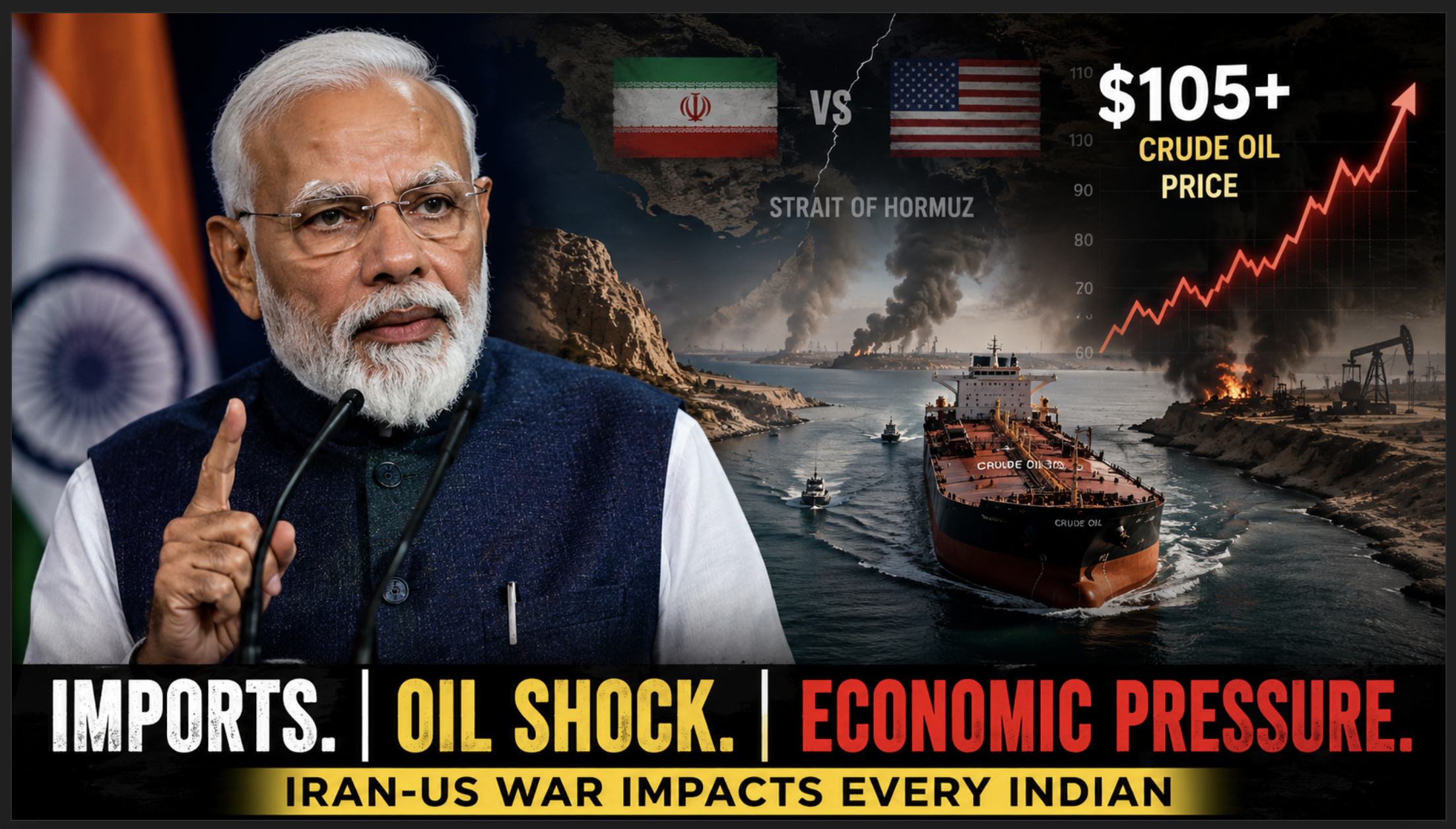
Modi reduce imports amid Iran-US war has suddenly become one of the biggest economic concerns for India as crude oil prices cross $105 a barrel and pressure builds on the rupee, fuel costs, and foreign exchange reserves.PM Modi urges Indians to reduce dependence on imported goods as the Iran-US war disrupts the Strait of Hormuz and pushes crude oil above $105/barrel. Here’s what the crisis is, why it happened, and what changes if India actually listens.
Table of Contents
1. Modi Reduce Imports Amid Iran-US War: 7 Big Risks for India
2. The Strait of Hormuz Closure: Why It Matters So Much
3. Modi Reduce Imports Amid Iran-US War What Exactly Is Modi Asking Citizens to Do?
4. What Happens If India Actually Follows Through
5. This Playbook Has Been Used Before
6. Can Personal Behaviour Really Move Macro Numbers?
7. Frequently Asked Questions (FAQ)
8. References & External Links
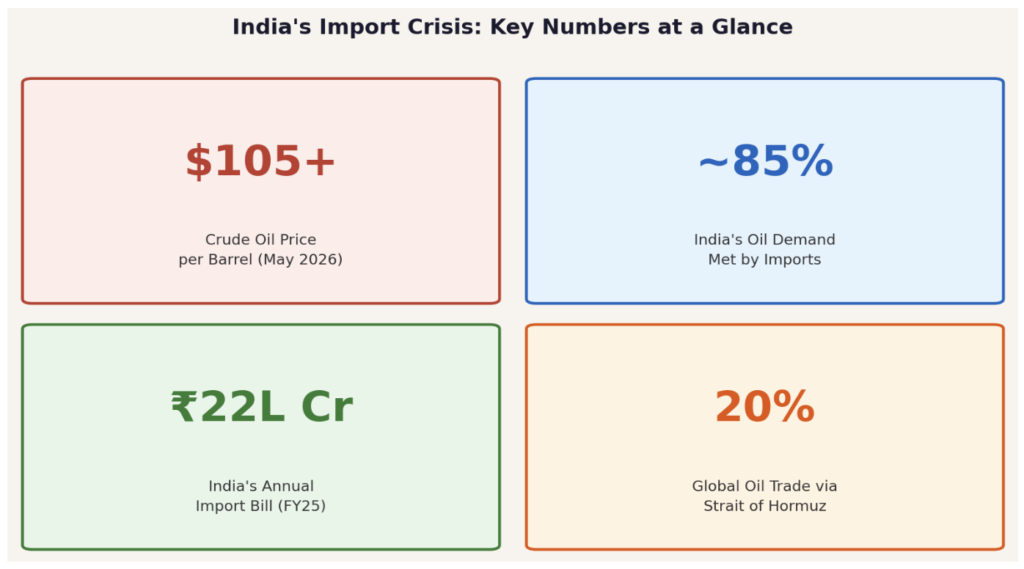
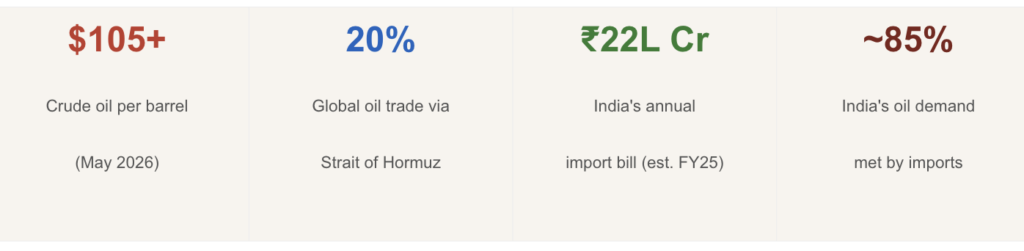
Crude oil crossed $105 a barrel last week. The Strait of Hormuz — through which roughly 20% of the world’s traded oil passes — has been effectively shut since Iran-US hostilities escalated two months ago. And on Monday, Prime Minister Narendra Modi stood before an audience in Gujarat and asked something Indian leaders rarely ask citizens directly: stop buying things from abroad.
Not a tariff. Not a trade policy. A personal appeal — reduce imports, cut fuel use, skip the foreign holiday this year, and don’t buy gold for the next twelve months.The Modi reduce imports amid Iran-US war message reflects growing concern over India’s rising import bill and energy vulnerability.
Modi’s call to reduce dependence on imported goods comes as India’s foreign exchange reserves face mounting pressure from surging crude oil prices triggered by the Iran-US war. The appeal wasn’t a one-off. Over the past week he has repeated versions of it at a BJP rally in Hyderabad, in televised addresses, and now at an official government event. That pattern signals something beyond political messaging.
1. Modi Reduce Imports Amid Iran-US War: 7 Big Risks for India
The immediate trigger for the current conflict traces back to a breakdown in nuclear negotiations between Washington and Tehran that had been deteriorating since early 2025. Iran had been steadily expanding its uranium enrichment capacity — reportedly reaching 60% purity at the Fordow facility — while the Biden-era framework for reviving the JCPOA remained in limbo.
When Donald Trump returned to the White House in January 2025, his administration took a sharply maximalist position: full dismantlement of Iran’s nuclear infrastructure, not just limitations. Iran’s counter-proposal — transferring a portion of its enriched uranium stockpile to a neutral third country, possibly Turkey or Oman — was rejected by Trump as “unreasonable.” That rejection, coupled with new US sanctions targeting Iranian oil exports and financial systems, produced a rapid escalation.
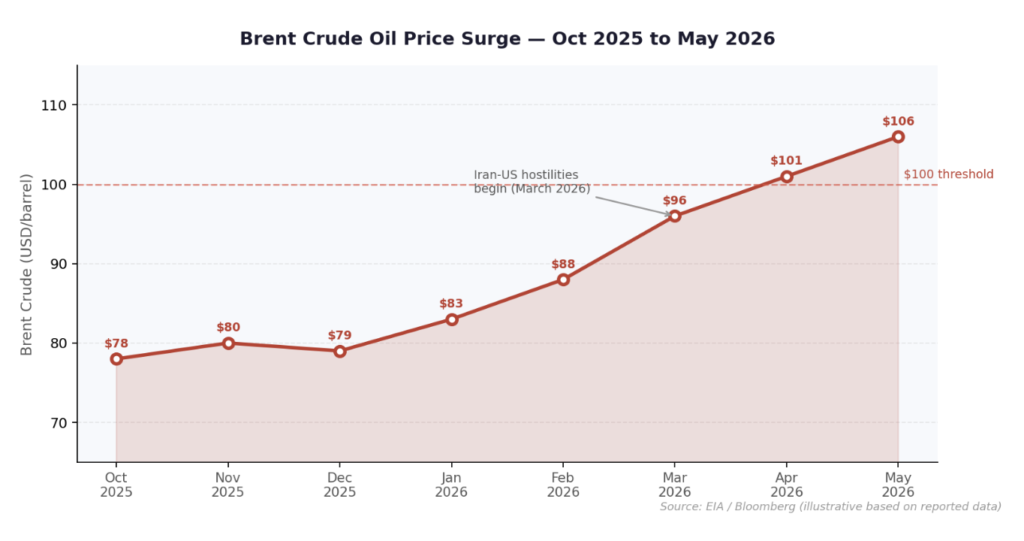
Military hostilities broke out in early March 2026. Iran responded to US strikes on its nuclear sites by closing the Strait of Hormuz to international shipping — a move that sent global markets into immediate convulsion. Two months later, no peace framework is in sight.
“The West Asia crisis is one of the worst in the decade; just as we overcame COVID-19, we will come out of this also.” — PM Narendra Modi, Gujarat, May 12, 2026
For India, the arithmetic is stark. The country imports roughly 85% of its crude oil needs — approximately 5 million barrels per day. A sustained $30-per-barrel spike in oil prices translates to an additional import burden of roughly $55 billion annually. That hits the current account, weakens the rupee, fuels domestic inflation, and erodes foreign exchange reserves simultaneously.
2. The Strait of Hormuz Closure: Why It Matters So Much
The Strait of Hormuz is a 33-kilometre-wide channel between Iran and Oman. It is the single most critical oil chokepoint on the planet. Saudi Arabia, UAE, Iraq, Kuwait, and Iran itself route the bulk of their exports through it. In 2024, approximately 21 million barrels of oil per day passed through the strait — roughly one in every five barrels traded globally.Economists say the Modi reduce imports amid Iran-US war appeal is closely linked to fears of prolonged disruption in global oil supply chains.
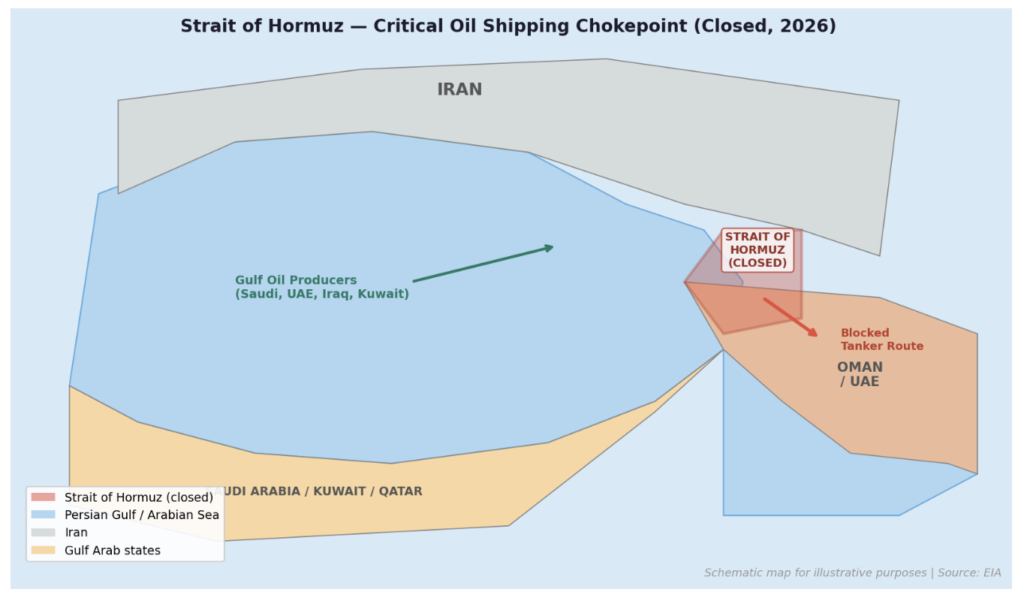
When Iran effectively halted safe passage in March, tanker insurance rates for the Persian Gulf spiked to levels not seen since the 1980s tanker wars. Several major shipping insurers suspended coverage entirely. Saudi Arabia and the UAE began diverting some exports through the Petroline pipeline and the Abu Dhabi Crude Oil Pipeline (ADCO) — but combined, these bypass routes can handle only about 6.5 million barrels per day, far short of the strait’s normal volume.
The gap has to come from somewhere: higher prices, reduced supply, or both. Global strategic petroleum reserves have been tapped, but at current rates of drawdown, most IEA member states have reserves covering fewer than 90 days of normal consumption.
3.Modi Reduce Imports Amid Iran-US War What Exactly Is Modi Asking Citizens to Do?
Modi’s Gujarat address was unusual for its specificity. He didn’t speak in abstractions about national resilience. He named categories — gold, foreign travel, imported electronics, foreign exchange spending — and put a timeline on at least one of them. The full list of asks across his recent public appearances:
- Avoid purchasing gold for at least 12 months
- Postpone non-essential foreign travel
- Switch to work-from-home where possible to reduce fuel consumption
- Reduce use of imported consumer goods in daily life
- Conserve fuel — drive less, use public transport
- Avoid activities that involve foreign exchange spending domestically
- Prioritise Indian-made alternatives where available
“India spends lakhs of crores of rupees in foreign exchange to import many products from abroad. At the same time, the prices of imported goods are soaring, and global supply chains have also been severely disrupted,” Modi said.
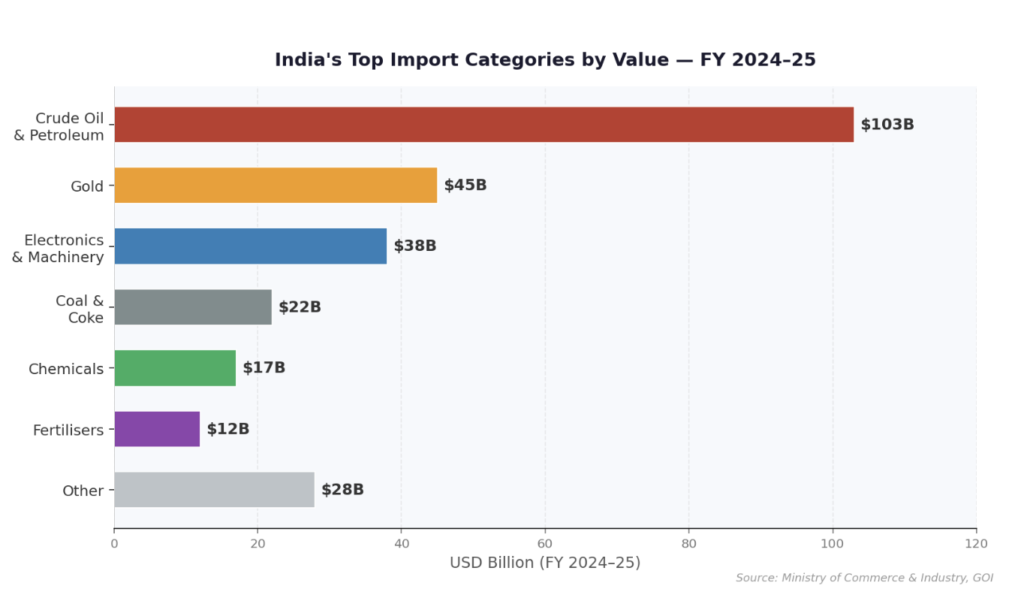
Gold and foreign travel together account for two of India’s largest non-oil import expenditures. In FY25, India imported approximately $45 billion worth of gold. Outbound tourism spending added another $20–25 billion in forex outflows. If even a fraction of those categories contract, the pressure on the current account eases measurably.
4. What Happens If India Actually Follows Through
The honest answer is: probably more than sceptics assume, less than optimists claim.
India’s import bill in FY25 was approximately ₹22 lakh crore ($265 billion). Crude oil and petroleum products alone accounted for roughly 28% of that. No amount of citizen behaviour change touches that oil bill directly — India’s industries need to run, power plants need fuel, and there’s no short-term substitution at scale.
Impact scenario: If gold imports fall 30%
That saves approximately $13–14 billion in annual forex. Equivalent to nearly three months of India’s IT services export earnings being redirected to stabilise the current account — and directly relieves pressure on the rupee.
Work-from-home has a slightly more measurable effect. During COVID lockdowns of 2020, India’s daily fuel consumption fell by approximately 60–70% at peak. Even a 10–15% sustained reduction in urban commuting would cut petrol and diesel import demand by several hundred thousand barrels per day — a figure that starts to appear in official data within a quarter.The Modi reduce imports amid Iran-US war strategy also targets non-essential forex outflows such as gold imports and overseas spending.
The rupee is the real transmission mechanism here. If foreign exchange outflows on gold, travel, and non-essential imports slow, the pressure on the rupee eases. A stronger rupee directly reduces the cost of all dollar-denominated imports — including the oil that India has no choice but to buy.
5. This Playbook Has Been Used Before
Modi explicitly invoked historical precedent in his Gujarat address, referencing earlier decades when Indian citizens answered government appeals during wartime or crisis conditions. He isn’t wrong about the history.
During the 1965 and 1971 wars with Pakistan, the Indian government ran food-conservation and resource-saving campaigns that had measurable public uptake — aided partly by limited consumer choice and partly by a genuine sense of national emergency. The 1991 balance-of-payments crisis produced a different dynamic: with reserves down to barely three weeks of import cover, India pledged gold physically to the Bank of England and IMF as collateral for emergency loans.
The COVID-19 analogy that Modi used is rhetorically useful but structurally different. Pandemic response involved collective sacrifice with a public health logic most people could understand intuitively. Economic sacrifice is harder to make tangible; the connection between one family skipping a foreign holiday and the national current account is not something most households feel directly.
6. Can Personal Behaviour Really Move Macro Numbers?
The macroeconomic reality is that India’s vulnerability to the Iran-US war stems from structural factors that citizen behaviour cannot fix. India’s oil dependency is a product of decades of underinvestment in renewable energy at scale, a transport infrastructure built around petroleum, and an electricity grid that still relies heavily on coal and gas for baseload. The Iran crisis has simply compressed the timeline on decisions that were always going to become unavoidable.
Modi’s appeals are partly about optics — demonstrating that the government is mobilising all levers, including public sentiment. But they also contain a genuine economic logic at the margins. India runs a current account deficit. Every dollar saved on discretionary foreign exchange spending is a dollar that doesn’t need to be sourced from reserves or propped up through RBI intervention in currency markets.
The bigger unknown is how long the Iran-US standoff continues. Trump’s rejection of Tehran’s latest proposal — the partial uranium transfer plan — has pushed negotiations effectively back to zero. Iran’s supreme leader has publicly rejected dismantling nuclear infrastructure as a red line. Without a meaningful diplomatic off-ramp, the Strait of Hormuz situation could persist through the rest of 2026 and possibly into 2027. That’s the scenario Modi’s economic team is clearly preparing for, even if the public messaging remains optimistic.If oil prices remain elevated through 2026, the Modi reduce imports amid Iran-US war campaign could become a larger economic policy push.
7. Frequently Asked Questions (FAQ)
Q: Why is Modi asking people to avoid buying gold?
India is the world’s second-largest gold consumer. In FY25, India spent approximately $45 billion on gold imports alone. Reducing gold purchases directly reduces pressure on the rupee and the current account deficit — both of which are under severe stress due to the oil price surge triggered by the Iran-US war.
Q: What is the Strait of Hormuz and why does its closure affect India?
The Strait of Hormuz is a 33-km-wide waterway between Iran and Oman through which ~21 million barrels per day of oil is normally traded — roughly 20% of global supply. Iran’s effective closure since March 2026 has drastically reduced global oil availability, pushing crude prices above $105/barrel. Since India imports ~85% of its oil, this directly inflates India’s import bill, weakens the rupee, and increases fuel and commodity costs domestically.
Q: How did the Iran-US war begin?
The conflict escalated from a collapse in nuclear negotiations. Trump’s administration demanded full dismantlement of Iran’s nuclear facilities; Iran offered only a partial solution (transferring some enriched uranium abroad). Trump rejected this as “unreasonable.” US strikes on Iranian nuclear sites followed, and Iran retaliated by closing the Strait of Hormuz. Hostilities have continued for over two months with no peace framework in sight.
Q: What will happen if India follows Modi’s advice?
At the margins, it could meaningfully ease pressure on India’s foreign exchange reserves. A 30% fall in gold imports saves ~$13–14 billion in forex annually. Sustained WFH adoption could reduce fuel demand by hundreds of thousands of barrels per day. Neither changes India’s structural oil dependency, but together they could slow the drain on reserves and reduce rupee depreciation pressure while global supply chains remain disrupted.
Q: Has India faced a similar foreign exchange crisis before?
Yes. The most severe was in 1991, when India’s forex reserves fell to barely three weeks of import cover. The government physically pledged gold to the Bank of England and IMF for emergency loans — an event that triggered India’s landmark economic liberalisation. Modi’s team is evidently trying to act well before reserves approach that stress point.
Q: Why is Modi reduce imports amid Iran-US war becoming a major issue?
India’s total merchandise import bill in FY25 was approximately ₹22 lakh crore (~$265 billion). Crude oil and petroleum products constituted roughly 28% of that. At current elevated prices, that share in FY26 could be closer to 32–35%, representing an additional burden of $40–55 billion over FY25 levels.
8. References & External Links
External Authority Sources:
[1] International Energy Agency (IEA) — Oil Market Report, May 2026 → Link
[2] US Energy Information Administration — World Oil Transit Chokepoints → Link
[3] Reserve Bank of India — Foreign Exchange Reserves Weekly Statistical Supplement → Link
[4] Ministry of Commerce & Industry, Government of India — Trade Statistics Portal → Link
[5] IMF World Economic Outlook — April 2026 → Link
[6] IISS — Iran Nuclear Programme and JCPOA Status Report 2025–26 → Link
[7] Bloomberg / Reuters — Brent Crude Price Data, March–May 2026 (reported figures)
[8] Petroleum Planning & Analysis Cell (PPAC), GOI — India’s Crude Import Data → Link