
Introduction: A Missile Born in India
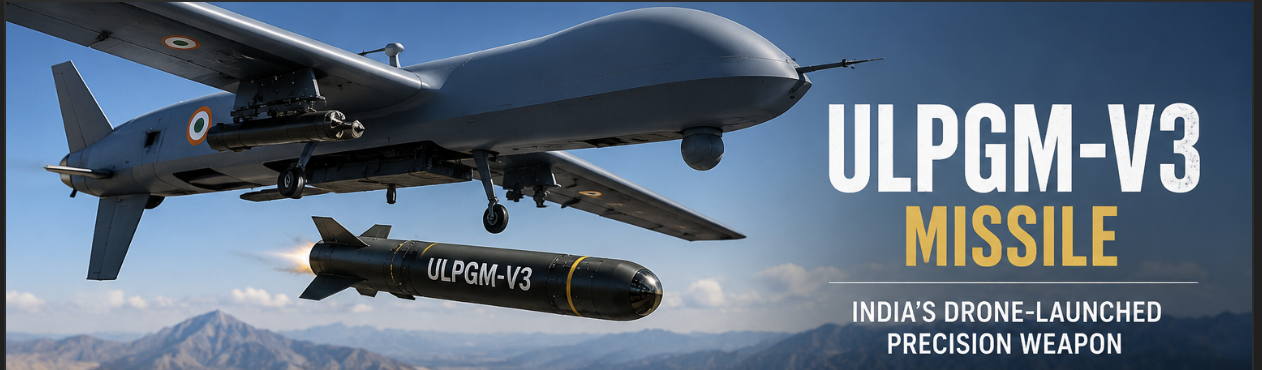
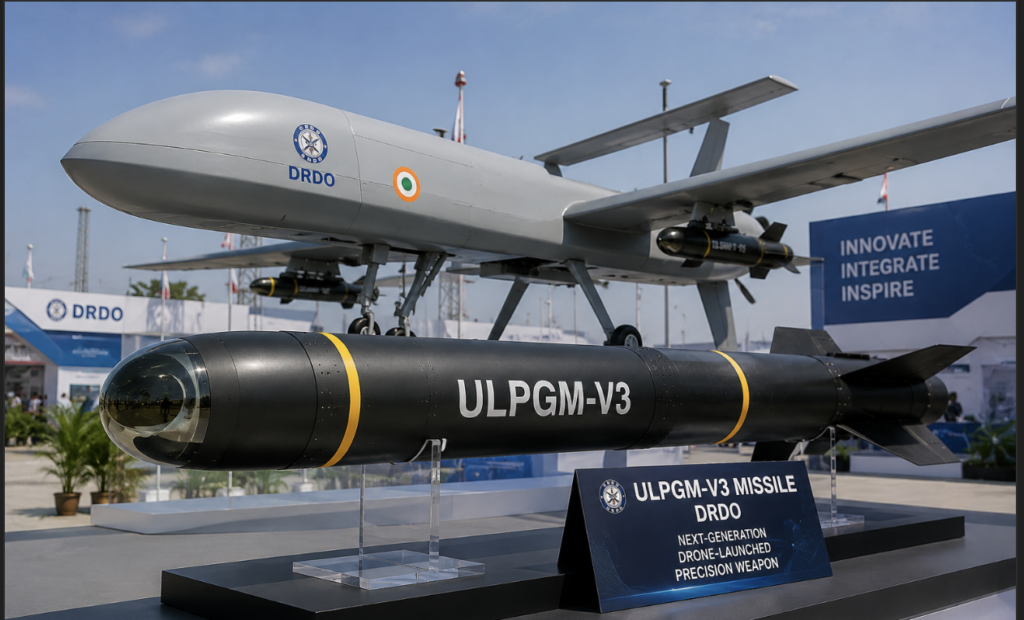
ULPGM-V3 missile is India’s newest drone-launched precision guided missile developed by DRDO for modern battlefield operations. On 19 May 2026, a quiet test range near Kurnool in Andhra Pradesh bore witness to something India’s defence establishment had been building toward for years. A drone climbed to altitude, a missile detached, hurtled toward its target — and hit. The ULPGM-V3 — Unmanned Aerial Vehicle Launched Precision Guided Missile, Version 3 — had just passed its final configuration development trials, validating it in both Air-to-Ground and Air-to-Air combat modes.
This was not merely a successful weapons test. It was proof that India’s defence industrial ecosystem — laboratories, private firms, MSMEs, startups — can now conceptualise, design, build, and validate a sophisticated precision weapon entirely within its own borders. The supply chain is mature. Serial production can begin immediately. And Defence Minister Rajnath Singh wasted little time calling it a ‘strategic milestone’ towards Aatmanirbharta in defence.
The broader context matters. Russia’s war in Ukraine has exposed how dangerously dependent nations can become on foreign suppliers for spare parts and ammunition. India, with roughly 70 percent of its military hardware historically sourced from Russia, has had a front-row seat to that lesson. The ULPGM-V3’s success is, in part, a direct response to that vulnerability.
What exactly is this missile, how does it work, what can it destroy — and how does India intend to use it? That is what this analysis unpacks.
What Is the ULPGM-V3 Missile? Technology Explained
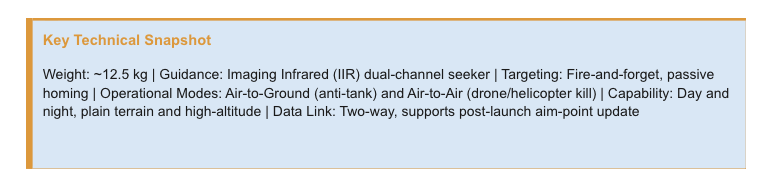
The ULPGM-V3 is a lightweight, UAV-launched, fire-and-forget precision guided missile developed by India’s Defence Research and Development Organisation. It weighs approximately 12.5 kg, making it compact enough to be slung under mid-size tactical drones without significantly compromising the platform’s endurance or manoeuvrability.
The missile is the third generation of DRDO’s ULPGM programme. Its predecessor, the ULPGM-V2, had already been developed and delivered. The V3 represents a significant upgrade in guidance precision, warhead versatility, and — crucially — its dual-role capability to engage both ground and aerial targets.
Also referred to as the ULM-ER (Unmanned Launched Munition – Extended Range), the system was publicly displayed for the first time at Aero India 2025 in Bengaluru in February 2025, before completing its earlier anti-armour flight trials in July 2025 and its final deliverable configuration trials in May 2026.
Key Technical
ULPGM-V3 Missile Guidance and Seeker Technology
At the heart of the ULPGM-V3 is its high-definition dual-channel seeker. This imaging infrared (IIR) system enables passive homing — the missile does not emit radar signals that might alert the target. It acquires and locks onto heat signatures and visual/thermal contrast, then guides itself to the aim-point.
The fire-and-forget capability means the launching platform — the drone — does not need to maintain a lock on the target after release. The operator can turn away, seek cover, or engage secondary threats. This dramatically reduces the UAV’s exposure window and the operator’s workload.
The two-way data link is a significant additional capability. Even after launch, the operator can transmit an updated aim-point if the target moves or a higher-value target is identified. This mid-course correction facility adds flexibility that older one-way-link missiles lack.
ULPGM-V3 Missile Components and Sub-Systems Explained
1. Imaging Infrared (IIR) Dual-Channel Seeker
The seeker is the missile’s eye. It operates in the infrared spectrum, detecting thermal signatures of armoured vehicles, aircraft engines, and rotor heat. The dual-channel configuration provides redundancy and improves discrimination between genuine targets and decoy flares or background clutter. DRDO’s high-definition classification means the seeker can distinguish target type — tank versus helicopter — and select the most lethal aim-point on that target (engine compartment, fuel tanks, etc.).
Day-and-night capability is intrinsic to IIR technology since heat signatures are equally strong regardless of ambient light. The seeker is housed in a hardened dome at the missile’s nose, protected against aerodynamic heating and mechanical stress during launch.
2. Guidance and Control Computer (GCC)
After target lock, the GCC takes over. It processes seeker data using a Kalman filter-based tracking algorithm, fusing Inertial Navigation System (INS) data with live IIR input. The INS component ensures the missile maintains its trajectory even during momentary seeker loss — such as when a tank passes behind foliage or when a helicopter uses terrain masking.
The two-way data link feeds updated target coordinates or aim-point corrections from the GCS into the GCC mid-flight. This is the missile’s ‘man-in-the-loop’ override — useful in urban environments where positive identification of targets is legally and operationally critical.
3. Modular Warhead Section
This is the ULPGM-V3’s most operationally flexible feature. Three warhead options are available, and they are designed to be swapped depending on the mission:
- Anti-Armour Warhead: A shaped charge designed to penetrate Rolled Homogeneous Armour (RHA) even when protected by Explosive Reactive Armour (ERA). The tandem-charge design defeats ERA by triggering it with a precursor charge before the main jet penetrates the primary armour.
- Penetration-Cum-Blast (PCB) Warhead: Designed for hardened targets such as bunkers, command posts, and reinforced field fortifications. The penetrator punches through the structure’s skin before the blast warhead detonates inside.
- Pre-Fragmentation Warhead: For use against soft-skinned vehicles, troops in the open, radar arrays, and drone swarms. The controlled fragmentation generates a high-lethality kill zone.
4. Solid Rocket Motor (Propulsion)
Developed by the High Energy Materials Research Laboratory (HEMRL) in Pune, the propulsion system uses a compact solid-fuel rocket motor. Solid propellant is preferred for tactical missiles because it requires no pre-launch fuelling, has a long shelf life, and is significantly safer than liquid-fuel alternatives in field conditions. The motor provides the burst of energy needed to bring the missile to terminal velocity before the seeker takes over guidance.
5. Airframe and Aerodynamic Fins
The Defence Research & Development Laboratory (DRDL) in Hyderabad handled aerodynamic design. The missile’s body is optimised for low drag at the engagement velocities typical of its combat envelope. Folding fins deploy after launch to stabilise the missile’s flight without creating drag while still attached to the UAV’s hardpoint.
6. Carrier UAV (Newspace Research Technologies)
The integration UAV for current trials is developed by Newspace Research and Technologies, a Bengaluru-based aerospace startup. The UAV provides a stable launch platform and transmits real-time EO/IR (electro-optical/infrared) video to the GCS operator, who uses this feed to designate the target before missile release. DRDO is pursuing integration with additional UAV platforms from other Indian companies to expand the missile’s deployment options across longer-range, higher-endurance drones.
7. Ground Control Station (GCS)
The GCS is the nerve centre of the weapon system. DRDO described it as incorporating ‘state-of-the-art technologies to automate readiness and launch operations.’ In practice, this means the GCS handles pre-launch Built-In-Test (BIT) sequences automatically, reducing human error and launch preparation time. The operator focuses on target identification, designation, and the launch decision — the system manages the weapon’s technical readiness.
The GCS also manages the two-way data link, giving the operator the ability to abort or redirect the missile until just before terminal impact. This human-in-the-loop architecture is critical for adherence to international norms on autonomous weapons.
ULPGM-V3 Missile Spare Parts and Supply Chain Strategy
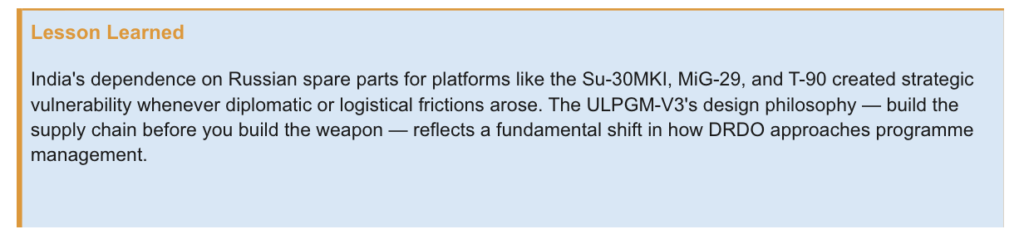
India’s defence establishment has a complicated history with spare parts. The country spent decades in a cycle familiar to developing nations: import the platform, struggle for the spares. The ULPGM-V3 was deliberately architected to break that cycle.
The Indigenisation Mandate
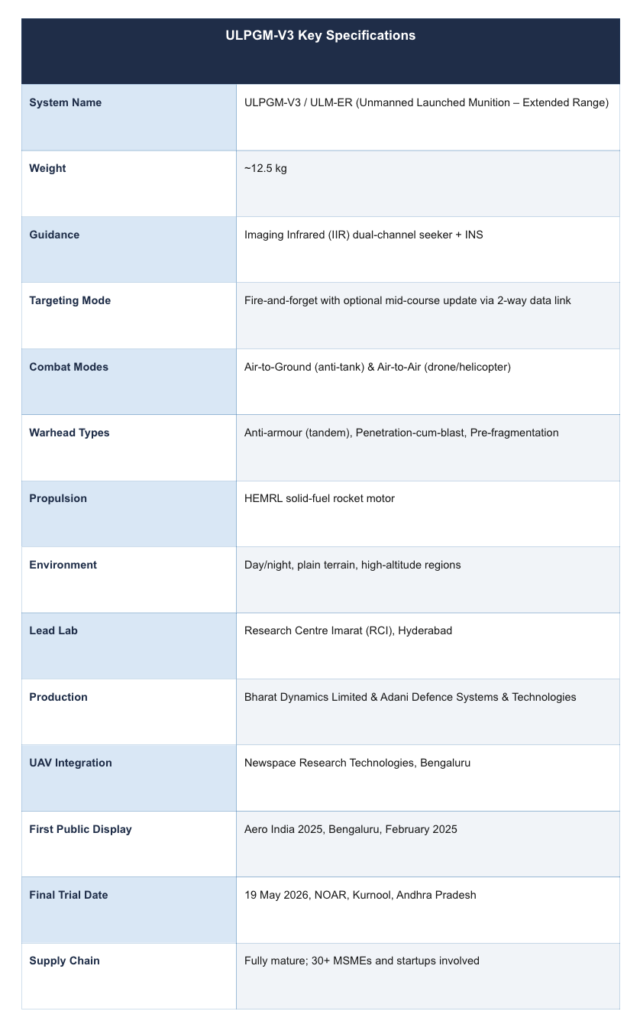
DRDO confirmed after the May 2026 trials that the supply chain for ULPGM-V3 missile is ‘fully mature’ and capable of ‘immediate serial mass production.’ That is not a vague bureaucratic claim — it reflects a deliberate design philosophy that began during development. Every sub-system was developed alongside a domestic manufacturing partner, with the explicit intention of enabling local spares production.
Approximately 30 MSMEs and startups were involved in building the ULPGM-V3 missile system, spread across propulsion components, seeker optics, guidance electronics, airframe fabrication, and warhead filler. This distributed supply base ensures that no single vendor failure can ground the fleet.
How Spares Will Be Managed
- Dedicated Spares Inventory: BDL and Adani Defence, as designated production agencies, will maintain rolling inventories of Line Replaceable Units (LRUs) — the modular sub-assemblies that can be swapped in the field without depot-level maintenance.
- MSME Tier-2 Suppliers: Tier-2 component suppliers — optics, electronic assemblies, propellant mixes — are contracted under long-term framework agreements. This prevents the single-point sourcing failures that have historically plagued imported platforms.
- Modular Warhead Logistics: The swappable warhead design simplifies forward-area logistics. A unit in the field can switch from anti-armour to penetration-cum-blast configuration by changing the warhead module — no specialist tools, no depot turnaround.
- HEMRL Propellant Production: The solid rocket motor propellant is produced by HEMRL Pune, which is an established government facility. Propellant shelf-life is managed through a batch-coded rotation system, ensuring that older stock is consumed before newer production.
- TBRL Warhead Testing: Terminal Ballistics Research Laboratory in Chandigarh handles ongoing warhead qualification testing, ensuring that production batches from BDL and Adani Defence meet performance standards consistently.
- Lifecycle Support Contracts (LSC): Under DAP 2020 provisions, production contracts will include mandatory lifecycle support arrangements, requiring manufacturers to guarantee spares availability for a defined period post-induction.
Operational Deployment of the ULPGM-V3 Missile
The ULPGM-V3’s versatility — engaging both ground armour and aerial targets — gives Indian military planners options that did not exist before. But the missile is only as effective as the doctrine built around it. Here is how India is likely to employ the system across its three major operational theatres.
Western Front: Pakistan Theatre
The plains and semi-arid terrain of Rajasthan and Punjab are ideal for armour and infantry operations. Pakistan’s armoured formations — Abrams-era T-80UDs and Al-Zarar tanks — represent a credible threat. ULPGM-V3 missile -armed UAVs can be pre-positioned well behind the Line of Contact, loiter over likely avenues of approach, and engage tank formations as they concentrate for breakthrough operations.
The Air-to-Air mode adds a layer the Indian Army previously lacked: the ability to counter Pakistan’s growing Chinese-origin drone fleet, including Wing Loong IIs and CH-4s. An ULPGM-V3 missile -armed patrol drone can engage an incoming enemy ISR drone before it locates Indian troop positions — a mission set that currently has no indigenous solution at this price point.
Northern Front: China/Ladakh Theatre
High altitude is where the ULPGM-V3’s design choice to validate performance in elevated terrain pays off. Chinese PLA armour and mechanised infantry in the Galwan and Depsang sectors present genuine threats that helicopter-launched missiles struggle to reach efficiently given the altitude effects on rotorcraft performance. A UAV does not suffer the same constraints — it can loiter at altitude indefinitely and engage targets at ranges its carrier platform can reach safely.
China’s own drone fleet — including TB-001 and Wing Loong variants observed near the LAC — presents a growing ISR and strike threat. ULPGM-V3-equipped Indian UAVs could provide the Army’s newly-formed drone formations with an organic counter-drone capability at the forward edge of the battle area.
Maritime Application
While not the primary application, the Air-to-Air mode with the pre-fragmentation warhead has potential utility against low-flying anti-ship cruise missiles at very short range, or against enemy maritime patrol drones. Naval integration would require additional qualification trials, but the technological pathway is clear.
Counter-Terror and Sub-Conventional Operations
The missile’s man-in-the-loop architecture — via the two-way data link — makes it suitable for high-value target (HVT) strikes in counter-insurgency or counter-terror environments where positive identification before strike is legally and politically essential. The ability to abort after launch until the very last moment gives commanders a level of control that unguided rockets or direct-fire weapons cannot offer.
ULPGM-V3 Missile Operational and Strategic Significance
Filling the Anti-Tank Gap
India’s anti-tank missile inventory has historically depended on the MILAN (French), Konkurs and Invar (Russian), and HELINA/Dhruvastra (indigenous but helicopter-launched). None of these could be launched from a small tactical UAV. ULPGM-V3 fills a genuine capability gap: precision anti-armour effect delivered by a platform that costs a fraction of a helicopter to operate and can be deployed in greater numbers.
Counter-Drone Architecture
Drone warfare has reshaped every modern conflict since Nagorno-Karabakh 2020. India observed how Azerbaijan’s Bayraktar TB2 and Israeli loitering munitions destroyed Armenian armour systematically. Ukraine has since taken that lesson further. India’s own experience in the Ladakh standoff underscored the need for organic drone and counter-drone capacity at formation level. ULPGM-V3 provides a cost-effective kinetic counter to enemy UAVs, complementing electronic warfare solutions.
Supply Chain Sovereignty
From a strategic supply chain perspective, the ULPGM-V3’s mature domestic supplier base means India can produce this weapon at scale independent of any foreign political situation. That is strategically significant. In a two-front conflict scenario — the contingency India’s military plans around — the ability to sustain munitions expenditure without waiting for foreign approvals or facing export restrictions is not a luxury; it is a prerequisite for credible deterrence.
Best Employment Doctrine: How to Use ULPGM-V3 Most Effectively
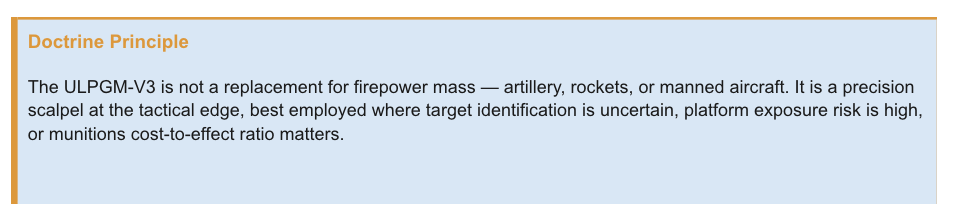
Possessing the weapon is one thing. Integrating it into doctrine effectively is another. The following framework draws on lessons from modern drone warfare to outline how Indian formation commanders can get the most from ULPGM-V3.
Paired Platform Operations
Pair one ULPGM-V3-armed attack UAV with one ISR-optimised surveillance drone. The surveillance drone identifies, classifies, and prioritises targets while remaining at a safe distance. The attack UAV, receiving targeting data via the GCS’s communications layer, approaches from a masked azimuth and engages. This division of labour protects the relatively expensive attack UAV from premature exposure.
Saturation Sequencing Against Armour
Against a concentrating armoured formation, do not engage with a single missile. Hold fire until 4–6 targets are identified and prioritised. Then sequence rapid engagements — the first missile’s strike creates confusion and halts manoeuvre, the second and third exploit the static targets and disabled lead vehicles that are now blocking the formation’s movement. The ULPGM-V3’s fire-and-forget capability means the UAV can ripple-fire, reposition, and repeat without remaining over the target area.
High Altitude Loiter Reserves
In the Ladakh sector, position ULPGM-V3-armed UAVs as a dedicated loiter reserve at 4,500+ metres, beyond visual range of forward deployed troops. Activate only when armoured or drone threats are confirmed. This preserves battery/fuel and maintains the element of surprise — an enemy that cannot detect the UAV cannot take evasive action or activate countermeasures.
Counter-Drone Patrol Corridors
Designate UAV air patrol corridors at likely enemy drone ingress vectors — typically valleys, ridgelines, and corridors where terrain masking limits radar coverage. A single ULPGM-V3-armed drone on patrol in such a corridor provides a layered defence against enemy reconnaissance drones at minimal cost per patrol hour relative to fighter aircraft or MANPADS systems.
Urban and Sub-Conventional Environment
Employ the man-in-the-loop mode exclusively in populated areas or politically sensitive environments. The PCB warhead’s limited blast radius reduces collateral damage relative to larger munitions. Always maintain abort capability until positive identification is confirmed by the operator. Integrate ULPGM-V3 strikes with real-time feeds from surveillance assets to maintain proportionality and legal compliance under Laws of Armed Conflict.
Signalling and Deterrence
The May 2026 trials occurred in a charged geopolitical environment — weeks after the Pahalgam attack, Operation Sindoor, and the subsequent ceasefire. India’s public demonstration of an indigenous precision strike capability is not operationally neutral. It signals to adversaries that India’s precision guided munitions inventory is no longer primarily dependent on foreign suppliers who might impose restrictions during a conflict. The ULPGM-V3 is both a weapon and a statement.
Best Employment Doctrine for the ULPGM-V3 Missile
Possessing the weapon is one thing. Integrating it into doctrine effectively is another. The following framework draws on lessons from modern drone warfare to outline how Indian formation commanders can get the most from ULPGM-V3.
Paired Platform Operations
Pair one ULPGM-V3-armed attack UAV with one ISR-optimised surveillance drone. The surveillance drone identifies, classifies, and prioritises targets while remaining at a safe distance. The attack UAV, receiving targeting data via the GCS’s communications layer, approaches from a masked azimuth and engages. This division of labour protects the relatively expensive attack UAV from premature exposure.
Saturation Sequencing Against Armour
Against a concentrating armoured formation, do not engage with a single missile. Hold fire until 4–6 targets are identified and prioritised. Then sequence rapid engagements — the first missile’s strike creates confusion and halts manoeuvre, the second and third exploit the static targets and disabled lead vehicles that are now blocking the formation’s movement. The ULPGM-V3’s fire-and-forget capability means the UAV can ripple-fire, reposition, and repeat without remaining over the target area.
High Altitude Loiter Reserves
In the Ladakh sector, position ULPGM-V3-armed UAVs as a dedicated loiter reserve at 4,500+ metres, beyond visual range of forward deployed troops. Activate only when armoured or drone threats are confirmed. This preserves battery/fuel and maintains the element of surprise — an enemy that cannot detect the UAV cannot take evasive action or activate countermeasures.
Counter-Drone Patrol Corridors
Designate UAV air patrol corridors at likely enemy drone ingress vectors — typically valleys, ridgelines, and corridors where terrain masking limits radar coverage. A single ULPGM-V3-armed drone on patrol in such a corridor provides a layered defence against enemy reconnaissance drones at minimal cost per patrol hour relative to fighter aircraft or MANPADS systems.
Urban and Sub-Conventional Environment
Employ the man-in-the-loop mode exclusively in populated areas or politically sensitive environments. The PCB warhead’s limited blast radius reduces collateral damage relative to larger munitions. Always maintain abort capability until positive identification is confirmed by the operator. Integrate ULPGM-V3 strikes with real-time feeds from surveillance assets to maintain proportionality and legal compliance under Laws of Armed Conflict.
Conclusion and Way Forward
The ULPGM-V3 missile represents a major advancement in India’s indigenous precision strike capability.
The ULPGM-V3 missile cleared its final hurdle in May 2026, but the harder work begins now. Serial production — even from a ‘mature’ supply chain — requires quality management, batch testing, and logistics infrastructure that takes time to scale. The Army and Air Force will need to build operator training pipelines, establish maintenance regimes, and integrate the system into formation-level doctrine before the weapon moves from test range to frontline.
There are also open questions. DRDO’s next step is integration with longer-range, higher-endurance UAV platforms beyond Newspace Research Technologies’ current offering. The more capable the carrier, the deeper the missile’s effective engagement range. A higher-endurance platform could, in theory, extend the ULPGM-V3’s tactical reach from a few kilometres to tens of kilometres of loiter-before-engagement.
Export potential is a secondary but real consideration. India’s defence export target — Rs 50,000 crore by 2028-29 — requires products competitive in the international market. A UAV-launched precision missile from a credible defence ecosystem, priced below Western equivalents, could find buyers across the Indo-Pacific, Middle East, and Africa, particularly among nations that already operate Indian-origin UAVs or are looking at Tier-2 defence partnerships with New Delhi.
The retired-equipment list documented in this analysis is simultaneously a lesson and a motivation. The HF-24 Marut died because India could not source engines. The MiG-21 bled pilots for decades because Russia could not or would not fully transfer spares technology. The Jaguar is still flying its last sorties partly because there is nothing ready to replace it and partly because buying back Oman’s decommissioned fleet for parts has become India’s only option. The ULPGM-V3 missile was built to ensure that none of its successors end up in that same graveyard.
What remains to be seen is how quickly India’s armed forces absorb the system into actual operational units, how production ramp-up compares to the Army’s stated requirements for drone-launched munitions, and whether the two-role (air and ground) capability proves as battle-proven in realistic wargaming environments as it did on the Kurnool test range. The science is done. The engineering is done. The industry is ready. The next chapter belongs to doctrine, training, and the quiet, unglamorous work of making a weapon system actually work at formation level.
Frequently Asked Questions (FAQs)
Q: What is the ULPGM-V3 missile ?
A: The ULPGM-V3 missile is India’s indigenously developed Unmanned Aerial Vehicle Launched Precision Guided Missile, Version 3. It is a fire-and-forget, dual-role missile capable of engaging both ground armour and aerial targets such as drones and helicopters.
Q: When did ULPGM-V3 missile complete its final trials?
A: The final deliverable configuration development trials were completed on 19 May 2026 at the National Open Area Range (NOAR) near Kurnool, Andhra Pradesh.
Q: How heavy is the ULPGM-V3 missile ?
A: The missile weighs approximately 12.5 kg, making it light enough for tactical UAV integration.
Q: What targets can ULPGM-V3 missile destroy?
A: In Air-to-Ground mode: tanks, armoured vehicles, and hardened bunkers. In Air-to-Air mode: enemy drones, helicopters, and other airborne threats.
Q: How does the fire-and-forget feature work?
A: After the operator designates a target and releases the missile, the onboard IIR seeker autonomously guides the weapon to impact. The launching UAV does not need to maintain a lock, freeing it to reposition or engage new targets. A two-way data link also allows mid-course corrections if needed.
Q: Who manufactures the ULPGM-V3 missile ?
A: Production partners are Bharat Dynamics Limited (BDL) and Adani Defence Systems & Technologies, both based in Hyderabad. Approximately 30 MSMEs and startups contribute sub-components.
Q: Which UAV carries the ULPGM-V3 missile ?
A: Current trials used a UAV developed by Newspace Research Technologies, Bengaluru. DRDO is pursuing integration with additional platforms.
Q: Can ULPGM-V3 missile be used at high altitude?
A: Yes. DRDO validated deployment capability in both plain terrain and high-altitude regions, making it relevant for the Ladakh theatre.
Q: Is ULPGM-V3 missile ready for serial production?
A: DRDO confirmed after the May 2026 trials that the supply chain is mature and capable of immediate serial mass production.
Q: What was India’s first public display of ULPGM-V3 missile ?
A: The system was first publicly displayed at Aero India 2025 in Bengaluru, in February 2025.
Authoritative External Reference Sources
- DRDO, Government of India — drdo.gov.in (Research Centre Imarat profile and programme updates)
- Bharat Dynamics Limited — bdl-india.in (production partner corporate disclosures)
- Business Standard Defence — defence coverage and DRDO programme tracking
- The Wire Science — independent analysis of DRDO programme milestones