The book that could reshape how India keeps its jets in the air
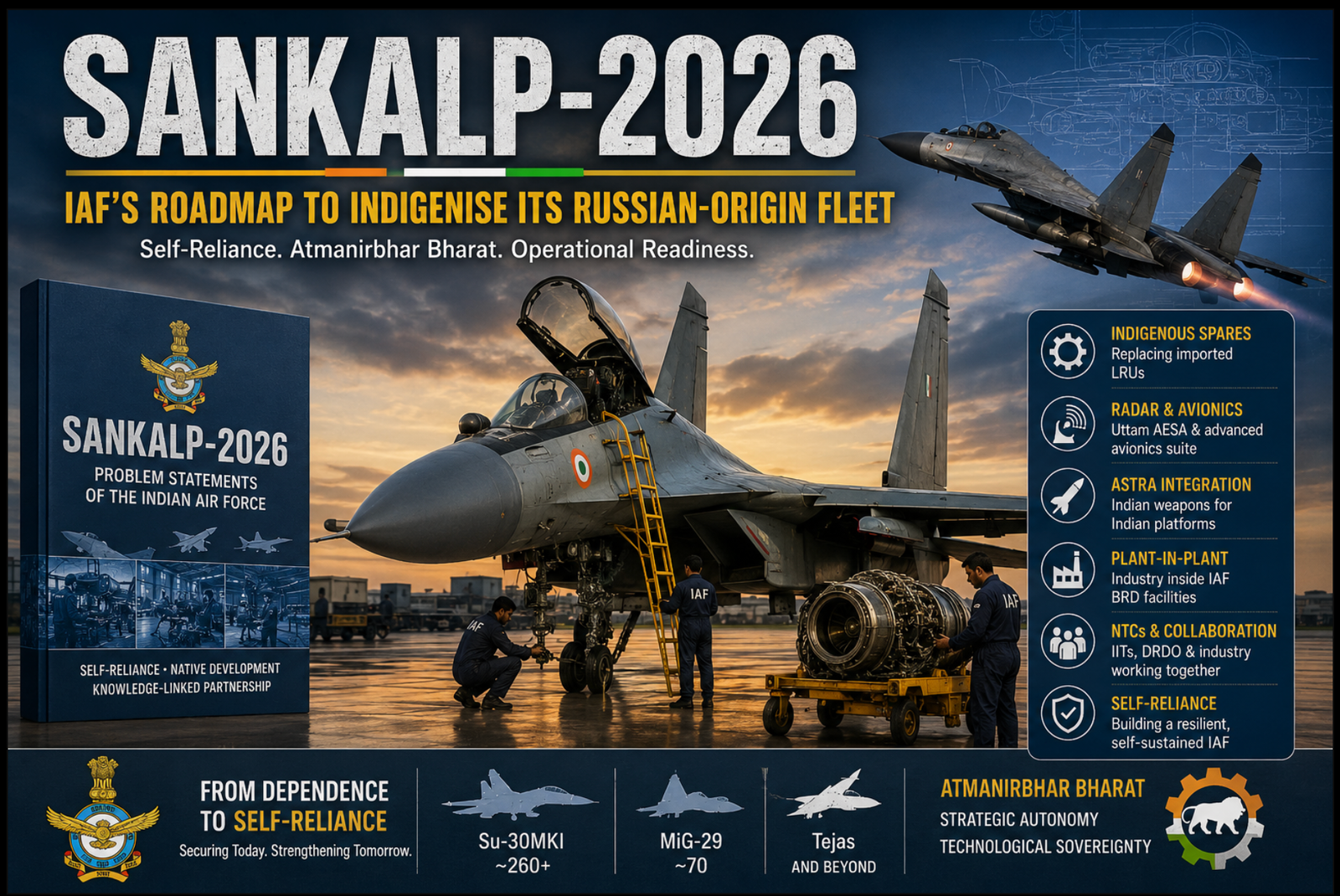
On 30 July 2026, in a New Delhi conference hall crowded with uniforms and industry lanyards, Minister of State for Defence Sanjay Seth held up a book and, in effect, handed Indian industry a to-do list. The book was Sankalp-2026: Problem Statements of the Indian Air Force — a compendium of everything the IAF wants built at home so it can stop waiting on foreign suppliers for the parts that keep its fighters flying. Air Chief Marshal AP Singh sat in the front row. So did the president of the Society of Indian Defence Manufacturers. The message was blunt: here are our gaps, come fill them.
Sankalp-2026 is not a procurement contract and it is not a weapons programme. It is closer to a shopping list written in the open — a signal to HAL, to the big private players and to hundreds of MSMEs about where the money and the urgency now sit. The acronym itself is a bit of a mouthful: Self-reliance, Atmanirbhar Bharat, Native Development and Knowledge-Linked Partnership. Strip away the branding and what remains is a maintenance crisis that the war in Ukraine turned from a slow worry into an immediate one.
Roughly 70 per cent of the IAF’s equipment is of Soviet or Russian origin, and when Russian factories pivoted to feeding their own war and Western sanctions tangled the payment routes, the spares pipeline that India had leaned on for four decades started to sputter. The compendium is the Air Force’s attempt to build a domestic substitute before that sputter becomes a stall.
Why Sankalp-2026 Became Unavoidable
India did not drift into Russian dependence — it chose it, deliberately, across the Cold War and well past it. The result is an air arm whose backbone speaks Russian. The Su-30MKI alone accounts for around 260 to 272 aircraft, built under licence at HAL’s Nashik line but reliant on Russian design authority for critical systems. Add the MiG-29 fleet and the picture sharpens.
The Russian-origin footprint, by the numbers
| Platform / system | Approx. numbers | Role | Sustainment pain point |
| Su-30MKI | ~260–272 (IAF) | Air dominance, strike | AL-31FP engine hot section, N011M Bars radar modules |
| MiG-29 UPG | ~65–70 (IAF) | Air defence | RD-33 engines, avionics LRUs |
| MiG-29K/KUB | ~40 (Navy) | Carrier fighter | High cannibalisation, low availability |
| Il-76 ‘Gajraj’ | ~14 (from 17) | Heavy lift / AWACS host | Availability once fell to ~32% |
| An-32 ‘Sutlej’ | ~100+ | Medium transport | Ukraine was the upgrade partner |
| Mi-17 / V5 family | 200+ (various) | Utility / medium lift | Engine and gearbox spares |
| Pechora (S-125) & SAMs | Multiple squadrons | Point air defence | Ageing Soviet-era electronics |
None of these fleets is easily walked away from. The Il-76 story is the cautionary one: procured between 1985 and 1989, its fleet availability dropped to a recorded low of around 32 per cent in one stretch of the last decade, forcing the IAF to cannibalise airframes just to keep a handful flying. That is what spare starvation looks like in practice — not a dramatic grounding, but a slow bleed of numbers.
Layered on top is a squadron shortfall the IAF has stopped trying to hide. The service is down to roughly 29–31 fighter squadrons against a sanctioned 42.5. Every jet lost to a missing part widens a gap that new inductions are struggling to close.
What the Ukraine war did to the spares pipeline
For decades the arrangement was simple. India ordered, Russia shipped, and the rupee-rouble arrangement smoothed the money. February 2022 broke the rhythm. Russian plants prioritised their own attrition-heavy front, Western sanctions boxed in the banks that once cleared defence payments, and shipments that used to take months began slipping into years.
- Supply disruption: Russian OEMs redirected output to domestic military needs, pushing Indian orders down the queue.
- Payment friction: Sanctions on Russian banks and the SWIFT cut-off made settling invoices a recurring headache.
- Spare delays: Lead times for engine parts, radar modules and avionics LRUs stretched well beyond contracted windows.
- Rising costs: Workarounds — third-country routing, alternate currencies — added a premium on top of already inflated wartime prices.
- Longer overhaul cycles: Depot-level servicing that depends on Russian sub-assemblies dragged, cutting into fleet availability.
The mechanics of this are unforgiving. A fighter grounded for a single unavailable Line Replaceable Unit is combat-ineffective no matter how healthy the rest of the airframe is. Multiply that across a fleet and mission-capable rates fall — which is precisely the pressure Sankalp-2026 is meant to relieve.
So what exactly is Sankalp-2026?
Think of it as a curated catalogue of problems the Air Force is willing to pay to have solved. The compendium lists equipment, spares and sub-systems that the IAF wants produced within India, arranged so that a private firm or a start-up can flip to the relevant section and see whether it can bid.
The stakeholder web behind it is dense, and that density is the point:
- IAF Base Repair Depots (BRDs): the depot-level maintenance backbone, roughly ten across the country, where much of the physical work happens.
- DRDO: design authority for indigenous radars, EW suites and missiles feeding the roadmap.
- DPSUs: HAL, BEL, BDL and others as production anchors.
- Private industry & MSMEs: the scale-up layer the IAF is openly courting.
- IITs & academia: partnered through Nodal Technology Centres for reverse-engineering and design support.
- SIDM, CEMILAC & DGAQA: industry coordination and the airworthiness certification gatekeepers.
The seminar closed not with speeches but with business-to-business tables — IAF officers, vendors and certification agencies sitting down together. That structure tells you the IAF has learned something: a problem statement without a certification pathway tends to die on the runway.
The core features, at a glance
| Feature | What it covers |
| Indigenous spares | Replacing imported Line Replaceable Units (LRUs) across engines, avionics and hydraulics |
| Radar upgrades | Uttam AESA for Tejas; Virupaksha AESA for the Super Sukhoi |
| EW suites | Indigenous electronic warfare and self-protection jammers |
| Astra integration | Home-built beyond-visual-range air-to-air missile across fleets |
| Plant-in-Plant | Private workforce embedded inside secure BRD facilities |
| Nodal Tech Centres | IIT and DRDO collaboration on critical-spare projects |
| Digital manufacturing | Reverse engineering, additive manufacturing, digital twins |
| Certification | CEMILAC / DGAQA airworthiness clearance built into the pipeline |
Fleet by fleet: where the work actually lands
Su-30MKI — the Super Sukhoi bet
The Su-30MKI is the fleet everything else orbits. It flies air dominance and deep strike, carries the BrahMos-A air-launched cruise missile, and runs on the AL-31FP turbofan — a Russian engine whose hot-section spares sit right at the centre of the supply worry. The answer is the Super Sukhoi upgrade, a roughly ₹63,000 crore (about $7.2 billion) programme to modernise 84 jets first, with follow-on tranches that could eventually cover 200-plus airframes into the early 2030s.
At its heart is DRDO-LRDE’s Virupaksha AESA radar — a Gallium Nitride design built around roughly 2,400–2,600 transmit/receive modules, promising detection ranges around 1.5 to 1.7 times the old N011M Bars it replaces. Virupaksha achieved its ‘First Light’ power-on test in February 2026, with a pre-production batch expected by late 2026. Pair that with a new digital cockpit, an indigenous mission computer, a home-grown EW suite and weapons like Astra and Rudram, and HAL reckons each jet gains 25 to 30 years of relevant service life — keeping the type flying as a 4.5-plus generation fighter into the 2050s. Cabinet clearance for the first 84 was, as of early 2026, still working through the system.
MiG-29 — holding the line on an ageing type
The MiG-29 UPG fleet, around 65 to 70 jets, is a smaller but persistent dependency. Its RD-33 engines and avionics remain tied to Russian sources, and the naval MiG-29K has been dogged by low serviceability and heavy cannibalisation. Sankalp flags the fleet for indigenous LRU substitution rather than a wholesale rebuild — a pragmatic call for a platform the IAF plans to phase down rather than reinvent.
Tejas — the indigenous showcase that keeps slipping
Tejas is where the self-reliance story is supposed to look easy, and it hasn’t. The Mk1A order now stands at 83 jets (₹48,000 crore, 2021) plus 97 more (₹62,370 crore, December 2025) — 180 in total. The compendium pushes for fully indigenous avionics and EW, and for the Uttam AESA radar from LRDE to replace the interim Israeli EL/M-2052 on later batches.
The reality has been messier. GE F404-IN20 engine deliveries have crawled — seven received by mid-2026, with 20-odd more promised before year-end — and integration snags between radar, EW and the Astra Mk1 firing chain have pushed the first full squadron to late 2026 or early 2027. HAL asked for concessions to deliver jets with software to follow; the IAF, short on squadrons but unwilling to accept half-finished warfighting capability, has largely held firm. The longer-range Astra Mk2 is being expedited, and the Uttam is edging toward serial production, possibly through a dual-vendor split to keep pace.
Rafale — why a French jet made a Russian-focused list
The document reaches past Russian platforms to flag spares for the French Rafale and US-origin helicopters like the Apache and Chinook. That is deliberate. A supply chain that survives one geopolitical shock only to break on the next isn’t resilient. Folding Rafale sustainment into the indigenisation drive is the IAF hedging against dependence of any flavour, not just the Russian kind.
Plant-in-Plant: letting private hands inside the depot gates
This is the idea in Sankalp most likely to change how repair actually gets done. Under the Plant-in-Plant model, a private company deploys its own workforce and machinery inside the secure perimeter of an IAF Base Repair Depot. Instead of shipping a component out for overhaul and waiting, the depot and the vendor work side by side.
The flow it is meant to compress looks like this:
OEM / design authority → IAF Base Repair Depot → Embedded private industry → Faster repair & overhaul → Higher fleet availability
- Benefits: shorter turnaround, on-site quality control, and knowledge transfer from military technicians to industry.
- Precedent: the US and Israel both run deep public-private depot arrangements; India is adapting the template to its security constraints.
- The friction: intellectual property, security clearances, liability for military airworthiness, and pricing all still need clean frameworks.
Nodal Technology Centres — the reverse-engineering engine room
Before private industry can scale, someone has to crack the problem of a part that no one in India has ever made. That is the job of the Nodal Technology Centres set up at various BRDs, working with IITs and DRDO. These centres have already taken on nearly 300 projects aimed at beating supply-chain shortfalls for critical spares.
- Reverse engineering of legacy Russian components with no available drawings.
- Indigenous redesign where the original part is obsolete or unobtainable.
- Additive manufacturing for low-volume, high-complexity spares.
- Early AI applications for predictive maintenance and failure analysis.
The next move, as the compendium frames it, is to hand the proven designs to private manufacturers who can produce at volume — closing the loop between a lab fix and a fleet-wide solution.
A quick word on LRUs, because everything hinges on them
Line Replaceable Units are the modular black boxes a technician can swap on the flightline without tearing the aircraft apart. In military parlance they are the difference between a jet back in the air by afternoon and one stuck for weeks. When the IAF talks about indigenising ‘high-technology spares’, LRUs are mostly what it means.
- Mission computers that run the aircraft’s core processing.
- Radar transmit/receive modules and signal processors.
- Cockpit display processors and multi-function displays.
- Hydraulic and flight-control controllers.
Each of these has to clear CEMILAC and DGAQA certification before it flies. That gate is where good ideas often stall, which is why Sankalp tries to wire certification into the process from the start rather than bolting it on at the end.
The compendium is being read across the sector as an opening rather than an obligation. Who does what breaks down roughly like this:
| Company | Likely contribution |
| HAL | Airframe overhaul, Super Sukhoi and Tejas integration, engine MRO |
| Bharat Electronics (BEL) | Radars, avionics, EW subsystems |
| Bharat Dynamics (BDL) | Missile production, including Astra |
| Bharat Forge | Precision forgings, engine and structural components |
| Tata Advanced Systems | Aerostructures, systems integration |
| L&T | Precision engineering, subsystems |
| Alpha Design | Avionics, electro-optics |
| Astra Microwave | RF and microwave components for radar/EW |
| Data Patterns | Radar processing, embedded electronics |
| Paras Defence | Optics, defence electronics |
| VEM Technologies | Precision components, missile subsystems |
| MSME ecosystem | Machined parts, castings, niche LRUs |
The technologies India still has to master
- Reverse engineering of parts with no surviving documentation.
- Additive manufacturing for complex, low-run spares.
- Digital twins to model wear and validate replacements before flight.
- AI-based predictive maintenance to forecast failures instead of reacting to them.
- Composite manufacturing for airframe and structural elements.
- A semiconductor and indigenous-chip base — arguably the hardest and slowest piece.
- Precision machining and specialist metallurgy for engine-grade components.
How others solved the same problem
| Country | Model | Lesson for India |
| USA | Deep organic industrial base + private depots | Sustainment capacity is a strategic asset, not an afterthought |
| Israel | Self-reliant maintenance and upgrade culture | Small base can still master its own MRO if it commits |
| China | Civil-military fusion; reverse-engineered its Russian fleet | Full indigenisation is possible but took ~25 years |
| Turkey | State-driven defence industrialisation | Sustained policy push can build an ecosystem from thin base |
China’s arc is the one Indian planners watch most closely — Beijing turned licensed Su-27s into the J-11 and J-16 families, but the process consumed a quarter-century and a great deal of quiet corner-cutting on IP. India is attempting something narrower and, in theory, cleaner: sustain and upgrade rather than clone.
Why this matters beyond the hangar
- Operational availability: home-built spares mean fewer jets grounded waiting on Moscow.
- Wartime resilience: a domestic pipeline can’t be choked by a distant conflict or sanctions regime.
- Deterrence: higher serviceable numbers strengthen the IAF’s hand against a two-front threat.
- Import substitution & exports: what India learns to sustain, it can eventually sell.
The strategic logic tightens when you factor in the neighbourhood — Pakistan’s induction of J-10CE jets and PL-15 missiles, and the persistent talk of the J-35A, is exactly the threat window the Super Sukhoi and Astra Mk2 timelines are racing.
The money side
| Lever | Expected effect |
| Foreign exchange | Savings on imported spares and overhaul contracts |
| MSME growth | Hundreds of small suppliers pulled into the defence chain |
| Employment | Skilled manufacturing and engineering jobs |
| Make in India | Domestic value addition across the aerospace stack |
| Technology transfer | Design know-how retained inside the country |
There is a rough cost logic underneath all of it: imported LRUs carry not just a hardware price but a wartime premium, shipping, and the hidden cost of a jet sitting idle. Indigenous production doesn’t erase those, but it moves the spend inside the border and keeps the skills there too.
| Cost factor | Imported route | Indigenous route |
| Unit price | High, dollar/rouble-linked | Rupee-denominated, scalable |
| Lead time | Months to years, sanction-exposed | Domestic control of schedule |
| Downtime cost | High (grounded aircraft) | Reduced turnaround |
| Skill retention | Stays with the OEM abroad | Builds domestic capability |
Enthusiasm at a launch seminar is not the same as a certified part on a wing. The obstacles are familiar to anyone who has watched Indian defence programmes:
- Certification bottlenecks at CEMILAC and DGAQA that can outlast the R&D itself.
- Metallurgy and aero-engine technology — the hardest nut, where India remains genuinely behind.
- Electronics and semiconductors built on a thin domestic chip base.
- Testing infrastructure that is often the quiet limiting factor.
- IP and OEM cooperation — reverse-engineering Russian parts without drawings raises legal and technical walls.
- Quality assurance at scale , where a single bad batch on a flight-critical LRU is a serious problem.
What sits further down the road
Sankalp-2026 doesn’t stand alone. It feeds into, and draws from, a cluster of programmes the IAF is banking on:
- Super Sukhoi — the anchor upgrade for the Su-30MKI backbone.
- Tejas Mk2 — a heavier, more capable LCA with the Uttam radar baked in.
- AMCA — India’s fifth-generation stealth fighter ambition.
- CATS Warrior — the loyal-wingman drone programme.
- Indigenous engines — the long-running quest to escape foreign powerplants.
- Astra Mk2 and Mk3 — extending India’s air-to-air reach.
- A home-grown EW ecosystem — jammers and self-protection built end to end in India.
The policy scaffolding
None of this floats free of policy. Sankalp plugs into Aatmanirbhar Bharat, the Defence Acquisition Procedure (DAP) 2020, the Defence Production and Export Promotion Policy (DPEPP) 2020, the five Positive Indigenisation Lists the MoD has issued since 2020, iDEX (Innovations for Defence Excellence) and the Technology Development Fund — the instruments that are supposed to move a problem statement from a book into a bid, and eventually onto a jet.
Sankalp-2026: a SWOT read
| Strengths | Weaknesses |
| Clear demand signal to industry; existing BRD and NTC base; strong policy backing | Certification lag; weak engine/semiconductor base; reliance on unproven private scale-up |
| Opportunities | Threats |
| Export potential; MSME growth; skill retention; template for other services | Timeline slippage; OEM/IP disputes; regional threat outpacing delivery; funding pressure |
A short timeline of the indigenisation push (2014–2026)
| Year | Milestone |
| 2014 | ‘Make in India’ launched, defence flagged as a priority sector |
| 2020 | First Positive Indigenisation Lists; DAP 2020 and DPEPP 2020 issued |
| 2021 | 83 Tejas Mk1A ordered (₹48,000 crore) |
| Dec 2025 | 97 more Tejas Mk1A ordered (₹62,370 crore) |
| Feb 2026 | Virupaksha AESA achieves ‘First Light’ power-on test |
| Jul 2026 | Sankalp-2026 compendium launched at IAF–SIDM seminar |
| Late 2026 | Virupaksha pre-production batch expected; first Mk1A squadron targeted |
Where it stands now
For all the ceremony around the book launch, the hard questions are unanswered. Cabinet clearance for the first 84 Super Sukhois was still grinding through the approval machinery as the compendium went out. The Tejas Mk1A line — the supposed easy win — hasn’t delivered its first full squadron. And the certification agencies that can make or break every indigenous LRU remain the same bottleneck they have always been.
What Sankalp-2026 changes is the direction of the pressure. For years the IAF absorbed supply shocks quietly and hoped the next order would arrive. Now it has published its vulnerabilities and dared industry to fix them, which is either a sign of confidence or of how little room is left to manoeuvre. The Russia-Ukraine war is not winding down on any schedule that suits India’s spares calendar, and the fleet is not getting younger.
Whether a book of problem statements can outrun a squadron shortfall and a regional arms build-up is the question the next two or three years will settle — quietly, on flightlines and in certification labs, long after the seminar chairs are folded away. Sankalp-2026 is more than a maintenance initiative. It is the Indian Air Force’s long-term roadmap to build a self-reliant aerospace ecosystem, strengthen operational readiness, and reduce dependence on foreign suppliers.
Frequently Asked Questions
Q. What is Sankalp-2026?
A. Sankalp-2026 is a compendium of ‘problem statements’ launched by the Indian Air Force on 30 July 2026, listing the spares, systems and technologies it wants Indian industry to produce domestically — especially for its Russian-origin fighter fleet. The name stands for Self-reliance, Atmanirbhar Bharat, Native Development and Knowledge-Linked Partnership.
Q. Why did the IAF launch Sankalp-2026 now?
A. The Russia-Ukraine war disrupted the supply of Russian spare parts, delayed overhauls and complicated payments. With around 70% of IAF equipment of Soviet/Russian origin, the Air Force needed a domestic route to keep fleets like the Su-30MKI and MiG-29 flying.
Q. What is the Super Sukhoi upgrade?
A. It is a roughly ₹63,000 crore (about $7.2 billion) programme to modernise 84 Su-30MKI jets — with follow-on tranches possible — fitting the indigenous Virupaksha AESA radar, a new digital cockpit, an Indian EW suite and weapons like Astra and Rudram, extending service life by 25–30 years.
Q. What is the difference between Virupaksha and Uttam radars?
A. Both are indigenous DRDO-LRDE AESA radars. Virupaksha is the larger radar being developed for the Su-30MKI Super Sukhoi upgrade; Uttam is the AESA radar intended for the lighter Tejas Mk1A and Mk2 fighters.
Q. What is the Plant-in-Plant model?
A. It allows private companies to place their own workforce and equipment inside the secure premises of IAF Base Repair Depots, speeding up repair, overhaul and spare production instead of shipping components out.
Q. What are LRUs?
A. Line Replaceable Units are modular components — mission computers, radar modules, display processors, hydraulic controllers — that can be swapped quickly on the flightline. Indigenising these is central to Sankalp-2026.
Q. How does Sankalp-2026 connect to Atmanirbhar Bharat?
A. It operationalises the self-reliance vision by giving industry a concrete list of defence-aerospace gaps to fill, backed by policies like DAP 2020, DPEPP 2020, the Positive Indigenisation Lists and iDEX.
External Authority Links
- Press Information Bureau — SANKALP seminar release
- Indian Air Force official site
- DRDO official site
- Hindustan Aeronautics Limited (HAL)
- Ministry of Defence, Government of India
- Society of Indian Defence Manufacturers (SIDM)
- iDEX — Innovations for Defence Excellence