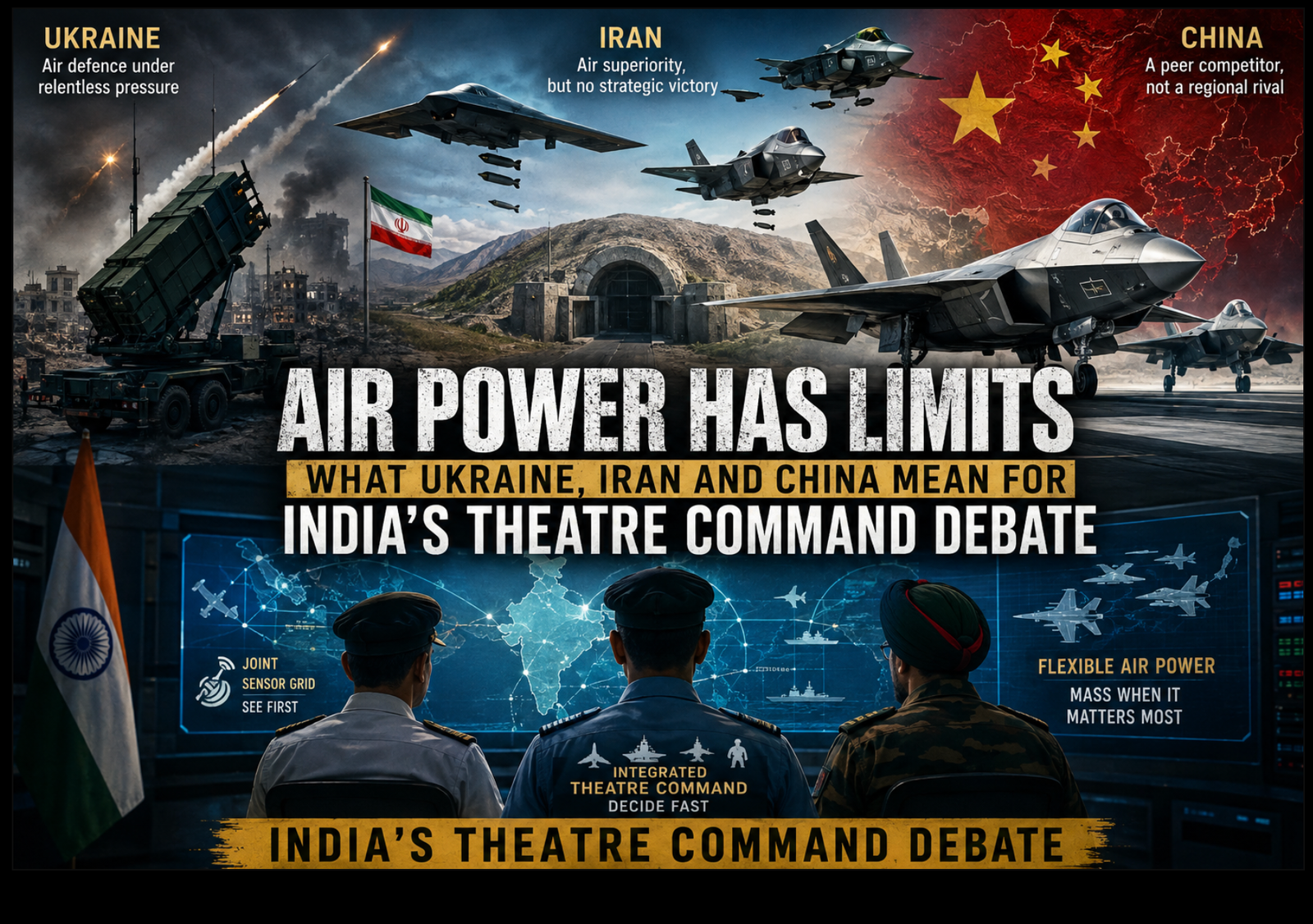
The air power theatre command India debate is no longer simply about whether India should theatreise its armed forces, but about how to integrate air power without sacrificing its flexibility. Air power has limits, but its importance in modern warfare has not diminished. Ukraine, Iran and China’s recent conflicts show that air superiority alone cannot guarantee strategic victory without integrated joint warfare. At the heart of the air power theatre command India debate is a difficult operational question: how can India achieve greater jointness while retaining the ability to concentrate scarce air assets where they are most needed?
In August 2026, Ukraine’s air-defence problem became starkly visible: President Volodymyr Zelensky said Kyiv had received only about a third as many air-defence missiles from allies in the first half of 2026 as during the comparable period of 2025. The shortage came as Russia intensified missile and drone attacks and as the Middle East war placed additional pressure on the global supply of advanced interceptors.
Air Chief Marshal A.P. Singh’s line, delivered on August 22, was carefully chosen. The air force, he said, is not against theatreisation — it simply wants the reform built to India’s own requirements, in stages, rather than lifted from someone else’s playbook.
Two stories, two continents, and no obvious link between them. Except there is one. Both are, underneath, about what air power can and cannot do on its own — and India is watching both unfold at exactly the moment it has to decide how to organise its own air force for a war it hopes never comes, against a neighbour considerably larger than either Ukraine’s or Iran’s opponent.
Air Power Theatre Command India: The Real Fault Lines
Say “air power” to most people and they picture a fighter jet. That’s a narrow way to think about it, and it’s part of why India’s theatre command argument keeps getting flattened into “does the IAF get to keep its planes.” Air power, properly defined, is the capacity to generate strategic, operational and tactical effects through the air and space domain — and that covers considerably more than Rafales and Su-30s. It includes bombers and transport fleets, airborne early warning aircraft, aerial refuellers, uninhabited aircraft, cruise missiles, ground-based air defence, electronic warfare, space-based sensors, and the command network stitching all of it together.
That matters, because the fight over theatreisation isn’t really about who “owns” fighter squadrons. It’s about who decides how all these pieces get combined — and, increasingly, about whether owning the sky is even the same thing as winning.
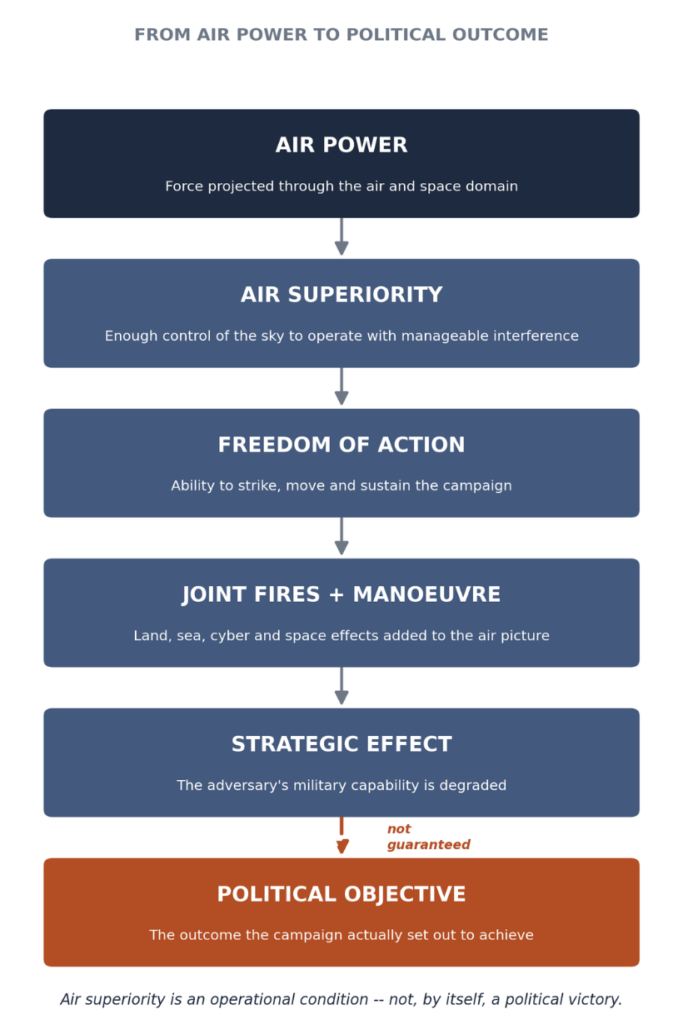
Air planners talk about control of the air in three rough stages. Air parity is when neither side has meaningful control: contested, costly, unpredictable for everyone. Air superiority is a step up — enough control to operate with manageable interference, not none. Air supremacy is the rarer, near-total condition in which the other side’s air force can barely interfere at all. American forces came close to supremacy over Iraq in 1991 and again in 2003. Nobody has had it over Ukraine, on either side, since February 2022.
The distinction sounds academic until you notice what it implies: air superiority is an operational condition, not a political victory. A country can own the sky above a battlefield and still lose the war it was fighting for. That single idea, more than any statistic about squadron numbers, is what the last two years of war have driven home — first in Ukraine, then, far more dramatically, in Iran.
Ukraine’s Real Lesson Isn’t That Missiles Beat Jets
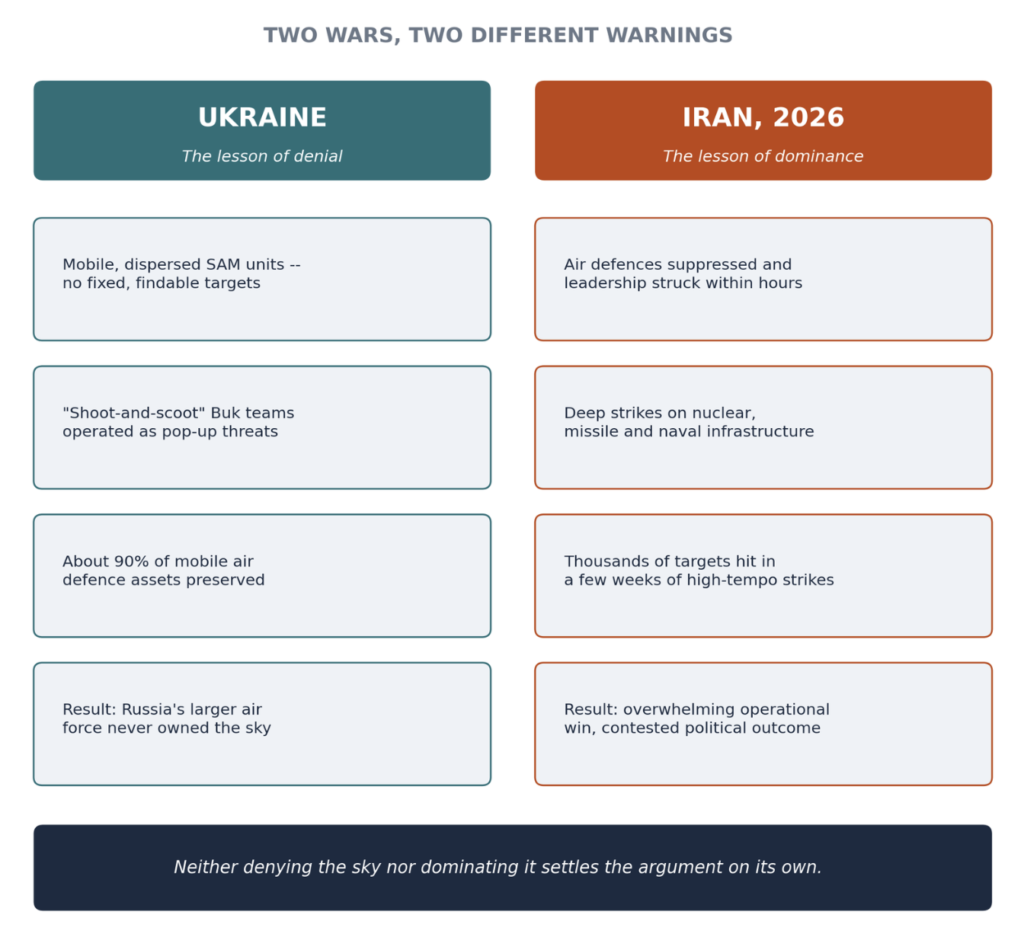
The lazy version of the Ukraine story is that shoulder-fired missiles and Soviet-era SAMs somehow “beat” one of the world’s largest air forces. That’s not quite what happened, and the more precise version is far more useful for India. Russia went into the war with something like a ten-to-one advantage in combat aircraft. It never converted that advantage into control of Ukrainian skies, and three and a half years later, it still hasn’t.
What Ukraine actually built was a denial architecture, not a single wonder-weapon. In the hours before the first Russian strikes, crews moved mobile air-defence systems off their known, mapped positions.
Research from the Center for Strategic and International Studies found that this one decision saved roughly 90 percent of Ukraine’s mobile ground-based air defence from the opening salvo. Buk batteries that once operated as full divisions were broken into small, independent teams — “shoot-and-scoot” units that fired, then relocated before return fire could find them.
MANPADS teams were folded into the same network, which left Russian pilots an unpleasant choice: fly high and risk radar-guided SAMs, or fly low and risk a shoulder-fired missile from a position they couldn’t see. Add dispersal, decoys, camouflage and a fast intelligence pipeline from Western partners, and Russia’s numerical edge in aircraft simply stopped mattering as much as anyone expected in February 2022.
But — and this is the part that gets dropped when Ukraine is cited as proof that air defence “wins” — denying an adversary control of the sky is not the same as breaking his capacity to keep fighting. Russia has sustained large missile and drone barrages against Ukrainian cities right through 2026, even as Ukraine’s own air defence has run desperately short of interceptors.
Some of that shortage, awkwardly, has nothing to do with Russia at all: CSIS estimated last month that the United States burned through roughly half its Patriot PAC-3 and THAAD interceptor stock fighting Iran, leaving less in the pipeline for Kyiv. Zelensky put the comparison bluntly — more Patriot interceptors were fired over three days of the Iran war than in nearly four years of fighting in Ukraine.
That’s the Ukraine lesson worth carrying into any conversation about India’s future air defence: denial works, but denial isn’t victory, and it draws on a finite, shared global stockpile of interceptors that a second, simultaneous crisis can drain out from under you without warning.
Iran, and the Gap Between Destroying and Disrupting
If Ukraine is the case study in denying air superiority, Iran is the case study in what happens once you actually seize it — and it’s a more unsettling lesson, not a more comforting one.
On February 28, 2026, the United States and Israel opened a joint air and missile campaign against Iran: Operation Epic Fury on the American side, Operation Roaring Lion on the Israeli, dwarfing the shorter Israel-Iran exchange of June 2025 in scale.
Iran’s Supreme Leader was killed within the opening hours. Within days, American officials said more than 40 senior regime and military figures were dead, Iranian naval vessels were being sunk by the dozen, and combat sorties had already topped 6,000 inside the campaign’s first three weeks, a tempo few air forces besides the American one could sustain for long. The White House later described the operation’s stated military objectives as met within 38 days — gutting Iran’s missile and drone programmes, its navy and its defence-industrial base.
Here’s the uncomfortable part. Close to six months on, Iran hasn’t produced anything resembling a clean surrender, and the war hasn’t produced a clean political outcome either. Ceasefires have been announced, broken and renegotiated more than once — in April, in June, in July — and the Strait of Hormuz has swung between open and blockaded each time. Iran’s regime survived the killing of its own Supreme Leader and reconstituted a harder-line leadership from inside the Revolutionary Guard. American intelligence assessed in April that Iran still held onto roughly half of its pre-war missile launchers.
And in June and July, commercial satellite imagery analysed by the Institute for Science and International Security showed Iran quietly repairing Taleghan 2 — a bunkered explosives-research facility inside the Parchin complex that had already been hit twice — apparently while a US-Iran memorandum of understanding was still supposed to be in effect.
None of this is a knock on the campaign’s military execution, which by most independent accounts was extraordinarily effective at what airstrikes are actually good at: hitting things you can see. It’s a demonstration of the limit that matters most for anyone drawing lessons for India — that operational dominance and strategic victory aren’t the same purchase.
The Council on Foreign Relations was blunt about the odds of the campaign meeting its own stated goals in full: unlikely, in its assessment, bordering on remote. That’s not a verdict on air power. It’s a verdict on the distance between destroying an adversary’s visible capability and disrupting his ability, and his will, to keep fighting.
The Drone Economics Nobody Can Keep Ignoring
Here’s a number that keeps surfacing in almost every honest conversation about modern air defence: a Shahed-type one-way attack drone costs somewhere between $20,000 and $50,000 to build. A Patriot PAC-3 interceptor — the missile you’d fire to bring one down — runs into the millions, with the higher-end MSE variant recently estimated at close to $4 million apiece. Fire an expensive interceptor at a cheap drone often enough, across a long enough war, and the arithmetic stops making sense well before the fighting does.
Ukraine has lived this problem since Russia started receiving Shaheds from Iran in late 2022, and 2026 made it worse rather than better, for exactly the reason above — the same interceptor stockpiles now have two wars pulling on them at once. Kyiv has responded by leaning harder on cheaper countermeasures: interceptor drones, electronic warfare, gun-based systems, decoys, anything that isn’t a seven-figure missile.
Reporting on the shortfall points to the same conclusion Ukraine’s own defenders have reached: the sustainable long-run answer looks less like more Patriots and more like a layered kill chain — detect, track, classify, jam, deceive, and only then, for the threats that actually warrant it, intercept with an expensive missile.
This is precisely the design problem facing India, and it’s worth being precise about a system that keeps getting mislabelled in the popular telling: Project Kusha. Kusha is not, whatever the headlines occasionally imply, a cheap counter-drone system. It’s DRDO’s indigenous long-range surface-to-air missile programme — three interceptor tiers reaching out to roughly 150, 250 and 400 kilometres, tested successfully off Odisha in July 2026, built to do for India’s northern skies something close to what the S-400 already does.
It’s a genuinely important programme. It is also the wrong tool for a $20,000 drone, and treating it as India’s answer to swarm attacks would repeat exactly the mismatch currently draining everyone else’s stockpiles. What actually answers the drone problem is cheaper, layered, and mostly still being built: indigenous counter-UAS grids, directed-energy systems still in development, and the guns-and-jamming toolkit Indian air-defence units already used against Pakistani drones and loitering munitions during Operation Sindoor in May 2025.
Bury It, Disperse It, Survive It
There’s a second Iran lesson that deserves its own space, because it will matter even more against China than it did against Tehran: depth and dispersal beat air power in ways raw sortie counts can’t fix.
Iran built its missile programme assuming it would eventually be bombed, and planned accordingly — roughly 30 hardened bases driven into the Zagros and Alborz mountains over the years before the war, some sunk 400 to 1,500 feet into granite bedrock and linked by more than a hundred interconnected tunnels with their own automated rail systems. You cannot flatten that kind of target set with however many stealth bombers an air force can put over a country at once, and the campaign’s own record makes the point: even after the Fordow and Taleghan strikes — the latter hit twice, with penetrator munitions purpose-built for exactly this problem — reconstruction work was visible from space within weeks.
The principle generalises cleanly: the deeper and more dispersed an adversary’s military system becomes, the less likely air strikes alone produce effects that don’t get quietly undone. China has spent two decades building precisely this kind of resilience into its own posture — hardened shelters, dispersed launchers, mobile transporter-erector-launchers for its missile forces, redundant command nodes spread across Tibet and Xinjiang. None of that is secret, and none of it goes away because India adds a few fighter squadrons.
Why China Isn’t Just a Bigger Pakistan
This is the point where Indian defence planning tends to get lazy — borrowing confidence earned against one adversary and applying it to a completely different one. Pakistan lacks strategic depth; its air bases sit within easy reach of Indian strike aircraft, its industrial base struggles to replace what it loses, and nuclear deterrence keeps any exchange bounded. Balakot in 2019 and Operation Sindoor in 2025 both worked, in their own limited terms, partly because of that geometry.
China’s geometry runs the other way on almost every count. It has the industrial depth to absorb losses and rebuild. It runs an integrated, layered air-defence network of its own, backed by space-based sensors and a large, increasingly capable air force that includes the J-20 — China’s operational fifth-generation stealth fighter, a class of aircraft India doesn’t yet field in any number.
Commercial satellite imagery published in July 2026 showed roughly a dozen J-20s newly visible at Hotan in Xinjiang and Damxung in Tibet — bases that put low-observable Chinese air power within a few hundred kilometres of Indian positions in Ladakh and Arunachal Pradesh. Analysts were careful to note that a snapshot of aircraft on a tarmac doesn’t reveal intent, readiness or how long they’ll stay. It doesn’t need to. The capability to surge fifth-generation fighters toward both ends of the Himalayan frontier on short notice is the point — whether or not those particular jets ever fly a single sortie.
None of that resembles Pakistan’s position, and a command structure built for a concentrated, less resilient target system cannot simply be scaled up and pointed at Beijing. That distinction — routinely glossed over in the public debate — is probably the strongest argument for why India’s posture along the China front has to look different from how it fights Pakistan.
| Dimension | Facing Pakistan | Facing China |
| Strategic depth | Limited; key bases within easy reach | Vast interior; industry sits far from the front |
| Industrial capacity | Constrained, import-dependent | Large and increasingly self-sufficient |
| Air force | Capable, mostly 4th-generation | Larger fleet; includes 5th-gen J-20 |
| Air defence network | Layered but narrower | Integrated and space-supported |
| Escalation ceiling | Bounded by nuclear symmetry | Longer, less predictable |
| Recent precedent | Balakot (2019), Op Sindoor (2025) | No comparable precedent |
India’s Own Numbers Problem
The IAF’s institutional caution about theatreisation doesn’t come from nowhere, and it deserves to be taken seriously even while disagreeing with parts of it. The force is authorised for 42 fighter squadrons to fight a two-front war. It currently fields 29 — the lowest count in six decades — after the last MiG-21 squadrons retired in September 2025 and deliveries of the Tejas Mk1A kept slipping behind schedule. Parliamentary data recorded 31 active squadrons as recently as 2024; the number has fallen since, not risen, even as both borders have grown more demanding.
Squeezed numbers meet difficult geography. Airbases in Ladakh and along the northeastern frontier sit at altitudes that eat into an aircraft’s payload and range, with runway lengths, weather windows and maintenance infrastructure that limit how fast squadrons can be shuffled between fronts.
India has invested seriously in closing that gap — the Mudh-Nyoma airbase in eastern Ladakh, roughly 23 kilometres from the LAC and sitting close to 13,700 feet, was formally inaugurated in November 2025 — the fourth operational runway in the region, alongside Leh, Kargil and Thoise. It’s a genuine improvement. It doesn’t erase the underlying problem: thin air, short flying seasons, and long distances between bases that a 29-squadron force has to cover across two active fronts at once.
Put those two facts together — a shrinking squadron count and an unforgiving, high-altitude geography — and the IAF’s argument for flexibility stops sounding like institutional turf-guarding and starts sounding like arithmetic. If you don’t have enough aircraft to begin with, permanently fencing them into fixed geographic commands is a real risk, not an imagined one.
What the Air Force Chief Actually Said in Kanpur
For years, the shorthand version of this debate has been “the IAF versus theatre commands,” built around the service’s argument that air power is inherently flexible and indivisible: the same handful of Rafale and Su-30MKI squadrons need to be able to swing from the western front to the eastern one within hours, not sit permanently facing one border. That’s why the air force has historically preferred Joint Coordination Centres — consultative bodies that coordinate operations during a crisis — over handing its squadrons to a permanent ground-force theatre commander.
That shorthand needs updating. Speaking at a memorial lecture in Kanpur on August 22, 2026, Air Chief Marshal A.P. Singh said plainly that the air force “is not against theatreisation,” and that the way some media coverage had framed the issue didn’t reflect the service’s actual position. His real stance is narrower and more specific than either “for it” or “against it”: build the reform to India’s own requirements, in stages, and don’t import a foreign model wholesale.
That’s a meaningfully different debate from the one that’s been running through Indian defence commentary for the better part of two decades. It’s no longer “should India theatreise.” It’s “how,” and “how fast,” and — the question that actually keeps air planners up at night — “what happens to the handful of squadrons everyone is fighting over in the meantime.”
The Real Argument Isn’t Yes-or-No, It’s How
Strip away the institutional politics and the actual disagreement is fairly narrow, and fairly solvable: how do you give a theatre commander enough air power to fight his campaign without permanently draining a scarce, shared national asset that another theatre might need the very next day?
The answer the Indian system appears to be converging on sits close to what American planners call centralised control, decentralised execution — a theatre commander directs the air wings assigned to his fight day to day, a strategic reserve of high-value assets stays under central control for surge and reallocation, air-defence networks stay integrated across theatre boundaries rather than fenced by them, and long-range strike and ISR assets get retasked wherever the campaign actually needs them.
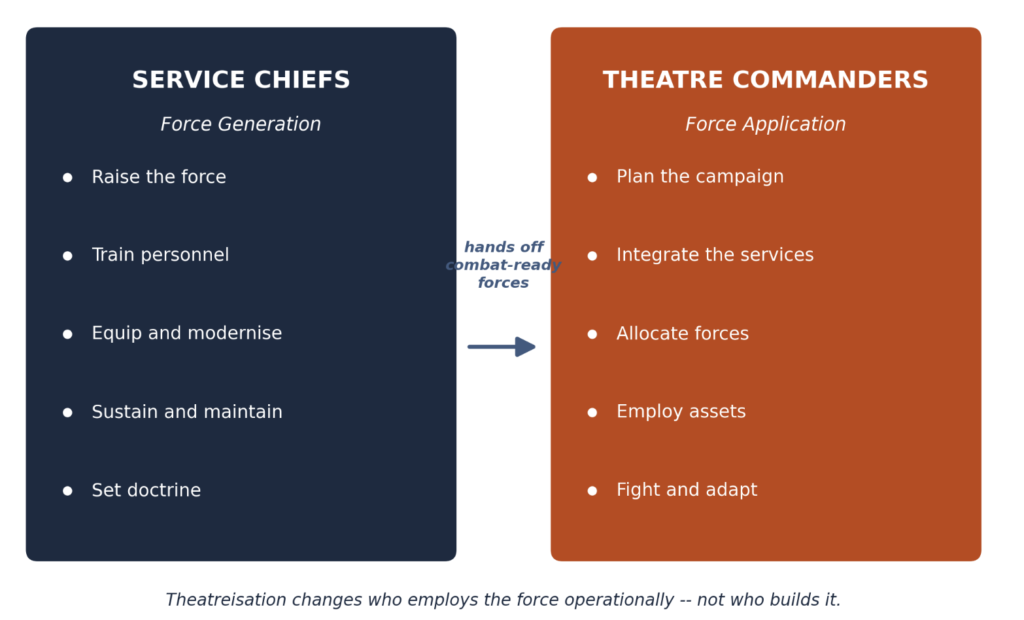
Underneath that sits a distinction that does more work than almost anything else in this debate: force generation is not force application. Raising, training, equipping, sustaining and setting doctrine stay with the Service Chiefs — that’s the IAF’s institutional core, and nothing about theatreisation threatens it. What changes is force application: who plans the campaign, integrates the services, allocates assets day to day, and fights. That job moves to the theatre commander. Framed this way, theatreisation isn’t a demotion for the air force. It’s a division of labour that already exists informally, being made explicit.
Where India’s Theatre Command Plan Actually Stands
The air power theatre command India debate therefore cannot be reduced to a choice between centralised air control and permanent theatre-based allocation of aircraft. Strip away the debate and look at the paperwork, and the reform is further along than most of the public conversation gives it credit for. The plan on the table consolidates India’s current 17 single-service commands — seven each run by the Army and the Air Force, three by the Navy — into three integrated theatres: a Northern Theatre facing China, expected to be headquartered at Lucknow and led by an Army officer; a Western Theatre facing Pakistan, headquartered at Jaipur and led by an Air Force officer, a choice reportedly shaped by how central air power was to Operation Sindoor; and a Maritime Theatre covering the Indian Ocean, likely headquartered in the south under a naval officer, absorbing the existing Andaman and Nicobar Command.
General Anil Chauhan, India’s second Chief of Defence Staff, spent years shaping this framework before submitting a final report to the Ministry of Defence shortly before demitting office at the end of May 2026. General N.S. Raja Subramani took over as the third CDS the following day and named jointness and integration an immediate priority.
Parliament’s Standing Committee on Defence, in a report tabled this August, noted something striking: of the 34 defence recommendations the committee tracks, theatre-command operationalisation is now the only one still awaiting a final government reply — described as “under consideration,” with a dedicated tri-service team working under the Chief of Integrated Defence Staff to move it along. Every other recommendation already has an answer.
None of this happened in a vacuum. The legal groundwork was laid by the Inter-Services Organisations Act, passed by Parliament in 2023 and in force since May 2024, which lets a joint commander exercise disciplinary authority over personnel from all three services under one roof — a small-sounding provision that turns out to be a precondition for a theatre commander to function at all. The office of the Chief of Defence Staff, announced in 2019 and first occupied from January 2020, and the Department of Military Affairs sit above the whole structure, tasked explicitly with pushing jointness along. What’s left, at this point, isn’t concept. It’s a note headed for the Cabinet Committee on Security.
| When | What happened |
| 2016 | Shekatkar Committee recommends three integrated theatre commands |
| 2019 | Post of Chief of Defence Staff announced |
| 2020–21 | First CDS, Bipin Rawat, proposes an initial multi-command model |
| 2022 | General Anil Chauhan takes over as second CDS; framework revised |
| 2023 | Parliament passes the Inter-Services Organisations Act |
| May 2024 | ISO Act comes into force |
| 2025 | Ministry of Defence declares 2025 the “Year of Reforms” |
| Apr 2026 | Three-theatre leadership structure finalised; proposal sent to the Ministry |
| 31 May 2026 | General N.S. Raja Subramani takes over as third CDS |
| Aug 2026 | Parliamentary committee: theatre commands the only pending item among 34 tracked reforms |
What Operation Sindoor Did and Didn’t Prove
Operation Sindoor gets cited constantly in this debate, usually as proof of whatever the person citing it already believed going in. It’s worth being more careful with it than that.
After the April 2025 Pahalgam attack, India struck nine sites across Pakistan and Pakistan-occupied Kashmir on the night of May 7, in what officials described at the time as a focused, non-escalatory response aimed at terror infrastructure rather than Pakistani military assets.
Pakistan responded over the following days with drones, loitering munitions and missiles aimed at military installations across northern and western India — Awantipura, Jammu, Pathankot, Adampur, Bhuj, more than a dozen locations in all. India’s layered, networked air-defence grid — indigenous systems running alongside imported ones, tied together through an integrated counter-UAS architecture — stopped that follow-on barrage from doing damage, officials said at the time. India’s Director General of Military Operations was explicit that every domain of the operation showed “absolute synergy” between the three services.
That’s a real, well-documented success, and it deserves to be treated as one. What it isn’t is proof that centralised air control is the right model for a war with China. Sindoor ran for a matter of days, against a single, geographically concentrated adversary, with limited declared objectives and heavy political management of escalation throughout. None of those conditions would necessarily hold in a prolonged, high-intensity fight along the LAC. The operation shows India’s networked, multi-domain air defence works. It doesn’t settle how India should command that same air power in a fight that doesn’t end in a week.
Borrowing From China and the US, Carefully
India isn’t inventing theatre commands from a blank page, and it would be a mistake to pretend otherwise — but it would be just as serious a mistake to copy anyone else’s answer wholesale.
China folded its seven military regions into five theatre commands in 2016, under a structure that’s almost architecturally clean on paper: the Central Military Commission holds strategic leadership, the theatre commands run joint combat operations, and the services concentrate on developing troops and equipment.
It’s a useful reference point for what a mature, functioning theatre system can look like at China’s scale. It is not a template India can lift directly — India’s civil-military relationship, its federal politics, its two-and-a-half-front geography and its considerably smaller force all make a direct copy unworkable, a point the IAF chief himself made explicitly in Kanpur.
The more useful borrowing, oddly, may be American, and not the org chart so much as the incentive structure behind it. The 1986 Goldwater-Nichols Act didn’t just redraw American command boundaries; it made joint professional education and joint-duty postings a prerequisite for senior promotion, forcing a generation of officers to build genuine tri-service fluency rather than treat it as a career detour. India’s own version of that idea — mandatory joint staff-college courses and tri-service postings tied to promotion, echoing the “Jointness 2.0” language General Chauhan himself used in 2024 — arguably matters more than any headquarters map. Redrawing boxes on an org chart changes very little if the officers inside those boxes still think, train and get promoted along single-service lines.
The Sensor Grid Is the Real Reform
Here’s the part of this debate that gets the least attention relative to how much it actually matters: none of the command-structure argument means anything without a sensor network that can feed it.
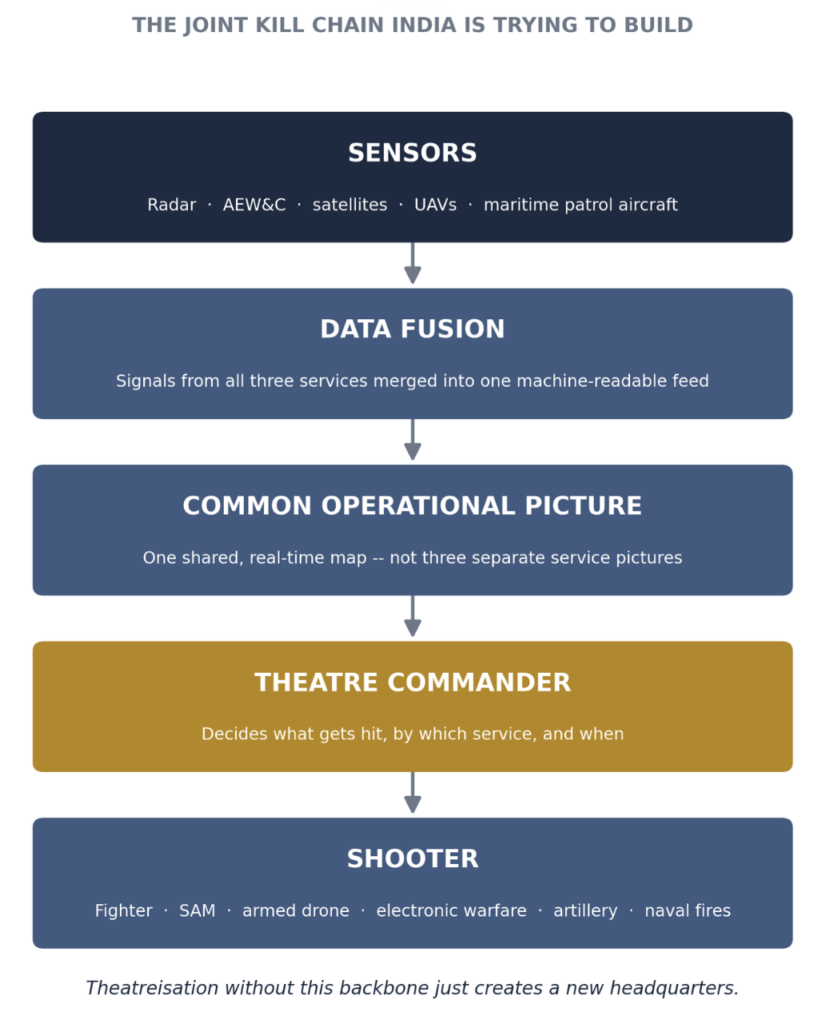
The future fight along the LAC will be won or lost, in large part, by how fast India can move information from a radar, a satellite or a UAV to whichever weapon — fighter, missile, drone, artillery, ship — is best placed to act on it. That means fusing Army radar arrays, Navy maritime-patrol data and IAF sensors, including the Integrated Air Command and Control System, into one shared operational picture, rather than three services separately working off three different pictures of the same battlefield. It also means the theatre commander’s real job is less “who gets which squadron” and more “who sees what, first, and how fast can that information reach a shooter.”
Skip this step, and theatreisation risks becoming exactly what its critics fear: a new headquarters bolted onto the same old, poorly connected sensors and shooters — a fancier org chart, none of the speed the reform was supposed to buy.
What Could Still Go Wrong
None of this is risk-free, and it’s worth being honest about where a reform this size can misfire.
- Fragmenting scarce air assets permanently across theatres — the risk the IAF worries about most, and, given the squadron numbers above, not a paranoid one.
- Duplication — three new theatre headquarters can just as easily grow three overlapping intelligence and planning staffs as they can retire the old single-service ones.
- Command ambiguity over genuinely strategic assets — long-range missiles, space systems, the nuclear-capable end of the force — has to be resolved explicitly, or it gets resolved badly, mid-crisis, by whoever argues loudest.
- Inter-service friction over promotion timelines, seniority and career paths, which doesn’t vanish because a reorganisation order gets signed; it just moves into the new building.
- Transition risk — reorganising while operational tension along the LAC stays elevated can dip readiness at exactly the moment it’s least affordable.
That list is precisely why Air Chief Marshal Singh has argued for a graded, India-specific transition rather than one dramatic overhaul — a more defensible position than the “IAF is blocking reform” framing it often gets reduced to.
The Argument India Is Actually Having Now
Ultimately, the air power theatre command India debate is about finding the right balance between joint operational control and the flexibility to mass scarce air power when and where it matters most. Put the last two years together and a cleaner version of the original argument emerges. Ukraine shows that denying air superiority to a much larger opponent is achievable, and still isn’t the same as winning a war of attrition. Iran shows that achieving air dominance at a scale few militaries could match still doesn’t automatically buy the political outcome the war was fought for.
China shows why neither lesson can simply be copied onto India’s northern frontier, given the depth, the industrial base and the fifth-generation air force sitting on the other side of the Himalayas. And the IAF’s own institutional caution, once you look past the “IAF versus theatre commands” headline, turns out to rest on a genuinely difficult resource-allocation problem that any serious reform has to solve rather than wave away.
None of that argues against theatreisation. It argues for building it carefully enough that India’s air power comes out more usable, not less — joined to the other services wherever jointness adds real capability, and still able to mass wherever a crisis actually needs it.
The paperwork on that reform is reportedly close to a Cabinet Committee on Security note. The war in Iran is still, six months in, without a settled political ending. Ukraine’s air-defence crews are still waiting on interceptors that partly went somewhere else this year. Whatever gets decided in Delhi over the coming months will be decided with both of those stories still running in the background — not after them.
Frequently Asked Questions
What is theatreisation, in simple terms?
It means merging India’s 17 separate single-service commands — seven Army, seven Air Force, three Navy — into a smaller number of joint theatre commands, each led by one officer who directs land, sea and air assets in that theatre together, instead of three services planning separately and coordinating afterward.
Is the Indian Air Force against theatre commands?
Not anymore, at least not the way it’s often reported. Air Chief Marshal A.P. Singh said in August 2026 that the IAF is not opposed to theatreisation, but wants it built to India’s own requirements and rolled out in stages rather than copied wholesale from another country’s model.
What did the war in Ukraine actually prove about air power?
That a smaller, well-organised air-defence network can deny a much larger air force control of the sky — Ukraine preserved most of its mobile air defences through dispersal and shoot-and-scoot tactics. It also showed that denial alone doesn’t end a war: Russia kept up missile and drone attacks for years afterward.
What’s the difference between air superiority and air supremacy?
Air superiority means one side has enough control of the air to operate without serious interference, though not none. Air supremacy is rarer and more complete — the opposing air force can barely interfere at all. Both are operational conditions; neither automatically delivers the political outcome a war was fought for.
Why is fighting China different from fighting Pakistan, for the IAF?
Pakistan has limited strategic depth and a smaller industrial base, which is part of why operations like Balakot and Operation Sindoor stayed short and contained. China has far greater depth, a larger and more modern air force that includes fifth-generation J-20 fighters, and the industrial capacity to absorb losses and keep fighting — conditions that simply don’t exist on the western front.
What is Project Kusha, and is it a counter-drone system?
Project Kusha is DRDO’s indigenous long-range surface-to-air missile programme, with three interceptor variants reaching roughly 150, 250 and 400 kilometres — comparable in role to Russia’s S-400. It is not a counter-drone system; using a long-range interceptor against a cheap drone is exactly the costly mismatch that has drained air-defence stockpiles elsewhere.
When will India’s theatre commands actually be created?
There’s no confirmed date yet. The military side of the process — three proposed commands, tentative headquarters and leadership assignments — was reportedly finalised and sent to the government by mid-2026. The proposal still needs sign-off from the Ministry of Defence and the Cabinet Committee on Security before implementation can begin.
Sources & Further Reading
External, authoritative sources used in reporting this piece.
- CSIS – Air Superiority in the Twenty-First Century: Lessons from Iran and Ukraine
- CSIS – Operation Epic Fury and the Remnants of Iran’s Nuclear Program
- Business Standard – “IAF is not against theaterisation,” says Air Chief Marshal AP Singh
- The Week – India moves closer to integrated theatre commands
- SSBCrack – Theatre commands reform enters decisive phase
- Institute for Science and International Security – Repair activity identified at Taleghan 2
- The Tribune – IAF Chief inaugurates Mudh-Nyoma airbase near LAC in Ladakh
- RFE/RL – Ukraine critically short of air defences as questions swirl over US Patriot stockpiles
- Air & Space Forces Magazine – World: Epic Fury
- Defence Security Asia – China’s J-20 surge near India: stealth fighters at Hotan and Damxung
- PIB – Operation SINDOOR: the rise of Aatmanirbhar innovation in national security
- Wikipedia – Project Kusha (specifications and test status)