Table of Contents
- Israel Drone Ban: What the Proposal Actually Means
- A detection problem wearing a policy costume
- The precedent Israel set for itself over Iran
- India’s drone problem started earlier and never paused
- Why a blanket ban would cost India more than it costs Israel
- What India can currently shoot down
- The registration gap nobody has closed
- The India-Israel drone loop runs both ways
- The case against banning drones at all
- FAQs
The Israel Drone Ban debate has triggered discussion across defence circles worldwide. Israel’s security cabinet spent part of a recent sitting discussing something that would have sounded faintly ridiculous two years ago: switching off the country’s civilian drone fleet altogether. Channel 12’s N12 broke the story on 18 July, and the reasoning behind the proposed Israel drone ban was unusually candid. The defence establishment does not believe it can reliably tell a wedding videographer’s quadcopter from an incoming Iranian one, in the seconds available to make that call.
Nothing has been signed. That detail has gone missing in a lot of the aggregated coverage, and it matters. Ministers were briefed, an opinion was circulated, and the file is still open.
What is striking is the shape of the proposal. Israel Hayom reported that the restriction being examined would run for roughly six months, with a new supervised licensing regime drafted during that window. So this is less a ban than a hard reset of an airspace the state no longer feels it can read. Which is a very different admission.
It is also an admission that should be read carefully in New Delhi, for reasons that have nothing to do with Iran.
1. Israel Drone Ban: What the Proposal Actually Means
Strip away the headline and three things are on the record. The security cabinet discussed the measure. The defence establishment’s assessment went to Knesset ministers. And the trigger is a capability shortfall rather than a specific intelligence warning about a specific attack.
Israeli officials have been fairly open about the technical bottleneck: small drones with a low radar signature are hard to detect and harder to intercept in real time, and the same airframe can carry a camera or a charge. Israel National News reported that the defence establishment is weighing whether thinning out civilian traffic would let security forces identify unauthorised aircraft faster.
The cost of that is not hidden either. Photographers, broadcasters, farmers, infrastructure inspection firms and every licensed operator in the country would be grounded. Officials know it. They are weighing it anyway, which tells you where the threat assessment currently sits.
The other claim doing the rounds, that Iran has tripled its drone production, deserves more scepticism than it is getting. It surfaces in headlines far more often than it is sourced to a dated, attributable Iranian statement. Treat it as an assertion until somebody produces the original.
2. A detection problem wearing a policy costume
Here is the part worth sitting with. A blanket prohibition is not primarily a deterrent. An operator willing to fly an explosive-laden FPV drone into a substation is not going to be dissuaded by a licensing rule.
What a ban does is solve a signal-to-noise problem. If no civilian drone is legally airborne, every contact on the screen is hostile by default, and the rules of engagement collapse into something a duty officer can execute in four seconds instead of forty. That is the actual product being bought here.
Which means the ban is a workaround for the failure of identification technology, not a substitute for it. Israel is not the only democracy stuck at that wall. Gatwick shut down for the better part of two days in December 2018 over drone sightings that were never fully resolved, and the drone panic over New Jersey in December 2024 ran for weeks without producing a clean explanation.
The economics do not help. Analysts have pointed out the awkward arithmetic of firing million-dollar interceptors at a threat that causes limited damage, while Ukraine has pushed towards interceptor drones costing somewhere between $1,000 and $4,000 apiece.
3. The precedent Israel set for itself over Iran
The reason civilian drones are now treated as a weapons category rather than a hobby has a specific origin, and Israel is part of it.
During Operation Rising Lion in June 2025, pre-positioned drone teams operating from inside Iran struck air defence systems and missile launchers as Israeli aircraft approached, opening corridors that let fighters operate over Tehran for hours. Days earlier, Ukraine’s Operation Spiderweb had used 117 drones smuggled into Russia over eighteen months, hidden in modified civilian trucks, then activated remotely against parked strategic bombers.
Tehran’s response afterwards was telling. Iran’s defence ministry complained publicly that civilian drone use had gone unregulated, and that Israeli-operated civilian drones had been launched from inside Iranian territory.
So the state that demonstrated the tactic is now considering the countermeasure that its adversary wished it had adopted first. There is a lesson in the sequencing, and it is not a flattering one for anyone running an open drone registry. For India, the Israel Drone Ban offers several important lessons.
4. India’s drone problem started earlier and never paused
India did not need a cabinet briefing to learn that a cheap quadcopter is a delivery system. It learned that on 27 June 2021, when two payloads were dropped on the Indian Air Force station at Jammu, in what is still treated as the country’s first drone-borne terror strike.
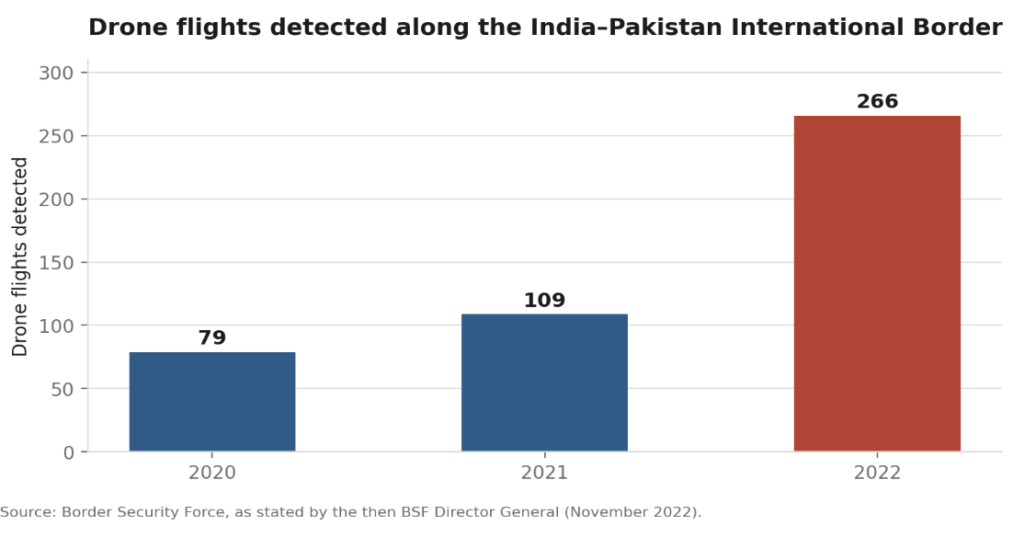
The border numbers since then read like a slow-motion escalation. The BSF detected 79 drone flights along the India-Pakistan International Border in 2020, 109 in 2021, and more than doubled that to 266 in 2022. The force’s Director General at the time did not pretend otherwise, conceding that no foolproof solution existed and that the drones were bringing narcotics, weapons and counterfeit currency.
Punjab is where the pressure concentrates
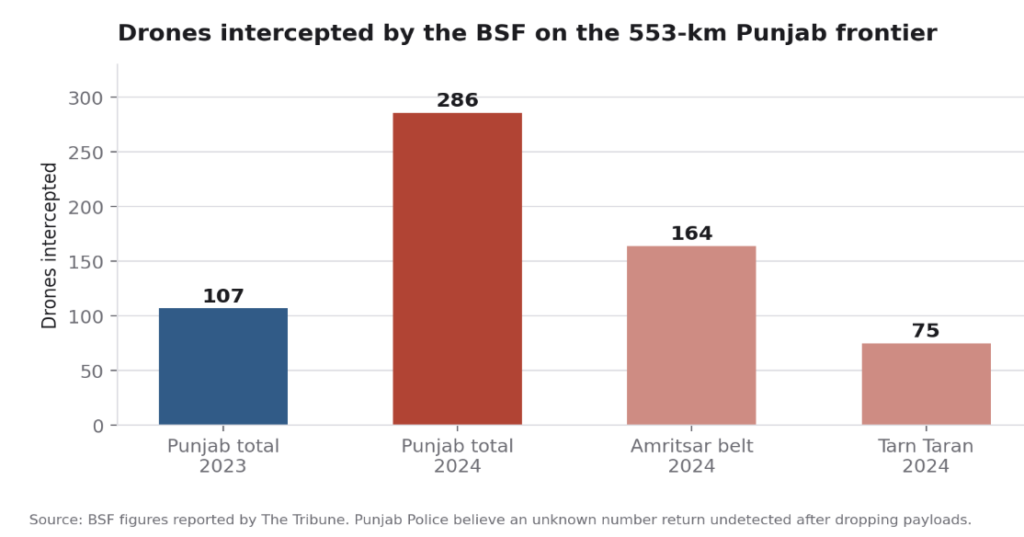
The Amritsar belt has become the preferred corridor. Of 286 drones intercepted along the 553-km Punjab frontier in 2024, 164 came down in the Amritsar sector alone and 75 more in Tarn Taran, against 107 interceptions across the whole state the previous year.
Punjab Police officers add the uncomfortable footnote: an unknown number of drones drop their consignment and return undetected. Interception counts measure what was caught, not what flew. The Israel Drone Ban also raises questions about balancing security with innovation.
Then came Operation Sindoor in May 2025, India’s first large-scale non-contact engagement, which is credited with validating indigenous counter-drone systems against hundreds of drones fielded per day. The institutional response followed quickly: a BSF Drone Warfare School at Tekanpur in September 2025, training personnel in anti-drone work with an emphasis on AI-driven systems, and a drone indigenisation incentive programme of roughly $234 million.
5. Why a blanket ban would cost India more than it costs Israel
This is where the Israel drone ban stops being a foreign policy story and starts being an Indian one. India has spent five years pointing its regulation in precisely the opposite direction.
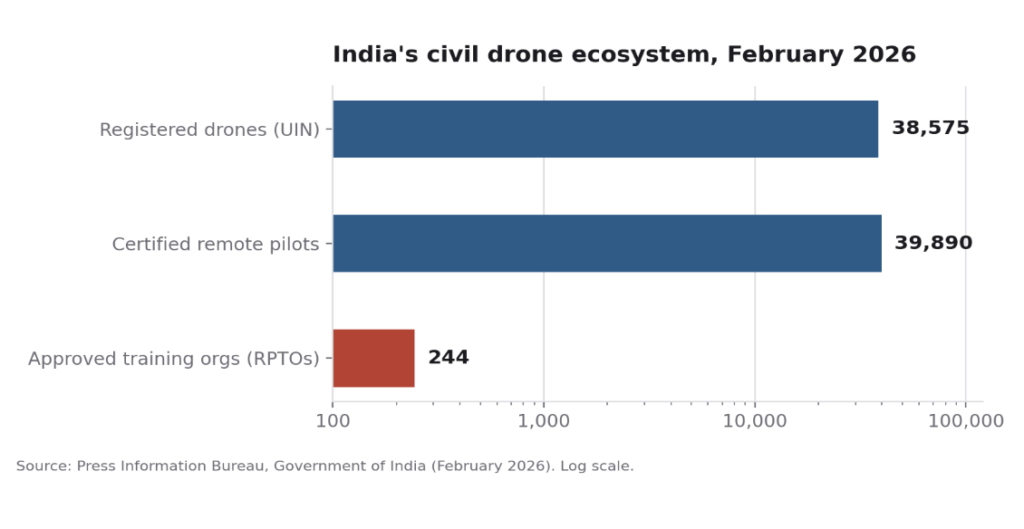
As of February 2026, the Press Information Bureau counted 38,575 registered drones with unique identification numbers, 39,890 certified remote pilots and 244 approved training organisations. Under SVAMITVA, 3.28 lakh villages have been surveyed by drone and 2.76 crore property cards prepared. Another 1,094 drones have gone to women’s self-help groups, more than 500 of them under Namo Drone Didi.
The industrial commitment behind that is not small either. The production-linked incentive scheme has been expanded to a Rs 2,000 crore outlay for 2025-28 at 20 per cent of value addition, GST on drones has been cut to a uniform 5 per cent, fully assembled drones cannot be imported, and DGCA has opened initial BVLOS corridors in Telangana, Uttarakhand and Gujarat. Over 350 drone startups carry DPIIT recognition.
An Israel-style six-month freeze in India would not merely irritate wedding photographers. It would stall land-titling surveys, crop insurance assessment under PMFBY, a season-bound agricultural spraying industry and an infant logistics sector, while stranding a large chunk of industrial policy mid-flight. Understanding the Israel Drone Ban requires looking at India’s existing counter-drone capabilities.
| Israel (proposal on the table) | India (policy in force) | |
| Direction of travel | Considering a blanket six-month closure of airspace to private drones | Liberalised since Drone Rules 2021; BVLOS corridors opened in three states |
| Stated driver | No dependable way to detect and intercept small, low-signature drones in real time | Self-reliance, rural service delivery, export ambition |
| Money behind it | Counter-drone procurement, mesh nets, interception R&D | PLI expanded to Rs 2,000 crore for 2025-28; GST on drones cut to 5% |
| Who it hits | Photographers, media, farmers, infrastructure firms, licensed pilots | Same constituencies, plus SVAMITVA surveys, PMFBY claims, Namo Drone Didi operators |
| Enforcement tool | Blanket prohibition, then re-licensing under supervision | Digital Sky, UIN registration, NPNT still rolling out |
6. What India can currently shoot down
The counter-drone picture has improved, though not evenly. DRDO’s D4 system, built by Bharat Electronics, was formally inducted on 19 March 2026. It combines radar, radio-frequency and electro-optical detection out to around five kilometres with soft-kill jamming and a hard-kill laser effective to roughly three, and it now functions as the yardstick other Indian vendors are measured against.
Around it sits a growing private base including Zen Technologies, Big Bang Boom, Paras Defence and Adani, while indigenisation rules keep foreign primes such as IAI, Rafael, RTX and DroneShield to partnership-based entry.
A five-kilometre bubble protects points, though. It does not protect a country. India’s land borders run into the thousands of kilometres and its high-value infrastructure is scattered across refineries, nuclear stations, airports, dams, stadiums and the parliamentary zone. Point defence plus a registry is not airspace control, and the difference between those two things is exactly the gap Israel is proposing to legislate shut.
7. The registration gap nobody has closed
Registration is not the same as command. India’s No Permission No Take-off regime, which forces a drone’s flight controller to validate a digitally signed permission artefact before the motors arm, is still being enforced in stages as of 2026.
The practical effect is familiar to anyone who has watched compliance regimes mature. Geofencing binds hardest on the operators who were never the problem, and barely at all on assembled airframes, grey-market imports and DIY builds that never touched Digital Sky. The 38,575 registered drones are a known quantity. The unregistered population is not, and no agency has published a credible estimate of it.
That unknown is the entire Israeli argument, transplanted.
The India-Israel drone loop runs both ways
There is a commercial dimension that rarely makes it into the coverage. India operates and co-produces Israeli-origin unmanned platforms, from the IAI Heron and Searcher lineage through to the Hermes 900 line assembled by Adani and Elbit near Hyderabad. Israeli counter-drone firms, meanwhile, want Indian market access that indigenisation rules currently route through joint ventures.
A restrictive domestic regime in Israel changes the testing, demonstration and certification cycle for the same companies selling into that pipeline. Buyers in Delhi will notice the effect on delivery schedules before they notice anything else.
The case against banning drones at all
A comprehensive reading has to hold the counter-arguments too, and there are several.
- A prohibition is a confession, not a strategy. Israel is reaching for it because detection has not been solved. Emergency restrictions on civilian technology have a habit of outliving the emergency, and the six-month framing is the part to watch sceptically.
- It binds the compliant. Every operator who registers, geofences and files a flight plan is grounded. Every operator who does none of those things is unaffected.
- There is a press freedom cost. Grounding media drones during a conflict has an obvious secondary effect on what the public gets to see, and that effect is rarely discussed by the people proposing it.
- India has no single switch anyway. Any equivalent measure here would run through the Bharatiya Vayuyan Adhiniyam 2024, amendments to the Drone Rules 2021, MHA advisories and state-level prohibitory orders. Whether that fragmentation is a weakness or a safeguard is a genuinely open question.
The more useful conversation, and the one Indian policymakers have mostly avoided in public, is about graduated response. A protocol that can close a defined airspace block for a defined window, verified through mandatory remote identification and enforced through drone forensics, does most of what a national ban does without switching off a rural governance programme.
Israel is contemplating the blunt version because it ran out of runway on the precise version. India still has runway, and a much larger civilian fleet to lose. The file in Jerusalem is still open, the cabinet has not voted, and the drone flights along the Punjab frontier have not stopped for any of it. Whether implemented or not, the Israel Drone Ban has already influenced how countries think about civilian drones in conflict zones.
FAQs
Has the Israel Drone Ban actually been implemented?
No. As of the time of writing, the Israel drone ban is a proposal that was discussed by the security cabinet and circulated to Knesset ministers. N12 reported the discussion on 18 July 2026, and no final decision has been announced.
Why would Israel ban civilian drones instead of intercepting hostile ones?
Because interception depends on identification, and small low-signature drones are difficult to detect and classify in real time. Clearing civilian traffic from the airspace turns every remaining radar contact into a presumptive threat, which shortens the decision cycle considerably.
Could India impose a similar drone ban?
Legally it could, through the Bharatiya Vayuyan Adhiniyam 2024, amendments to the Drone Rules 2021 and state prohibitory orders. Politically and economically it would be far more disruptive, given roughly 38,500 registered drones, a Rs 2,000 crore incentive programme and drone-dependent schemes such as SVAMITVA and PMFBY.
How many drones cross into India from Pakistan?
Detections along the India-Pakistan International Border rose from 79 in 2020 to 266 in 2022, and the BSF intercepted 286 drones along the Punjab frontier in 2024 alone, with 164 of those in the Amritsar belt. Officials accept that an unquantified number cross undetected.
What counter-drone systems does India have?
The main indigenous platform is DRDO’s D4 system, manufactured by Bharat Electronics and inducted in March 2026, which pairs radar, radio-frequency and electro-optical detection out to about five kilometres with jamming and a laser effective to roughly three. Private firms including Zen Technologies, Paras Defence, Big Bang Boom and Adani supply adjacent capability.
Does the Israel drone ban affect Indian drone companies?
Indirectly. India co-produces Israeli-origin platforms and several Israeli counter-drone firms operate here through joint ventures, so a restrictive domestic regime in Israel would affect their testing and demonstration cycles before it affects anything on the Indian statute book.
Internal Link Suggestions
- Operation Sindoor explained: how India’s first non-contact war was fought ->”Operation Sindoor“
- DRDO’s D4 anti-drone system and India’s counter-UAS pipeline -> “India counter-drone systems“
External Authority Links
Jerusalem Post reporting on the proposed restriction: jpost.com
Israel Hayom on the six-month framing: israelhayom.com
Israel National News on the defence establishment’s assessment: israelnationalnews.com
Press Information Bureau on India’s drone ecosystem: pib.gov.in
Carnegie Endowment on drone intrusions across the international border: carnegieendowment.org
Times of Israel on the cost asymmetry of drone defence: timesofisrael.com
DGCA Digital Sky platform: digitalsky.dgca.gov.in