1. When a Missile Hits — and So Does the Code
LATEST NEWS (2025–26): DRDO has issued multiple Expressions of Interest (EoI) under its Technology Development Fund (TDF) Scheme for the development of an Indigenous Large Language Model (LLM) for Cybersecurity Vulnerability Discovery and Threat Intelligence, an Indigenous Zero-Day Vulnerability Discovery Framework, and a Comprehensive Vulnerability Assessment Framework for LLMs. These signal that India’s military-AI ambition is no longer a roadmap — it is active procurement.
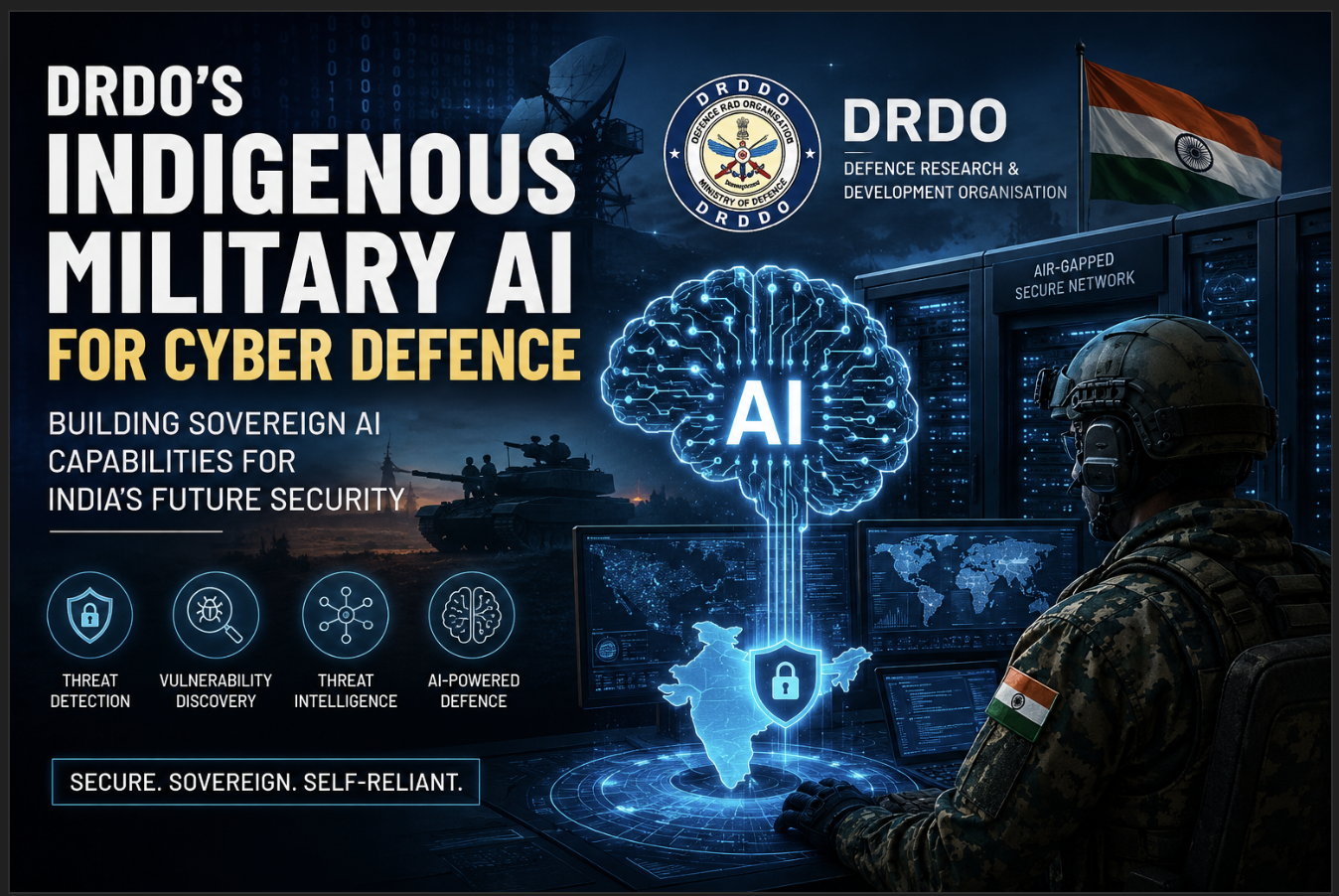
DRDO Indigenous Military AI for Cyber Defence represents a major step towards strengthening India’s sovereign cyber security and military technology capabilities. In May 2025, even as India’s kinetic military operations drew international attention, a less-visible battle was unfolding in the digital domain. State-sponsored actors, operating across jurisdictions and beyond the reach of any treaty, were probing Indian defence networks, government infrastructure, and critical systems. That month, CERT-In reported a dramatic surge in cyber incidents targeting the defence and energy sectors — the kind of attacks that leave no craters but can cripple command structures just as effectively as any missile.
It was against this backdrop that DRDO’s move to build an indigenous military-grade AI system for cyber defence became less of a policy aspiration and more of a strategic emergency response. The Defence Research and Development Organisation’s EoIs, released under the TDF Scheme in 2025-26, outline a system of remarkable ambition: a large language model with 30 to 70 billion parameters, designed to operate entirely within an air-gapped military environment, with no dependency on foreign servers, no cloud connectivity, and no exposure to the vulnerabilities that come with externally hosted AI services.
This matters for reasons that go well beyond technical specifications. India is, according to the dark web threat landscape report compiled by cybersecurity firm CloudSEK, the second most targeted nation globally, after the United States. In 2024, at least 95 Indian entities — spanning banking, government, defence, and telecommunications — suffered confirmed data breaches. CERT-In recorded more than 2.04 million cyber incidents that year alone, up from 1.39 million in 2022. The trajectory is not just steep; it is accelerating in direct proportion to India’s digital expansion.
The DRDO indigenous military AI for cyber defence initiative is, therefore, both a technological statement and a strategic doctrine. It says, plainly, that India cannot entrust its most sensitive military data to systems built elsewhere, maintained elsewhere, and ultimately controlled elsewhere. What follows is an analysis of that initiative — what it involves, why it is necessary, and where the formidable gaps still remain.
2. Why DRDO Indigenous Military AI for Cyber Defence Matters
The Stepwise Evolution of Warfare
Conflict has always evolved alongside technology. But the pace of change in the last decade has been qualitatively different. Military analysts increasingly distinguish between five distinct phases of modern warfare, each building on the last.
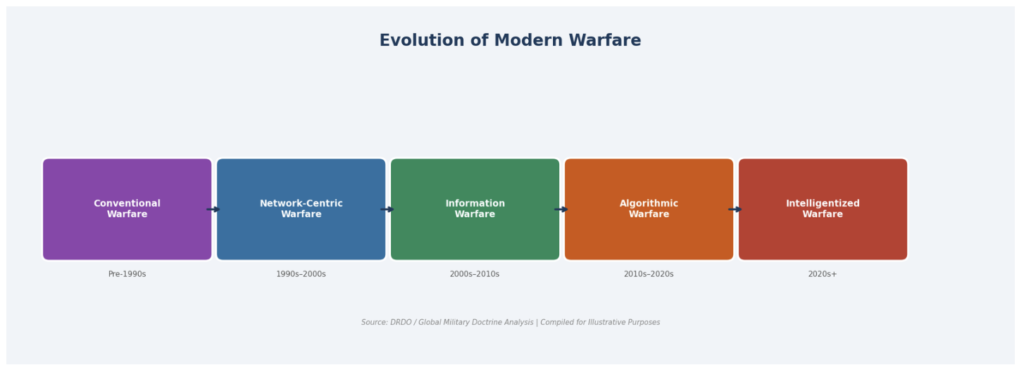
Conventional warfare dominated the 20th century’s conflicts. Network-centric warfare, born from the Gulf War, demonstrated how information superiority — who knows what, first — determines outcome. Information warfare extended this to include the digital battlespace, treating data infrastructure as both a weapon and a target. Algorithmic warfare introduced machine-speed decision support, where sensors, shooters, and commanders are linked through automated data pipelines.
And then there is what Chinese military doctrine calls ‘intelligentized warfare’ — a concept that places AI at the operational core of every domain: land, sea, air, space, and cyber. It is not merely AI as a decision-support tool. It is AI as a combatant, as an autonomous defender, as a system that can identify, classify, and neutralise threats in timescales no human operator can match.
India’s defence establishment has been slower than its competitors to formally adopt this framing, but the DRDO TDF Scheme EoIs suggest the institutional understanding is catching up fast. The development of DRDO Indigenous Military AI for Cyber Defence reflects the growing importance of artificial intelligence in modern military operations and cyber warfare.
Where AI Is Already Deployed in Defence
Across the world’s major military powers, AI applications in defence have moved from theoretical to operational. Intelligence, surveillance, and reconnaissance — the ISR triad — now incorporates AI-driven image processing, signal analysis, and pattern recognition. The US Air Force’s Project Maven, initially controversial, now processes thousands of satellite images daily through machine learning pipelines that would take human analysts weeks.
In cyber defence specifically, AI’s role has become indispensable. The volume of network traffic in a modern military environment — and the speed at which malicious packets can propagate — exceeds any human team’s capacity to monitor in real time. An AI system that can detect anomalies, correlate indicators of compromise, and isolate affected segments in milliseconds is not a luxury; it is the baseline for any serious cyber defence posture.
India’s current cyber defence architecture, by most independent assessments, still relies heavily on perimeter security, signature-based detection tools, and manual incident response. The DRDO initiative represents the ambition to close that gap — and to do it without depending on tools built by countries that are also, in various contexts, strategic competitors.
3. The Global Military AI Race: Where India Stands
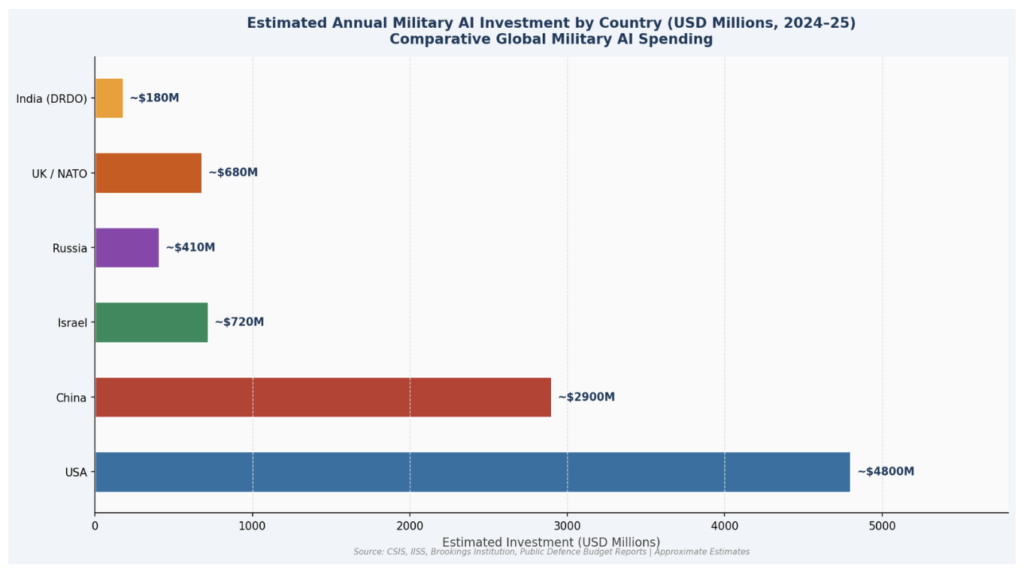
The United States and China are not in the same race as everyone else. They are in a different race entirely.
The Pentagon’s Project Maven, launched in 2017 and now embedded across multiple commands, was just the beginning. The Joint All-Domain Command and Control (JADC2) architecture — which aims to connect sensors and shooters across every military domain through AI-driven networks — represents perhaps the most ambitious command-and-control transformation in military history. US military AI investment is estimated to exceed $4.8 billion annually across its various programmes. The proposed DRDO Indigenous Military AI for Cyber Defence platform aims to provide indigenous solutions for threat intelligence, malware analysis, and vulnerability assessment.
China has been even more explicit in its doctrine. The People’s Liberation Army’s ‘intelligentized warfare’ doctrine, formalized in its 2019 defence white paper, places AI at the center of its military modernisation effort. Civil-military fusion — the deliberate integration of commercial AI research into military applications — means that companies like Baidu, Alibaba, and Huawei are, in effect, defence contractors whether they frame it that way or not.
Israel, Russia and NATO
Israel has demonstrated, in repeated operations including in Gaza and Lebanon since 2023, what AI-assisted targeting and intelligence actually looks like in practice. Its AI-enabled intelligence systems can reportedly cross-reference massive datasets — signals intelligence, biometrics, social media patterns — to identify targets at a pace and scale that human analysts could not approach. The ethical debates this has triggered are significant, but the operational capability is real.
Russia, despite sanctions degrading its access to advanced semiconductors, has maintained a programme of AI-enabled military systems, with particular emphasis on autonomous drone guidance and signals intelligence. Its performance in Ukraine has been inconsistent, partly due to logistics and partly due to electronic warfare capabilities that have disrupted GPS-dependent autonomous systems.
NATO published its first AI strategy in 2021 and has since developed a Responsible AI Framework for defence applications, essentially acknowledging that its member states need common standards if they are going to integrate AI systems across different national militaries. The challenge of interoperability is not one India faces, but the question of standards — how do you validate, test, and trust an AI system in a military context — is entirely relevant.
India’s Position in This Race
India is not at the front of this race. That is a frank assessment, not a judgment. The DRDO’s 2024 Evaluating Trustworthy AI (ETAI) Framework, launched by Chief of Defence Staff General Anil Chauhan and DRDO Chairman Dr Samir V Kamat in October 2024, was a significant governance milestone. The framework’s five principles — reliability, safety, transparency, fairness, and privacy — represent a more rigorous governance model than many comparable nations have published. But governance frameworks and operational capabilities are different things.
What the DRDO TDF EoIs reveal is that India is moving from governance to deployment. The gap between where India is and where the US and China are is substantial. The strategic question is whether that gap can be narrowed on India’s own terms, with India’s own data, on India’s own infrastructure — or whether the shortcut of relying on foreign AI platforms simply creates a different and more dangerous kind of vulnerability.
4. Genesis of the DRDO Indigenous AI Initiative
The argument for an indigenous military AI system is not new. What is new is that DRDO has moved from articulating the argument to actually soliciting the technology.
The TDF Scheme, which provides grants-in-aid to Indian industry, MSMEs and startups to develop defence and dual-use technologies, has until recently focused on conventional hardware domains: electronic warfare components, propulsion systems, naval equipment. The 2025-26 round of EoIs marks the first time the scheme has explicitly targeted large language models and AI-driven cyber defence capabilities.
DRDO leadership has been explicit about the reasoning. In a February 2026 interview, the Director General of DRDO stated that India’s long-term vision for AI-enabled defence is to ‘treat AI as strategic infrastructure that ensures deterrence, decision superiority and sovereign capability.’ The phrase ‘decision superiority’ is telling — it is the same language the US military has used to justify its own AI investments. India is internalising the same logic, but for a different strategic context.
The trigger was partly the growing awareness within the ministry that military planners and intelligence analysts were increasingly using commercial AI tools — ChatGPT-class models hosted on foreign servers — for analysis, summarization, and report drafting. The risk is not hypothetical: any data submitted to a non-air-gapped, externally hosted AI model is, by definition, potentially accessible to the model’s developers, the cloud provider, and any actor who can compromise that chain. For routine civilian applications, this is an acceptable risk. For military planning documents, it is not.
There was also the operational lesson from conflicts abroad. In Ukraine, AI-enabled drone targeting and digital intelligence systems proved decisive in specific engagements. The lesson absorbed in New Delhi was not simply that AI helps — it was that the side with better, faster, more integrated AI tools wins particular categories of engagement. Cyber defence is one of those categories, perhaps the most immediately applicable to India’s own threat environment.
5. Salient Features of the Proposed System
What DRDO Is Actually Building
Based on the TDF EoIs and associated documentation, the proposed indigenous military AI system has several defining characteristics that distinguish it from commercial AI platforms.
Air-Gapped Architecture
The entire system is designed to operate without any internet connectivity. This is non-negotiable in a military context — air-gapping is the physical and logical separation of the system from external networks. It prevents data exfiltration and eliminates the class of attacks that exploit network connectivity. It also, of course, makes the system harder to update and maintain, which is one of the significant operational trade-offs that will need to be managed.
Indigenous Model Development
Rather than fine-tuning an existing foreign model (the GPT family, Claude, Gemini, or others), DRDO’s EoIs specify the development of a genuinely indigenous LLM. The proposed parameter range is 30 to 70 billion — large enough to handle complex reasoning and cross-domain analysis, but smaller than the largest commercial models and therefore more feasible to run on dedicated military hardware without continuous cloud-scale compute.
Defence-Specific Training Data
The model is intended to be trained on defence-relevant data: military threat intelligence, vulnerability databases, malware samples, network traffic logs from defence environments, and operational security documentation. This specialised training corpus is what would differentiate it from a general-purpose AI model — and it is also one of the hardest parts of the project to execute, because the quality and breadth of training data directly determines the quality of the model’s outputs. A key strength of the DRDO Indigenous Military AI for Cyber Defence initiative is its air-gapped architecture and defence-specific training ecosystem.
Core Functional Capabilities
- Cyber Threat Intelligence: Automated aggregation, correlation and summarisation of threat data from multiple military-domain sources.
- Malware Analysis: Deep analysis of malicious code, including reverse engineering support and classification of malware families.
- Vulnerability Discovery: Automated scanning and analysis to identify weaknesses in defence network configurations, software, and hardware interfaces.
- Automated Security Recommendations: AI-generated remediation guidance for identified vulnerabilities, reducing the response time from hours to minutes.
- Proof-of-Concept Exploit Generation: Controlled generation of exploit code to test and validate defence postures — a capability that is sensitive and tightly controlled even in commercial security research contexts.
- Agentic AI Framework with Human-in-the-Loop: The system does not act autonomously on its outputs. Human operators retain control of all consequential actions, with the AI serving as an analyst and recommender rather than an autonomous actor.
6. Technical Architecture of the AI System.
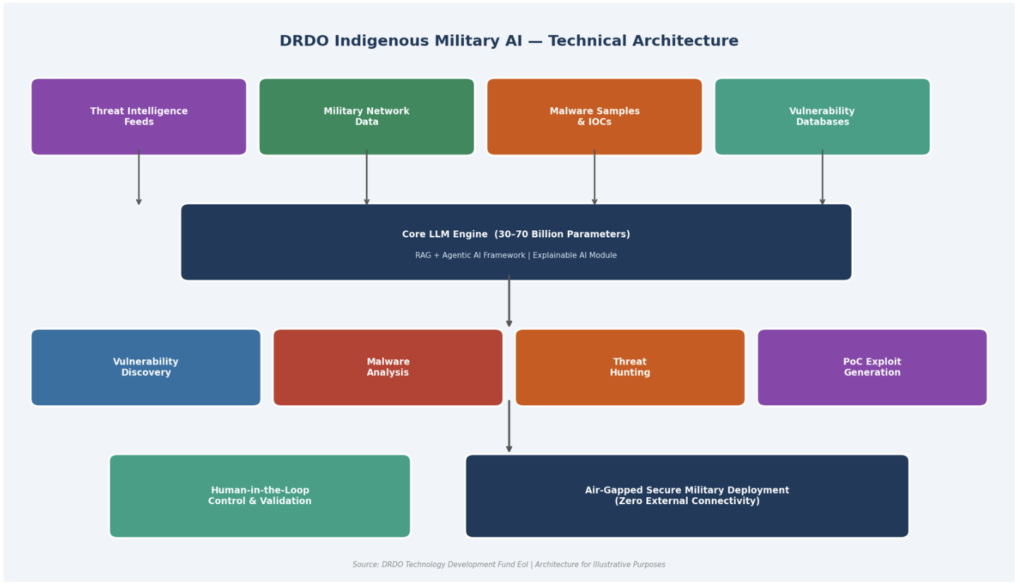
The architecture described in the EoIs draws on several advanced AI development paradigms that represent the current state of the art in enterprise and government AI deployment.
Large Language Model Core
At the foundation is a transformer-based LLM in the 30-70 billion parameter range. This is a substantial model — comparable in size to Meta’s Llama 3 70B, which is itself a highly capable open-source model. The key distinction is that the defence model would be trained from scratch (or from a classified foundation model) on military-specific data, rather than on the general-purpose internet corpora that commercial models use. Parameter count alone does not determine capability; the specificity and quality of training data is at least as important.
Retrieval-Augmented Generation (RAG)
RAG is a technique that improves an AI model’s outputs by augmenting its responses with real-time retrieval from a structured knowledge base. In a military cyber defence context, this means the LLM can query an up-to-date database of known vulnerabilities, active threat actor profiles, and current indicators of compromise — rather than relying entirely on what it learned during training, which inevitably becomes outdated. RAG significantly reduces the rate of hallucination (the generation of confident but false outputs) in domain-specific tasks, which is critical when the output is a security recommendation that might inform a real military response.
Agentic AI and Human-in-the-Loop
The agentic AI framework allows the system to perform multi-step tasks autonomously — for instance, detecting an anomaly, retrieving relevant threat intelligence, analysing related malware samples, and drafting a remediation recommendation, all within a single workflow. But the human-in-the-loop constraint means that no consequential action — isolating a network segment, flagging a target for human review, generating a vulnerability report for command — is executed without a human operator confirming the output. This is both an operational requirement and an ethical one.
Explainable AI (XAI)
Military operators, quite reasonably, will not trust a system that says ‘this is a threat’ without explaining why. Explainable AI modules generate natural-language justifications for the model’s conclusions, allowing a human analyst to assess the quality of the AI’s reasoning and override it where necessary. In high-stakes environments, explainability is not just a regulatory nicety — it is the mechanism by which human judgment remains in the loop even when AI is doing the heavy lifting.
7. The Data Behind the Threat: Why the Numbers Demand Action.
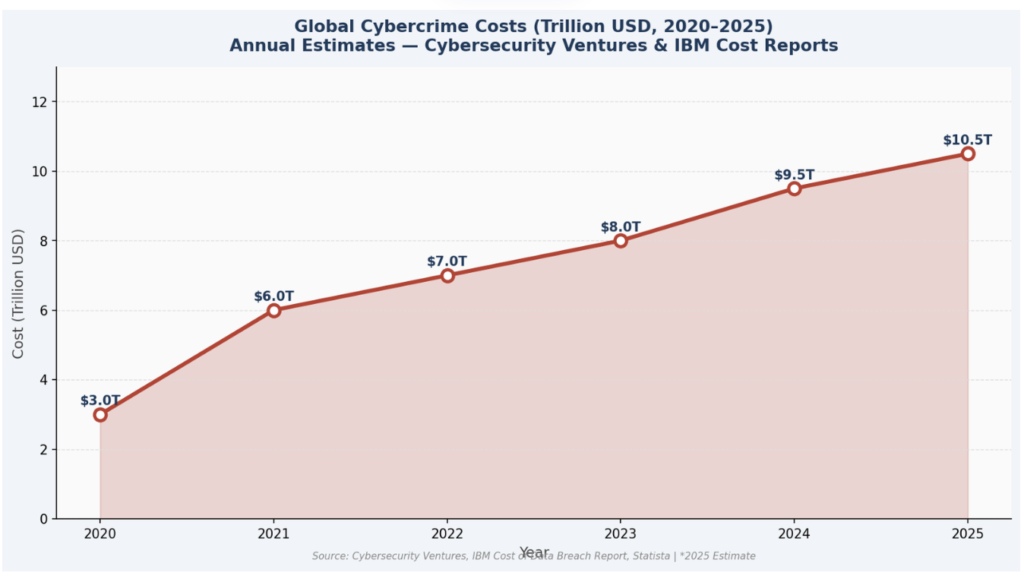
Global Scale
The macroeconomic context for this initiative is almost difficult to process. Global cybercrime costs reached an estimated $10.5 trillion in 2025, according to figures compiled by Cybersecurity Ventures and IBM’s Cost of Data Breach reports. To put that in perspective, it exceeds the GDP of every country except the United States and China. It is more than the global trade in illegal drugs.
State-sponsored cyberattacks account for a disproportionate share of the most damaging incidents. These are not opportunistic criminals looking for credit card numbers. They are intelligence services, military units, and state-affiliated contractors conducting strategic operations: stealing weapons blueprints, mapping critical infrastructure, planting persistent access for future use, and degrading adversaries’ confidence in their own networks.
Global cybersecurity spending — defence and offence combined — exceeded $212 billion in 2025, according to analysis across publicly available national security budgets. The asymmetry between attack costs and defence costs is extreme: a sophisticated cyberattack might cost the attacker a few million dollars to execute, while the damage it causes — and the defensive response it requires — can run into the billions.
Critical Infrastructure as Primary Target
The most dangerous category of cyberattack is not data theft. It is infrastructure disruption. Defence networks, power grids, financial clearing systems, and telecommunications backbone all represent targets whose disruption could, in a conflict scenario, be more debilitating than a conventional strike. Russia’s use of cyberattacks in Ukraine — targeting the power grid, disrupting satellite communications, and attempting to compromise battlefield command systems — demonstrated that cyber operations are now fully integrated into kinetic military campaigns, not conducted as separate activities.
Chinese state-sponsored actors’ documented targeting of Indian power grid infrastructure — including incidents in 2020 and 2024 near Ladakh during periods of heightened military tension — suggests that this integration is not a distant theoretical risk for India. It is current. The AIIMS ransomware attack of 2022, widely attributed to a state-linked actor, took the country’s premier public hospital network offline for weeks and highlighted the cascading effects of targeting a single node in an interconnected digital ecosystem.
Lessons From Major Cyber Incidents
| Incident | Year | Method | Impact / Lesson |
| Stuxnet | 2010 | Air-gap bypass via USB | Physical infrastructure can be destroyed via cyber means |
| SolarWinds Breach | 2020 | Supply chain compromise | 18,000+ organisations compromised via trusted software update |
| AIIMS Ransomware | 2022 | Ransomware / APT | National health infrastructure paralysed for weeks |
| Colonial Pipeline | 2021 | Ransomware via VPN | Fuel supply to US East Coast disrupted |
| India Power Grid | 2024 | State-sponsored APT | Defence-adjacent infrastructure targeted during border tensions |
| MOVEit Vulnerability | 2023 | Zero-day SQL injection | Hundreds of government agencies globally compromised |
8. India’s Specific Cyber Threat Landscape
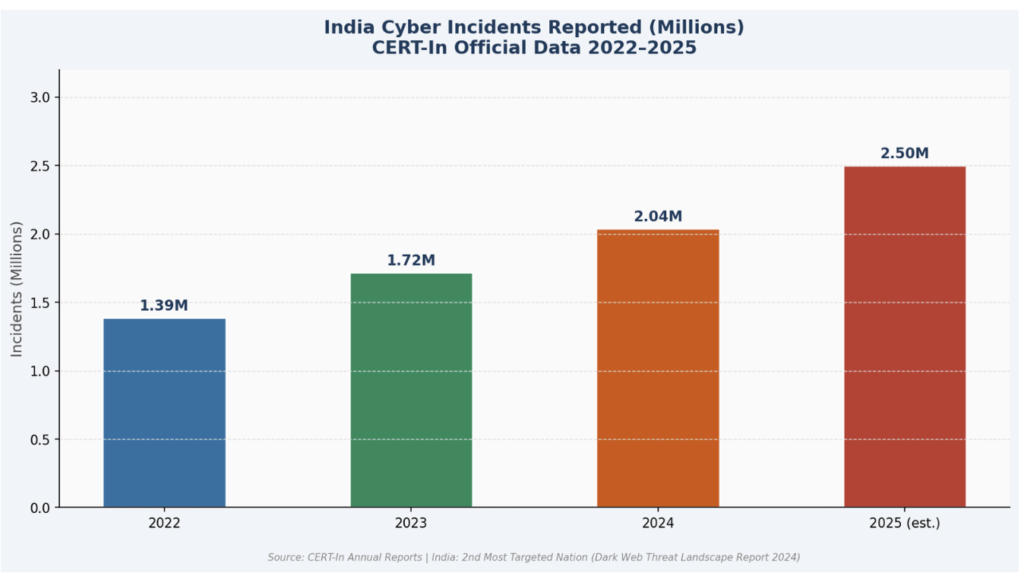
India occupies an uncomfortable position in the global cyber threat picture. It is a high-value target by almost every metric: large economy, extensive digital infrastructure, ongoing border disputes with two nuclear-armed neighbours, and a defence establishment that is in the process of digitising at pace. That combination is precisely what threat actors — state-sponsored and criminal alike — look for. The increasing volume of cyber incidents reinforces the strategic necessity of DRDO Indigenous Military AI for Cyber Defence.
CERT-In’s data tells a stark story. From 1.39 million registered incidents in 2022 to 2.04 million in 2024, India’s cyber incident volume has grown by nearly 47 percent in just two years. Check Point Software’s State of Cybersecurity in India 2025 report found that Indian organisations faced an average of 2,011 cyberattacks per week in 2025, significantly above the global average. The sectors hardest hit — banking and finance (20 entities breached), government (13), telecommunications (12) — are precisely the sectors where a successful attack carries the highest strategic consequence.
Pakistan-linked groups, particularly the Transparent Tribe / SideCopy cluster, have maintained persistent targeting of Indian defence and government entities using spear-phishing campaigns, RAT deployments, and social engineering. In March 2024, the cybersecurity firm EclecticIQ identified a campaign using a modified version of the open-source HackBrowserData infostealer, delivered through phishing emails camouflaged as Indian Air Force correspondence, targeting Indian government entities in the energy and defence sectors.
Chinese APT groups have demonstrated both the intent and the capability to map Indian critical infrastructure for potential future disruption. The documented intrusions into the Mumbai power grid in 2020 and subsequent incidents in 2024 were not random. Power grids near operational military zones, during periods of active military standoff, are strategic intelligence targets.
Why India Needs AI-Driven Cyber Defence
The scale of the threat has outpaced the capacity of human defenders. A security operations centre analyst can review perhaps a few hundred alerts per shift. An AI system can process millions of log entries, correlate indicators of compromise across dozens of systems, and flag the 0.01 percent of events that warrant human attention — all in real time. That is not replacing human expertise; it is enabling human expertise to operate at a scale that matches the threat.
The specific capabilities outlined in DRDO’s EoIs — vulnerability discovery, zero-day identification, malware analysis, threat hunting — are exactly the capabilities that are most difficult to scale through human effort alone and most amenable to AI augmentation. A well-designed indigenous military AI would not eliminate the need for skilled human cyber defenders; it would multiply their effectiveness by orders of magnitude.DRDO Indigenous Military AI for Cyber Defence is designed to reduce dependence on foreign AI systems and improve technological sovereignty.
9. Why Indigenous AI Is a Strategic Necessity, Not an Option
The argument for indigenous military AI is sometimes framed as national pride or economic policy. Those factors are present, but they are secondary. The primary argument is purely strategic.
The Backdoor Risk
Any AI system trained on data from a foreign commercial platform, or running on foreign cloud infrastructure, introduces a structural vulnerability that no amount of contractual protection can fully eliminate. The SolarWinds incident of 2020 demonstrated how deeply trusted third-party software can be compromised without any obvious indicator for months or years. If India’s military cyber defence AI is running on infrastructure that a foreign intelligence service can access, the entire system — including its identification of India’s own vulnerabilities — is potentially an intelligence gift to the adversary.
An air-gapped, indigenously developed system with no external dependencies does not have this vulnerability. It has different vulnerabilities — insider threats, data poisoning during training, hardware supply chain risks — but these are more controllable and do not come with the structural exposure that foreign-hosted systems carry.
Customisation for Indian Military Requirements
Commercial AI models are built on global datasets, for global use cases. India’s military threat environment has specific characteristics: the nature of the adversaries, the specific vulnerabilities of Indian military systems, the operational patterns of threat actors targeting the subcontinent, the specific software and hardware in India’s defence networks. An AI trained specifically on Indian military cyber data will perform significantly better on Indian military cyber defence tasks than a general-purpose commercial model, however capable that model is in its own domain.
Technological Sovereignty
India’s stated aspiration to be among the top-three AI powers by the early 2030s requires that it own AI infrastructure, not just consume it. Military AI is the most strategically sensitive category of AI capability. If India’s military AI runs on foreign models, foreign chips, and foreign cloud infrastructure, then India’s ‘AI sovereignty’ is a commercial arrangement, not a strategic reality. The moment a foreign government decides to restrict access to that infrastructure — through sanctions, export controls, or simple commercial decisions — India’s military capability degrades.
This is not a hypothetical concern. US export controls on advanced semiconductors, specifically targeting China but with broader implications, have already demonstrated how swiftly strategic dependencies can become strategic vulnerabilities. India’s current reliance on NVIDIA GPUs for AI compute — an area where DRDO’s EoIs make no specific commitment to indigenisation — is itself a significant exposure that the broader military AI initiative will need to address.
10. Military Applications of the AI Platform
| Application Area | Capability | Current Status in India |
| Security Operations Centres | AI-driven alert triage, SIEM integration, automated playbooks | Partially deployed in civilian CERTs; military gaps remain |
| Vulnerability Assessment | Automated scanning of defence networks and applications | Manual / outsourced; indigenous AI would automate |
| Malware Reverse Engineering | AI-assisted decompilation, classification, attribution | Limited indigenous capability; reliant on foreign tools |
| Cyber Threat Hunting | Proactive adversary discovery in military networks | Nascent; DRDO AI would enable this at scale |
| Defence Intelligence Support | OSINT aggregation, dark web monitoring, attribution analysis | Fragmented; AI would unify and accelerate |
| Joint Cyber Command Ops | Cross-service cyber coordination and response | Institutional framework developing since 2023 |
| Strategic Decision Support | AI-assisted analysis for senior military leadership | Manual; high latency; AI would compress decision cycles |
11. How DRDO’s Programme Compares With Global Military AI Initiatives
| Country | Programme | Primary Focus | Notable Feature |
| USA | Project Maven + JADC2 | ISR, Targeting, C2 | AI embedded in operational command chains |
| China | Intelligentized Warfare | Full-spectrum AI operations | Civil-military fusion; commercial AI as military R&D |
| Israel | AI Battle Networks | Intelligence & Targeting | Operational AI-assisted targeting (operational since 2021+) |
| Russia | Military AI Systems | Autonomous Drone & EW | Constrained by sanctions; strong conceptual doctrine |
| UK / NATO | Responsible AI Framework | Standards & Interoperability | Governance-first approach; standardising across 32 members |
| India (DRDO) | TDF Indigenous AI Initiative | Cyber Defence & Threat Intel | Air-gapped, indigenous LLM; ETAI governance framework |
Despite its promise, DRDO Indigenous Military AI for Cyber Defence faces significant challenges related to compute infrastructure, data quality, and AI reliability.
12. The Formidable Challenges That Cannot Be Glossed Over
The ambition is clear. The execution is where the difficulties accumulate.
Compute Infrastructure
Training a 30-70 billion parameter model requires substantial GPU compute — the kind of infrastructure that currently exists in commercial hyperscale data centres. India’s indigenous semiconductor and GPU manufacturing capability is still in its early stages. DRDO’s existing compute infrastructure, built primarily for simulation and engineering workloads, is not configured for the scale of parallel computation that LLM training requires. Acquiring sufficient GPUs through commercial channels has become more complicated, not less, as US export controls on advanced chips have tightened.
This is not an unsolvable problem — India has the National Supercomputing Mission and is investing in dedicated AI compute through the National AI Mission — but it is a bottleneck that will affect the timeline of any indigenous military AI programme.
Data Quality and Availability
A military AI for cyber defence is only as good as its training data. The specific challenge is that the highest-quality data — the most sophisticated malware samples, the most detailed vulnerability intelligence, the most accurate threat actor profiles — is often classified, fragmented across different agencies, or not yet in machine-readable formats. Building a comprehensive, high-quality military cyber training corpus from Indian data sources is itself a significant multi-year undertaking.
Hallucination and Reliability
Large language models hallucinate. They generate confident, plausible-sounding outputs that are factually wrong. In a consumer context, this is an inconvenience. In a military cyber defence context, a false positive that triggers an unnecessary response, or a false negative that misses a real threat, has operational consequences. The RAG architecture and explainable AI modules are designed to mitigate this, but they do not eliminate it. Extensive validation and testing regimes — which themselves require significant time and expertise — will be essential before the system is deployed in operational contexts.
Adversarial Attacks
An AI model that is known to exist can be targeted specifically. Adversarial attacks on AI systems — data poisoning during training, prompt injection in deployment, evasion techniques that fool classification systems — are a growing area of both offensive research and defensive concern. An indigenous military AI, however well-secured in its deployment environment, is only as resilient as its training pipeline and its inference infrastructure. Adversaries who anticipate the development of such a system may seek to compromise its inputs before it is even operational.
Institutional Readiness
Technology is often the easier part. The harder part is building the institutional culture, the doctrinal frameworks, the training programmes, and the legal authorities needed to deploy AI in military contexts responsibly. India’s ETAI Framework is a start, but the gap between a governance document and a trained, confident, operationally integrated cyber defence AI capability is measured in years and thousands of person-hours.
13. Integration with India’s Broader National Missions
DRDO’s military AI initiative does not exist in isolation. It intersects with, and draws support from, a constellation of government programmes that collectively constitute India’s technology sovereignty agenda.
The Atmanirbhar Bharat initiative, translated from defence policy into R&D investment, provides the institutional rationale and political cover for prioritising indigenous development even when imported solutions are faster. DRDO’s budget for 2025-26 is Rs 26,816 crore — its largest ever allocation — and represents the government’s bet that indigenous R&D delivers compounding strategic returns.
The National AI Mission, launched with a corpus of Rs 10,372 crore, is building shared compute infrastructure that defence applications could leverage. The Digital India programme’s expansion of government digital infrastructure creates both the demand for cybersecurity and the training ground for AI systems designed to protect it.
The Ministry of Defence’s ongoing digitalisation of military functions — logistics, maintenance, personnel management, operational planning — is simultaneously creating both the digital assets that need protecting and the data exhaust that could feed an AI training pipeline. The cyber defence AI initiative is best understood as the security layer for a much broader digital military transformation.
14. DRDO’s Recent Technological Momentum
DRDO’s credibility on the indigenous AI project rests partly on its track record in other complex technology domains. The last eighteen months have provided substantive evidence of capability.
During Operation Sindoor in 2025, Defence Minister Rajnath Singh confirmed that DRDO-developed weapons ‘played a decisive role’ and ‘worked seamlessly,’ boosting soldiers’ morale. The operations also saw the combat debut of the Akashteer AI-enabled Air Defence Control and Reporting System — jointly developed by DRDO, BEL and ISRO — which demonstrated that India can field AI-integrated defence systems that perform under operational pressure.
The Rudram-II air-to-surface anti-radiation missile completed its flight testing programme, validating a propulsion and guidance system that incorporates AI-driven target discrimination algorithms. DRDO’s 30kW laser-based directed energy weapon, demonstrated in April 2025, destroyed drones and missiles at ranges up to 5km — a system that requires real-time AI tracking and fire control to function.
In December 2025, DRDO handed over seven technologies developed under the TDF Scheme to the tri-services, with the Empowered Committee approving twelve new projects in strategic, aerospace, naval and electronic warfare domains. DRDO has also increased the funding ceiling per TDF project from Rs 10 crore to Rs 50 crore, and has sanctioned an additional Rs 500 crore corpus specifically for deep-tech and pioneering projects.
These are not the outputs of an organisation that lacks technical ambition. The AI initiative sits within a broader institutional trajectory of indigenisation that has gained real momentum. The question is whether the specific challenges of LLM development — data, compute, talent, time — can be navigated at the pace that the threat environment demands.
15. The Future Operational Landscape: AI-Enabled Warfare
The trajectory of military AI development globally suggests that the gap between current capabilities and future requirements will widen faster than most defence establishments are institutionally prepared for.
Human-Machine Teaming
The near-term model is not autonomous AI replacing human soldiers or commanders. It is human-machine teams, where AI systems handle data aggregation, pattern recognition, and initial analysis while human operators retain decision authority for consequential actions. This model — already operational in US Air Force strike planning and Israeli intelligence workflows — will become the standard configuration across most military functions within the next decade.
Autonomous Cyber Defence
The longer-term trajectory in cyber defence specifically is toward greater AI autonomy. A cyberattack that propagates at machine speed — milliseconds between intrusion and lateral movement — cannot be defended against solely through human-supervised AI responses. Some categories of automated response (network isolation, session termination, signature-based blocking) are already effectively autonomous in commercial security tools. Military AI will extend this to more complex and consequential response categories, with the policy and legal frameworks trailing the technology.
Multi-Domain Operations
The concept that future conflicts will be won or lost in a single domain — land, sea, air — has been comprehensively abandoned by every major military. Multi-domain operations require AI systems that can process intelligence across all domains simultaneously, identify cross-domain dependencies, and present commanders with a fused operational picture. India’s stated intent to develop a Joint Cyber Command, alongside existing commands for land, sea, air and space, suggests the institutional framework for multi-domain AI integration is taking shape.
16. The Way Forward: What Success Actually Requires
The TDF EoIs are a beginning, not an outcome. Translating them into an operational indigenous military AI for cyber defence will require sustained commitment across several dimensions simultaneously.
- Develop sovereign defence AI compute infrastructure: Partner with the National Supercomputing Mission and the semiconductor mission to create dedicated, classified AI training and inference hardware, reducing dependence on commercial GPU markets.
- Build the training data ecosystem: Systematically digitise and classify historical cyber incident data, threat intelligence, and vulnerability research across all three services and CERT-In, creating the corpus that any indigenous model needs to be effective.
- Establish military AI doctrine: Define, publicly where possible, the rules of engagement for AI-assisted military cyber operations — what AI can decide autonomously, what requires human authorisation, and what is never delegated.
- Expand cyber command capabilities: The Defence Cyber Agency, established in 2019, needs to scale its capacity and integrate AI tools as they become available, rather than waiting for a complete system before beginning integration.
- Promote academia-industry-military collaboration: The TDF Scheme’s engagement with MSMEs and startups is the right model. India has a deep reservoir of AI talent in its private sector and academic institutions; creating structured pathways for that talent to contribute to classified defence projects, with appropriate security frameworks, is essential.
- Create dedicated military AI validation centres: Testing an AI system for military cyber defence requires adversarial red-teaming, scenario simulation, and failure mode analysis under conditions that cannot be replicated in commercial environments. Dedicated testing infrastructure is needed. If successfully implemented, DRDO Indigenous Military AI for Cyber Defence could become a cornerstone of India’s future military cyber security architecture.
17. A Strategic Leap, With Real Distance Still to Cover
DRDO’s indigenous military AI initiative for cyber defence is strategically correct, technically ambitious, and operationally necessary. The ETAI Framework provides a governance foundation that compares well with what most comparable countries have published. The TDF EoIs demonstrate institutional readiness to move beyond conceptual frameworks into actual procurement and development. Operation Sindoor proved that DRDO-developed systems can perform under real operational pressure.
But the gap between a well-crafted expression of interest and a deployed, battle-tested, AI-driven cyber defence capability is substantial. The compute problem is real. The training data problem is real. The talent pipeline problem is real. The timeline risk is real. China’s cyber capabilities targeting India are not waiting for India’s indigenous AI to mature. Pakistan-linked threat actors are not pausing their campaigns. The threat environment continues to evolve at a pace that no defence R&D cycle has historically managed to match.
What the initiative has in its favour is political will at the highest levels, a defence budget that is growing, an increasingly capable indigenous defence industry, and an AI talent base that is genuinely world-class. Whether those assets can be marshalled effectively — across inter-agency bureaucracies, classification boundaries, procurement timelines, and institutional cultures that do not naturally move at the speed of AI development — is the real question.
The DRDO’s 68th Foundation Day speech from Defence Minister Rajnath Singh, delivered in January 2026, referenced Prime Minister Modi’s announcement of the Sudarshan Chakra — an initiative whose full contours are not yet public, but whose name evokes an all-seeing, all-defending capability. Whether that aspiration translates into an indigenous military AI for cyber defence that actually works, at scale, in time, will depend less on the quality of the vision and more on the quality of the execution. And execution, as any defence project manager will confirm, is where the difficult work begins.
Frequently Asked Questions (FAQ)
Q1. What exactly is DRDO’s indigenous military AI for cyber defence?
DRDO has issued Expressions of Interest under its Technology Development Fund Scheme for the development of a large language model (30–70 billion parameters) specifically designed for military cyber defence. The system is intended to operate in an air-gapped environment, with no internet connectivity, and will perform functions including vulnerability discovery, malware analysis, threat intelligence aggregation, and automated security recommendations. It is not a commercial AI tool adapted for military use — it is to be developed indigenously, trained on defence-specific data.
Q2. Why does India need its own military AI rather than using existing commercial AI?
Commercial AI systems operate on foreign cloud infrastructure, process data on servers outside India’s legal jurisdiction, and are trained on general-purpose datasets that do not reflect the specific threat environment India’s military faces. Submitting classified military data to commercially hosted AI models creates structural security vulnerabilities. An indigenous, air-gapped system eliminates this exposure and can be customised specifically for Indian military requirements.
Q3. What is the Technology Development Fund (TDF) Scheme?
The TDF Scheme is DRDO’s flagship programme for catalysing indigenous defence technology development through grants-in-aid to Indian industry, MSMEs, and startups. It covers proof-of-concept development, prototyping, and shared intellectual property arrangements. The funding ceiling per project has recently been increased from Rs 10 crore to Rs 50 crore, and an additional Rs 500 crore corpus has been sanctioned for deep-tech projects. The AI cyber defence initiative is being executed under this scheme.
Q4. What are the main technical challenges?
The primary challenges are: (1) compute infrastructure — training a 30-70B parameter model requires GPU resources that exceed DRDO’s current capacity; (2) training data quality — building a comprehensive military cyber training corpus is a multi-year effort; (3) hallucination and reliability — LLMs generate incorrect outputs that must be detected and filtered before they influence military decisions; (4) adversarial attacks — the AI system itself is a high-value target for data poisoning and evasion; and (5) institutional readiness to integrate AI into military workflows.
Q5. How does India’s initiative compare with Project Maven in the US?
Project Maven is primarily focused on image analysis for intelligence, surveillance, and reconnaissance — processing satellite and drone imagery at scale. India’s DRDO initiative is focused on cyber defence: vulnerability discovery, malware analysis, and threat intelligence. The scale and maturity differ significantly: Project Maven is embedded in operational command chains, while DRDO’s system is currently at the procurement stage. Both initiatives reflect the same underlying doctrine — that AI is now a core component of military capability — but are at different points in their development arcs.
Q6. What is Akashteer, and how does it demonstrate DRDO’s AI capability?
Akashteer is an AI-enabled, fully automated Air Defence Control and Reporting System developed by DRDO, BEL, and ISRO, inducted into service in 2024 and combat-tested during Operation Sindoor in 2025. It demonstrated India’s ability to field AI-integrated military systems that perform under real operational pressure — providing a proof of concept that DRDO can develop, test, and deploy AI-augmented defence systems at operational scale.
Q7. Is there a risk that the indigenous AI system could be used for offensive cyber operations?
The TDF EoIs specifically reference ‘Proof-of-Concept Exploit Generation’ as one of the intended capabilities — the generation of exploit code to test and validate defensive postures. This is a standard practice in professional cybersecurity (called ‘red teaming’) and is tightly controlled even in commercial contexts. Whether India is developing offensive cyber capabilities alongside the defensive system is a separate policy question that is not addressed in publicly available documentation. The human-in-the-loop requirement and the ETAI governance framework both suggest an institutional emphasis on controlled, overseen capability rather than autonomous offensive action.
Annexure : Timeline of Military AI Development Worldwide
| Year | Event | Significance |
| 2010 | Stuxnet deployed against Iranian nuclear facility | First known state-sponsored cyberweapon causing physical infrastructure damage |
| 2014 | DARPA Cyber Grand Challenge launched | First AI vs AI cybersecurity competition; demonstrated automated vulnerability discovery |
| 2017 | Project Maven launched (USA) | AI integrated into US military ISR pipelines for the first time at operational scale |
| 2019 | China publishes “Intelligentized Warfare” doctrine | AI formally designated as core military capability in PLA modernisation plan |
| 2021 | NATO AI Strategy published | First multilateral military AI governance framework across 32 member nations |
| 2022 | AIIMS ransomware attack (India) | National health infrastructure compromised; highlighted India’s cyber vulnerability |
| 2023 | MOVEit zero-day exploited globally | Supply chain attack affecting hundreds of government agencies and corporations worldwide |
| 2024 | DRDO launches ETAI Framework (India) | India’s first formal military AI governance framework; launched by CDS and DRDO Chairman |
| 2024 | Akashteer AI air defence system inducted | DRDO’s first AI-enabled automated air defence C2 system enters Indian Army service |
| 2025 | DRDO TDF EoIs for indigenous military LLM | India moves from doctrine to active procurement of indigenous military AI capability |
| 2025 | Operation Sindoor; DRDO systems perform | DRDO-developed weapons and AI-enabled systems validated under real combat conditions |
External Links
1. DRDO Official Website — TDF Scheme EoIs: https://drdo.gov.in/drdo/en
2. DRDO ETAI Framework Launch: BharatShakti.in — CDS Launches ETAI Framework
3. India Cyber Threat Report: India Foundation — Fortifying the Digital Frontier
4. India’s Approach to Military AI: CSDR Online — India’s Approach to Military AI (2026)
5. Check Point Cybersecurity India 2025: Sanskriti IAS — India Cyber Threat Surge Analysis
6. DRDO Operation Sindoor Role: News on Air — DRDO Weapons in Operation Sindoor