
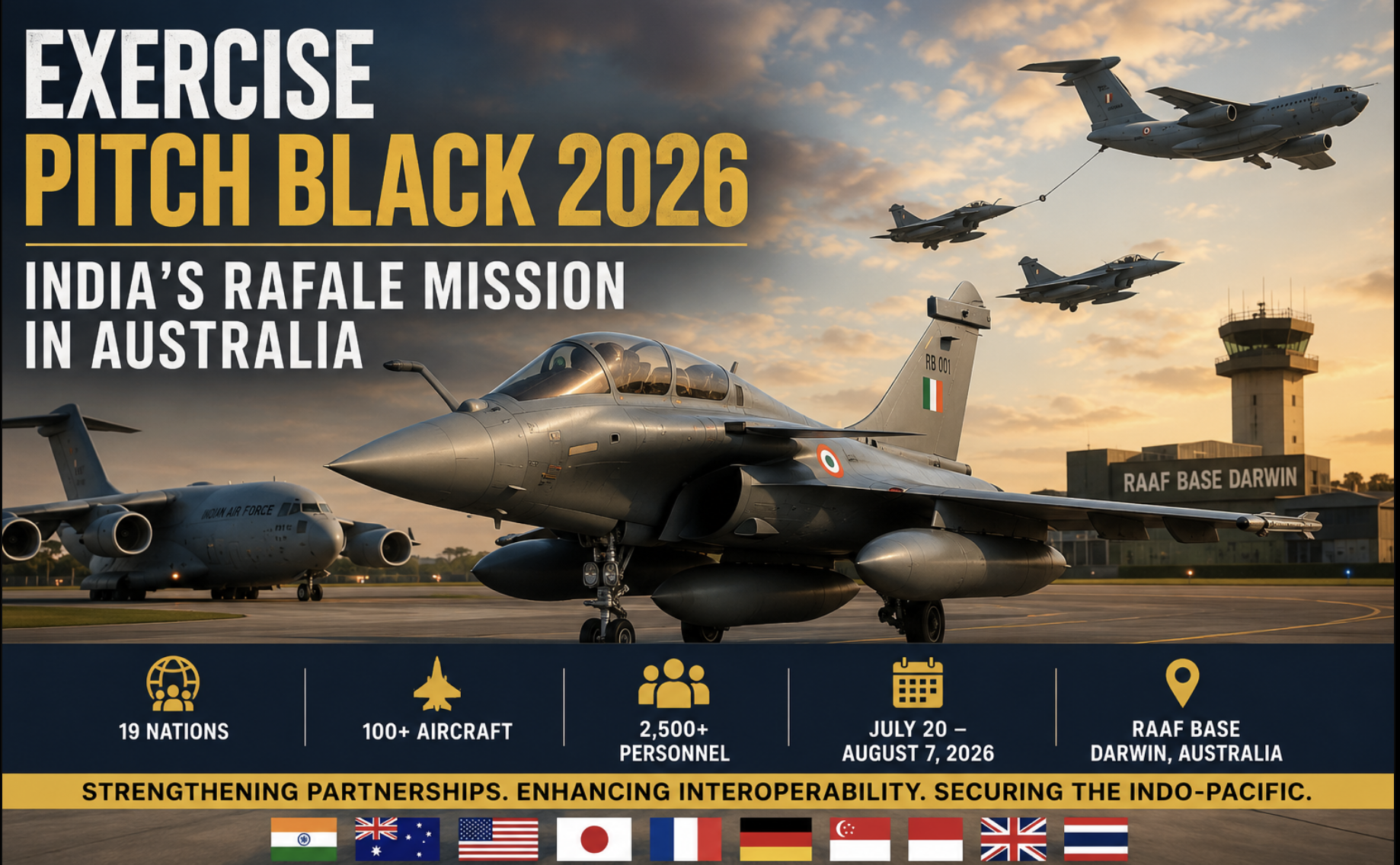
1. A Debut Worth Watching
Exercise Pitch Black 2026 is Australia’s premier multinational air combat exercise, bringing together 19 air forces, more than 100 aircraft and around 2,500 personnel. For the first time, the Indian Air Force has deployed Rafale fighters to the exercise, marking an important milestone in India’s growing role in the Indo-Pacific. Somewhere over the Java Sea last week, an Indian Air Force IL-78 tanker operating out of Juanda airport in Surabaya topped up a formation of Rafale fighters transiting Indonesian airspace. Their destination: Darwin, in Australia’s Northern Territory, where Exercise Pitch Black 2026 opens on Monday, July 20, and runs until August 7.
The IAF has been to Pitch Black before — in 2018, 2022 and 2024 — but always with the Su-30MKI. This time, for the first time, it is the Rafale flying India’s flag at the Royal Australian Air Force’s premier multinational air combat exercise. Four Rafales, two C-17 Globemaster III transports, an IL-78 mid-air refueller and more than 120 air warriors make up the contingent.
On paper, this is a routine biennial commitment. In practice, it is a statement about how far the IAF has come as an expeditionary force, and about where India sees itself in the Indo-Pacific conversation. Nineteen air forces, over 100 aircraft and roughly 2,500 personnel will share the same airspace for three weeks. That kind of density does not happen by accident.
2. What is Exercise Pitch Black 2026?
Pitch Black is the Royal Australian Air Force’s largest and most complex international air exercise, held every two years across the Northern Territory. The name is literal: the exercise was built around night flying over the vast, sparsely populated expanses of northern Australia, where aircraft can train in near-total darkness without the restrictions that crowd most of the world’s airspace.
The exercise traces its roots to the early 1980s, when it began as a largely Australian affair, with Darwin hosting editions from 1983 onwards. Singapore came aboard as an early foreign partner, and the guest list has kept growing since — the United States, Thailand, France, Germany, Japan, South Korea and, from 2018, India. What started as a domestic air defence drill is now, in its 45th year, one of the biggest air combat gatherings in the southern hemisphere.
The training space is a big part of the draw. The Bradshaw Field Training Area and the Delamere Air Weapons Range together offer one of the largest military training zones anywhere, letting planners script large force employment missions — the kind where 40 or 50 aircraft fight a single coordinated battle — without worrying about civilian traffic underneath.
Objectives, in Plain Terms
- Practise offensive and defensive counter-air operations in large, mixed multinational packages
- Build interoperability between air forces that may one day have to operate together at short notice
- Exchange tactics, procedures and honest lessons in a setting where mistakes cost nothing but pride
- Deepen defence relationships across the Indo-Pacific and beyond
3. Exercise Pitch Black 2026: Scale, Dates and Participants
The 2026 edition runs from July 20 to August 7, flown mainly out of RAAF Bases Darwin and Tindal. Australian officials have flagged it as among the largest editions in the exercise’s history, with 19 nations, more than 100 aircraft and around 2,500 personnel involved. The 2024 edition had set the previous benchmark with 20 countries and over 140 aircraft; 2026 trades a little of that raw volume for a heavier emphasis on the complexity of the missions themselves.
The participant list reads like a map of Indo-Pacific and European interest in the region: Australia, Brunei, Canada, Fiji, Finland, France, Germany, India, Indonesia, Japan, Malaysia, New Zealand, Papua New Guinea, the Philippines, the Republic of Korea, Singapore, Sweden, Thailand and the United States. The presence of Nordic air arms — Finland and Sweden, both recent NATO entrants — alongside Pacific island states like Fiji and Papua New Guinea says something about how wide the exercise’s pull has become.
The airframe mix is equally varied. Australian F-35As and Super Hornets, Japanese fighters making their own long-range deployment, French and Indian Rafales flying side by side, plus tankers, transporters and electronic warfare assets from a dozen air forces. For mission planners, that diversity is the whole point — and the whole headache.
4. India’s Contingent: Who and What Has Gone to Darwin
The IAF package for Exercise Pitch Black 2026 is compact but complete: four Rafale multirole fighters as the combat edge, two C-17 Globemaster IIIs hauling personnel, spares and ground equipment, and an IL-78 tanker that both enabled the ferry flight and will fly refuelling missions during the exercise itself.
The 120-plus air warriors are not just pilots. The contingent includes engineers, technicians, air traffic and fighter controllers, and subject matter experts across domains — the people who keep a fighter detachment flying 8,000-odd kilometres from its home base. In many ways, they are the ones being tested most. Flying a Rafale is one thing; sustaining four of them at surge rates in another country’s ecosystem is quite another.
The transit itself was a mini-exercise. The Rafales staged across Southeast Asia with IL-78 support, including the refuelling leg over Indonesia that New Delhi’s embassy in Jakarta publicised warmly — a small diplomatic dividend collected before the first exercise sortie was even flown.
5. The Aircraft India Has Sent
Rafale: The Combat Edge
The Rafale is a twin-engine, 4.5-generation multirole fighter built by Dassault Aviation, flown by the IAF from Ambala and Hasimara. It pairs the RBE2 AESA radar with the Spectra electronic warfare suite and a weapons fit that includes the Meteor beyond-visual-range missile — a combination that makes it one of the more complete air combat packages flying anywhere today. India picked it for Pitch Black 2026 partly because it is the newest fighter in the inventory, and partly, one suspects, because Darwin offers the perfect stage to fly it against and alongside F-35s, Gripens and Typhoon-class opposition.
C-17 Globemaster III: The Muscle
The C-17 is the IAF’s strategic airlift workhorse — a four-engine heavy transporter that can carry around 70 tonnes across continents and land on austere strips. For a deployment like this, the two C-17s are the supply line: ground power units, tow bars, spares, tool kits, and the technicians who use them. No C-17s, no detachment.
IL-78: The Range Extender
The Russian-origin IL-78 is the IAF’s mid-air refuelling platform, able to transfer fuel to multiple receivers through its probe-and-drogue system. It made the trans-oceanic ferry possible and gives Indian planners the option of flying longer, more ambitious sorties during the exercise. The IL-78 fleet is ageing, and India’s long-running search for new tankers is well documented — which makes every expeditionary outing like this one a quiet reminder of why that acquisition matters.
Aircraft Comparison at a Glance
| Parameter | Rafale | C-17 Globemaster III | IL-78 |
| Role | Multirole fighter | Strategic airlift | Air-to-air refuelling |
| Origin | France (Dassault) | USA (Boeing) | Russia (Ilyushin) |
| Crew | 1–2 | 3 | 6–7 |
| Key strength | Meteor BVR missile, Spectra EW, sensor fusion | ~70-tonne payload, austere-strip capable | Multi-point probe-and-drogue refuelling |
| Job at Pitch Black 2026 | Combat missions in multinational packages | Deployment logistics and sustainment | Ferry support and in-exercise refuelling |
6. What Actually Happens During the Exercise
The public imagination pictures dogfights. The reality is closer to an elaborate, fast-moving chess match flown at 500 knots. Pitch Black is organised around large force employment — composite air operations, or COMAO in the jargon — where strike aircraft, escorts, jammers, tankers and airborne controllers from different countries fly a single integrated mission against a thinking adversary.
- Offensive Counter Air — Aircraft fight for control of contested airspace in offensive sweeps and escort roles
- Defensive Counter Air — Defenders scramble to protect designated targets against incoming raids
- Beyond Visual Range engagements — Long-range missile combat where the fight is decided before the jets ever see each other
- Strike missions — Simulated attacks on ground targets across the Delamere and Bradshaw ranges
- Air-to-air refuelling — Tankers keep packages airborne through multi-hour missions
- Electronic warfare — Jamming, deception and spectrum warfare woven into nearly every scenario
- Night operations — The exercise’s signature: complex missions flown in darkness over unlit terrain
Between the flying comes the less glamorous grind — joint mission planning cells, mass briefings in a shared operational language, and debriefs where a young Indian flight lieutenant might find her tactics dissected by a USAF weapons school graduate. Practitioners will tell you the debrief room is where the real learning happens.
7. Why India Participates in Exercise Pitch Black 2026
India’s objectives at Exercise Pitch Black 2026 are practical rather than ceremonial. The first is interoperability — the ability to plug Indian aircraft, procedures and communications into a coalition package without friction. The second is validating expeditionary capability: proving the IAF can move a fighter detachment across an ocean, sustain it for three weeks, and fly demanding missions throughout.
There is also the matter of exposure. The IAF rarely gets to fly against fifth-generation aircraft or alongside this many different air forces at once. Every radar picture of an F-35, every mixed-formation sortie with the RAAF or the Luftwaffe, feeds back into tactics development at home. Coalition warfare experience of this sort cannot be simulated; it has to be flown.
8. The Strategic Layer: Indo-Pacific, Quad and China
Strip away the airshow gloss and Pitch Black sits squarely inside the Indo-Pacific’s shifting security geometry. India and Australia are both Quad members, both maritime democracies with long coastlines and longer supply chains, and both increasingly candid about the challenge posed by China’s military expansion — from the Line of Actual Control to the South China Sea to the island chains of the Pacific.
An IAF Rafale detachment operating from Darwin is not aimed at anyone, officially. But capability signalling does not require naming an adversary. The message embedded in the deployment is that India can project air power deep into the Indo-Pacific, operate seamlessly with partners, and do so as a matter of routine. Deterrence, in the end, is a story told through demonstrated capability, and exercises are its most visible chapters.
It helps that the political relationship has thickened at the same time. The Comprehensive Strategic Partnership of 2020, the Mutual Logistics Support Arrangement that lets each side use the other’s bases for replenishment, the 2+2 ministerial dialogue — each agreement makes the next deployment easier, and each deployment gives the agreements something real to stand on.
9. What Australia Gets Out of It
For Canberra, Pitch Black is military diplomacy at scale. Hosting 19 air forces every two years positions the RAAF as the convening power of regional air combat training, much as the US Air Force does with Red Flag. It lets Australia train its own crews against unfamiliar aircraft and tactics, stress-test the northern base network that sits at the heart of its defence posture, and bind partners into habits of cooperation that outlast any single government.
There is a community dimension too. Darwin turns into an aviation carnival for three weeks — residents watch fighter streams overhead, open days draw crowds to the flightline, and the Northern Territory economy gets a welcome injection. Soft power, in this case, comes with afterburners.
10. India–Australia Defence Relations: The Wider Canvas
Pitch Black is one thread in a relationship that has moved remarkably fast over the past decade. Two navies that barely spoke in the early 2000s now exercise together at AUSINDEX and in the Malabar series, which Australia rejoined in 2020 and hosted in 2023. The armies run the AUSTRAHIND drills. Ministers meet in the 2+2 format. And the logistics arrangement signed in 2020 quietly does the unglamorous work of making all of it sustainable.
India–Australia Defence Milestones
| Year | Milestone |
| 2014 | Framework for Security Cooperation signed during PM Modi’s visit to Australia |
| 2015 | First AUSINDEX bilateral naval exercise held |
| 2018 | IAF debuts at Exercise Pitch Black with Su-30MKI fighters |
| 2020 | Comprehensive Strategic Partnership; Mutual Logistics Support Arrangement signed; Australia rejoins Malabar |
| 2021 | Inaugural India–Australia 2+2 Ministerial Dialogue in New Delhi |
| 2022 | First AUSTRAHIND army exercise; India returns to Pitch Black after COVID gap |
| 2023 | Australia hosts Malabar for the first time; PM-level exchanges deepen ties |
| 2024 | IAF fields Su-30MKI, C-17 and IL-78 at the largest Pitch Black to that date |
| 2026 | Rafale makes its Pitch Black debut at the 19-nation 2026 edition |
11. India at Pitch Black: 2018, 2022, 2024
India’s Pitch Black story is short but steep. The 2018 debut with Su-30MKIs was a proof of concept — could the IAF get there, operate, and get home? The 2020 edition fell to the pandemic. In 2022, a contingent of about 100 personnel with four Su-30MKIs and two C-17s flew multi-domain combat missions and, memorably, took fuel from a French tanker mid-route — a snapshot of the interoperability the exercise exists to build.
By 2024, the IAF was fielding over 150 personnel at what was then the largest edition ever, with the IL-78 added to the mix. Each cycle, India’s role has grown less like a guest’s and more like a stakeholder’s. The switch to the Rafale in 2026 continues that arc: bring your best, fly it hard, learn in public.
India’s Participation History
| Edition | Aircraft Deployed | Personnel | Notable Firsts |
| 2018 | 4 Su-30MKI, C-17, IL-78 support | ~145 | IAF’s Pitch Black debut |
| 2022 | 4 Su-30MKI, 2 C-17 | ~100 | Mid-air refuelling by French tanker en route |
| 2024 | Su-30MKI, C-17, IL-78 | 150+ | Part of largest edition to date (20 nations, 140+ aircraft) |
| 2026 | 4 Rafale, 2 C-17, IL-78 | 120+ | First Rafale deployment to Pitch Black |
12. What the IAF Stands to Gain
For the IAF as an institution, the returns come in layers. At the sharp end, pilots bank combat-representative sorties against dissimilar aircraft — the kind of training that no amount of squadron-level flying at home can replicate. Controllers learn to manage crowded, multilingual airspace. Maintenance crews discover exactly which spares run short after two weeks of surge operations far from the depot.
Then there is validation. Doctrine on expeditionary air operations reads well on paper; Darwin is where it gets audited. If the Rafales generate sorties reliably through three weeks of high-tempo flying, that is evidence the IAF’s logistics model works at strategic distance. If they do not, better to find out here than during a crisis.
13. Why Multinational Air Exercises Matter
Air forces are creatures of procedure, and procedures differ. How a package checks in with an AWACS controller, how a tanker rendezvous is timed, how a mission commander runs a mass debrief — these small frictions, multiplied across a coalition, can cripple real operations. Exercises exist to sand them down.
- Common standard operating procedures emerge from repeated joint missions
- Trust builds at the human level — between pilots, planners and commanders who now know each other by name
- Tactical innovation spreads faster when air forces watch each other work
- Logistics coordination — fuel standards, ground handling, spares — gets tested for real
- Information-sharing habits formed in peacetime pay off when a crisis demands quick coordination
14. The Rafale Factor
Why does the Rafale’s presence change the texture of India’s participation? Start with the Meteor. The ramjet-powered missile’s large no-escape zone gives the Rafale a beyond-visual-range reach that few aircraft at Darwin can match, and BVR combat is where modern air battles are largely decided. Flying Meteor-armed jets in COMAO packages lets the IAF refine how that advantage is actually employed inside a coalition fight.
Then there is the electronics. Spectra’s ability to detect, locate and jam threats, combined with the jet’s sensor fusion, makes the Rafale as much an information node as a shooter. Pitch Black’s electronic warfare-rich scenarios are precisely the environment where those systems earn their keep. And because France is also flying Rafales at the exercise, there is a rare chance for two air forces operating the same type to compare notes on tactics, maintenance and upgrades.
15. The Enablers: C-17 and IL-78
Fighters get the photographs; enablers make the deployment possible. The two C-17s moved the entire ecosystem of the detachment — people, spares, ground equipment — in a handful of sorties, a task that would have taken a fleet of smaller transporters days. That is force projection in its most literal form: the ability to place a functioning combat unit on another continent quickly.
The IL-78’s contribution is subtler but just as decisive. Without tanking, four Rafales do not cross the Indian Ocean and Indonesian archipelago in operationally sensible time. During the exercise, the tanker extends mission durations and lets Indian jets participate fully in long-range scenarios. Sustained air operations at strategic distance rest on exactly these two capabilities, which is why both aircraft appear in every serious IAF expeditionary package.
16. The Hard Part: Challenges of Deploying So Far From Home
None of this is easy, and it would be a disservice to pretend otherwise. The distance from Indian bases to Darwin is measured in thousands of kilometres, every one of which complicates the supply chain. A failed component with no spare in the C-17’s cargo means either cannibalising another jet or waiting on a resupply flight.
- Long-distance logistics — Diplomatic clearances and staging arrangements across Southeast Asian airspace
- Maintenance — Sustaining surge flying rates with a finite spares package and no depot support
- Environment — Northern Australia’s dry-season conditions differ from home-base weather patterns crews know instinctively
- Communications — Matching data links, radio procedures and crypto arrangements across 19 air forces
- Interoperability friction — Operating alongside partners whose doctrine, language and habits differ from your own
These are, of course, precisely the problems the exercise is designed to surface. An air force that has wrestled them in peacetime is far better placed when the stakes are real.
17. Pitch Black in the Global League of Air Wargames
Where does Pitch Black sit among the world’s marquee air exercises? Red Flag at Nellis remains the gold standard for high-end air combat training, with its instrumented ranges and professional aggressor squadrons. Cobra Gold in Thailand is broader but less air-centric. Cope India and Garuda are valuable bilateral events for the IAF, and Israel’s Blue Flag offers its own concentrated intensity.
Pitch Black’s niche is the combination of scale, airspace and diversity. Nowhere else do this many different air forces — Asian, European, North American, Pacific — fly complex COMAO missions together over training areas this large, with night operations as the organising theme. For countries deciding where to spend scarce exercise budgets, that mix explains why the Darwin flightline keeps getting more crowded every two years.
18. Why Exercise Pitch Black 2026 Matters for Indo-Pacific Security
The regional implications run quieter than the jet noise. Every edition of Pitch Black thickens the web of relationships that would underpin any collective response to a crisis in the Indo-Pacific — whether that crisis is a conflict, a humanitarian disaster or something in between. Air forces that have refuelled from each other’s tankers and shared each other’s briefing rooms coordinate faster when it counts.
For the smaller regional states on the participant list, the exercise offers access to training and partnerships they could never generate alone. For the larger ones, it is a hedge — a demonstration that the region’s security architecture is plural, networked and not dependent on any single capital. Freedom of navigation and overflight, so often discussed in naval terms, has an air power dimension too, and exercises like this one are where it gets rehearsed.
19. Reading Between the Lines
A few observations suggest themselves. First, the choice of the Rafale over the Su-30MKI is operationally logical — newest jet, best sensors — but it also carries a signal about the IAF’s direction of travel, away from legacy Russian-origin platforms as the face of its international engagement, even as the IL-78 in the package shows how mixed the inventory remains.
Second, the Indonesia refuelling stop deserves more attention than it received. India using Indonesian airspace and facilities for a military transit, publicised by both sides, reflects a comfort level between New Delhi and Jakarta that did not exist a decade ago. The road to Darwin, it turns out, runs through Southeast Asian goodwill.
Third, watch what the IAF says after the exercise, not before it. Past editions have shaped Indian thinking on tanker requirements, data-link standards and the design of India’s own multinational exercise, Tarang Shakti. The lessons of 2026 — how the Rafale fares in coalition packages, where the logistics strained — will filter into procurement files and doctrine papers over the next year, mostly out of public view.
20. Where This Leaves Things
When the last mission recovers to Darwin on August 7, the measurable outputs will be sortie counts and serviceability rates. The outputs that matter more — trust, familiarity, tested procedures — resist measurement altogether. India will pack up its Rafales having flown them against and alongside some of the world’s most capable air forces for the first time, and the 2028 edition will almost certainly find the IAF back again, probably with a larger footprint.
The larger question hanging over all of it is whether the habits built at exercises like Pitch Black would hold under genuine pressure. That is not something Darwin can answer. What the exercise does establish is the baseline: nineteen air forces that can plan together, fly together and debrief together in the same room. Whether that baseline ever gets called upon is the part nobody at RAAF Base Darwin can script. Exercise Pitch Black 2026 highlights the Indian Air Force’s expanding expeditionary capability and its commitment to strengthening defence cooperation in the Indo-Pacific. The deployment of Rafale fighters, supported by C-17 and IL-78 aircraft, underscores India’s ability to operate seamlessly with partner air forces in complex multinational environments.
Exercise at a Glance: Fact Sheet
| Item | Detail |
| Exercise | Pitch Black 2026 (45th year of the series) |
| Host | Royal Australian Air Force (RAAF) |
| Dates | July 20 – August 7, 2026 |
| Venues | RAAF Base Darwin and RAAF Base Tindal, Northern Territory |
| Participants | 19 nations, 100+ aircraft, ~2,500 personnel |
| Indian contingent | 4 Rafale, 2 C-17 Globemaster III, IL-78 tanker, 120+ air warriors |
| Focus | Large force employment, night operations, multinational interoperability |
| India’s editions | 2018, 2022, 2024, 2026 |
Timeline of Exercise Pitch Black
| Period | Development |
| 1981–1983 | Exercise series begins as an Australian air defence drill; Darwin hosts from 1983 |
| 1990s | Singapore and other regional partners join; exercise turns genuinely multinational |
| 2000s–2010s | US, Thailand, France and others become regulars; scale grows steadily |
| 2018 | India debuts; Germany, Japan and South Korea deepen involvement in following editions |
| 2020 | Edition cancelled due to the COVID-19 pandemic |
| 2022 | 17 air forces and 2,500+ personnel mark the post-pandemic return |
| 2024 | Largest edition to that point: 20 nations, 140+ aircraft, 4,400 personnel |
| 2026 | 19 nations; complexity of missions emphasised; India’s Rafales debut |
Countries Participating in 2026
Australia (host), Brunei, Canada, Fiji, Finland, France, Germany, India, Indonesia, Japan, Malaysia, New Zealand, Papua New Guinea, the Philippines, the Republic of Korea, Singapore, Sweden, Thailand and the United States. Some Australian reporting has also mentioned observer-level or community involvement from additional nations, including the UK and Spain.
Frequently Asked Questions (FAQs)
What is Exercise Pitch Black 2026?
It is the Royal Australian Air Force’s premier biennial multinational air combat exercise, held from July 20 to August 7, 2026 at RAAF Bases Darwin and Tindal, bringing together 19 nations, more than 100 aircraft and around 2,500 personnel.
Why is it called Pitch Black?
The name comes from the exercise’s emphasis on night flying over the vast, sparsely populated regions of northern Australia.
Which aircraft has India sent to Pitch Black 2026?
The IAF has deployed four Rafale fighters, two C-17 Globemaster III transport aircraft and an IL-78 air-to-air refueller, along with more than 120 personnel.
Is this the Rafale’s first Pitch Black?
Yes. India participated in 2018, 2022 and 2024 with the Su-30MKI; 2026 marks the first time IAF Rafales are flying in the exercise.
Which countries are taking part in 2026?
Nineteen nations including Australia, India, the United States, Japan, France, Germany, South Korea, Singapore, Indonesia, Finland, Sweden and several Pacific and Southeast Asian states.
What kinds of missions are flown?
Offensive and defensive counter-air, beyond-visual-range engagements, strike missions, air-to-air refuelling, electronic warfare and large composite air operations, with a strong night-flying component.
How does the exercise benefit the IAF?
It builds interoperability with partner air forces, validates long-range expeditionary deployment, exposes crews to advanced aircraft such as the F-35, and feeds lessons back into IAF tactics and doctrine.
How does Pitch Black fit into India–Australia relations?
It sits alongside the Comprehensive Strategic Partnership, the Mutual Logistics Support Arrangement, the 2+2 dialogue and naval exercises like AUSINDEX and Malabar as part of a rapidly deepening defence relationship.
Key Terms Glossary
- COMAO — Composite Air Operations — large missions where different aircraft types (fighters, jammers, tankers, strike aircraft) fly as one integrated package.
- Interoperability — The ability of different countries’ forces to operate together smoothly — shared procedures, compatible communications, common understanding.
- Expeditionary operations — Deploying and sustaining military forces far from home bases, often on another continent.
- BVR — Beyond Visual Range — air combat conducted at distances where pilots cannot see each other, decided by radar, missiles and tactics.
- Air-to-air refuelling — Transferring fuel between aircraft in flight, extending range and mission endurance.
- OCA / DCA — Offensive Counter Air (taking the fight into contested airspace) and Defensive Counter Air (protecting friendly airspace and assets).
- Large Force Employment (LFE) — Training missions involving dozens of aircraft executing a single coordinated battle plan.
- MLSA — Mutual Logistics Support Arrangement — the 2020 India–Australia pact allowing reciprocal access to each other’s bases for supplies and services.
External Authority Links
- Royal Australian Air Force: Exercise Pitch Black — official exercise page with history, participants and public events
- Australian Department of Defence: Exercise Pitch Black 2026 takes to the skies — official media release on the 2026 edition
- Australian Defence Ministers: Exercise Pitch Black officially takes off — opening announcement by the Prime Minister
- Press Information Bureau, Ministry of Defence, Government of India — official MoD releases on IAF deployments
- Dassault Aviation: Rafale — manufacturer’s technical page on the Rafale
- Ministry of External Affairs, India — documents on the India–Australia Comprehensive Strategic Partnership