The Zorawar light tank is being developed for India’s high-altitude operational requirements. But reported demands for heavier armour raise a difficult question: how much protection can the tank gain without compromising weight and mobility?. In the last week of September, Defence Secretary Rajesh Kumar Singh told the NDTV Defence Summit something senior officials rarely say about a tank that hasn’t entered service. The first batch of the Zorawar light tank, about 18 of an initial 59 planned for the Army, will carry “a slightly lower level of protection” than the Army now wants, he said. The rest would follow at a higher standard.
That is a plan, not a contract. As of 19 October no order for the first batch had been published. His explanation, as Livefist reported it, was plain: requirements grew while the design was being finished, and the Ministry would rather keep L&T building than let the programme stall while the argument runs on.
In mid-October, retired Lt Gen Karanbir Singh Brar, a former Director General of the Armoured Corps who has been closely tied to the project, put numbers on the trade during an NDTV podcast, as idrw reported. Armour that stops a 30 mm sabot round across the front of a 25-tonne tank isn’t free, and his arithmetic shows what it costs.
What follows sorts the figures into three piles: what officials have said on the record, what has only been reported, and what is somebody’s estimate. The number everyone wants, the final combat weight of the Zorawar light tank, hasn’t been published by anyone in a position to publish it.
FACT CHECK: WHAT’S ON THE RECORD, AND WHAT ISN’T
| On the record | DRDO’s Combat Vehicles Research & Development Establishment and L&T developed the tank. DRDO announced desert trials on 13 September 2024, and the Defence Ministry reported firing above 4,200 m that December, calling the vehicle a 25-ton-class design. In June 2026 the Army Chief said induction is expected in 2028–29. In September the Defence Secretary described a plan for about 18 Mk1 tanks, with slightly lower protection, to come first. |
| Reported, not confirmed | A Mk2 with a Level 6 front, Level 5-class sides, an active protection system and counter-drone jammers; a combat weight of 30–32 tonnes; a 1,000 hp engine. A prototype rated Level 4 at the front and Level 2 elsewhere. |
| Estimate | Lt Gen Brar’s armour masses for an assumed 7 m² frontal arc: 0.70–1.05 t at Level 4, 2.45–3.15 t at Level 6. |
| Not public | The final weight, the Mk2 engine, a published Mk1 contract, the formal General Staff Qualitative Requirement, and any independent Level 6 test result. |
Why the Zorawar light tank exists at all
The tank is a product of the 2020 standoff. Indian tanks went up onto the Kailash Range, south of Pangong Tso, in August that year, and in Swarajya’s account Chinese tanks and armoured carriers followed a few hours later. By then the PLA had the Type 15, a light tank built for mountainous terrain that, according to Janes, officially entered service in late 2018. India’s T-72s and T-90s weigh 45 to 50 tonnes, Swarajya notes. It puts the Type 15 at 33 to 36.
Heavy armour can operate up there, and does. It just costs more at every step. Diesel engines lose power as the air thins, mountain roads and bridges carry weight limits, and each extra tonne tightens what an aircraft can lift in one go. The Army’s answer, set down in a 2021 requirement, was a light tank with a combat weight not above 25 tonnes and a power-to-weight ratio of at least 25 horsepower per tonne.
The Defence Ministry cleared the purchase in 2022, for about 354 tanks in all, and split it in two. Fifty-nine would come from a development project run by DRDO with L&T as industrial partner. The other 295 or so would be competed for.
DRDO’s Combat Vehicles Research & Development Establishment (CVRDE) designed the tank, with L&T as industry partner. The prototype was unveiled at L&T’s Hazira plant in Gujarat on 6 July 2024. DRDO announced preliminary automotive and firing trials in desert terrain on 13 September that year. In December, the Defence Ministry said the tank had fired rounds at more than 4,200 metres after the Air Force flew it to the site. That release calls it a 25-ton-class vehicle, designed against the Army’s Provisional Staff Qualitative Requirements. The phrase comes back later.
At the unveiling, DRDO’s chairman, Samir Kamat, said two Zorawars can ride inside one IAF C-17 and that the tank should be ready for induction by 2027, according to the Tribune. The protection question came after that, and it hasn’t been closed.
STANAG Level 6, minus the jargon
STANAG 4569 is NATO’s yardstick for how well armoured vehicles protect the people inside. It names specific threats, fixes the test conditions and grades a vehicle from Level 1 to Level 6. The standard is listed as active in the US defence standards database, but the full text is controlled-distribution. Everything below therefore comes from public summaries, which are useful and aren’t the standard itself. Where they disagree, I say so.
On the kinetic rounds, the English and German Wikipedia summaries line up. Level 4 is a 14.5 mm armour-piercing bullet fired from 200 metres, from any direction. Level 5 steps up to a 25 mm round at 500 metres. Level 6 is a 30 mm armour-piercing round, the fin-stabilised sabot type included, from the same 500 metres. For Levels 5 and 6 the kinetic test covers a frontal arc, 30 degrees either side of the vehicle’s centreline, and not the whole hull.
| Level | Kinetic-energy threat | Fired from | Kinetic coverage | Artillery-fragment criterion (public summaries) |
| 4 | 14.5 × 114 mm armour-piercing | 200 m | All round (360°) | Summaries differ: a 155 mm HE burst at 30 m (German) or a 20 mm fragment-simulating projectile from 25 m (English) |
| 5 | 25 mm APDS-T (M791) | 500 m | Frontal arc, ±30° either side of centreline | Summaries differ: a 155 mm HE burst at 25 m (German) or the same 20 mm fragment-simulating projectile from 25 m (English) |
| 6 | 30 mm APFSDS or armour-piercing | 500 m | Frontal arc, ±30° either side of centreline | 155 mm HE burst at 10 m (both summaries) |
Public summaries only: English Wikipedia and German Wikipedia, plus militaryvehiclesdata.com for the structure of the standard. The controlled standard governs. The two Wikipedia summaries disagree on the artillery criteria for Levels 4 and 5, so only Level 6 is stated without qualification. Mine-blast criteria are rated separately and aren’t shown.
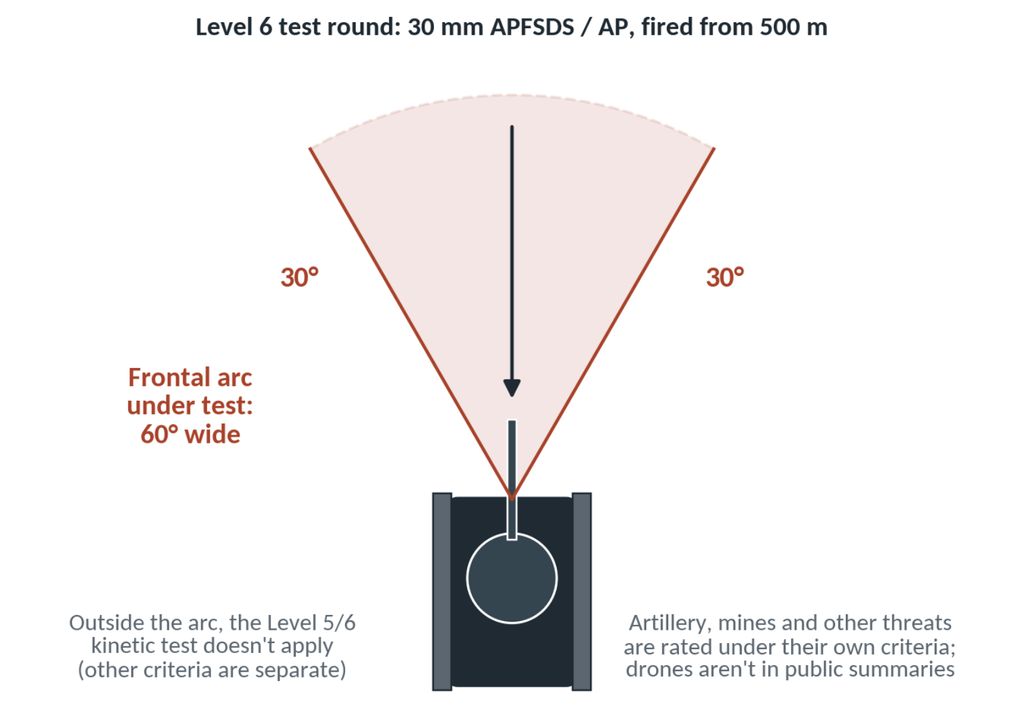
Figure 1. What the Level 5 and Level 6 kinetic-energy criteria cover, per public summaries of STANAG 4569: a 60-degree frontal arc. Other threats and other parts of the vehicle are rated under separate criteria.
The frontal-arc wording matters more than it first appears. The standard rates a vehicle separately against kinetic rounds, artillery fragments and mine blast, and one public overview says the wider document set covers shaped-charge threats too. When Indian reporting says “Level 6”, it means the kinetic round on the front arc. That says little about how the roof, rear deck or tracks fare, or about a drone dropping a charge from above. I found no public summary that describes a test for FPV drones or loitering munitions.
Brar’s own advice, as idrw reports it, was to judge armour by the protection it gives against the actual threat and not by its label. He added that the Chinese tank used as the benchmark carries no Level 6 designation, which he said shouldn’t be read as weaker protection.
As for the Zorawar itself, reports put the prototype at Level 4 on the front and Level 2 elsewhere. The upgraded version is reported to be aiming at Level 6 on the front and Level 5-class protection on the sides. Lt Gen A B Shivane, who conceived the light tank project in 2017 as Director General Mechanised Forces, wrote in July that Level 4 barely holds against a 14.5 mm round. In his view that isn’t good enough for a tank an infantry carrier’s cannon could trouble.
The armour sum behind the argument
Brar’s sums start with a frontal arc he puts at about 7 square metres. Level 4 armour across that area, he estimates, weighs 0.70 to 1.05 tonnes. Level 6 weighs 2.45 to 3.15. Divide by the area and Level 4 works out at 100 to 150 kg per square metre, Level 6 at 350 to 450. Mass per square metre roughly triples. These are his estimates, not measured Zorawar armour weights, and idrw’s report of the interview notes they will vary with the actual design.
On the podcast he described the cost of going from Level 4 to Level 6 as around two tonnes, and said that wouldn’t hurt the tank’s operational capability. His own range is wider. Subtract matching ends and the gap is 1.75 to 2.10 tonnes. Mix the extremes, top-end Level 6 minus bottom-end Level 4, and it stretches from 1.40 to 2.45. Some write-ups quote only the 2.45 as the price of the upgrade. It’s the far end of the range, not the middle.
Set that against the allowance. The 2021 requirement, as Swarajya reads it, allows 25 tonnes with a 10 per cent tolerance. That implies a ceiling of 27.5 tonnes and 2.5 tonnes of headroom, though I haven’t seen 27.5 stated anywhere as a final combat-weight limit. Reports say the prototype already carries Level 4 on the front, so take that as the starting point, with the caveat that nobody has published the armour layout. A Level 6 front would then use up 56 to 98 per cent of that headroom, or 70 to 84 per cent if you compare matching ends.
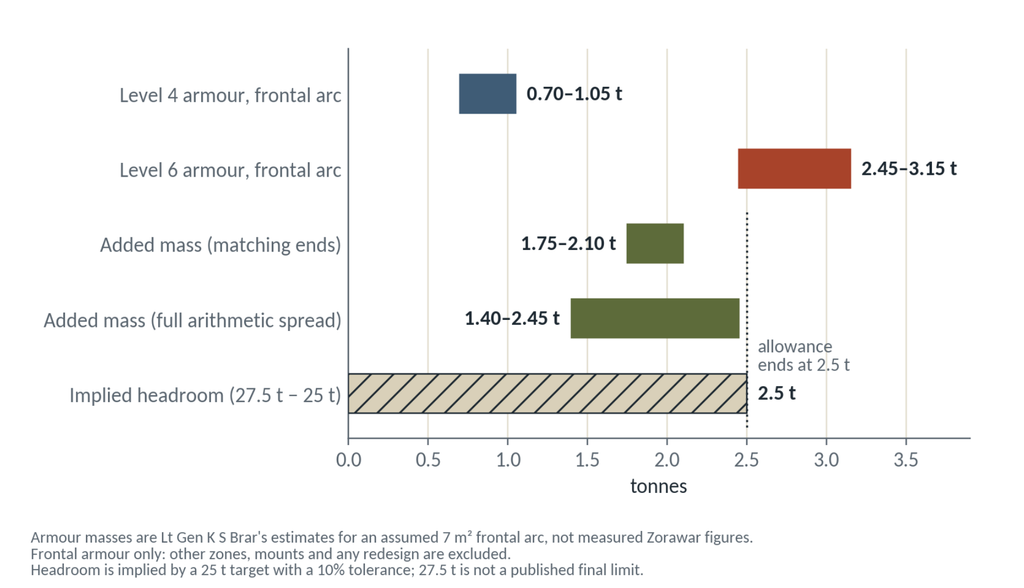
Figure 2. Brar’s armour-mass estimates (frontal arc only) against the 2.5-tonne headroom implied by a 25-tonne target with 10% tolerance.
Read the chart for what it is. It isolates the estimated mass difference for the front armour and holds everything else constant. It leaves out the other armour zones, the mounts and structure that carry the plates, and any redesign a heavier front would set off, which could push the total either way. The difference is a starting point for the weight change, not the weight change itself.
And the list doesn’t stop at the front. Brar’s calculation leaves out the sides, which reports say are to be lifted from Level 2 to Level 5-class, as well as the active protection system and the counter-drone jammers. Press reports on the heavier version talk of 5 to 7 tonnes added in all, which would take the tank to 30–32 tonnes. That range comes from the reports, not from Brar’s frontal sum, and DRDO is also said to have designed the hull with room to grow to 35. No official document has put any of these figures on the table.
Brar’s own warning concerned a hypothetical 36-tonne tank built to stop the 30 mm round: at that weight, he said, it can’t climb a slope. That’s an illustration, not a Zorawar test result. It’s worth remembering, too, that the Type 15 is reported at up to 36 tonnes in its armoured form and serves with units in Tibet. It has 1,000 horsepower to do it with.
Why 760 horsepower leaves so little room
Power is where the squeeze shows. The prototypes use a Cummins VTA903E-T760 diesel rated at 760 horsepower (some reports say 750), and reports suggest the Mk1 will keep it. At 25 tonnes that works out to 30.4 hp per tonne. The Army’s requirement, as Swarajya quotes it, sets 25 as the minimum, and Shivane calls 30 the desirable figure. Both are ratios of rated power to weight.
Run the same engine against the heavier weights now being discussed and the margin goes quickly. These are illustrative scenarios, built from rated power and nothing else: 27.6 hp per tonne at 27.5 tonnes, 25.3 at 30, 23.8 at 32. On paper, 760 horsepower keeps the minimum alive until the tank reaches about 30.4 tonnes. It loses the desirable figure the moment the tank passes 25.3.
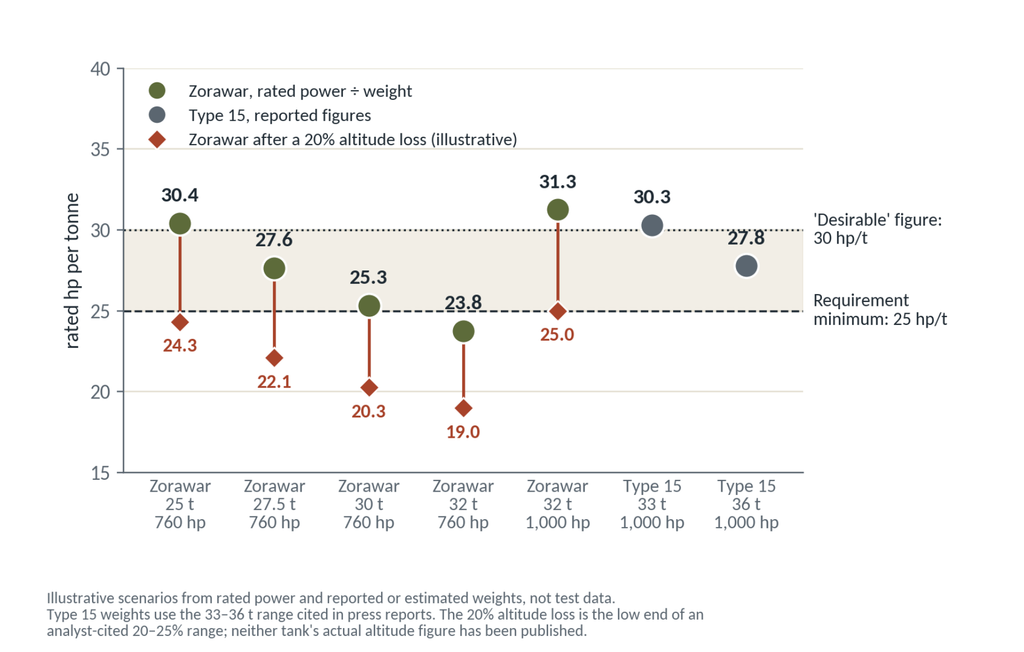
Figure 3. Illustrative power-to-weight scenarios: rated power divided by reported or estimated weight, with the Type 15 for reference. Diamonds show an illustrative 20% altitude loss; neither tank’s actual figure has been published.
Then there’s the air. At 4,200 metres, close to the altitude of the December 2024 firing trial, standard-atmosphere tables put air pressure at about 59 per cent of its sea-level value and air density at about 65 per cent. Turbocharging recovers part of that, and nobody has published what the Zorawar’s powerpack actually loses. Swarajya and Shivane both cite a power loss of 20 to 25 per cent for tank diesels at these heights.
If a loss in that range applied here, 760 horsepower would fall to roughly 570–610, and a 25-tonne tank to 23–24 hp per tonne. That’s an illustration, not a finding. Actual output depends on the powerpack, its turbocharging and calibration, cooling and the conditions on the day, and none of that has been published for the Zorawar. Nor is it clear whether the Army’s 25-to-1 figure is a sea-level rating or an at-altitude requirement.
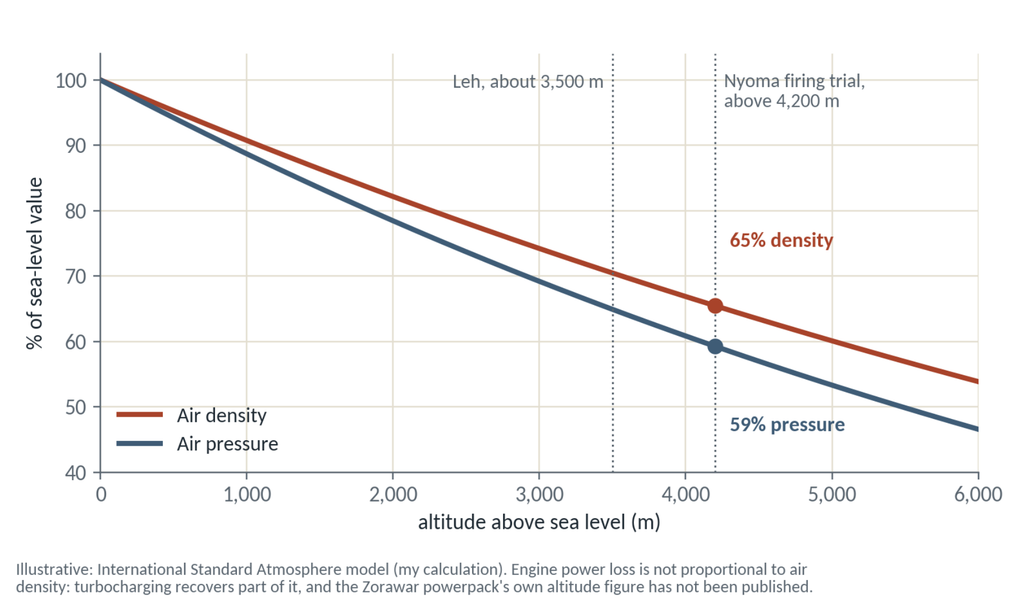
Figure 4. Illustrative: air pressure and density against altitude, from a standard-atmosphere model. At 4,200 m, pressure is about 59% and density about 65% of sea-level values. Engine output depends on the powerpack and is not shown.
A heavier Mk2 would need a bigger engine. Reports say Cummins has offered a 1,000-horsepower engine along with technology transfer, and that DRDO has built an 800-horsepower engine of its own and is working towards 1,000. Another account puts the DRDO engine at 700. Nothing has been announced for the Mk2.
On a 32-tonne tank, 1,000 horsepower would give 31 hp per tonne, slightly better than the original. It would also be a new powerpack, and reports on the delay point out that every new powerpack means another round of testing and validation.
Zorawar light tank vs Type 15: the comparison that started it
The table below is easier to read if you keep in mind that one column is a prototype and the other is a tank in service, and that most Type 15 figures are press or analyst estimates, not Chinese specifications.
| Zorawar | Type 15 (ZTQ-15): press and analyst estimates | |
| Status | Prototype; trials continuing; induction expected 2028–29 (Army Chief, reported) | In PLA service since late 2018; units in the Tibet Military District (Janes) |
| Weight | About 25 t design figure (DRDO, official); requirement of 25 t ±10% (reported); 30–32 t reported for the upgraded version | 32–36 t depending on source and configuration (press and analyst estimates) |
| Engine | Cummins VTA903E-T760, 760 hp (reported; some reports say 750); Mk2 engine not announced | About 1,000 hp diesel (Chinese media, via Janes; unconfirmed) |
| Main gun | 105 mm high-pressure rifled gun in a John Cockerill 3105 turret, with autoloader (reported) | 105 mm gun, thought able to fire APFSDS rounds (Janes); reported able to fire gun-launched missiles (ORF) |
| Power-to-weight (my calculation) | 30.4 hp/t at 25 t; 23.8–25.3 hp/t at 30–32 t on the same engine | 27.8–31.3 hp/t (1,000 hp over 32–36 t) |
| Protection | Level 4 front, Level 2 elsewhere (reported). Level 6 front and Level 5-class sides targeted for Mk2 (reported) | No public STANAG rating. Protected against hand-held anti-tank weapons (Janes); armour described as modular (ORF, analyst description) |
Sources: Defence Ministry release; Janes; Swarajya; Asianet Newsable; ORF. “Official” means a government release and “reported” means press or analyst reporting. Power-to-weight figures are my calculations from those numbers. No Type 15 figure here is an official Chinese specification.
Side by side, the Type 15 looks like a different answer to the same question. China added armour and engine together. At an estimated 32 to 36 tonnes and 1,000 horsepower it lands at roughly 28 to 31 hp per tonne, close to the Zorawar’s 30.4. The Indian tank gets there with about a quarter less horsepower and some 7 to 11 tonnes less to move, if the estimates hold.
That’s the route critics of the 25-tonne limit have argued for. According to Swarajya’s summary of his 2022 piece, Lt Gen J K Sharma said the Army should consider a 30-tonne tank with a 105 mm gun, a 1,000 hp engine and heavier protection instead. He thought a floating 25-tonne tank with T-90-class firepower would be a nightmare to design.
What’s unknown matters as much. China hasn’t published a STANAG rating for the Type 15, as far as I can find. Janes says it’s protected against hand-held anti-tank weapons, and ORF’s Kartik Bommakanti describes its armour as modular, mixing composite with explosive reactive blocks. Anything beyond that is inference.
Where the Zorawar light tank programme stands today
The official record is thinner than the headlines suggest. This is what’s actually on it, with the status of each entry marked.
| Date | What happened | Status |
| 6 Jul 2024 | Prototype unveiled at L&T’s Hazira plant. DRDO’s chairman says two tanks fit in one C-17 and targets induction by 2027. | Public event, widely reported |
| 13 Sep 2024 | Preliminary automotive and field-firing trials in desert terrain. | Official: DRDO and Defence Ministry release |
| 12 Dec 2024 | Defence Ministry reports firing above 4,200 m at a high-altitude site, reportedly Nyoma in Ladakh, after an IAF airlift. It calls the tank a 25-ton-class vehicle designed against the Army’s Provisional Staff Qualitative Requirements. | Official: Defence Ministry release |
| 8 Jun 2026 | Army Chief Gen Upendra Dwivedi says induction is expected in 2028–29 after fixes and trials. | Reported statement |
| Jun 2026 | Times of India reports, as relayed by Indian Defence News, that the Army wants protection beyond Level 4, with a possible delay of up to two years. | Reported; not an official announcement |
| 10 Sep 2026 | Tata Advanced Systems reported as lowest bidder for the competitive tranche, Mahindra Defence second. | Reported |
| Late Sep 2026 | Defence Secretary describes a plan for about 18 Mk1 tanks first, with slightly lower protection, and the balance at a higher level. | Official remark at the NDTV Defence Summit, as reported. A plan; no contract published |
| Mid-Oct 2026 | Lt Gen Brar’s NDTV podcast, as reported by idrw: Level 6 is negotiable under the preliminary requirement; armour-mass estimates. | Expert opinion, not an official position |
Two details deserve a closer look. The first is the Army Chief’s timeline. In June, General Upendra Dwivedi put induction at 2028–29, according to idrw. Swarajya says he pointed to issues found in development and testing and didn’t list better protection as a reason. Press reports do tie the delay to the demand for protection beyond Level 4: the Times of India said so in June, as relayed by Indian Defence News. The link is plausible. It isn’t something the Chief said.
The second is the Defence Secretary’s plan, which isn’t a contract yet. He said the Army has largely agreed to the two-step approach and that he hopes L&T will get an initial order fairly soon; I couldn’t find a published order as of 19 October. Some earlier reports, such as Vayu Aerospace in August 2024, call the 59 tanks an initial order already placed. Singh’s phrasing suggests otherwise, so I treat 59 as the planned initial tranche.
Brar’s remarks supply the engineering logic. The document on the table, he explained, is a Preliminary Staff Qualitative Requirement, with the General Staff version still to come. That fits the Defence Ministry’s December 2024 release, which says the tank was designed against the Army’s Provisional Staff Qualitative Requirements. Level 6 is negotiable inside 25 tonnes plus 10 per cent, he said, and if it can’t be reached, the user can accept a lower level of protection in the Mark 1. Singh had described that route, in effect, roughly two weeks earlier.
The competitive track moves on separately. Swarajya and Asianet Newsable report Tata Advanced Systems as the lowest bidder, with Mahindra Defence second. Both companies are expected to build prototypes within 130 weeks. Figure 5 shows how the pieces fit.
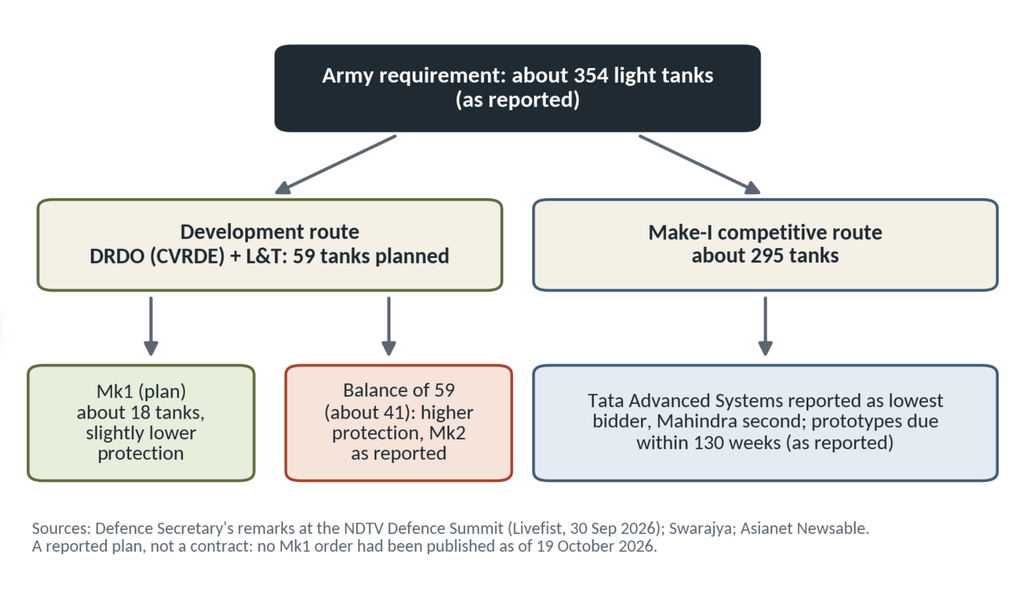
Figure 5. How the Army’s reported 354-tank requirement is divided in the plan between the DRDO–L&T programme and the competitive Make-I route. The Mk1/Mk2 split is a reported plan, not a contract.
The weight nobody puts on the spec sheet
Start with the aircraft. DRDO’s chairman said in July 2024 that two Zorawars fit inside one C-17, and that claim describes the 25-tonne design as it stood then. The US Air Force lists the C-17’s maximum payload at 77.5 tonnes, so two 25-tonne tanks use about 50 and two 32-tonne tanks about 64. On weight alone, both sit under the ceiling.
That isn’t the whole test, though. Maximum payload is a ceiling and nothing else. Whether a vehicle can be flown depends on its dimensions, loading configuration and balance, the aircraft and the mission, down to fuel and the airfield at the far end. I couldn’t find a published airlift assessment of a heavier Zorawar. The Defence Ministry’s December 2024 release says the IAF demonstrated an airlift but doesn’t name the aircraft, so the two-per-C-17 claim and the demonstrated airlift aren’t the same thing, and neither automatically covers a heavier variant.
Roads come next. Swarajya points out that mountain roads and bridges in the region carry strict weight limits, and says the Army itself judged the Arjun too heavy for deployment in most sectors.
Then the tail of support vehicles. Shivane’s list of what a tank needs at altitude runs well beyond the tank: separate oils and lubricants, antifreeze mixtures, battery pre-heaters, external starter generators, a different method of zeroing the gun, different garages and storage, and a family of recovery, bridge-laying and command variants. A heavier Zorawar could change some of that. Whether it would is for the Army to work out, and none of it has been reported as a confirmed shortfall.
Armour is only one layer of survivability
Why does the Army want Level 6 at all? Because of what Chinese infantry carriers carry. Swarajya names the 30 mm gun on the Type 04A tracked and Type 08 wheeled infantry fighting vehicles, plus the 25 mm guns still found on older ones. Shivane’s argument is blunt: a tank that a carrier can defeat is hard to justify.
The counter-argument comes from the drone war. Swarajya cites accounts that put FPV drones behind a large share of Russian armour losses in Ukraine, most of them hits on the roof, rear deck and tracks, where plating is thinnest. A Level 6 front does nothing there.
Writing in ThePrint, retired IAF Group Captain Ajay Ahlawat goes further and argues that a tank on a hilltop is easy to find, and that a drone network could do the same job more cheaply. He concedes that tanks keep firing under jamming and bad weather, and that in peacetime they occupy terrain, signal intent and mark possession.
The Army’s own answer, going by reports, is layers. The Mk2 is said to get an active protection system and built-in counter-drone jammers on top of the heavier front. Shivane’s July table lists the APS and the counter-drone suite as foreign-sourced, with suppliers yet to be finalised. Each layer draws power and adds weight, and the Level 6 label covers none of them.
Four ways out, and what each one costs
Nobody in the Ministry or the Army has laid out the choices publicly, so these are analytical options rather than decisions. The Army hasn’t endorsed all four.
1. Hold the weight, accept less armour
Keep the 25-tonne priority and judge protection against the threats the Army actually expects. This is roughly what the reported Mk1 plan amounts to, though no final Mk1 specification has been published. It preserves air-portability and the power-to-weight ratio. The price is a front that Shivane, among others, considers thin.
2. Squeeze more protection in under the implied 27.5-tonne ceiling
ORF’s Kartik Bommakanti argues that modular armour using advanced ceramics could lift protection to Level 5, and possibly Level 6, without a large weight penalty. idrw reports that DRDO’s metallurgical laboratory, DMRL, says it is working towards Level 5B against 25 mm rounds and Level 6 against 30 mm. The price: nothing public shows either approach tested on this tank, and Shivane says the imported turret can’t be upgraded under its maker’s terms.
3. Go heavier and more powerful
This is the reported Mk2: 30–32 tonnes, a 1,000-horsepower engine, protection to match. Shivane argues the Army should accept a slight weight offset for the protection it wants. The price: a redesign, a new powerpack to validate, fresh checks on airlift, bridges and recovery, and more time. Livefist and Swarajya both set it beside the Arjun, whose weight drifted from a brief of about 40 tonnes to over 60.
4. Build survivability in layers
Pair whatever armour the weight allows with better sensors, an active protection system, counter-drone measures and closer work with infantry and fires. The price: integration, power demand, cost and maintenance, and, going by Shivane’s table, dependence on foreign suppliers who haven’t been chosen yet.
My reading is that the Defence Secretary’s reported plan runs the first option now and the third behind it. A phased plan doesn’t by itself show that every detail of the heavier Mk2 has been approved, and I haven’t seen anything on whether the second or fourth gets a place.
What’s actually Indian inside the tank
DRDO’s release credits CVRDE with developing the tank and says Indian industries, MSMEs among them, supplied subsystems. That much is on the record. The rest depends on who you read.
In July, Shivane set out a subsystem table. The hull and suspension are Indian designs, and so is the Nag Mk-II anti-tank missile. The engine is Cummins, from the United States. The 105 mm gun and turret are John Cockerill’s, from Belgium. The sights are Safran’s, from France. The fire-control system, the active protection system and the counter-drone suite were still foreign-sourced, with vendors not finalised.
He puts indigenous content at 40 to 45 per cent by value, at best. That is his assessment, not an audited or official figure. He also says a German MTU powerpack originally planned for the tank couldn’t be bought because of export restrictions.
Bharat Forge is developing an Indian 105 mm gun for future variants, according to the same table, and DRDO’s own engine is in development, though accounts differ on its rating. If Shivane is right that the Belgian turret can’t be upgraded under its maker’s terms, a higher-protection Zorawar becomes partly a negotiation with a foreign supplier, a point Swarajya also makes. I couldn’t find an official response.
What to watch next
A handful of documents would settle most of this, and none has surfaced yet. The first is the Mk1 contract: its size, its price and the protection level written into it will be the first hard number on how much armour the Army has agreed to forgo. The second is the formal requirement. Brar said the General Staff Qualitative Requirement follows the preliminary one, and what it says about weight and protection will outrank any interview.
The third is the Mk2 powerpack: Cummins’ 1,000-horsepower offer, a DRDO engine, or something else. The fourth is the competition. Tata and Mahindra have 130 weeks to put prototypes in front of the Army, and they’ll be measured against whatever the Zorawar becomes.
Until then, the figures in circulation come from interviews and press reports, and they don’t agree with each other: 30 to 32 tonnes in one account, under 30 in another, a design margin of 35 in a third. The first official number will probably arrive attached to a contract.
Frequently asked questions
What is the Zorawar light tank?
A 25-ton-class light tank with a 105 mm gun, developed by DRDO’s Combat Vehicles Research & Development Establishment with Larsen & Toubro for high-altitude operations such as eastern Ladakh. It is still a prototype. The Army Chief has said induction is expected in 2028–29.
Does the Zorawar light tank have STANAG Level 6 protection today?
No. Reports put the prototype at Level 4 on the front and Level 2 elsewhere. Level 6 is a requirement the Army is reported to want on an upgraded version. The Defence Secretary has described a plan under which the first batch of about 18 tanks has slightly lower protection.
What does STANAG Level 6 actually cover?
In the Zorawar debate it refers to the kinetic-energy criterion: a 30 mm armour-piercing round, including the fin-stabilised sabot type, fired from 500 metres at a frontal arc 30 degrees either side of the centreline. Artillery fragments and mine blast are rated separately. Public summaries are not the controlled standard itself.
How much weight would Level 6 armour add?
For the front alone, Lt Gen Brar’s estimate is about two tonnes, within a range of 1.40 to 2.45 tonnes for an assumed 7 m² frontal arc. It excludes other armour zones, mounts and any redesign. Press reports put the full upgrade, with side armour, active protection and jammers, at 5 to 7 tonnes, which would mean 30–32 tonnes in total. Neither figure is official.
When will the Zorawar enter service?
Army Chief General Upendra Dwivedi said in June 2026 that induction is expected in 2028–29, after issues found in development and testing are worked through. The earlier target was 2027. The Defence Secretary has said he hopes L&T will get an initial order, for about 18 Mk1 tanks, fairly soon. No published contract had turned up as of 19 October 2026.
How does the Zorawar compare with China’s Type 15?
The Zorawar is designed at about 25 tonnes with a 760 hp engine. The Type 15 is estimated at 32–36 tonnes with about 1,000 hp. Both carry 105 mm guns. Their power-to-weight ratios are close, at roughly 28–31 hp per tonne for the Type 15 and 30.4 for the Zorawar at 25 tonnes. China has not published a STANAG rating for the Type 15.
Why not just use T-72 and T-90 tanks in Ladakh?
They are used there. But at 45–50 tonnes they are heavy for mountain roads and bridges, lose engine power in thin air and are harder to airlift in numbers. The Zorawar was conceived to ease those penalties.
How many Zorawar tanks will India buy?
The Army’s reported requirement is about 354 light tanks. Fifty-nine are planned for the DRDO–L&T programme, split into about 18 Mk1 tanks and the balance at higher protection. The other 295 or so are to come from a separate competition in which Tata Advanced Systems was reported as lowest bidder and Mahindra Defence second.