South Korea’s arms-procurement agency issued a short statement on Tuesday after defence-industry talks in New Delhi. Most of it was routine: industrial cooperation, support for the K9 howitzers already serving with the Indian Army, a 2020 roadmap that needs reviving. One line reopened the K30 Biho India question. The Biho Hybrid air-defence system, Seoul said, is “currently under discussion with India.”
That does not mean India has decided to buy it. No contract has been announced, and we found no fresh Acceptance of Necessity, the Defence Acquisition Council’s first formal approval. What exists is a line in a Korean readout, a $2.5 billion figure attached to an earlier version of the project, and a steady drip of Indian defence-site reports that the Army is looking at the requirement again.
| K30 Biho India: Current Status: South Korea’s DAPA says the Biho Hybrid is under discussion with India. India’s published account of the 29 September meeting does not mention it. No Indian contract, request for proposals or fresh Acceptance of Necessity has been publicly announced. |
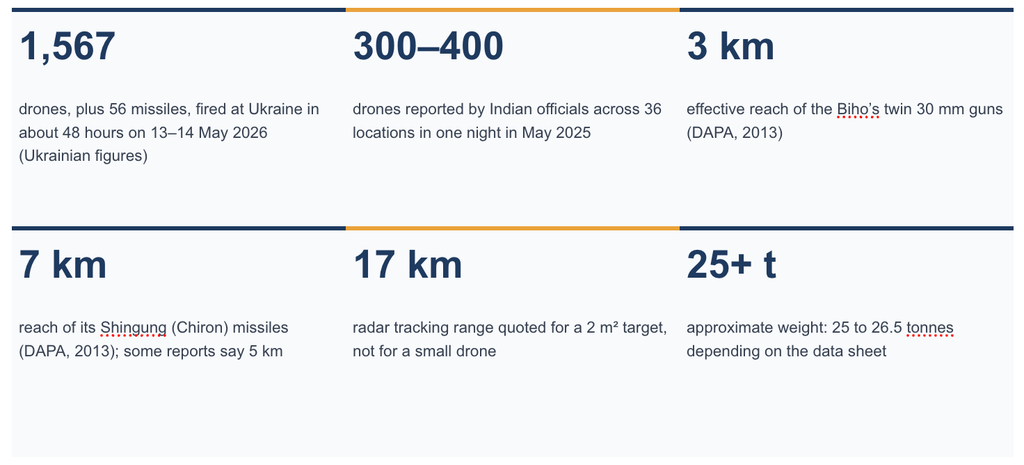
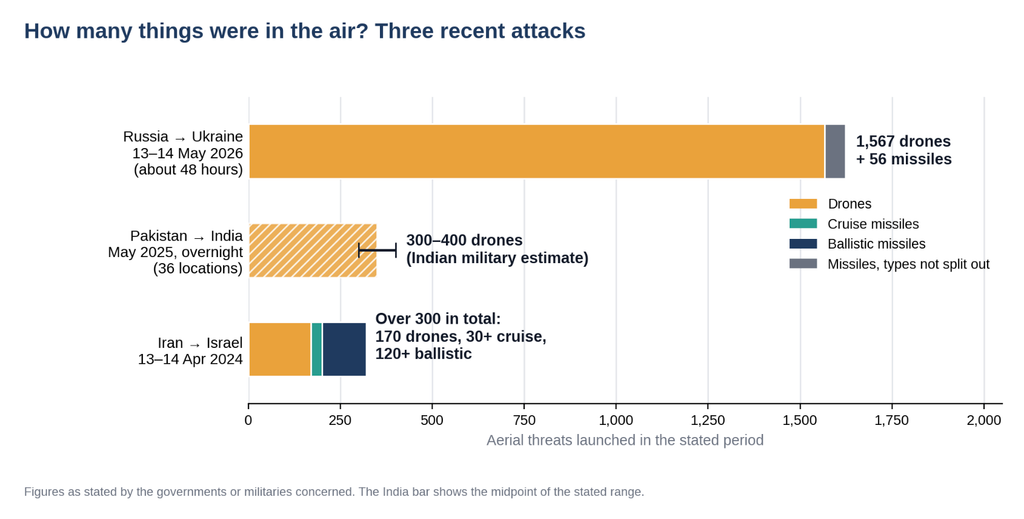
The vehicle has a history here. The Army went looking for a tracked gun-and-missile system years ago, tested the Korean entry against Russian rivals, and then watched the file stall as New Delhi leaned towards buying Indian. What has changed is the sky over the battlefield. In May 2025, Indian officials said roughly 300 to 400 drones were sent at 36 locations between Leh and Sir Creek in a single night. This May, Ukraine said Russia fired 1,567 drones and 56 missiles at it in about 48 hours.
So the useful question isn’t whether India should buy the Biho. It is where a tracked gun-missile SHORAD system makes operational sense within India’s geography and its existing air-defence architecture, and where it doesn’t. The answer is uneven, and getting to it means asking eight questions that most of the coverage has skipped.
THE NUMBERS THAT MATTER
K30 Biho India: What Was Actually Said in New Delhi
The meeting was the 10th India–South Korea joint committee on defence industries and logistics cooperation, held on 29 September and co-chaired by Dinesh Mahur, Additional Secretary (Defence Production), and Kim Il Dong, Vice Minister of Korea’s Defense Acquisition Program Administration (DAPA) (IANS via Hans India).
The Biho reference comes from DAPA’s own release, relayed by Yonhap and the Korea Times, which listed the system among the major joint projects Seoul wants to keep moving, next to the K9. The Indian statement, as reported, doesn’t mention it. The Korea Times adds that India had considered buying the system in a deal estimated at $2.5 billion, but that the project stalled amid New Delhi’s push for domestic manufacturing.
FACT CHECK

The Deal That Wouldn’t Close: A Short History
The Biho’s case rests on the 2018 evaluation. India’s self-propelled air-defence gun-missile programme, SPAD-GMS, began bidding in 2013 for the border with Pakistan. By October 2018, Korea JoongAng Daily reported, India had picked the K30 as sole bidder for price negotiations after it beat Russia’s Tunguska-M1 and Pantsir. Army Recognition and Asian Military Review followed in May 2019 with a package of 104 vehicles, 97 ammunition carriers and 39 command vehicles worth about 3 trillion won, roughly $2.6 billion.
Then the file stopped moving. Korean reporting said Russia lobbied against the Biho (JoongAng, 2019), and by September 2020 ThePrint was reporting that the defence ministry would drop the foreign purchase and build such systems at home. Some online summaries say India placed an order in 2019 and cancelled it in 2020. We found no paperwork for that. Contemporary reports describe a selection and a shelved plan, not a signed contract, which changes what “reviving” the deal would mean.
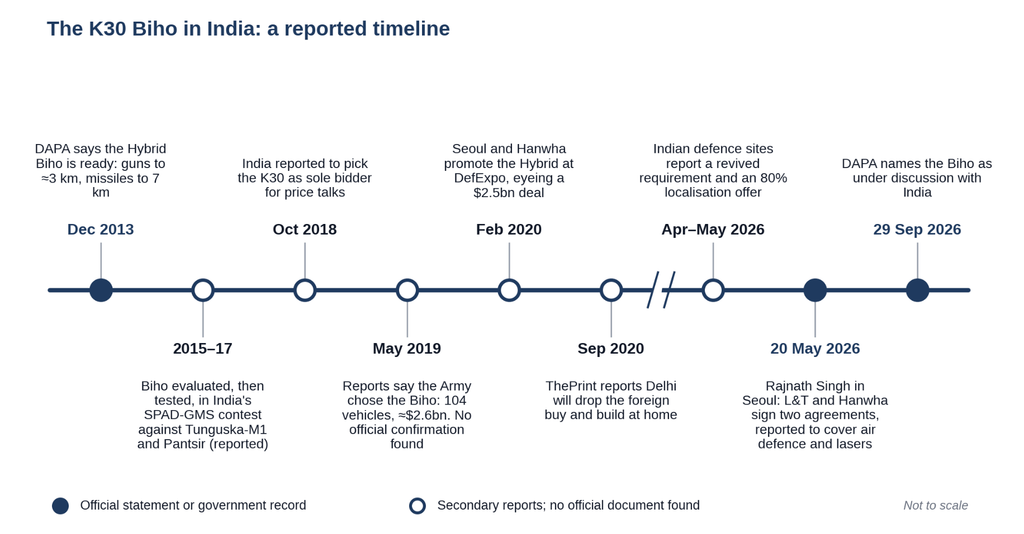
This year’s signals are thinner than the headlines suggest. Indian defence websites reported in April and May that the requirement was moving again, that Hanwha had offered up to 80 per cent Indian content by the 50th vehicle, and that the Army would first need a fresh Acceptance of Necessity (idrw.org, idrw.org again).
On 20 May, with Rajnath Singh in Seoul, L&T and Hanwha signed two corporate agreements that the Times of India said covered directed-energy weapons and self-propelled air defence (via Indian Defence News). The government’s own account, in the Sunday Guardian, was more general. Neither named the Biho. DAPA’s readout is the first official statement we found that does.
What the K30 Biho Hybrid Actually Is
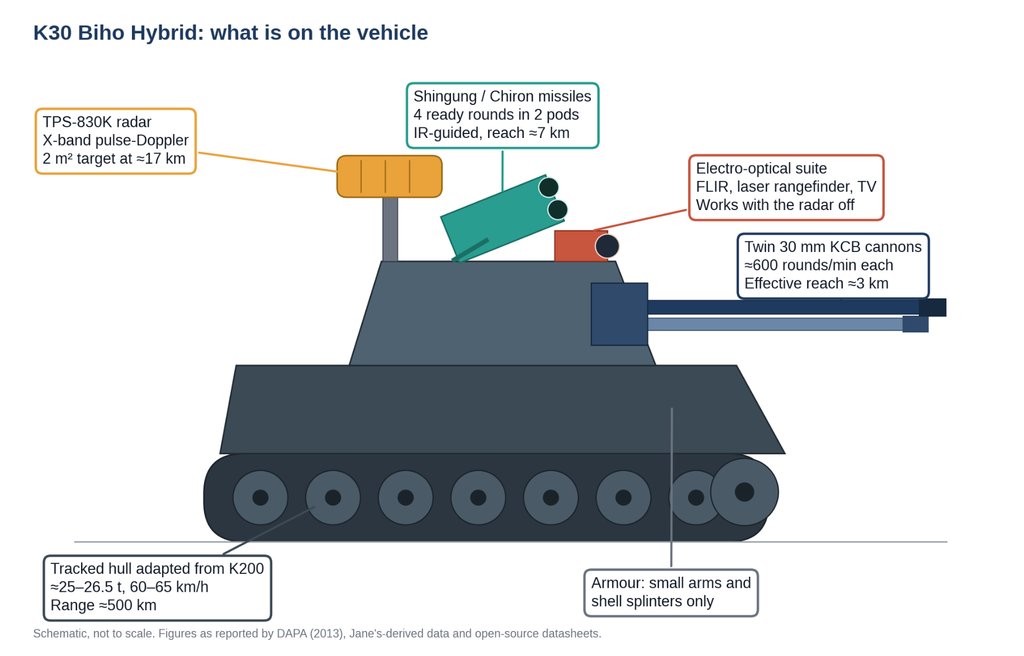
The K30 Biho, whose name translates as “flying tiger,” is a tracked air-defence vehicle built by Hanwha Aerospace on a hull adapted from South Korea’s K200 infantry vehicle. The Hybrid version carries twin 30 mm cannons and four Shingung infrared-guided missiles, sold abroad as the Chiron, in two pods. More than 300 K30s have served with the South Korean Army since 1999, according to DAPA’s 2013 announcement of the missile upgrade (Army Recognition, Defense Update).
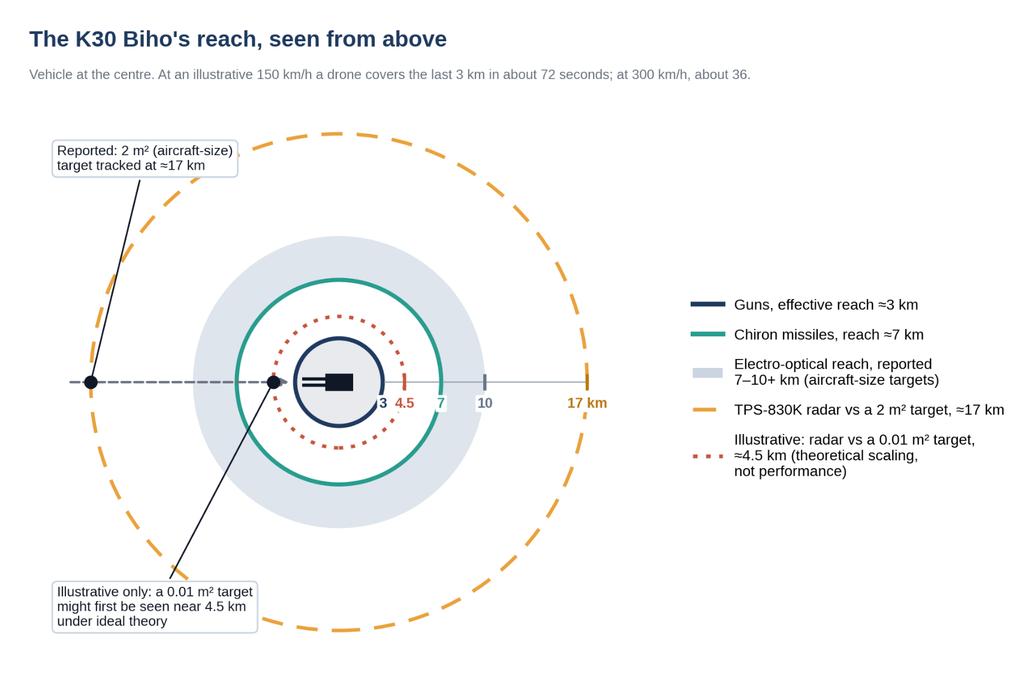
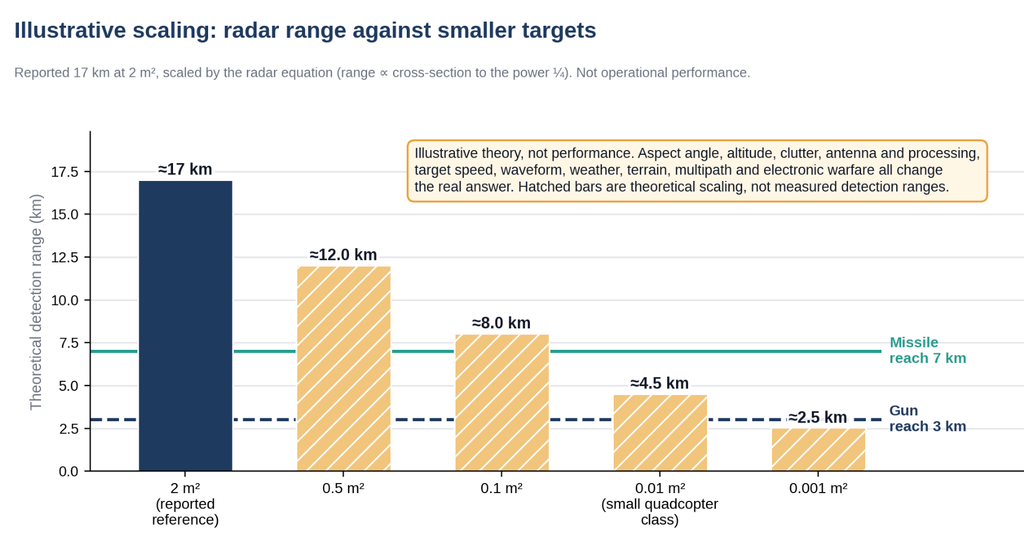
DAPA put the guns’ effective reach at about 3 km and the missiles’ at 7 km, with each barrel firing around 600 rounds a minute. The TPS-830K radar, an X-band pulse-Doppler set, is credited with tracking a 2 m² target at roughly 17 km. That is a figure for something the size of a small aircraft. It should not be read as a 17 km detection range against every drone. A thermal imager, laser rangefinder and TV camera let the crew track and fire with the radar switched off.
K30 BIHO HYBRID AT A GLANCE
| Maker | Hanwha Aerospace |
| Guns | Twin 30 mm cannons, about 600 rounds a minute each; effective reach about 3 km |
| Missiles | Four Shingung (Chiron), two pods of two, each pod able to engage a different target; infrared-guided; reach about 7 km |
| Radar | TPS-830K, X-band pulse-Doppler; tracks a 2 m² target at about 17 km (Jane’s-derived figure) |
| Optics | Thermal imager, laser rangefinder and TV camera; reported reach 7 to 10+ km |
| Hull | Tracked, K200-derived; about 25 to 26.5 tonnes; 60 to 65 km/h; range about 500 km; small-arms and splinter protection |
| Service | 300+ K30s with the South Korean Army since 1999; Hybrid missile upgrade announced December 2013 |
The real pitch: mobility, sensors, guns, missiles and armour
Calling the Biho “a gun plus a missile” undersells the idea. The pitch is the combination: tracked mobility to stay with a manoeuvre formation, sensors that don’t depend on someone else’s radar, guns for close and cheap targets, missiles held back for those that need reach, and armour against fragments. That lets it operate inside a formation rather than defend a fixed point. The Anant Shastra, with a quoted range of about 30 km, is meant to protect armoured columns from a distance (Overt Defense); a Biho would travel within the column, so the two complement each other.
The cannons deal with what gets close and with targets not worth a missile; the four missiles stay in reserve for helicopters, larger UAVs and anything fast. Figure 3 shows how the rings stack up.
Why Drone Warfare Changed the Maths of Air Defence
Air defence was built around aircraft and helicopters, which cost tens of millions of dollars, so a missile on each made sense. Drones changed two things at once: the price of the target and the number of targets.
Cheap shots, expensive answers
The Pentagon’s weapons buyer put the problem plainly in May 2024: shooting down a $50,000 one-way drone with a $3 million missile is not a good cost equation (Axios). In the Red Sea the US Navy was firing Standard Missiles worth about $2 million each at Houthi drones that CSIS says are commonly priced near $2,000.
Saturation and the small stuff
Volume is the second change. On 13 and 14 May, Ukraine says, Russia launched 1,567 drones and 56 missiles in about 48 hours. President Zelensky put the drone interception rate at 94 per cent (Ukrainska Pravda), which still leaves around 90 that got through. India’s May 2025 episode was smaller but wider, and officials said its likely aim was to test air defences and gather intelligence (MEA transcript). Some drones in a wave are there to explode. Others are there to make the defence switch on its radars and fire, so the next wave knows where everything is.
At the tactical level the war is one of FPV and reconnaissance drones. Ukrainian officials say drones cause most of Russia’s battlefield casualties, a claim the UK Defence Journal noted has not been independently verified. Azerbaijan used the same logic against Armenia in 2020, and the lesson CSIS drew was about air defence: both sides’ short-range arsenals were limited in size and quality (CSIS).
Jamming, spoofing and the case for passive sensors
Electronic warfare has been both counterweight and complication. In one June 2025 attack, Ukraine’s air force said drones neutralised by electronic warfare nearly matched those shot down (Ukrainska Pravda). Attackers adapted: fibre-optic FPV drones, tied to the operator by a cable, can’t be jammed in the usual way (RFE/RL, mirrored). India has its own version of the problem: 465 GPS interference and spoofing incidents were reported in the border region, mostly around Amritsar and Jammu, between November 2023 and February 2025, the civil aviation ministry told the Lok Sabha (ETV Bharat).
Radiating carries a risk too. India’s May 2025 briefing said one of its armed drones destroyed an air-defence radar at a Pakistani site. A system that can track without emitting, as the Biho’s thermal and laser-ranging suite can, has a value beyond the spec sheet.
Five Conflicts, Five Lessons for India’s Air-Defence Planning
None of these conflicts maps neatly onto an Indian operational problem. They are better read as air-defence lessons than as shopping lists.
| Conflict | What happened (reported figures) | Lesson for India |
| Russia–Ukraine | 13–14 May 2026: 1,567 drones and 56 missiles in about 48 hours (Ukrainian figures). Interceptor drones costing a few thousand dollars now account for about a third of Russian aerial targets destroyed (Ukrainian Air Force, March 2026). | Quantity and layers decide outcomes. Cheap shooters are needed beside missiles, and the sensor net matters as much as the shooter. |
| Israel and the wider Middle East | April 2024: Iran fired drones, cruise and ballistic missiles at Israel; the IDF said 99% were intercepted, with help from partners. In the 2026 Iran war, Gulf states leaned on air-defence missiles against Shahed drones; an Oslo University analyst told Al Jazeera they had focused on high-altitude systems and neglected low-altitude threats. | Multiple layers are required, and the low-altitude layer can’t be an afterthought. |
| Red Sea | The US Navy fired Standard Missiles worth about $2 million each at Houthi drones often priced near $2,000. Cheaper laser-guided rockets later accounted for about 40% of drone kills in a recent operation, a US commander told lawmakers. | Persistent protection of ships and fixed sites needs affordable shooters. Guns and rockets can work the cheap end. |
| Nagorno-Karabakh (2020) | Azerbaijani drones, including the Bayraktar TB2, struck Armenian defences, rear areas and supply lines. CSIS judged the main lesson to be full-spectrum air defence, noting that both sides’ short-range arsenals were limited, and that advanced systems proved vulnerable. | Armoured formations are exposed without their own SHORAD cover, and SHORAD that radiates can itself be targeted. |
| India–Pakistan (May 2025) | Roughly 300–400 drones at 36 locations in one night, brought down by kinetic and non-kinetic means (Indian briefing). Army sources said upgraded L-70 and ZU-23 guns helped neutralise 50-plus drones in the Jammu–Pathankot belt. One of India’s own armed drones destroyed a Pakistani air-defence radar. | The western front needs mobile, networked counter-UAS that can follow the formation, share a common picture and survive electronic interference. |
Read together, the thread is plain: none of these defenders solved the drone problem with a single system. What worked, where anything worked, was a stack of sensors, jammers, guns and cheap missiles, with expensive interceptors held back.
Where a Tracked SHORAD Makes Sense in India
Start with the map, because that is where most Biho coverage thins out.
The western plains: Punjab, Rajasthan and Jammu
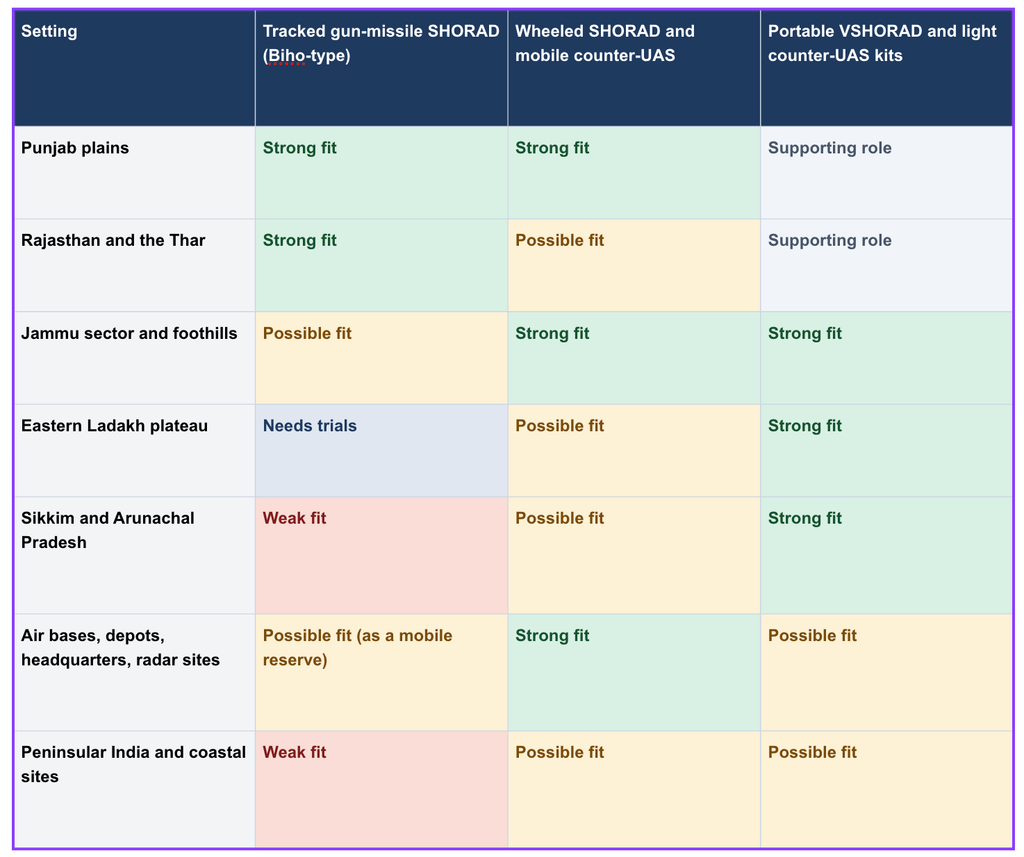
This is the Biho’s natural ground. Punjab and Rajasthan are where the Army’s strike formations would move in a conventional fight, and a tracked vehicle that can keep pace with tanks and infantry combat vehicles across open country is a different proposition from a wheeled launcher tied to roads. The target list is long: forward logistics nodes, ammunition dumps, command posts, bridges, airfields. Moving columns and forward batteries are the ones that need a tracked vehicle. Flat ground also suits the Biho’s sensors, since there is less terrain to hide behind.
The northern borders: Ladakh, Sikkim and Arunachal Pradesh
Here the caveat has to be stated plainly. A tracked SHORAD designed for mechanised manoeuvre warfare cannot be assumed to suit every Himalayan sector.
Ladakh complicates the easy answer. India has kept tracked armour on the plateau since 2020, including T-90s on the Depsang plains above 15,000 feet (Deccan Chronicle). About 90 tanks and 330 infantry combat vehicles were inducted (Tribune), and the Air Force flew in more than 9,000 tonnes of equipment (Raksha Anirveda). Heavy tracked vehicles can work in the open valleys, though an Army official has called maintaining them there a challenge. The Army is also developing a 25-tonne light tank, the Zorawar, with altitude in mind; the Biho weighs about the same. We found no published data on how its engine, optics and missile seekers perform at 4,500 metres.
Sikkim and Arunachal Pradesh are harder: steep gradients, narrow roads, bridge load limits, forest and monsoon cloud. DAPA said in 2013 that the Biho suited Korea’s mountainous terrain, which is not the eastern Himalaya. The likelier fit there is lighter and portable: shoulder-fired missiles, small radars and cameras, light jammers.
Air bases, depots and the semi-urban target set
Air bases, ammunition depots, logistics hubs, headquarters and radar sites don’t move. The sensible defence is layered and mostly fixed: sensors, jammers, a ring of guns, a few missile posts and a command system that decides who shoots. A tracked vehicle can serve as a mobile reserve, but one per site would be costly. Army Recognition describes the Biho as designed mainly to protect forward manoeuvre units.
A ROUGH FIT GUIDE (INFOWARFACTS ASSESSMENT, NOT AN ARMY DOCUMENT)
The Drone-Versus-Interceptor Equation
The cost-exchange ratio becomes dangerous when inexpensive threats can repeatedly force the defender to expend disproportionately expensive interceptors. A single exchange can still be rational. Take a hypothetical: a drone worth ₹10 lakh heading for a radar installation worth ₹500 crore. A ₹1 crore interceptor is a sound shot. The problem is repetition, when an attacker can send hundreds and the defender’s missiles and budget run out first.
Ukraine’s answer has been to move the shot down the price scale. Interceptor drones costing roughly $3,000 each, against a $50,000 Shahed and up to $10 million for a US ballistic-missile interceptor, according to Al Jazeera, now account for about a third of Russian aerial targets destroyed, Ukraine’s air force says (Defense News).
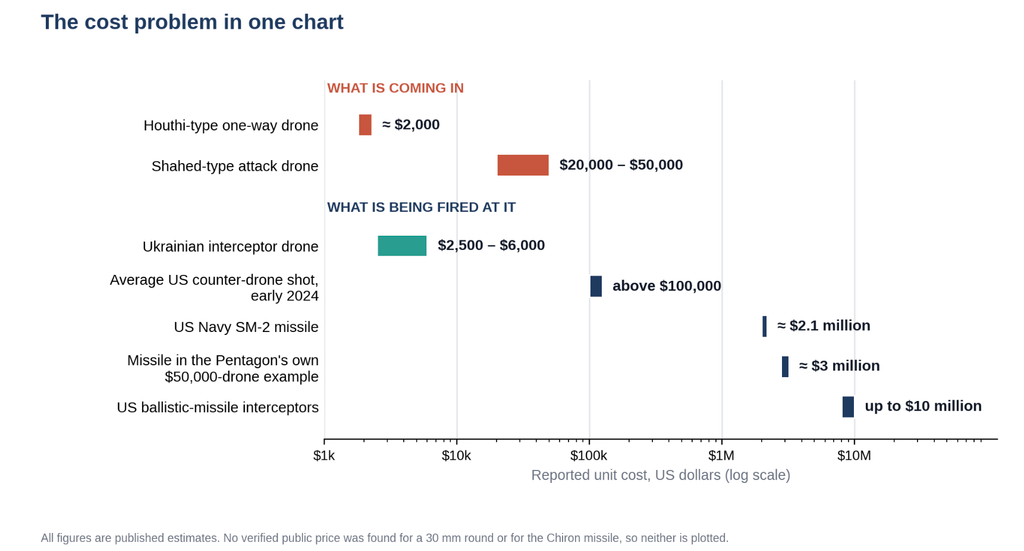
The Biho sits mostly at the cheaper, gun end of that scale. A burst of 30 mm rounds costs a fraction of a missile, though no per-round price we could verify has been published. The missile is the expensive part, and every missile spent on a decoy is unavailable for a helicopter or a cruise missile. That makes the engagement rules, who decides which target earns a missile and how fast, as important as the hardware.
Eight Hard Questions the K30 Biho Air Defence System Has to Answer
These are the questions we would want answered in any Army trial report.
1. Can two 30 mm guns reach far enough?
Effective reach is about 3 km. At an illustrative 150 km/h a drone covers that in 72 seconds, and at 300 km/h in 36. Inside that window the crew must detect, classify, track and fire accurately. Against a very small target the difficulty is less the shooting than finding and identifying it in time.
2. Is a missile ever the right answer to a cheap drone?
Sometimes, but rarely. Hanwha hasn’t published a unit price for the Chiron, yet any guided missile costs far more than a gun round. The likelier doctrine is to hold missiles for helicopters, larger UAVs and cruise missiles, and leave the rest to guns, jammers and cheaper interceptors.
3. What happens when forty arrive at once?
The vehicle carries four ready missiles and, by open-source figures, 500 to 600 rounds of 30 mm: about half a minute of continuous fire at the quoted combined rate, though crews fire in bursts. The package as reported by Korea JoongAng Daily implies roughly 47 missiles and 1,650 rounds per vehicle (our division of the totals), so planners expected heavy resupply. A finite magazine cannot answer a numbers problem.
4. Can the radar really see something that small?
The advertised figure should not be read as a 17 km detection range against every drone. It relates to a specified radar cross-section, and much smaller UAVs will be picked up at substantially shorter range. Aspect angle, altitude, clutter, processing, target speed, waveform, weather, terrain and electronic warfare all change the answer. Figure 6 is a theoretical illustration, not operational performance. Detection range is not engagement capability.
5. What do jamming and spoofing do to it?
The electro-optical suite lets the crew work without the radar and without announcing the vehicle’s position. It does not remove the electronic-warfare problem: the vehicle still depends on datalinks, navigation and timing, and cloud, dust, smoke and rain degrade thermal and TV sensors. Fibre-optic drones are indifferent to jamming of their control link.
6. Does it belong in the mountains?
Not by default. Road widths, bridge limits, transport by air or rail, engine performance at altitude and maintenance in the cold each need an answer, and the Army will want them from trials in Ladakh and the east, not from Rajasthan.
7. What does a 25-tonne tracked vehicle demand from logistics?
Fuel, maintenance, spares and recovery. The Army already operates tracked fleets, so crews and recovery vehicles exist, though a new type adds a new spares chain. The K9 precedent is encouraging: L&T delivered the first 100 guns ahead of schedule (Angel One). Spares in a long war are a different test.
8. Does it work alone?
It shouldn’t. A SHORAD vehicle is designed to sit inside a network: control systems such as Akashteer, surveillance radars, battlefield management systems, neighbouring SHORAD units and the higher layers. On its own it has a short horizon; connected, it shares a picture it could not build itself.
Where the Biho Sits Among India’s Existing Air-Defence Systems
The Army’s low-level air defence still leans on the Swedish-origin L/70 40 mm gun, the Russian ZU-23-2 and the Schilka. They earned respect in May 2025: Army sources said upgraded guns, working with other counter-UAS equipment, neutralised more than 50 drones around Jammu and Pathankot in a night of operations (The Week).
Upgrade tenders are live. idrw.org reported four on the government e-marketplace this week, covering sighting systems, counter-UAS detection, counter-UAS interdiction and “Quick Fire” upgrades for L/70 guns. The sighting-system bid closed on 29 September, the day of the Delhi meeting.
Above the guns sit the missiles. Akash and MRSAM cover the medium layers, with the S-400 above them. The Anant Shastra, formerly QRSAM, is quoted at about 30 km and can search and track on the move. The Army issued a tender worth about ₹30,000 crore to BEL for five to six regiments in September 2025 (Sunday Guardian, citing ANI); reports in June said signing was close, and we found no confirmation that it has happened. At the shoulder-fired end sit DRDO’s VSHORADS and imported systems, joined by a £350 million government-to-government deal for Thales’ Martlet missile, signed in October 2025, which adds a cheap missile in the 6 km class (ThePrint, Defense News).
Then the counter-UAS layers. On 3 July the Defence Acquisition Council cleared Akash Tarang, an anti-UAV electronic-warfare system for Army formations, together with a new V-SHORADS with multi-spectral sensing (PIB release, mirrored). India has cited an Integrated Counter-UAS Grid since Operation Sindoor (Business Today), and DRDO’s integrated air-defence weapon system combines a quick-reaction missile, VSHORADS missiles and a high-power laser.
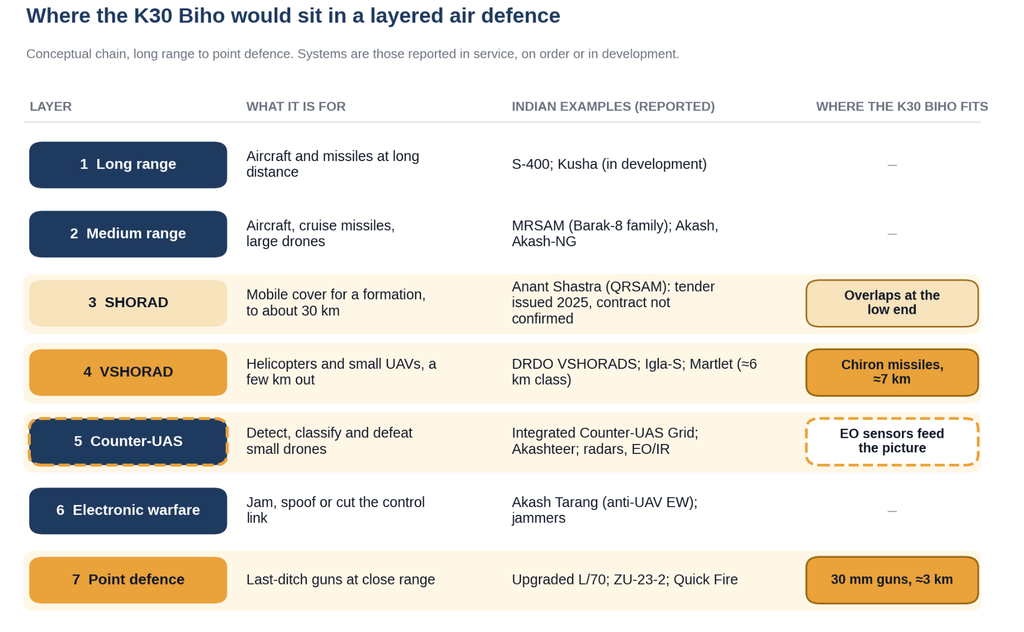
HOW THE BIHO COMPARES WITH WHAT INDIA ALREADY HAS
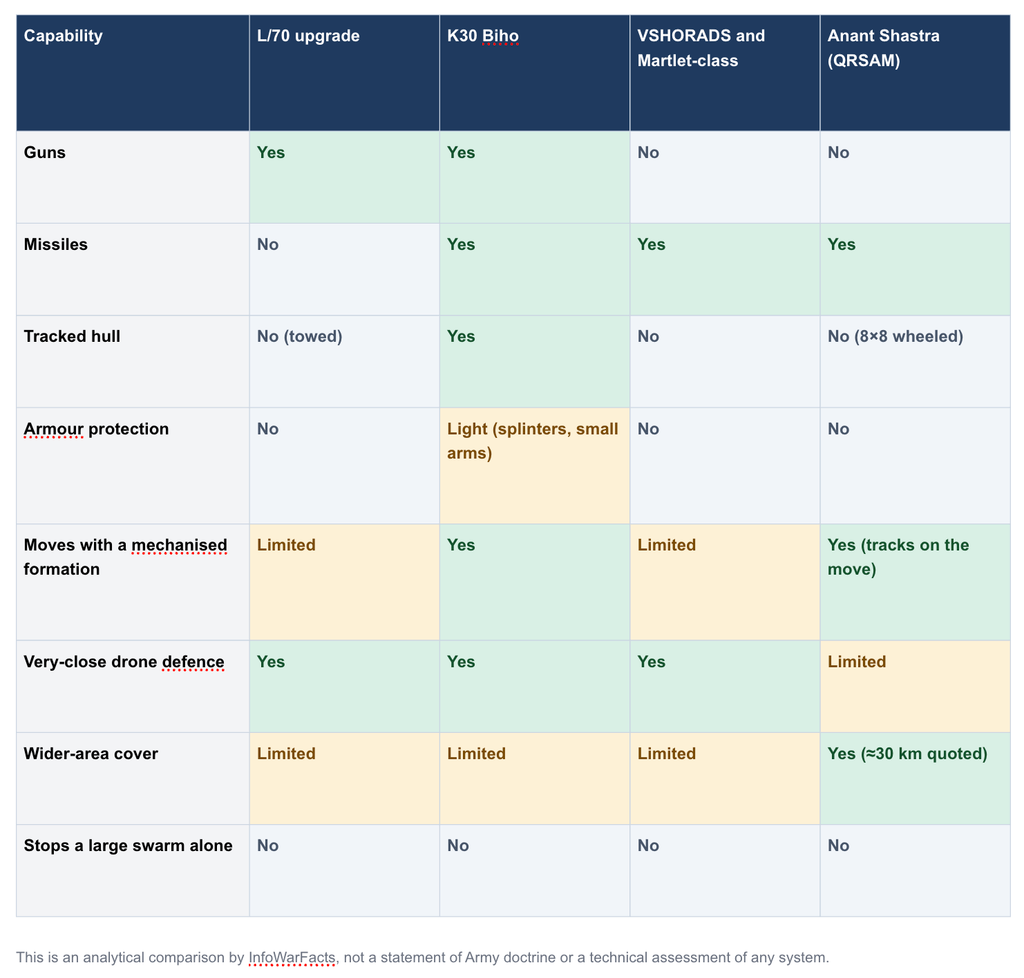
So where does the Biho go? Between the L/70 and the QRSAM, with a foot in each. It brings guns like the L/70, but with armour, mobility and a radar-and-camera suite; it brings missiles like the VSHORAD tier, but in a turret with fire control. The question for the Army is not whether the vehicle is capable. It is whether a tracked, armoured gun-missile layer is needed when the guns are being upgraded, a mobile SAM is on order and cheap missiles are filling the lower tiers.
Make in India: Assembly Is Not Self-Reliance
The K9 Vajra is the precedent people cite, and it deserves its credit. L&T builds the guns at Hazira under licence from Hanwha and delivered the first 100 ahead of schedule. The second contract, signed on 20 December 2024 for ₹7,628.70 crore under the Buy (Indian) category, requires a minimum indigenisation level of 60 per cent (Ajai Shukla).
Hanwha has reportedly offered the Biho a similar path, rising to 80 per cent Indian content by the 50th vehicle, and DAPA has spoken of moving beyond finished-product exports towards joint development (Defense Mirror). That is how India–South Korea defence cooperation is now being framed.
Percentages need careful reading. Indigenous content is measured as a share of contract value, and a high share can coexist with foreign ownership of the parts that matter most. The reported 80 per cent figure describes how much will be made in India, not who controls the design.
The questions that matter more are specific. Who holds design authority for the turret and the fire-control software? Does India get the source code and the right to modify it? Who makes the radar and the missile seeker, and under what licence? Can an Indian integrator add an Indian missile or an interceptor drone to the turret without Seoul’s consent?
Which export or third-party licence conditions attach to the Chiron? And in a prolonged conflict, where do spares and ammunition come from if the supplier’s own forces need them? Those answers decide how much South Korea defence technology actually stays in India.
One workaround reported by idrw.org is a “Hybrid-Biho” with an Indian radar and an Indian missile on the Korean chassis, which could qualify as Buy (Indian-IDDM), the category for indigenously designed, developed and manufactured equipment. It would also move more of the integration risk to India. Indian defence commentary has also floated a Zorawar-based air-defence variant for high altitude, which would be an entirely new development (idrw.org). Local assembly and self-reliance are different things, and the Biho file will be judged on the second.
A Western-Sector Scenario, Step by Step
Run a plausible sequence on the western front. It is illustrative, not a prediction, and not drawn from any Army document. A reconnaissance UAV loiters beyond the border and finds a mechanised column. It passes coordinates to artillery. A loitering munition or FPV drone follows to finish the job, and a follow-on strike is already being prepared.
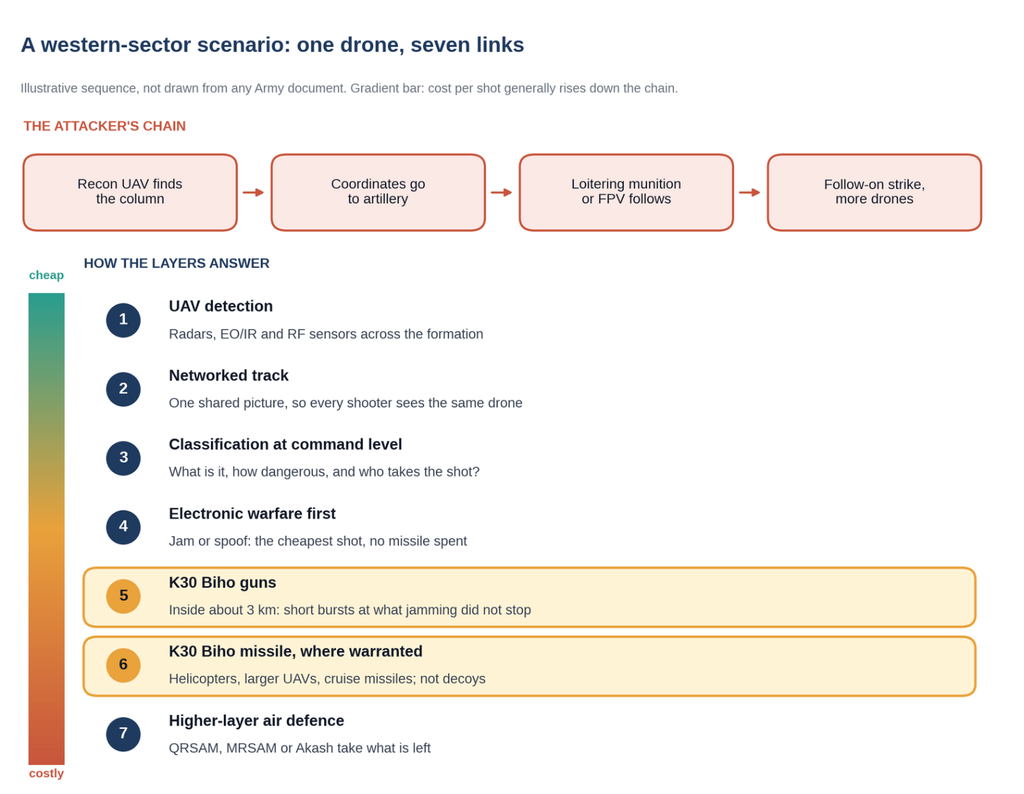
In that chain the Biho owns two links of seven. It doesn’t detect the first drone: a ground radar, an electro-optical post or the Akashteer network does that, assuming they are switched on and linked. It doesn’t classify it either. The electronic-warfare team gets the first try because a jammer is the cheapest shot available and costs nothing in missile stock.
If the drone doesn’t care about jamming, because it follows a pre-programmed course or trails a fibre-optic cable, the guns take it inside 3 km. If it is something faster or more valuable, a helicopter, a larger UAV, a cruise missile, the Chiron gets the call. Anything else goes upstairs. Run it again with forty drones instead of one, and every link strains.
Can the K30 Biho Solve India’s Drone Problem?
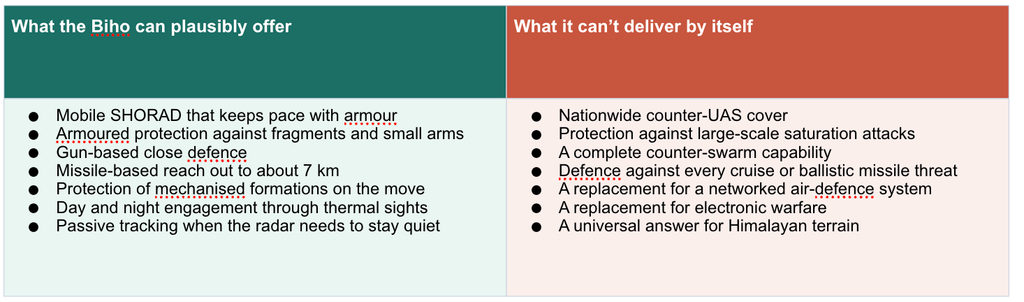
The Biho is potentially a useful component of India’s counter-UAS architecture. It is not the architecture itself.
One Country, Several Air-Defence Problems
The question for India is therefore not whether the K30 Biho is a capable air-defence vehicle. It is whether its particular combination of tracked mobility, guns, missiles, sensors and armour fills a gap that existing and indigenous systems cannot fill at acceptable cost. The answer is likely to be geography-specific.
The western plains, the Thar, the Jammu sector, Ladakh, Sikkim, Arunachal Pradesh, peninsular India and the air bases scattered across all of them ask different things of the equipment. The Biho may have a strong case with mechanised formations in the western plains and a conditional one in Jammu and Ladakh. In the eastern Himalaya, at fixed sites and against large swarms, the case is far less straightforward.
What would settle it is procedural. A fresh Acceptance of Necessity, if the Army wants one. A request for proposals that says which Biho, the Hybrid or the modular Biho II that Hanwha has been pitching, and with whose radar. User trials where the vehicle would actually serve, not only in Rajasthan. And a decision on whether the Anant Shastra contract, unsigned as far as we can tell, and the L/70 upgrades make a third layer redundant. None of that has been announced. The Korean readout said the Biho is being discussed, not negotiated, and for now the difference matters.
The L/70 upgrade tenders are further along than anything Biho-related. The sighting-system bid closed on 29 September, the day officials met in New Delhi, and three more sit alongside it. If the Biho does get paperwork, it will arrive in a market where the Army has already started spending at the cheaper end. How those bids are decided may say more about near-term priorities than the Delhi readout did.
Frequently Asked Questions About the K30 Biho in India
What is the K30 Biho Hybrid?
A South Korean tracked air-defence vehicle built by Hanwha Aerospace. It carries twin 30 mm cannons, four Shingung (Chiron) infrared-guided missiles, a TPS-830K radar and an electro-optical targeting suite on a hull adapted from the K200 infantry vehicle.
Is India buying the K30 Biho?
Not yet, as far as published information shows. South Korea’s DAPA said the Biho Hybrid was discussed at talks in New Delhi on 29 September 2026 and is under discussion with India. India’s published account of the meeting doesn’t mention it, and no contract or fresh Acceptance of Necessity has been announced.
How much could a K30 Biho purchase cost?
Yonhap put the earlier version of the project at about $2.5 billion. A 2019 report priced a package of 104 vehicles, 97 ammunition carriers and 39 command vehicles at roughly 3 trillion won, about $2.6 billion. Any new figure would depend on the specification and on how much is built in India.
Is the K30 Biho a complete counter-drone system?
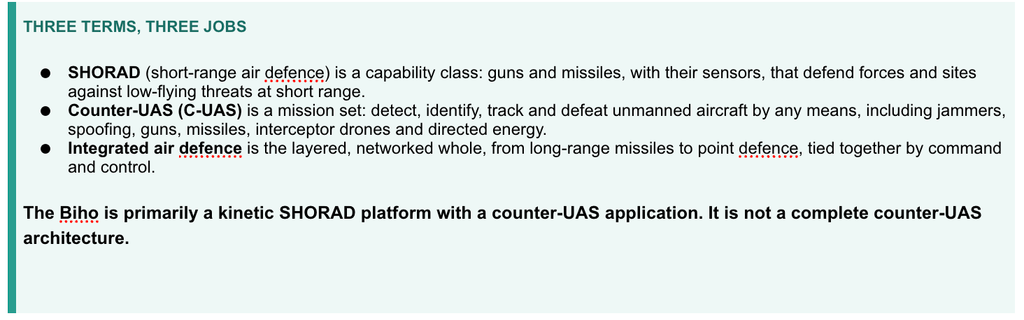
No. It is primarily a kinetic SHORAD platform with a counter-UAS application. Its guns reach about 3 km, it carries four ready missiles and it has a finite magazine. A counter-drone architecture also needs wide-area sensors, jammers, cheaper interceptors and a shared air picture, and no single vehicle stops a large swarm alone.
Why did the earlier K30 Biho plan stall?
Yonhap says the project did not progress amid India’s push for domestic defence manufacturing. Korea JoongAng Daily reported in September 2020 that the Indian defence ministry had agreed to drop the foreign purchase and build such systems at home, and that Russia had lobbied against the Biho.
Would the K30 Biho be built in India?
Indian defence websites report that Hanwha offered phased localisation of up to 80 per cent by the 50th vehicle. None of that is official. L&T already builds the K9 Vajra-T at Hazira under licence from Hanwha, which is the precedent people point to.
Is a tracked vehicle suitable for Ladakh and the Himalayas?
It depends on the sector. India has kept T-72, T-90 and BMP-2 tracked vehicles in eastern Ladakh. Steep, narrow terrain in Sikkim and Arunachal Pradesh is harder, and the Biho’s high-altitude performance hasn’t been published.
How does the Biho compare with India’s L/70 guns and the Anant Shastra?
The L/70 is an old 40 mm gun being upgraded for counter-UAS work. The Anant Shastra is a quick-reaction missile system with a quoted range of about 30 km. The Biho sits between them, combining guns and short-range missiles with armour and tracked mobility for work inside a mechanised formation.