
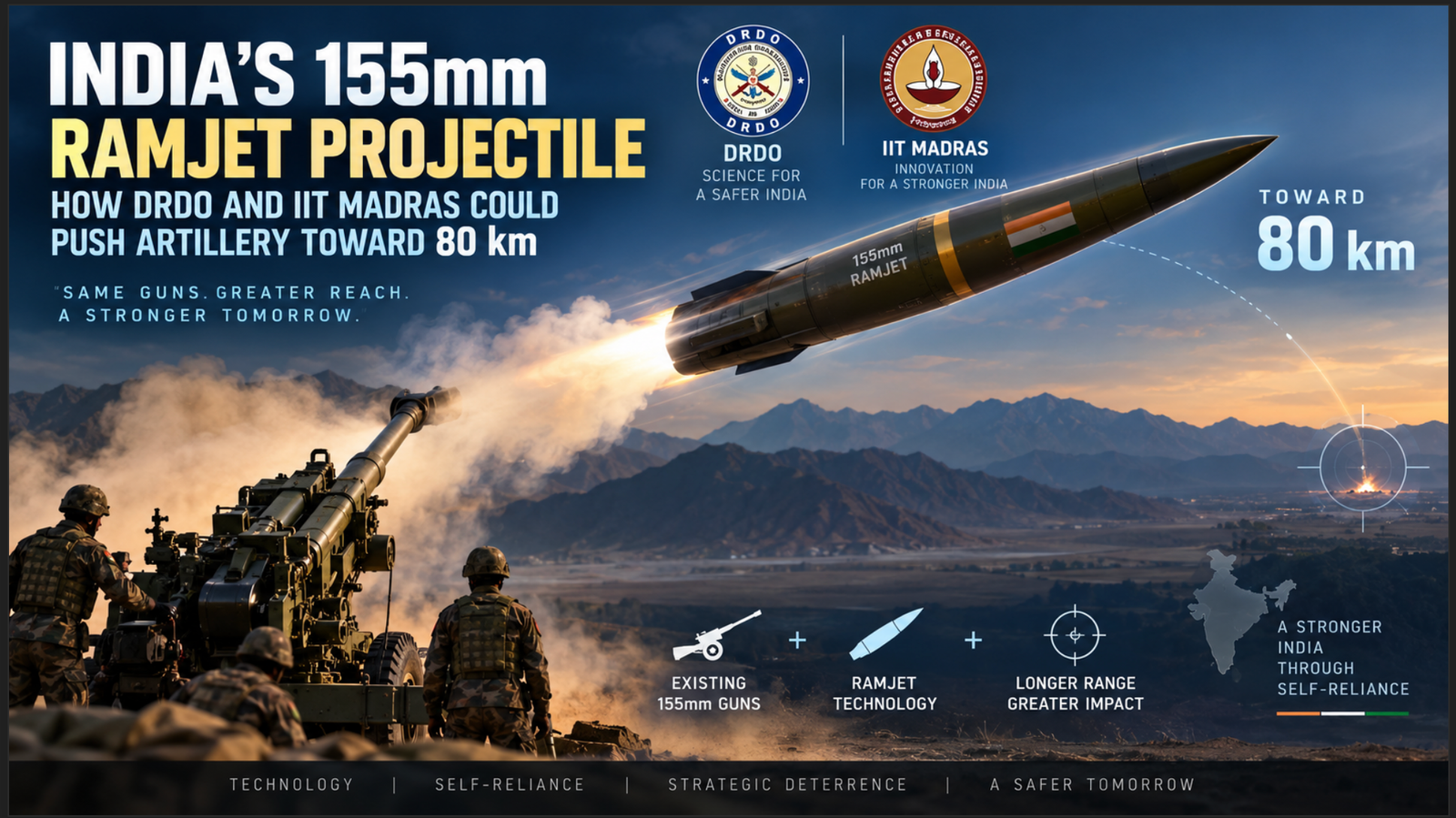
An artillery gun that can hit a target 80 kilometres away without calling in a missile sounds almost like a contradiction. For as long as tube artillery has existed, more range has meant a longer barrel, a bigger propellant charge, or simply accepting that the shell is on its own from the moment it clears the muzzle. India’s 155mm Ramjet Projectile programme is an attempt to break that trade-off by putting a small, air-breathing engine inside the shell itself.
The pitch is almost too convenient on paper: keep the same gun, keep the same crew, keep the same ammunition trucks and depots, but change what actually comes out of the barrel — and a towed howitzer that has spent years topping out around 40-45 km suddenly gets talked about in the same breath as a short-range missile. That is what the Defence Research and Development Organisation (DRDO) and a team of researchers at IIT Madras have been building, testing and, every so often, showing off in public.
What separates the current phase from the “concept poster” years is that the programme has actually gone through a test campaign. A Press Information Bureau release dated 12 January 2026 confirmed trials at the School of Artillery in Deolali in September 2025, followed by further field trials at the Pokhran Field Firing Range that December — a meaningfully different claim from a mock-up standing on a stand at a defence expo. DRDO’s own display material, shown as far back as Aero India 2025 and repeated since, still lists a target range of up to 80 km. That number deserves careful handling, and that is really what the rest of this piece is trying to do.
Key Facts at a Glance
| Parameter | Details |
| Calibre | 155mm |
| Technology | Ramjet-assisted (air-breathing) projectile, replacing the conventional base-bleed unit |
| Developer ecosystem | IIT Madras (Dept. of Aerospace Engineering) with the Indian Army’s Army Technology Board; DRDO/ARDE running a parallel 155mm Ramjet Projectile design effort |
| Intended platforms | Existing 155mm guns — ATAGS, Dhanush, K9 Vajra, M777, Sharang |
| Reported range figures | “Nearly 50%” more range (PIB / IIT Madras, Jan 2026); up to ~80 km as a displayed DRDO target (per Janes, Aero India 2025) |
| Propulsion | Air-breathing solid-fuel ramjet; ignites near Mach 2 |
| Gun compatibility | Designed as a retrofit — no new gun required |
| Development stage | Post-trial refinement; not yet inducted into service |
| Major trials reported | 76mm sub-scale gun (concept validation); School of Artillery, Deolali — September 2025; Pokhran Field Firing Range — December 2025 |
| Project origin | Initiated in 2020 in collaboration with the Indian Army |
What Is a 155mm Ramjet Projectile?
Fire a standard 155mm shell and almost its entire flight is decided in the fraction of a second it spends inside the barrel. A propellant charge burns behind it, pressure builds, and the shell is shoved out at whatever velocity that charge can deliver — typically somewhere in the 800-950 metres-per-second range depending on the charge zone selected. From that instant on, the shell is just a heavy, spin- or fin-stabilised object fighting gravity and drag. Its range is essentially a function of how much energy the gun could impart in that one brief moment.
Engineers have chased extra range from that same starting point for decades, mostly by attacking the drag side of the equation. A base-bleed unit burns a slow charge in the shell’s base to fill the low-pressure pocket that forms behind it in flight, cutting drag. A rocket-assisted projectile goes a step further, firing a small onboard rocket motor partway through the flight for one short extra push. A 155mm Ramjet Projectile takes a different route: instead of only fighting drag or adding a brief kick, it turns the shell into an air-breathing engine for a meaningful part of its flight.
IIT Madras describes the underlying idea in fairly plain terms — the ramjet uses the projectile’s own speed to force air in through a front intake, compress it, mix it with a fuel-rich charge, and let it burn, producing thrust with no moving parts such as a turbine or compressor. The gun still does the hard work of accelerating the shell to a high supersonic speed; the ramjet’s job only begins once that speed is reached, at roughly Mach 2. Below that speed, the intake cannot compress enough incoming air for the engine to function at all, which is exactly why a ramjet needs a gun, or a rocket booster, to give it a running start.
That single design decision — swap the base-bleed unit for a miniature jet engine, and leave the rest of the 155mm shell recognisable — is why officials keep describing this as upgrading the ammunition rather than replacing the gun. It sounds like a small distinction. It is actually the whole premise of the programme.
How Does the Ramjet Actually Work?
Strip away the acronyms and the process runs through six fairly intuitive stages, from the moment the gunner pulls the firing lever to the moment the shell is still climbing away long after a conventional round would have started losing speed.
- Gun launch. The artillery gun’s propellant charge accelerates the shell down the barrel to a very high initial velocity — high supersonic, well above Mach 2.
- Air intake. Once clear of the muzzle and still travelling near or above that threshold speed, the shell’s forward motion rams outside air into an intake built into its nose.
- Compression. The shape of the intake slows that incoming air and raises its pressure before it ever reaches the combustion zone — the entire “compressor” is really just aerodynamic geometry.
- Fuel injection and combustion. A fuel-rich propellant charge inside the shell burns and mixes with the compressed air, and the resulting fuel-air mixture ignites.
- Thrust generation. The hot, expanding combustion gases accelerate out through a rear nozzle, and by Newton’s third law, that push forward is what keeps the shell going.
- Extended flight. Because the shell is generating thrust rather than only coasting, it keeps fighting drag for longer, stretching the range well past what a purely ballistic trajectory would allow.
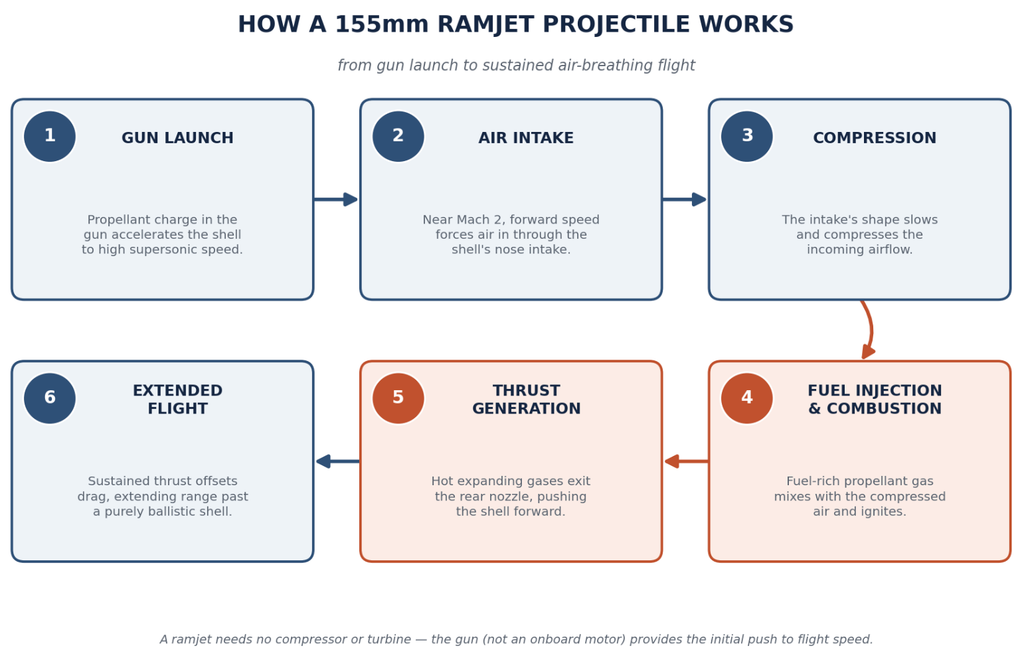
How a 155mm ramjet projectile works, from gun launch through sustained air-breathing flight.
None of this is exotic physics in isolation — ramjets have powered cruise missiles for decades. What makes the artillery version genuinely hard is packing an intake, a combustor and a nozzle into a 155mm-diameter shell that also has to survive being fired from a gun, carry a useful high-explosive payload, and — if the guidance package works as advertised — steer itself toward a point on the ground tens of kilometres away. That is a lot of engineering to fit into a tube not much wider than a dinner plate.
Ramjet vs Rocket-Assisted: Why the Difference Matters
It is tempting to lump every “extended-range” artillery shell into one basket, but a rocket-assisted projectile (RAP) and a ramjet-assisted projectile solve the range problem in fundamentally different ways — and the difference shows up directly in how far each one can plausibly go.
| Feature | Conventional | Rocket-Assisted | Ramjet-Assisted |
| Gun launch | Yes | Yes | Yes |
| Propulsion after launch | No | Yes | Yes |
| Air-breathing | No | No | Yes |
| Uses atmospheric oxygen | No | No | Yes |
| Moving turbine required | No | No | No |
| Extended range | Limited | Higher | Potentially significantly higher |
| Technical complexity | Low | Moderate | High |
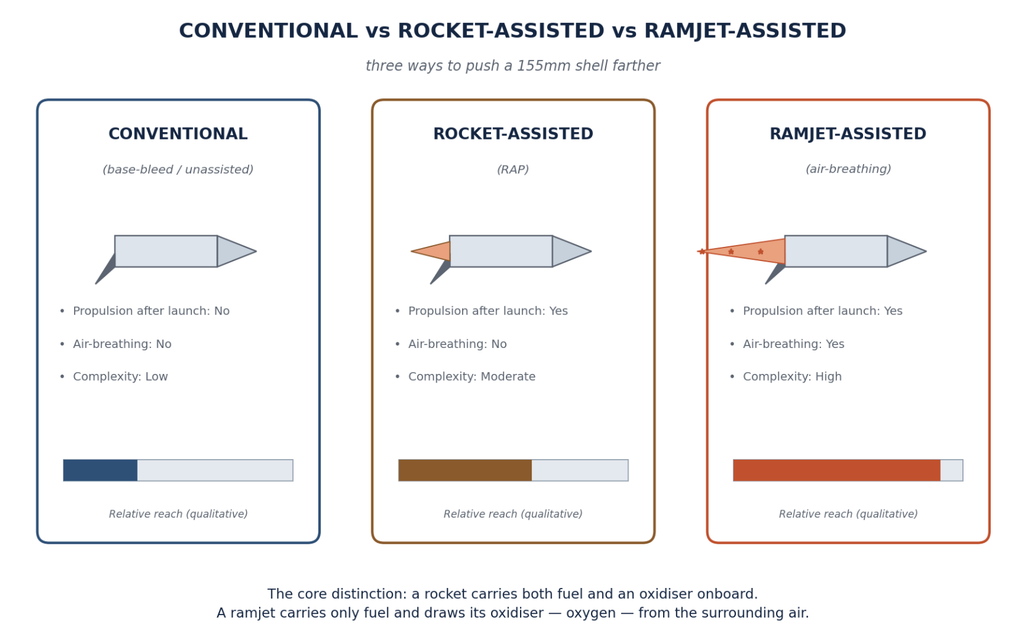
Conventional, rocket-assisted, and ramjet-assisted projectiles compared — range bars are illustrative, not exact figures.
The distinction worth remembering above all others: a rocket carries both fuel and an oxidiser onboard. A ramjet carries only fuel and pulls its oxidiser — plain atmospheric oxygen — from the air around it. That is not a minor engineering footnote. It is the entire reason a ramjet can, in principle, sustain thrust for far longer than a rocket motor of similar size, because it does not have to haul its own supply of oxidiser along for the ride.
A rocket-assisted 155mm round, such as the long-serving American M549, typically adds somewhere around a third more range over a base unassisted shell. Reports around the Indian programme have talked about extending range by 50 percent, and DRDO’s own displayed target goes further still. Whether that higher ceiling survives contact with actual combustion physics inside a shell this small is the entire story of the next few years.
What’s Actually New About India’s Approach
The obvious question is why India needs this at all when it already has the Pinaka rocket family, BrahMos, and a growing missile inventory. The answer researchers keep giving is that the objective here is not to replace rockets or missiles — it is to extend the reach of tube artillery that the Army is already operating, without touching the gun itself.
The PIB release and IIT Madras’s own account are specific on this point: the project integrates a ramjet engine into an existing 155mm artillery shell, in place of the conventional base-bleed unit. That framing matters more than it might first appear. It means the round is meant to be a drop-in replacement in terms of how it is stored, handled and loaded, even though what happens after it leaves the barrel is completely different from anything the Army currently fires.
There is also a slightly less tidy story underneath the headline one. Public reporting shows what look like two connected but distinct tracks: an IIT Madras-led research and flight-test effort running through the Army Technology Board, with named academics and retired officers, that produced the Deolali and Pokhran trials; and a separate, ARDE-driven engineering effort — DRDO’s own armament design house in Pune — working on its own 155mm Ramjet Projectile design and the display material shown publicly at events like Aero India 2025.
Whether these are formally the same programme, closely coordinated sister efforts, or a research track feeding into a production one is not something the public record spells out cleanly. Headlines tend to say “DRDO” and “IIT Madras” almost interchangeably, and the honest answer is that both names are legitimately in the picture, just not necessarily doing identical things.
That is a much more interesting story than a single line reading “India is developing an 80 km shell” — and it is also a more accurate one.
Why 80 km Would Matter
A 155mm/52-calibre gun such as ATAGS currently reaches somewhere around 45-48 km with its longest-range ammunition, depending on which DRDO figure and which point in its testing history you use. Older or shorter-barrelled 155mm systems in Indian service — Dhanush, the M777, the upgraded Sharang — reach noticeably less than that. An 80-km-class round, even as an aspirational target rather than a demonstrated one, sits in a different tactical universe from anything a gun crew can currently put downrange.
Stretching that far could potentially change what a battery is even used for. Instead of supporting troops in contact a few kilometres away, a gun with genuine 70-80 km reach starts to threaten things that used to be firmly in “missile only” territory: enemy artillery groups sitting well behind their own front line, command posts, surveillance and radar sites, logistics nodes, ammunition dumps, and forward air-defence elements.
None of that is guaranteed just because a projectile can physically travel that far — finding, identifying and confirming a target at 80 km is its own separate problem, which is worth returning to later. But the range itself is what opens the door to even considering those missions with a gun instead of a rocket.
It’s worth being precise about the word “could” in that last paragraph. Extra range could potentially enable deeper counter-battery fire, could potentially enable strikes on rear-area command nodes, could potentially enable economical suppression of surveillance assets — none of that becomes automatic just because a shell can physically travel 80 km. Each of those missions still depends on detection, identification, accuracy and enough rounds in the inventory to make the mission worthwhile.
Is 80 km Already Operational? (The Honest Answer)
Important:
The 80 km figure should not be read as an operationally proven range. It is a target that DRDO has displayed publicly since at least Aero India 2025, repeated in later exhibition material, and it describes what the projectile is intended to eventually achieve — not a distance the Indian Army has fired and confirmed in a fielded round.
Separate this into what has actually been shown versus what has only been stated as a goal, and the picture gets clearer rather than murkier. The January 2026 PIB release — the most authoritative public document on this programme’s status — says trials have demonstrated clean gun exit, stable flight and reliable ramjet ignition, and that this validated both internal and external ballistics. That is real, meaningful progress: it means the shell survives the violence of being fired, flies straight, and the engine actually lights when it is supposed to.
The same release is equally direct that “ongoing refinements are addressing remaining technical challenges, paving the way for full operational capability” — language that describes a programme still being finished, not one that has arrived.
Notice, too, that the officially quoted figure from Professor P.A. Ramakrishna, who leads the IIT Madras team, is that the technology “could allow Indian artillery units to engage targets at nearly 50% more distances” — a more conservative claim than the 80 km ceiling DRDO’s own exhibition material continues to display. Other reporting citing unnamed test data has floated numbers anywhere from 60 km to 70-72 km for ATAGS specifically. None of these figures obviously contradict each other — a development target, a demonstrated flight-test result, and a design ceiling are three different things — but they are also not the same number, and a website that quietly picks whichever figure sounds most impressive is doing its readers a disservice.
Guidance accuracy at the extremes of range, reliability across climates from the Rajasthan desert to a Himalayan winter, manufacturing consistency at scale, and formal qualification on each gun type all still sit ahead of the programme. None of that makes the September and December 2025 trials meaningless — quite the opposite — it just means “trials completed” and “ready for the gun park” are two very different sentences.
The Development Timeline, Step by Step
Laid out in sequence, the programme’s public history runs considerably longer than the recent headlines suggest.
2020 — Project initiated in collaboration with the Indian Army, under the Army Technology Board, with IIT Madras leading the propulsion research.
↓
Early phase — A sub-scale 76mm gun, developed at IIT Madras, is used to validate the core ramjet concept before committing to full 155mm hardware.
↓
155mm scale-up — The technology is adapted to 155mm artillery-shell dimensions, with the propellant reformulated for the shell’s internal volume and flight regime.
↓
September 2025 — Trials at the School of Artillery, Deolali: clean gun exit, stable flight and ramjet ignition confirmed, validating internal and external ballistics.
↓
December 2025 — Further field trials at the Pokhran Field Firing Range, with clean gun exit demonstrated at higher operational zones (higher charge settings).
↓
January 2026 — PIB publicly confirms successful development and testing, with refinements continuing toward full operational capability.
Who’s Building This: DRDO, ARDE and IIT Madras
Three names get used almost interchangeably in coverage of this programme, and they are not quite the same thing.
DRDO
The Defence Research and Development Organisation is India’s apex military R&D body, running dozens of specialised laboratories across disciplines from missiles to materials. It sits above this programme in the sense that its display material has publicized the 80 km target at defence exhibitions, and one of its own laboratories is separately engineering a version of the projectile.
ARDE
The Armament Research and Development Establishment, based in Pune, is the DRDO laboratory that actually designs guns and ammunition — it is the design authority behind ATAGS itself. Public reporting from late 2024 described ARDE using standard mechanical design software to prepare manufacturing drawings and 3D models for its own 155mm Ramjet Projectile, the kind of unglamorous but essential engineering work that has to happen before anything gets built at scale.
IIT Madras
The Department of Aerospace Engineering at IIT Madras has run the propulsion and propellant side of this problem since 2020, under Professor P.A. Ramakrishna. The project team named in the January 2026 PIB release also includes Lieutenant General P.R. Shankar (retired) and Lieutenant General Hari Mohan Iyer (retired) — both former artillery officers now serving as “Professor of Practice” faculty — alongside Professor H.S.N. Murthy, Professor G. Rajesh, Professor M. Ramakrishna, Professor Murugaiyan, Professor Lazar C, and Dr Yogesh Kumar Velari.
That mix of career artillery officers and aerospace academics sitting in the same research group is, on its own, a fairly unusual arrangement for an Indian defence R&D project, and probably explains why the work has stayed tied to real gun trials rather than staying purely theoretical.
The Indian Army’s own Army Technology Board sits alongside all three, acting as the institutional bridge that connects academic research to actual firing ranges and user trials — without it, a university aerospace department has no obvious route to putting a shell through a 155mm gun at Pokhran.
The Technical Core: Fuel-Rich Propellant
If there is one piece of unglamorous chemistry holding this entire concept together, it is the propellant sitting inside the ramjet’s combustor — and it is deliberately not the same kind of propellant used in an ordinary rocket motor.
A conventional solid rocket propellant is formulated to burn on its own, with a fuel-to-oxidiser ratio close to what full combustion actually needs, because a rocket motor gets no help from the outside air. A fuel-rich propellant, by contrast, is deliberately starved of oxidiser. It burns hot and produces a gas that is still loaded with unburned fuel — gas that only finishes combusting once it mixes with the fresh, oxygen-rich air being rammed in through the intake. That two-stage burn is what lets a ramjet extract useful energy from a fuel supply while carrying almost none of the oxidiser weight a rocket has to haul along.
A peer-reviewed paper from the IIT Madras team, published in DRDO’s own Defence Science Journal, describes exactly this kind of propellant — built around aluminium, ammonium perchlorate and a hydroxyl-terminated polybutadiene (HTPB) binder, tuned specifically to burn fast at the relatively low pressures found inside a ramjet’s primary combustion chamber. None of those ingredients are exotic; the same broad chemical family shows up across the solid-propellant world, from model rocketry to strategic boosters. What is hard is not the chemistry list, it is tuning the burn rate, pressure sensitivity and mechanical toughness of that specific mixture to survive gun-launch shock loads and then burn predictably for the shell’s entire powered flight.
Two more terms are worth understanding, because they explain why this is difficult rather than simply niche. Restricted combustor volume refers to the basic problem that a 155mm shell has very little spare internal space once you account for the explosive payload, the ramjet hardware itself, and — if guidance is fitted — the electronics and control surfaces. There is no room for an inefficient engine. Specific impulse (ISP) is essentially a measure of how much thrust an engine gets out of a given amount of propellant over time — the higher it is, the more range or payload you can squeeze out of the same internal volume.
DRDO’s own display material has quoted an ISP above 900 seconds for this projectile; separate reporting on the IIT Madras programme has cited specific impulse figures for the ramjet exceeding 4,000 newton-seconds per kilogram, against roughly 2,400-2,500 for a typical solid rocket motor of similar class. Those two sets of numbers use different units and come from different sources, and they do not obviously reconcile into one tidy figure — which is itself a useful reminder that public performance data on this programme is still fragmentary, not a settled specification sheet.
Guidance, Navigation and Control: Why Accuracy Gets Harder at Range
Reported display material for the projectile lists an accuracy figure of 10 metres or better “with GNC” — guidance, navigation and control. That figure should be read strictly as a stated, displayed specification rather than a result that has been independently confirmed in open testing, since neither the PIB release nor the Janes report on the Aero India display goes into the guidance package’s demonstrated performance.
The concept itself is not exotic. Guidance is the logic that decides where the projectile needs to go; navigation is the onboard sensing — typically an inertial measurement unit, possibly aided by satellite positioning — that tells the system where it actually is; control is the set of fins, canards or thrust adjustments that steer it from one to the other. Extended-range guided 155mm rounds already exist elsewhere in the world using broadly this architecture, so the concept is proven even if this specific Indian implementation has not yet been shown working end to end in public.
Why does any of this matter more at 80 km than at 25 km? Basic geometry. A one-degree angular error at short range translates into a small miss distance; the same one-degree error at 80 km translates into a miss distance dozens of times larger, simply because the error has that much more distance to compound over.
An unguided extended-range shell fired at maximum range can be accurate enough to matter against a large area target and still be nowhere close enough to matter against a single bunker, radar vehicle or command post. That is the entire reason “extended range” and “extended range with useful accuracy” are different engineering problems, and why the guidance package here is not a nice-to-have add-on — it is arguably as important to the programme’s usefulness as the ramjet motor itself.
India’s 155mm Artillery Family
One reason this programme has drawn so much attention is simply the size of the fleet it could plug into. The Indian Army does not operate one 155mm gun — it operates several distinct families, each with its own barrel length, chamber pressure and baseline range, all built around the same 155mm ammunition standard:
- ATAGS — the indigenous 155mm/52-calibre Advanced Towed Artillery Gun System, developed by ARDE with Tata Advanced Systems and Bharat Forge/Kalyani Strategic Systems, with 307 units on order.
- Dhanush — a 155mm/45-calibre gun, an indigenised evolution of the Swedish-origin Bofors FH-77B design.
- K9 Vajra — a 155mm/52-calibre self-propelled howitzer, built in India by Larsen & Toubro under license from South Korea’s Hanwha.
- M777 — the American-origin 155mm/39-calibre ultra-lightweight towed howitzer, used mainly in mountain and high-altitude sectors.
- Sharang — older 130mm Soviet-origin field guns upgraded and rebored to 155mm/45-calibre by the Ordnance Factory Board.
DRDO’s own published material on ATAGS describes it as designed to fire in-service Extended Range Full Bore (ERFB) ammunition, and at lower ranges, a Bi-Modular Charge System, with an integrated fire-control system built around an inertial-navigation-based gun alignment system, a muzzle velocity radar and a ballistics computer that runs the laying calculations automatically. That fire-control sophistication is worth flagging, because a ramjet round is only as useful as the gun’s ability to actually lay onto a target at the extremes of that round’s range.
IIT Madras’s own reported figures give a sense of what “nearly 50% more range” could look like translated across this fleet, platform by platform:
| Gun System | Calibre | Baseline Range (approx.) | Reported Range With Ramjet Round |
| M777 / ULH | 155mm/39-cal | ~24 km | ~43 km |
| Dhanush | 155mm/45-cal | ~30 km | ~55 km |
| K9 Vajra | 155mm/52-cal | ~36 km | ~62 km |
| ATAGS | 155mm/52-cal | ~40 km | ~70 km |
Why Sticking With Existing Guns Matters
The usual path to more artillery range looks like this: new gun, new logistics chain, new crew training, new spares pipeline, new maintenance ecosystem — an expensive, years-long undertaking even before the first unit reaches a regiment. The pitch behind a ramjet round is a shorter path: existing gun, upgraded ammunition, greater reach.
That does not mean every 155mm gun currently in an Indian Army gun park will automatically be able to fire this round the day it is ready. A shell built around a ramjet motor is a physically different object from a standard ERFB round — different weight distribution, different behaviour under acceleration, quite possibly different chamber pressure requirements depending on how the propelling charge is configured.
Each gun type would still need its own qualification process: proving the round is safe to fire from that specific barrel, that the fire-control system can compute a firing solution across the round’s full range envelope, and that accuracy and reliability hold up across repeated firings and different environmental conditions. None of that is exotic engineering, but none of it is instant either, and it is exactly the kind of unglamorous qualification work that tends to get skipped over in the more excitable headlines.
Ramjet Projectile or Missile? Not the Same Question
It is worth being blunt about where this technology sits relative to an actual guided missile, because the two get conflated fairly often in casual coverage.
Missile
- Needs a dedicated launcher and support system
- Carries its own full guidance package as standard
- Carries its own dedicated propulsion system for the full flight
- Much greater range potential — typically tens to hundreds of kilometres beyond what any gun-launched round can reach
- Higher cost and logistics complexity per round in most applications
Ramjet Artillery Projectile
- Fired from an existing artillery gun already in service
- Uses the artillery branch’s existing supply and handling infrastructure
- Potentially far lower cost per round than any missile
- Much shorter range than a genuine tactical or strategic missile
- Sits in the gap between conventional artillery and missile systems, rather than replacing either
Elsewhere, the closest comparison is the Boeing-Nammo “Ramjet 155” effort under the US Army’s XM1155 extended-range programme, which industry officials have described as a hybrid between a shell and a missile — precisely because it borrows guidance and control surfaces normally associated with missiles while still being fired from a conventional cannon.
South Africa’s Rheinmetall Denel Munition has also worked on ramjet-adjacent, long-range 155mm ammunition for roughly two decades. None of these programmes, Indian or foreign, has yet put a ramjet-powered 155mm round into full operational service anywhere in the world — which is exactly why officials involved in the Indian effort have started framing this as a race to become the first army to do so, rather than a race that has already been won.
The argument for India is straightforward: this is not a missile replacement. It is another layer of long-range fires, sitting underneath the missile inventory rather than competing with it.
How the Army Might Actually Use It
Speculating about doctrine is a different exercise from reporting on hardware, so treat what follows as analysis of plausible uses rather than any official statement of how the round would be employed.
Counter-battery fire
The most obvious use case: engaging an opposing artillery group from a stand-off distance well beyond that group’s own maximum range, reducing the returning battery’s ability to hit back before displacing.
Disrupting command and control
A confirmed command post or communications node sitting deeper behind the front line than conventional artillery could previously reach becomes a legitimate gun target rather than something reserved exclusively for rockets or aircraft.
Suppressing surveillance assets
Radars, ground surveillance systems and similar high-value but often static assets are, where appropriate targets, well suited to a projectile that trades some payload for range and precision rather than needing an expensive missile for every engagement.
Interdicting logistics
Selected ammunition dumps or supply nodes further behind the line than standard artillery can reach become reachable without diverting missile stocks that may be needed elsewhere.
Deeper tactical fires generally
More broadly, the round extends how far a battery’s normal fire-support role can reach, without requiring troops or forward observers to physically get closer to the target than they otherwise would.
The Sensor-to-Shooter Chain
None of the missions above happen just because a shell can fly 80 km. Range without the ability to find, identify and confirm a target at that distance is just an expensive way to miss something further away than before.
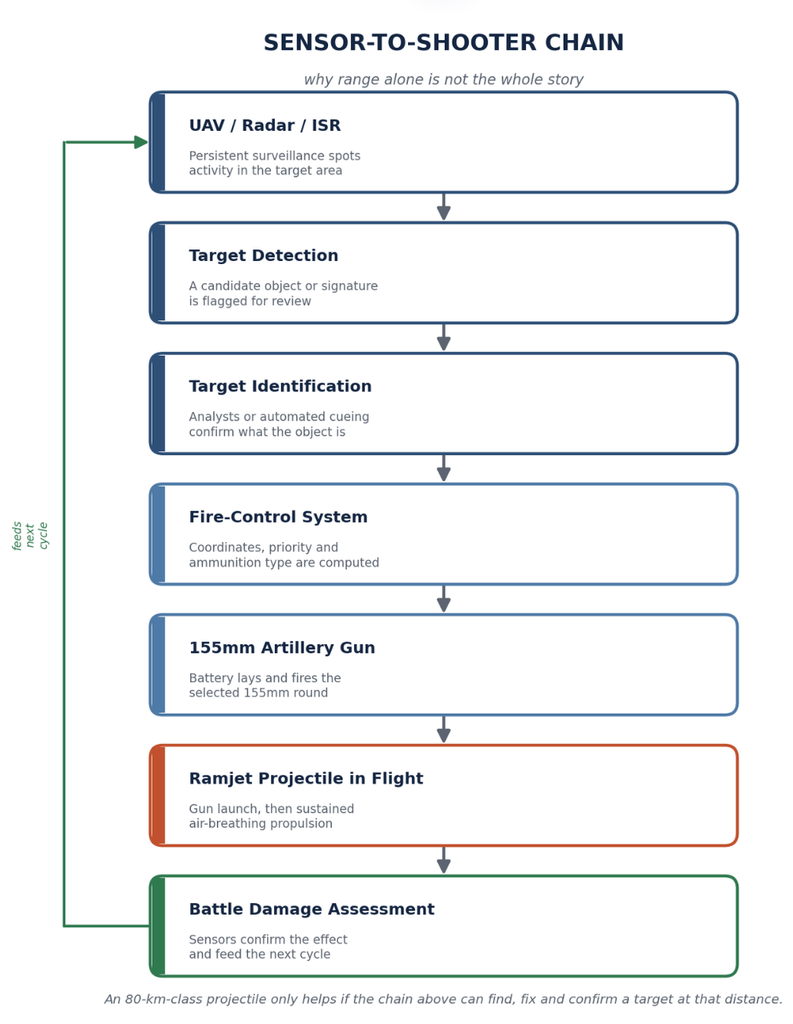
A UAV, a counter-battery radar such as the Swathi Weapon Locating Radar already in Indian Army service, or another ISR asset first has to detect activity in the target area. That detection then needs to be turned into a confirmed identification — not every heat signature or radar return is actually the target it looks like. Only after that does a fire-control system compute a firing solution, select the right ammunition, and pass it to the gun. Once the round is away, some form of battle damage assessment closes the loop, confirming whether the effect was achieved and feeding that back into the next targeting cycle.
An 80-km-class projectile makes that entire chain more valuable, not less necessary. If anything, longer engagement ranges raise the bar on the ISR and identification steps, since a target at that distance is inherently harder to positively confirm than one just beyond the current front line.
Survivability: Range Helps, But It Isn’t a Shield
Extra range has a fairly direct survivability upside for a gun battery. Greater stand-off distance from the intended target means less need to displace forward into more exposed positions, more flexibility in choosing where to actually site the guns, and — at least in principle — reduced exposure to counter-battery fire aimed back at the firing unit.
That benefit only goes so far, though. A gun battery that can be located by an opponent’s own counter-battery radar or ISR assets remains vulnerable regardless of how far its ammunition can reach, because the thing being targeted is the gun’s position, not the shell’s range. This is exactly why longer-range artillery tends to travel alongside “shoot-and-scoot” tactics — firing a mission and immediately displacing before counter-battery radar can cue a response — and why the broader counter-battery contest between opposing ISR networks matters just as much as the projectile itself.
The Technical Hurdles Still Standing
None of this is easy, and it is worth listing what still has to go right, in roughly the order an engineer would worry about it.
- Gun-launch acceleration — the shell has to survive launch loads reported to run into the tens of thousands of g, without damaging the intake, fuel grain or any onboard electronics.
- Structural integrity — the airframe has to hold together under that shock and then under sustained supersonic aerodynamic loads in flight.
- Air-intake design — the front-mounted intake has to function reliably in an extreme thermal and aerodynamic environment that starts the instant the shell leaves the barrel.
- Reliable ignition — the ramjet has to light consistently, round after round, not just on the test rounds that make it into a press release.
- Combustion efficiency — extracting enough thrust from a fuel-rich propellant inside a very small, “restricted” combustor volume.
- Aerodynamic stability — the wrap-around fins and overall shape have to keep the shell tracking straight through the transition from gun-launched flight to powered ramjet flight.
- Thermal loads — nose and intake surfaces face serious heating at sustained high supersonic speed.
- Propellant consistency — every production batch has to burn the same way; inconsistent burn rates translate directly into inconsistent range and accuracy.
- Guidance miniaturisation — fitting an inertial and/or satellite-aided guidance package into a shell that already has an engine and a warhead competing for the same limited space.
- Accuracy at range — achieving that reported 10-metre figure consistently, not just in favourable test conditions.
- Reliability across climates — a round tested in the Rajasthan desert has to work just as reliably in humid coastal conditions or Himalayan cold.
- Manufacturing at scale — moving from hand-built test articles to a production line that can turn out thousands of consistent rounds.
- Cost per round — a ramjet shell will almost certainly cost meaningfully more than a standard round, and that cost has to be justified by what it achieves.
- Gun compatibility — qualifying the round separately across ATAGS, Dhanush, K9 Vajra, M777 and Sharang, each with its own chamber and ballistic characteristics.
- Formal qualification and safety certification — the lengthy process of clearing any new artillery ammunition for general service use.
Taken together, this list is really the difference between “we fired one successfully at Pokhran” and “every gun regiment can rely on this round.” Both statements can be true about the same programme at different points in its life, and right now, this programme sits closer to the first one.
Why This Matters Strategically for India
Atmanirbhar Bharat
Every official statement on this programme, including the PIB release itself, frames it inside India’s push for indigenous defence technology. A sophisticated air-breathing propulsion system, developed and tested domestically rather than imported, is a genuine data point in that broader push, regardless of how the specific range figures eventually settle.
Long-range precision fires
Even a partial success here — say, a reliable 50-60% range increase with reasonable accuracy — expands how deep Indian artillery can operate without leaning on missile inventories for every long-range mission.
Cost-effectiveness
Artillery ammunition, even an expensive guided round, is very likely to remain cheaper per engagement than a missile. A workable ramjet round gives commanders a mid-tier option between “conventional shell” and “missile” that does not currently exist in the Indian inventory.
Force multiplication
Because the round is designed as a retrofit rather than a new platform, it potentially increases the effective utility of guns the Army has already paid for and already operates — ATAGS units still being delivered, K9 Vajras already in service, Dhanush regiments already raised.
Defence-industrial capability
Ramjet propulsion, fuel-rich propellant chemistry, miniaturised guidance packages and precision ammunition manufacturing are all transferable skills — the same expertise built here has obvious relevance to future missile, rocket and loitering-munition programmes well beyond this one projectile.
Where This Fits in the Future of Warfare
Zoom out from the specific shell, and this programme is really one small piece of a much larger shift in how militaries are trying to fight: longer engagement ranges, faster and more networked targeting, and an ever-thinner line between “artillery” and “precision-guided munition.”
The war in Ukraine has made the value of long-range, precision-capable fires — and the parallel importance of counter-battery radar and rapid displacement — harder to ignore for any army watching from outside. A gun that can reach 70-80 km with meaningful accuracy fits naturally into a future built around persistent ISR, AI-assisted target recognition, and sensor networks that compress the time between “something was spotted” and “a round is in the air.”
Distributed, harder-to-suppress fires supported by faster kill chains and a generally more transparent battlefield are the direction most modern militaries say they are heading. A 155mm ramjet round is a small, unglamorous piece of that picture — not a headline weapon in its own right, but exactly the kind of incremental capability that makes the larger network more useful.
What’s Still Unanswered
Being honest about a programme like this means being equally honest about what has not yet been demonstrated in public, rather than filling those gaps with the most flattering assumption.
- What is the final, qualified operational range — 50% more, 60 km, 70-72 km, or the displayed 80 km ceiling?
- What accuracy is actually achieved at maximum range, under real test conditions, rather than as a displayed specification?
- What will the round cost per unit once it reaches production, and how does that compare with existing extended-range ammunition?
- What production rate can Indian industry sustain once the design is finalised?
- Which specific 155mm platforms will actually be qualified to fire it — all five families, or a smaller subset first?
- How reliable is the round across genuinely different climatic conditions, from desert heat to high-altitude cold?
- What is the real circular error probable (CEP) at different range bands, not just at the maximum quoted range?
- How much does the ramjet hardware add to the projectile’s overall weight, and what does that cost in terms of payload?
- Does a larger propulsion section meaningfully reduce the high-explosive fill compared with a standard shell, and by how much?
- What does the Army’s actual induction timeline look like, and has a formal quantity or contract been discussed anywhere on the record?
These are not gotcha questions. They are simply the standard checklist any new ammunition programme has to clear before it becomes something a gun regiment can depend on, and right now the public record answers very few of them with real numbers.
Where the Programme Actually Stands
Strip away both the enthusiasm and the skepticism, and what is left is a programme that has moved from a research concept to demonstrated hardware — clean gun exit, stable flight and reliable ignition are not small achievements for a shell this complex — while still carrying a long list of open items before it becomes something a gun regiment can rely on in the field.
Its eventual military value will come down to a handful of unglamorous, measurable things: the range actually certified once testing is complete, the accuracy actually achieved at that range, the reliability shown across repeated firings and real climatic extremes, the cost per round once production begins, how many of the Army’s existing 155mm platforms can be qualified to fire it, and whether Indian industry can build it at the volume a war-fighting inventory actually needs.
Every one of those sits somewhere between “partially answered” and “not yet answered” as of early 2026. That is not a criticism of the engineering — it is simply where a genuinely hard propulsion problem sits two trial campaigns into its test programme.
Sources & Further Reading
Prioritised as requested: government release, then DRDO-linked/peer-reviewed material, then reputable defence trade press.
• Advanced Towed Artillery Gun System (ATAGS) — official DRDO product page
• Aero India 2025: DRDO unveils 155 mm ramjet projectile — Janes