A comprehensive strategic analysis of India’s biggest-ever drone procurement, Operation Sindoor, the China threat, swarm warfare, counter-drone systems, and the companies reshaping India’s defence landscape.
TABLE OF CONTENTS
1. Introduction: The Shot Heard on Drone Frequencies
2. India Drone Order $2 Billion: Why Operation Sindoor Changed Everything
3. What Types of Drones Is India Buying?
4. Which Service Gets What?
5. The Pakistan Factor: Turkey, China and the Drone Race
6. The China Factor: The Threat New Delhi Cannot Ignore
7. Lessons from Ukraine: The $500 Drone That Changed War
8. Swarm Warfare: India’s Next Frontier
9. Anti-Drone Systems: If Everyone Has Drones, How Do You Stop Them?
10. Which Indian Companies Will Benefit?
11. Atmanirbhar Bharat: Is India Ready to Make Its Own?
12. Is $2 Billion Actually Enough?
13. India Drone Order $2 Billion and the Future of Warfare
14. Frequently Asked Questions
15. External Authority Links
1. Introduction: The Shot Heard on Drone Frequencies
India Drone Order $2 Billion is one of the most significant defence developments of 2026. Following the lessons of Operation Sindoor and the growing drone threat from China and Pakistan, India is preparing its largest-ever military drone procurement. This strategic investment highlights the increasing importance of drone warfare, swarm technology, counter-drone systems and indigenous defence manufacturing.
On the night of May 7, 2025, the skies over India’s western border lit up in a way that no one had seen before. Hundreds of unmanned aerial vehicles — small, cheap, and relentless — crossed into Indian territory from Pakistan in a coordinated salvo targeting military stations from Avantipura in Kashmir to Bhuj in Gujarat. India’s integrated counter-drone systems and air defence networks intercepted and neutralised most of them. Then India fired back.
What followed over four days — a drone-versus-drone confrontation stretching from Leh to Sir Creek — was not just a skirmish. It was a stress test of an entirely new kind of warfare, played out in real time between two nuclear-armed neighbours. And when it ended, every senior planner in South Block knew that India’s approach to unmanned systems could never be business as usual again. The India Drone Order $2 Billion initiative represents one of the largest defence investments in India’s modern military history.
The answer, it turns out, is $2 billion. According to reporting by Reuters, citing Smit Shah, president of the Drone Federation India (DFI), India is in the advanced stages of its largest-ever military drone procurement, with orders expected to exceed 200 billion rupees placed with domestic manufacturers this year. Deliveries are expected within 18 to 24 months, almost certainly through the fast-track emergency procurement route.
“In the next phase, tactical drone procurements in India may exceed 200 billion rupees, or more than $2 billion.” — Smit Shah, President, Drone Federation India
This is not routine procurement. It is a strategic recalibration. And to understand why, you have to understand what happened in those four days of May, what is sitting across India’s borders on two fronts, and why a single $500 drone can now destroy what a $5 million tank cannot stop.
2. India Drone Order $2 Billion: Why Operation Sindoor Changed Everything
The trigger was the Pahalgam massacre. On April 22, 2025, 26 civilians were killed by terrorists in Jammu and Kashmir. India blamed Pakistan-based groups, and Prime Minister Narendra Modi’s government decided it would not respond the way previous governments had — by absorbing the blow and the outrage.
Under Operation Sindoor, India struck nine alleged terrorist infrastructure sites deep inside Pakistani territory. Pakistan’s response came in waves of drones and missiles targeting military stations across northern and western India — Srinagar, Pathankot, Amritsar, Jalandhar, Ludhiana, Adampur, Bathinda, Chandigarh, Uttarlai, and Bhuj. India said it neutralised the attacks using its Akashteer integrated counter-drone network. Then, on the night of May 8, Indian armed drones went after four Pakistani air defence sites, with one reportedly destroying an air defence radar.
Along the Line of Control and the International Border, India tracked between 300 and 400 drone intrusions at 36 locations simultaneously. Pakistan deployed Turkish-origin Asisguard Songar quadcopters and Baykar YIHA-III fixed-wing loitering systems. India used the Israeli-designed Harop kamikaze drone and domestically built Nagastra-1 loitering munitions. ideaForge’s Netra and Switch-class surveillance drones fed real-time targeting data to ground commanders.
What the conflict exposed was sobering. India’s surveillance gaps in certain sectors had to be filled in real time with commercial drones. The volume of enemy drone attacks — hundreds in a single night — showed just how difficult it is to defend against cheap, mass-produced systems. The operational value of having thousands of expendable unmanned platforms, rather than a few expensive ones, became impossible to ignore.
Ramesh Chandra Padhi, an executive at IG Defence, put it plainly: drones are force multipliers on the modern battlefield. The Indian Army is now executing emergency and fast-track procurement to induct drones on a very large scale. That is not a bureaucratic statement. That is a doctrinal shift.
3. What Types of Drones Is India Buying?
The Rs 17,000 crore order is not a single category of drone. The Indian military has operational needs across the full spectrum of unmanned systems, from small quadcopters a soldier can carry in a backpack to MALE-class platforms that can loiter over a border for 40 hours. Here is the breakdown:
Tactical Surveillance Drones
The immediate procurement focus is on tactical drones — platforms like ideaForge’s Switch and Netra, used in Operation Sindoor for real-time reconnaissance and targeting. Lightweight, battery-powered systems that a section-level unit can carry and deploy within minutes. The army wants thousands of them.
Loitering Munitions
The star of Operation Sindoor was the Nagastra-1, produced by Solar Defence and Economic Explosives Limited. Weighing 8–9 kg, with a 30 to 40 km range and 2-metre circular error probability, it can circle a target area, identify a threat, and strike autonomously. The army placed an order for 450 Nagastra-1R units post-conflict. This category is expected to scale dramatically.
MALE-Class Platforms
Medium Altitude Long Endurance drones are where India’s biggest capability gap lies. Adani Defence’s Drishti-10 Starliner — a derivative of Israel’s Elbit Hermes 900 — and Tata Advanced Systems’ collaboration with IAI for the Heron TP-class fall into this segment. These platforms provide persistent ISR over areas as large as an operational theatre.
Armed Strike Drones
The March 2026 defence ministry approval of 2.38 trillion rupees included remotely piloted strike aircraft — the bureaucratic term for armed drones capable of precision strikes. Adani Group’s Akshi-7, with 24-hour endurance and kinetic strike capability, is one of the indigenous contenders.
Swarm Drone Systems
NewSpace Research and Technologies has already delivered an autonomous surveillance and armed drone swarm system — the A-SADS — to the Indian Army. It combines Beluga hexacopters and Nimbus Mk-III quadcopters in swarms of up to 100 units operating jointly for three hours at a 50 km range. NewSpace’s Sheshnaag-150, a 150 kg loitering munition with 1,000 km range, has also completed its public debut.
| Drone Category | Representative Platform | Role | Indian Maker |
| Tactical Surveillance | ideaForge Switch / Netra | Battlefield ISR | ideaForge |
| Loitering Munition | Nagastra-1R | Precision Strike | Solar Defence / EEL |
| MALE Class | Drishti-10 Starliner | Long-Range ISR | Adani Defence / Elbit |
| Armed Strike UAV | Akshi-7 | Kinetic Strike | Adani Defence |
| Swarm System | A-SADS (Beluga + Nimbus) | Saturate Defences | NewSpace Research |
| Long-Range Loitering | Sheshnaag-150 | Deep Strike | NewSpace Research |
| Counter-Drone | Bhargavastra | Hard-Kill C-UAS | Solar Defence |
4. Which Service Gets What?
The $2 billion order cuts across all three services, and each has fundamentally different requirements — which is why the breadth of India’s drone industry matters as much as its depth.
Indian Army
The army is the most urgent buyer. Section-level surveillance drones, man-portable loitering munitions, swarm systems for saturation attacks, and logistics drones for forward supply — the army wants all of it, now. The Western Command’s IX Corps recently demonstrated that soldiers could assemble 50 small drones in under three hours from flat-pack components, pointing to a wartime production model that can scale at the speed of conflict.
Indian Air Force
The air force is looking at MALE and HALE platforms for strategic ISR, electronic warfare drones, and loyal wingman-style systems that can operate alongside crewed combat aircraft. Crewed-uncrewed teaming — an Su-30MKI or Tejas controlling a cluster of armed drones simultaneously — is an active procurement consideration.
Indian Navy
The navy wants maritime surveillance drones capable of long-endurance patrol over the Indian Ocean, where China’s PLA Navy has been steadily increasing its presence. Carrier-capable drones and sea-skimming strike systems are on the horizon. The Drishti-10 Starliner, already acquired for maritime patrol, is just the beginning.
5. The Pakistan Factor: Turkey, China and the Drone Race
Pakistan went into Operation Sindoor with what it believed was a formidable drone advantage. Its inventory of more than 1,000 unmanned systems included Turkish Bayraktar TB2 and Akinci platforms, Chinese Wing Loong II and CH-4 MALE drones, and the YIHA-III — a smaller loitering munition assembled domestically in collaboration with Turkish contractor Baykar. According to one Pakistani source, a unit can be produced locally in two to three days.The India Drone Order $2 Billion programme is partly a response to Pakistan’s rapidly expanding drone capabilities.
The results were mixed, at best. Pakistan reportedly deployed 300 to 400 drones in a single night. India neutralised the vast majority. Indian air defence and counter-drone systems — particularly the Akashteer network — performed well above expectations. Several Turkish and Chinese platforms that had proven effective in Libya, Azerbaijan, and Ukraine’s early conflict phase found India’s layered defences a far more difficult environment.
But Pakistan drew its own lessons. Defence intelligence firm Janes noted that Islamabad is likely to deepen its collaboration with both China and Turkey to advance domestic drone research and production. Turkey recently delivered Akinci UCAVs to Pakistan — a platform capable of firing cruise missiles at high altitude. Pakistan’s National Aerospace Science and Technology Park is building local production fast.
The arms race is now explicit. Two nuclear-armed nations that previously spent years on artillery shelling along the Line of Control are now racing to build unmanned fleets that can strike deep, at scale, without risking a pilot’s life or triggering immediate escalation. That dynamic — cheap drones as a tool of controlled pressure — is precisely what makes the situation structurally unstable.
6. The China Factor: The Threat New Delhi Cannot Ignore
Any honest assessment of India’s drone build-up has to confront a question the Reuters report politely sidestepped: how much of this is really about China?
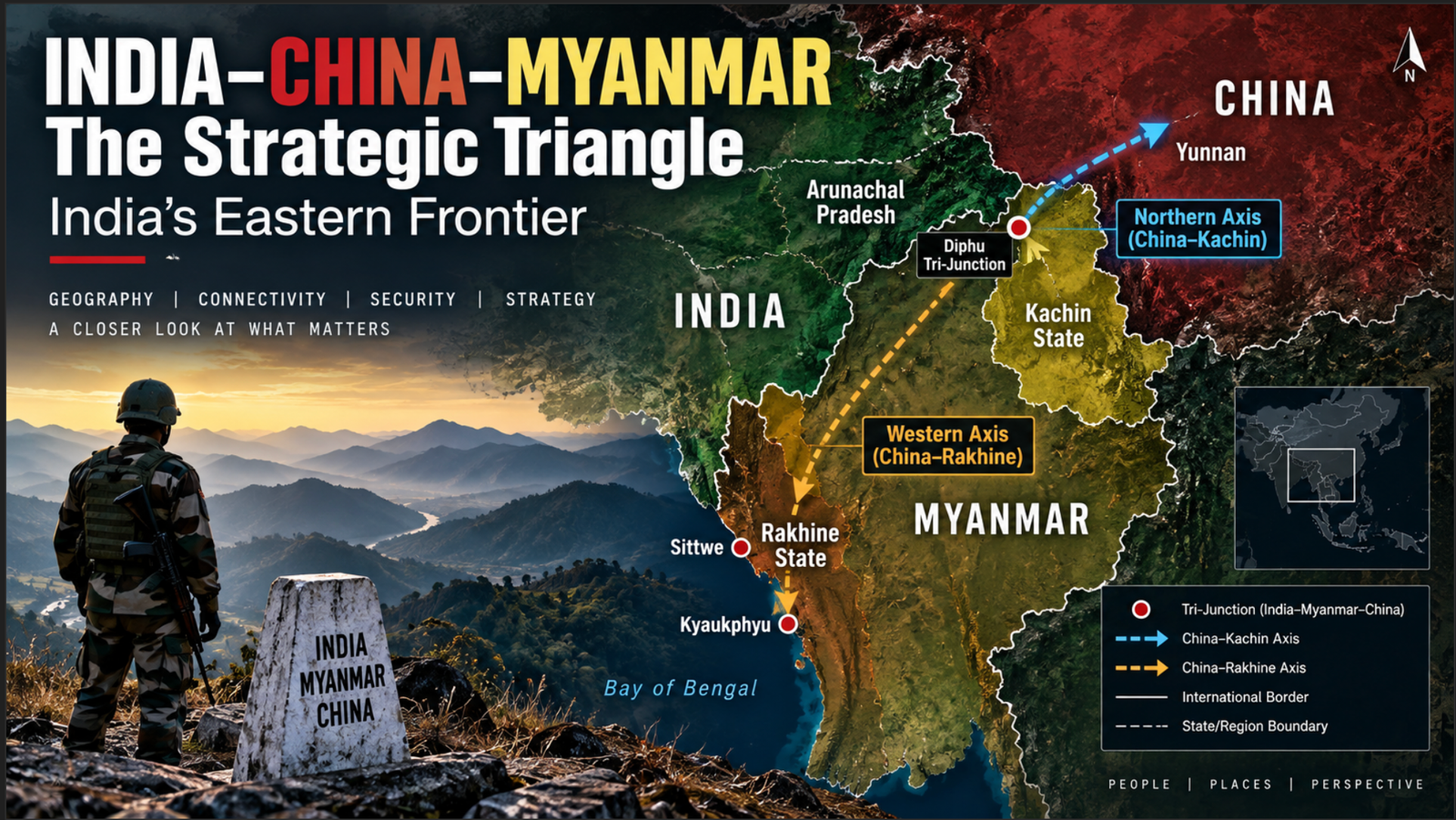
The PLA is not building a drone fleet. It is building a drone doctrine. Analysis describes it as three interdependent layers — persistent surveillance, strike coordination, and electronic warfare suppression — that together create a kill chain architecture no single counter-measure can neutralise. Along the LAC in Ladakh and Arunachal Pradesh, China has deployed Wing Loong, BZK-005, and CH-4 class drones in support of its forward positions.
In March 2026, the PLA unveiled its Atlas drone swarm system — a vehicle-mounted platform capable of launching and coordinating up to 96 drones from a single command node. Chinese military expert Wang Yunfei described it as enabling saturation attacks on air defences, precision strikes, and deep-strike missions. Its mobility makes it particularly relevant in Tibet, where rapid deployment at altitude could overwhelm Indian forward positions before reinforcements arrive.
Chinese military sources have reportedly confirmed plans to acquire approximately one million drones by 2026, including AI-enabled kamikaze systems with autonomous target recognition. China’s drone exports to Pakistan and others have already demonstrated how these platforms perform in contested airspace.
India’s Rs 2,000 crore incentive programme for domestic drone manufacturing partly reflects a quiet acknowledgment that India currently depends on Beijing for certain critical drone subsystems — even as it prepares to fight Chinese-backed adversaries with platforms that contain Chinese parts. That uncomfortable complexity sits underneath the clean headline of a $2 billion order.China’s growing unmanned warfare doctrine is another major reason behind the India Drone Order $2 Billion effort.
7. Lessons from Ukraine: The $500 Drone That Changed War
A $500 FPV drone can destroy a $5 million tank. That ratio has permanently altered the economics of warfare.
The Russia-Ukraine conflict has produced a battlefield laboratory unlike anything since the Second World War, and no military procurement planner anywhere can afford to ignore its findings.
First-person-view drones — cheap racing quadcopters fitted with a warhead, costing between $300 and $500 — have been used to destroy main battle tanks, armoured vehicles, artillery pieces, and command posts at a rate that has broken the traditional cost calculus of warfare. Ukraine has been producing tens of thousands of these monthly. Russia caught up and is now deploying FPV drones in massive volumes too.
Electronic warfare has emerged as the critical enabler. Drone jammers, GPS-spoofing systems, and signal-jamming umbrellas have made drone operations in Ukraine a constant technological leap-frog — the winning side is whoever adapts faster. AI-enabled targeting, where the drone’s guidance system autonomously identifies and tracks a moving target using computer vision, has shrunk the operator’s cognitive load and extended effective range.
Attrition warfare has taken on a new meaning. In Ukraine, drone losses are measured in thousands per month. The side that can manufacture and field replacements faster wins. This is why India’s emphasis on domestic production is not just Atmanirbhar Bharat optics. It is a wartime requirement.
| Lesson from Ukraine | India’s Response |
| Cheap FPV drones destroy expensive platforms | Nagastra-1 loitering munitions at scale |
| Mass drone production wins attrition battles | 600+ domestic drone firms, emergency procurement |
| Electronic warfare neutralises drones | Akashteer integrated C-UAS network |
| AI targeting extends operational range | A-SADS swarm with autonomous tracking |
| Counter-drone is as vital as offence | Bhargavastra, laser-based IDDIS systems |
8. Swarm Warfare: India’s Next Frontier
Here is a scenario that keeps air defence planners awake at night: 200 cheap drones launched simultaneously from 50 km away, each flying a slightly different route, each designed to saturate a radar network and force it to prioritise. Even a 90% intercept rate leaves 20 drones hitting their targets.
That is swarm warfare, and India is moving toward both its offensive and defensive dimensions faster than public reporting suggests. The Indian Army demonstrated a 75-drone coordinated swarm in 2021. NewSpace’s A-SADS system — 100 drones operating jointly in swarm mode — has been delivered. The Sheshnaag-150 loitering munition is explicitly described as a swarming one-way attack drone. These are not technology demonstrators any more.
The Chinese are further ahead. The PLA’s Atlas system, launching 96 drones from a vehicle-mounted platform, represents an operational-level swarm capability that can be pre-positioned in Tibet. The combination of altitude advantage, rapid deployment, and sheer numbers creates a threat profile that conventional air defence struggles to counter.
India’s response is to build offensive swarm capability alongside its counter-drone network. The logic is deterrence: if your adversary can launch 500 drones and absorb your entire intercept inventory, you need enough offensive systems that the first salvo is not also the last.
9. Anti-Drone Systems: If Everyone Has Drones, How Do You Stop Them?
Operation Sindoor produced a paradox every military is now wrestling with. India’s counter-drone performance — Akashteer integrating multiple detection radars, jammers, and kinetic interceptors into a single command network — was impressive. It neutralised the bulk of Pakistan’s 300-400 drone salvo in a single night. But the very success contains the seeds of its own failure: if cheap drones can overwhelm expensive interceptors by sheer volume, the defender with the most sophisticated system is also burning through $100,000 missiles to kill $500 drones.
Hard Kill Systems
India’s Bhargavastra multi-layer micro-missile system uses inexpensive micro-rockets and micro-missiles for hard-kill interception. Integrating with Akashteer, it detects a small drone at 6 kilometres and engages it. Explicitly designed to counter swarm attacks. Zen Technologies’ ZenShield combines radar, electro-optical sensors, and jamming in one platform.
Soft Kill — Jamming and Spoofing
Electronic warfare solutions — signal jammers that sever the GPS or radio link between a drone and its operator — are deployed across forward positions. India has developed laser-based Integrated Drone Detection and Interdiction Systems (IDDIS). But drone manufacturers are building frequency-hopping protocols, encrypted links, and autonomous navigation that does not depend on GPS at all.
Directed Energy
Laser-based counter-drone weapons, while expensive, attract significant investment because a laser has near-zero cost per shot — unlike a missile — making it mathematically superior against swarm attacks if the power source is available. India’s DRDO has active directed energy programmes, though operational deployment timelines remain classified.
| Counter-Drone Method | Cost per Kill | Effective Against Swarms? | Indian System |
| Surface-to-Air Missiles | High ($50K-$100K) | No — too expensive at scale | SPYDER, Akash short-range |
| Hard-Kill Micro-Missiles | Medium | Partially | Bhargavastra |
| Jamming / Spoofing | Near-zero | Yes, for radio-dependent drones | IDDIS, ZenShield |
| Directed Energy (Laser) | Near-zero per shot | Yes, power permitting | DRDO DEW programmes |
| Naval CIWS | Medium | Limited | Naval CIWS on warships |
10. Which Indian Companies Will Benefit?
India has more than 600 firms making drones and components, with over 100 focused on defence applications. The $2 billion order will not be spread evenly. Here is who is best positioned:
ideaForge Technology
Mumbai-based ideaForge is probably the most battle-tested domestic drone maker today. Its Switch and Netra platforms were deployed during Operation Sindoor. The Indian Army has awarded it major contracts, and post-conflict orders for 450 surveillance drones signal the government views it as a reliable supplier at scale.
NewSpace Research and Technologies
Bengaluru-based NewSpace is quietly building some of India’s most sophisticated capabilities. Its A-SADS swarm system is already deployed. The Sheshnaag-150 — 1,000 km range loitering munition — is the kind of deep-strike capability India currently imports from Israel. NewSpace is also developing MALE-class platforms under DRDO’s Development-cum-Production Partner model.
Adani Defence and Aerospace
The Adani Group’s Drishti-10 Starliner MALE drone — in collaboration with Israel’s Elbit Systems — is already operational with the Indian Navy. The Akshi-7 armed drone with 24-hour endurance is in development. Adani’s scale and balance sheet give it an advantage in large, complex contracts.
Tata Advanced Systems Limited (TASL)
TASL’s collaboration with Israel Aerospace Industries for Heron TP-class drones places it in the MALE market. It is also involved in loitering munition systems and ISR platforms through international joint ventures.
Solar Defence and Aerospace
The maker of both Nagastra-1 and Bhargavastra occupies a unique position — it has both an offensive and a defensive product in active operational use. Post-Sindoor procurement has already validated both platforms.
Larsen and Toubro
L&T’s Defence division has been building drone and unmanned systems capabilities. Its scale gives it access to large systems-integration contracts — integrating drone networks, ground control infrastructure, and communications systems across multiple platforms.
Asteria Aerospace
A Bengaluru-based specialist in precision surveillance drones, Asteria has worked with both civilian and defence clients. Its niche in high-accuracy mapping and surveillance makes it relevant for border surveillance applications.
11. Atmanirbhar Bharat: Is India Ready to Make Its Own?
The government’s push for indigenous manufacturing is genuine and, post-Sindoor, has acquired a clarity of purpose that earlier policy announcements lacked. The Rs 2,000 crore incentive programme for drone manufacturers — covering drones, components, software, counter-drone systems, and services — is designed to wean the sector off imported inputs. And that means, primarily, Chinese components.
India currently depends on China for certain critical drone subsystems — flight controllers, propulsion motors, battery cells, and electronic speed controllers. The irony of building an anti-China drone capability partly using Chinese components is not lost on planners in South Block. The incentive programme explicitly targets this dependency.
The Innovations for Defence Excellence (iDEX) scheme has funded more than 350 startups working on defence technology, including dozens in the drone space. The army’s demonstration that soldiers can assemble 50 drones from flat-pack components in three hours points toward a wartime production model that does not depend on a centralised factory. Atmanirbhar Bharat is expected to play a crucial role in the success of the India Drone Order $2 Billion programme.
| Dimension | Current Status | Target |
| Indigenous drone firms | 600+ companies, 100+ defence-focused | Scale to Tier-1 defence supplier status |
| Component import dependency | Significant (China: motors, batteries, FCs) | Reduce via Rs 2,000 cr incentive scheme |
| Drone market size | Growing rapidly | $11 billion by 2030 (PIB estimate) |
| Export potential | Early stage — Cyprus and others exploring | Become top-5 global drone exporter |
| Production speed | Months per contract cycle | Days in wartime surge production |
12. Is $2 Billion Actually Enough?
The $2 billion figure sounds large in isolation. In context, it is a down payment.
| Country | Approximate Drone Spending | Context |
| USA | Tens of billions annually | MQ-9, Reaper, autonomous programmes |
| China | Classified — likely $10B+/year | Target: 1 million drones by 2026 |
| Ukraine | Billions (wartime surge) | Producing hundreds of thousands of FPV drones monthly |
| Turkey | Several billion (exports + domestic) | Bayraktar series, Akinci UCAV |
| Pakistan | Growing rapidly via China+Turkey | Racing to rebuild after Sindoor losses |
| India | $2 billion proposed (this order) | Largest-ever — but catching up |
The March 2026 defence ministry approval covering 2.38 trillion rupees for transport aircraft, missile systems, and armed drones gives the broader context. The $2 billion drone order sits within a much larger rearmament programme. But the gap between India’s current drone inventory — approximately 200 MALE systems and close to 1,000 mini-UAVs — and what China is building is not closed by any single order.
What the order does is signal intent, create industrial capacity, and begin the process of building a production base that can sustain a much larger programme over the next decade. The Indian Army’s IX Corps soldiers assembling drones in three hours is not a one-time demonstration. It is a rehearsal for a wartime surge model that assumes mass attrition of unmanned systems and requires mass replacement at field level.
13. India Drone Order $2 Billion and the Future of Warfare
There is a tendency to treat a $2 billion procurement as an end in itself — a budget line, a contract, a delivery schedule. It is not. It is the latest chapter in a shift so fundamental that military strategists are still struggling to find the right language for it.
Drones are replacing reconnaissance aircraft. They are replacing artillery scouts. They are replacing the intelligence officer who used to fly a manned mission over enemy lines at enormous cost and risk. They are beginning to replace attack jets — not because they are more capable, but because they are cheap enough to lose. A drone that costs Rs 50 lakhs tells you something that a Rs 1,000 crore fighter jet only told you after careful mission planning and a trained pilot.
The crewed-uncrewed teaming concept — where a fighter pilot controls a cluster of autonomous drone wingmen simultaneously — is no longer science fiction. The US Air Force has been testing it. India’s procurement plans include elements of it. Pakistan’s interest in the Bayraktar Kizilelma, a jet-powered UCAV capable of autonomous air-to-air engagement, points to a future where an unmanned aircraft fights an unmanned aircraft and the humans manage the escalation ladder from the ground.
AI is the accelerant. Computer vision that allows a drone to autonomously identify a tank from 3 kilometres and guide itself to impact without operator input is commercially available today. The friction — the human in the loop — is what most military doctrines still require. Whether that friction survives the next decade of AI development is a question no defence ministry has satisfactorily answered.
India’s $2 billion order is not, at its core, a procurement story. It is a story about a country that watched its own doctrine tested by 300 enemy drones in a single night and concluded it needed to be on the right side of that arithmetic. The companies that win the contracts will matter. The delivery timelines will matter.
But what matters most is whether the industrial base, the training pipelines, and the tactical doctrine can absorb this technology and use it faster than the adversary can adapt to it. That race is already underway, and $2 billion is where India formally entered it. Ultimately, the India Drone Order $2 Billion strategy is about preparing India for the next generation of warfare.
14. Frequently Asked Questions (FAQs)
Q1. What is India’s $2 billion drone order?
India is planning its largest-ever military drone procurement, with orders expected to exceed 200 billion rupees ($2 billion+) placed with domestic manufacturers. The Drone Federation India confirmed that plans are in advanced stages, with deliveries expected within 18–24 months through fast-track emergency procurement.
Q2. What triggered this massive drone purchase?
Operation Sindoor in May 2025 — India’s four-day military confrontation with Pakistan — was the immediate trigger. Both nations deployed drones at scale for the first time, exposing Indian surveillance gaps and demonstrating the decisive value of cheap, mass-produced unmanned systems. Lessons from Ukraine’s drone-heavy warfare reinforced the urgency.
Q3. Which Indian companies will win contracts?
Best positioned: ideaForge Technology (tactical surveillance), NewSpace Research (swarm systems, loitering munitions), Solar Defence (Nagastra-1, Bhargavastra), Adani Defence (MALE drones, armed UAVs), Tata Advanced Systems (MALE platforms, ISR), and Larsen & Toubro (large systems integration).
Q4. What types of drones is India buying?
The procurement covers tactical surveillance drones, loitering munitions, MALE-class platforms, armed strike drones, swarm systems, and counter-drone systems. Each category addresses a specific operational gap exposed by Operation Sindoor.
Q5. Is the $2 billion order aimed at Pakistan or China?
Both. The immediate experience comes from Pakistan, but the structural threat driving long-term build-up is China. The PLA’s drone doctrine along the LAC — integrating surveillance, strike, and electronic warfare — represents a capability that dwarfs Pakistan’s. Army, Air Force, and Navy all face Chinese drone threats across different theatres.
Q6. What is India doing about counter-drone systems?
India’s Akashteer integrated counter-drone network performed well during Operation Sindoor. India is also deploying Bhargavastra hard-kill micro-missile systems, laser-based IDDIS, and jamming systems. The cost asymmetry between cheap attacking drones and expensive interceptors remains the central unsolved challenge.
Q7. How does India’s drone spending compare globally?
The gap is significant. China targets approximately one million drones by 2026, with spending likely in the tens of billions annually. India’s $2 billion order is a start within a broader 2.38 trillion rupee rearmament approved in March 2026. The goal is to establish an industrial base capable of mass production, not just initial procurement.
Q8. What is India’s drone market projected to be worth?
According to the Press Information Bureau, India’s drone market is projected to reach $11 billion by 2030, representing 12.2% of the global market. Defence procurement, civilian applications, and export potential are all driving this forecast.
1. External Authority Links
- Reuters: India set for $2-billion drone order in biggest buy — reuters.com
- Drone Federation India (DFI) — dronefederationindia.org
- SIPRI — Arms Transfers Database — sipri.org
- Stimson Center: Drone Warfare in South Asia — stimson.org
- Defence Acquisition Procedure 2020 (MoD India) — mod.gov.in
- DRDO India — Unmanned Systems — drdo.gov.in
- ideaForge Technology — Defence Portfolio — ideaforge.in
- Press Information Bureau — Drone Market Projections — pib.gov.in