
Indrajaal Ranger, developed by Hyderabad-based Indrajaal Autonomous Defense Systems, has secured approximately ₹155 crore in new orders for deployment in India’s border-security and urban-security environments. The orders mark a significant step in the deployment of mobile counter-UAS capability in India.
A Toyota Hilux fitted with radar, an AI command layer and a net launcher is now part of India’s homeland-security shopping list — and the order behind it says as much about how India wants to fight drones as the hardware does.
Indrajaal Autonomous Defense Systems and Sigma Advanced Systems, both based in Hyderabad, announced on 17 August 2026 that they had secured close to ₹155 crore in fresh government orders for the Indrajaal Ranger, a mobile anti-drone patrol vehicle (India Strategic, The Week). The announcement came days after India’s 80th Independence Day and split the money two ways: ₹145 crore for border-security deployment, and roughly ₹10 crore for urban policing and VVIP protection.
The Ranger itself is a Toyota Hilux fitted with radar and RF sensors, an AI command layer called SkyOS, and a spread of countermeasures running from electronic jamming to a physical net launcher — built to detect, track and neutralise drones while the vehicle is actually moving, not just when it’s parked at a fixed post. Indrajaal first unveiled it in November 2025 (Rushlane), calling it India’s first fully mobile, AI-enabled anti-drone patrol vehicle.
What makes the order worth a closer look isn’t the size of the cheque. It’s what the dual booking — one order for the border, a separate one for city policing — suggests about how India’s security establishment is starting to think about the drone problem: less as a fixed list of sites to defend, and more as a moving target that needs a response able to move with it.
Most reports identify the Union Ministry of Home Affairs as the customer behind the ₹145-crore border order, though at least one outlet attributed it to the Indian Army instead. The precise end-user and contracting authority would need to be confirmed against the official procurement paperwork, which hasn’t been made public. What’s easier to establish is what the vehicle actually does, and where the claims made about it hold up against what’s independently checkable.
What Is the Indrajaal Ranger?
It isn’t Indrajaal’s only counter-drone product, either. The company’s catalogue also includes fixed installations named Infra, Urban, Military, Trooper, Border, Combat, Zombee and Maritime, alongside Repulsor, reportedly built around the same SkyOS backbone. The Ranger is the one made for the road — officially an Anti-Drone Patrol Vehicle, or ADPV, and, on Indrajaal’s own account, the first of its kind built in India from the ground up as a road-going patrol platform rather than a sensor mast that happens to be able to move.
Why India Needs a Counter-Drone Vehicle That Moves
The case for something like this isn’t hypothetical. The Ministry of Home Affairs told Parliament in 2023 that 53 drone-linked smuggling incidents had been detected along the Punjab stretch of the India-Pakistan border over the preceding three years (PIB) — arms, narcotics and cash, dropped by small commercial drones flying low enough to slip under conventional radar. Then there’s the harder edge: in June 2021, explosives dropped from a drone struck the Indian Air Force station in Jammu, injuring two personnel (widely reported at the time) — the first use of a drone to attack a military installation on Indian soil.
What ties both problems together is that neither stays in one place. A radar-and-jammer array protects the ground underneath it and not much else; move the threat five kilometres down the fence line and it’s no help at all. Indrajaal’s own leadership has made that argument publicly — founder and CEO Kiran Raju Penumacha has said drone threats now reach past conventional battlefields into airports, cities, public events and VVIP movements, none of which come with a counter-drone tower already installed.
| How the Drone Threat Has Escalated — Smuggling — arms, narcotics and cash dropped across the Punjab border; 53 incidents recorded 2020–2023, per the Home Ministry. — Reconnaissance — drones used to surveil military positions and border infrastructure. — Weapon delivery — explosives dropped on the IAF Jammu station, June 2021. — Emerging concern — swarming and loitering-munition tactics seen in conflicts elsewhere are shaping how Indian planners think about the next stage of the threat. |
The ₹155-Crore Order, Broken Down
| Item | Detail |
| Total order value | ≈ ₹155 crore (≈ US$16.2 million) |
| Border-security order | ₹145 crore — Indrajaal-Sigma consortium |
| Reported customer (border) | Union Ministry of Home Affairs, per most reports (one report named the Army) |
| Urban / VVIP order | ≈ ₹10 crore — separate order |
| Reported customer (urban) | An urban police agency |
| Platform | Indrajaal Ranger (Toyota Hilux-based ADPV) |
| Announced | 17 August 2026, Hyderabad |
| Status | Orders announced; manufacturing and rollout to follow |
The headline figure is ₹155 crore, but it’s really two contracts stitched into one announcement (India Strategic, Sahi). The larger piece, ₹145 crore, goes to the Indrajaal-Sigma consortium for deployment in what both companies describe as India’s border-security environment. A separate, smaller order, roughly ₹10 crore, comes from an urban police force, aimed specifically at VVIP protection and city-security duty rather than the frontier.
The companies are framing the dual booking as evidence of something bigger than one sale: that mobile counter-drone technology is shifting from a border-only concern into routine homeland-security kit, useful anywhere a convoy, a rally or a stadium needs protecting for a few hours rather than permanently.
Who Are Indrajaal and Sigma Advanced Systems?
Indrajaal Autonomous Defense Systems is the newer, more narrowly focused of the two — Hyderabad-based, led by founder-CEO Kiran Raju Penumacha, and built almost entirely around counter-drone technology.
Sigma Advanced Systems brings roughly three decades in defence electronics — avionics, naval and submarine systems including torpedo control, radar, electronic warfare and secure communications — built up across India and, through its acquisition of the UK’s Nasmyth Group, in Britain too. Sigma entered a strategic partnership with Indrajaal in February 2026 to supply the radar, jamming and spoofing subsystems inside the Ranger, a deal reportedly worth around ₹250 crore in its first year alone (India Strategic). The August order looks like that partnership paying off rather than a one-off.
How the Ranger Actually Stops a Drone
A drone enters the Ranger’s reported detection range — up to roughly 10 kilometres (The Week, Rushlane) — and its radar and RF sensors pick up the signature. SkyOS, the AI layer running underneath everything, fuses that sensor data to work out what the object is and where it’s headed.
It helps to separate what each stage of that chain is actually answering. Detection is simply: something is in the air. Identification, or classification, asks what it is — bird, hobbyist drone, or something being flown with intent. Tracking follows where it’s going. Threat assessment is the judgment call: does this object’s size, speed, course and behaviour add up to something worth acting on. Only after all four does neutralisation come into play, and which countermeasure gets used depends on the answer to that last question, not just the first one.
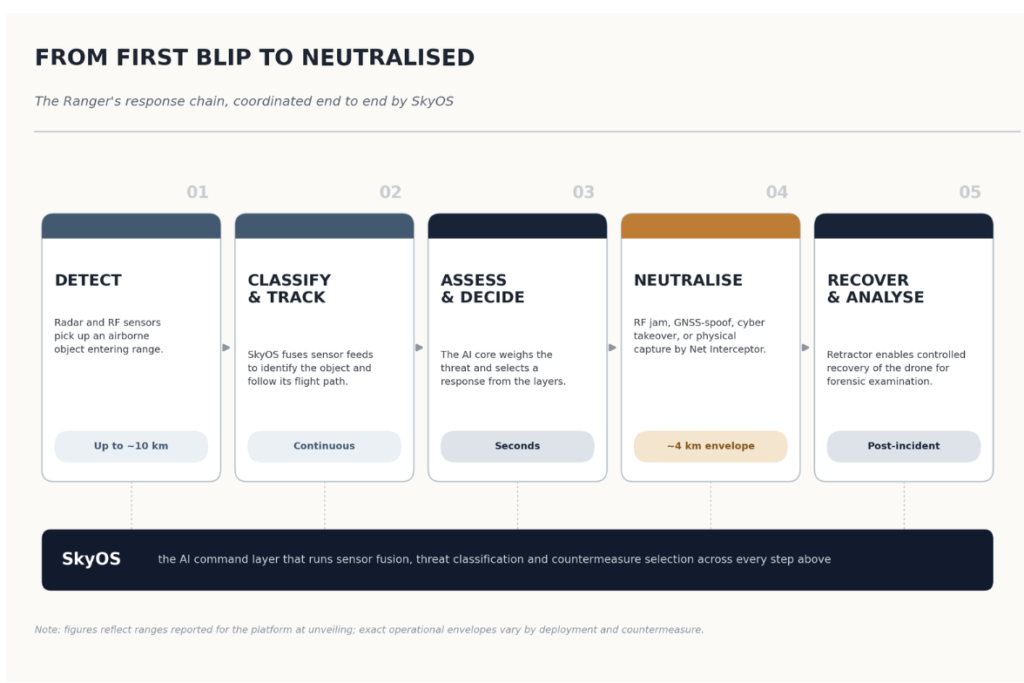
The Indrajaal Ranger’s detect-to-neutralise chain, coordinated end to end through SkyOS.
Once a target is classified as a threat, the Ranger has a menu of responses running from soft to hard: RF jamming and GNSS spoofing to disorient a drone or force it off course, a cyber takeover to seize its control link where that’s technically possible, and, if none of that works, physical interception through the Net Interceptor. Reported figures put the actual engagement envelope — the range within which the Ranger can neutralise a target, as opposed to merely see it — at around 4 kilometres (The Week), noticeably shorter than the detection range, which is a fairly standard gap across counter-drone systems generally.
SkyOS: The Software Doing the Thinking
Indrajaal positions SkyOS as a C5ISRT platform — command, control, communications, computers, cyber, intelligence, surveillance, reconnaissance and targeting, folded into one piece of software meant to run the Ranger without an operator manually switching between a radar screen and a set of jammer controls. “Indrajaal Ranger uses SkyOS as its command-and-control layer, integrating sensors, AI, sensor fusion and countermeasure management.”
Neither company has published a detailed breakdown of where automated decision-making ends and human sign-off begins — worth noting, given that SkyOS isn’t just flagging targets but, through Retractor, potentially seizing control of another aircraft in flight. The general pattern across serious C-UAS platforms elsewhere is to keep a person in or over the loop for anything beyond low-level electronic disruption.
Three Layers of Protection
The Ranger’s defensive architecture comes down to three named subsystems, coordinated throughout by SkyOS — easier to understand as an escalation ladder than as three separate machines each doing their own job.
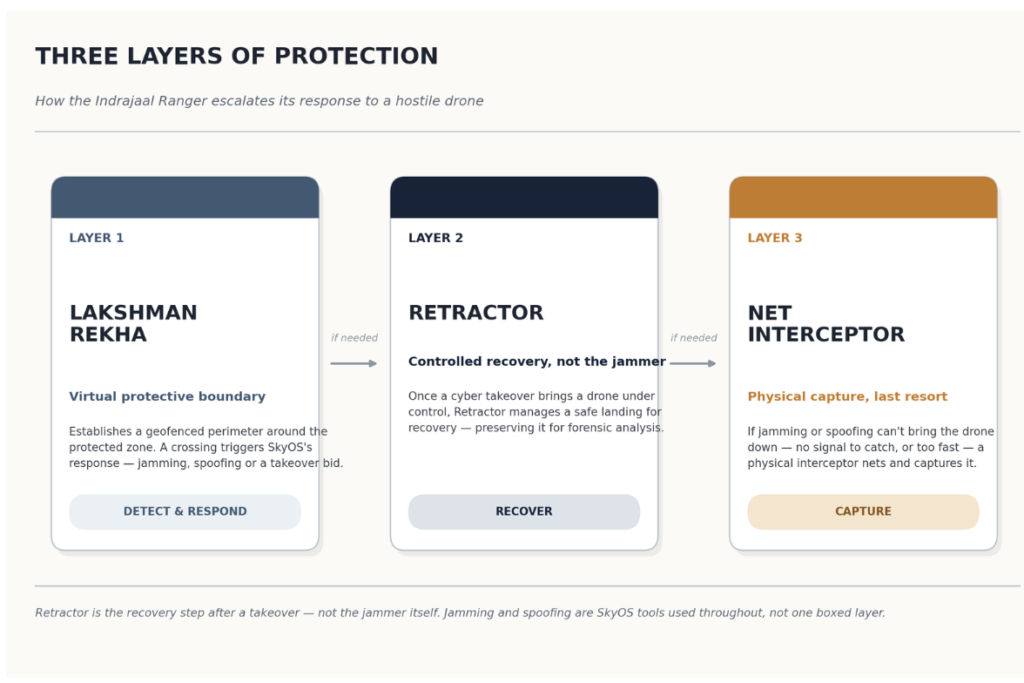
The Ranger’s three-layer response: Lakshman Rekha flags the intrusion, Retractor manages controlled recovery after a takeover, and Net Interceptor makes a physical capture only if the electronic layers fall short.
Lakshman Rekha — named for the line Sita was warned never to cross — is the first layer: a virtual, geofenced boundary around whatever the Ranger is protecting. Cross it without authorisation and the system flags the intrusion immediately.
From there, SkyOS can reach for electronic countermeasures — RF jamming and GNSS spoofing — to force a drone off course, or, where its link supports it, a cyber takeover to seize control mid-flight. Retractor is specifically the module built around that second outcome: once a drone is under control, it manages a safe, controlled recovery rather than letting it crash or fly off, which matters because a recovered drone can be examined afterward for clues about who sent it. Retractor isn’t the jamming system itself; it’s the recovery step that follows a successful takeover, and that distinction is worth keeping straight.
Net Interceptor is the last resort: physical capture, used when the electronic layers haven’t worked, whether because the drone is hardened against jamming, flying autonomously with no live link to spoof, or simply too fast to catch electronically. It’s the blunt backstop behind two more precise layers. Electronic methods are the lower-risk option and can bring a drone down intact, but only work if there’s a signal to jam or spoof in the first place; physical capture works regardless of link status, at the cost of more precision risk over a populated area.
Indrajaal Ranger: Specifications at a Glance
| Parameter | Indrajaal Ranger |
| Category | Mobile Anti-Drone Patrol Vehicle (ADPV) |
| Role | Counter-UAS / low-altitude airspace protection |
| Base platform | Toyota Hilux 4×4 (reported) |
| Developer | Indrajaal Autonomous Defense Systems |
| Key subsystem partner | Sigma Advanced Systems — radar, EW, sensing |
| Command & control | SkyOS (AI-driven C5ISRT platform) |
| Reported detection range | Up to ≈ 10 km |
| Reported engagement envelope | ≈ 4 km |
| Electronic countermeasures | RF jamming, GNSS spoofing, cyber takeover |
| Physical / hard-kill method | Net Interceptor (physical capture) |
| Recovery mechanism | Retractor — controlled recovery for forensics, after takeover |
| Perimeter system | Lakshman Rekha — virtual geofence |
| First unveiled | November 2025 |
| 2026 order customers | Ministry of Home Affairs (border, per most reports); urban police agency (VVIP/urban) |
These are company-reported figures, not independently audited specifications, and the labels above are written that way deliberately. Actual performance will depend on target size, radar cross-section, altitude, terrain, the electromagnetic environment and which countermeasure is used.
Where Ranger Fits in India’s Counter-Drone Ecosystem
The Ranger isn’t the only serious counter-drone effort India has running, and it’s worth placing it against that backdrop rather than treating it as the country’s answer to the drone problem on its own. DRDO’s own D4 system — Drone Detect, Deter, Destroy, developed across its Bengaluru and Hyderabad labs and produced at scale with Bharat Electronics Limited — has been inducted across the Army, Navy and Air Force, and comes in both a static, tripod-mounted configuration and a vehicle-mounted one, with newer portable variants aimed at VIP convoys and an urban rollout (DRDO/BEL, via Free Press Journal).
Where D4 leans on a laser-based directed-energy weapon for its hard-kill option, Ranger uses a physical net; the soft-kill toolkit — RF jamming, GNSS spoofing — looks broadly similar across both. Add the Army’s separate drone-detection and interdiction systems installed along the Line of Actual Control, BSF’s own border infrastructure, and private entrants such as Paras Defence working on directed-energy interception, and the picture is less “India buys one drone-catcher” and more a multi-track build-out running in parallel across fixed installations, vehicle-mounted systems, radar and RF networks, and dedicated border deployments.
What’s been comparatively rare in that mix, until recently, is a platform built from the ground up as a road-going patrol vehicle rather than a sensor package that happens to be able to move. That’s the gap Indrajaal is aiming the Ranger at. It isn’t a replacement for DRDO’s systems, the Army’s LAC deployments or BSF’s existing border infrastructure — its distinctive contribution is mobility: the ability to carry a layered response to wherever a convoy, a rally or a patrol route happens to need it that day, rather than waiting for the threat to wander into range of something bolted down.
Read that way, the ₹155-crore order looks less like a single decisive purchase and more like one more piece being slotted into a counter-drone architecture that’s still being assembled — DRDO and BEL on one side, a widening set of private developers like Indrajaal and Sigma on the other, and the actual test of how well it all works together still ahead.
Why a Vehicle Beats a Fixed Installation
Put the mobility question in blunt terms: a fixed C-UAS installation is excellent at protecting the one place it’s bolted to, and close to useless everywhere else. India’s borders run over 15,000 kilometres; its VVIP movements, public events and infrastructure sites are scattered across the country. Building a permanent counter-drone tower at every point that might need protecting on a given day isn’t realistic, any more than a permanent checkpoint at every spot a motorcade might pass through would be.
| Fixed C-UAS | Mobile C-UAS (the Ranger) |
| Protects one designated site | Can move with the mission or the threat |
| Needs permanent infrastructure | Deploys straight from a patrol vehicle |
| Best for static, high-value assets | Suited to convoys, events, shifting border stretches |
| Limited geographic reach | Wider operational flexibility |
| Site-specific protection only | Border, VVIP, urban and infrastructure duty alike |
A patrol vehicle sidesteps the site-bound problem by carrying the capability to the threat instead of waiting for the threat to arrive somewhere pre-equipped — sitting at a border outpost one week, escorting a convoy the next. In practice, that points to a handful of recurring settings:
- Border patrols and forward posts
- VVIP and convoy protection
- Public events and temporary security zones
- Critical infrastructure — airports, ports, power installations
- Military convoy escort
It’s why Indrajaal and Sigma keep pointing to the Ranger’s dual order — border plus urban policing — as validation of the concept rather than two unrelated wins.
What Is ARDTC, and What Does Its Approval Mean?
Both companies describe the Ranger as India’s only ARDTC-approved anti-drone patrol vehicle — worth unpacking rather than repeating uncritically, since ‘only’ is a strong word in a market with several serious counter-drone players.
ARDTC itself — the Anti-Rogue Drone Technology Committee — is real and reasonably well documented: the Home Ministry set it up under the supervision of the BSF Director General, with a mandate to evaluate counter-rogue-drone technology and certify its effectiveness, confirmed more than once in written Parliamentary replies (PIB; MHA). What that certification is not, based on the public record, is a blanket safety or performance guarantee; it’s a technical evaluation run against the committee’s own criteria, by a body that reports to the Home Ministry rather than an independent regulator.
Whether the Ranger genuinely holds a category of approval no rival platform has managed, or whether ‘only’ is doing some marketing work in that sentence, isn’t verifiable from outside the evaluation process. It’s the companies’ own characterisation of their own certification — worth taking seriously, but best read as a claim from an interested party rather than a settled fact.
India’s Drone Problem Is Bigger Than the Border
For most of the last decade, counter-drone in India has meant, by default, the Punjab and Jammu border — a response to a fairly specific smuggling and terrorism problem. That’s changing. Small, cheap, commercially available drones have shown up as reconnaissance tools and as delivery mechanisms for contraband and weapons, and, in conflicts elsewhere that Indian planners watch closely, as one-way attack munitions and coordinated swarms — all using hardware that costs relatively little and needs no state sponsorship to acquire.
That shift matters because a threat that used to be concentrated along one frontier is now, in principle, available to anyone within retail reach of a drone shop, aimable at anything from a stadium to a data centre to a motorcade. Protecting a fixed list of strategic sites was defensible when the threat was contained to that list; it’s a weaker strategy once the pool of possible targets is effectively unlimited and the pool of possible attackers has gotten cheaper to enter.
The Uncomfortable Economics of Shooting Down a Cheap Drone
There’s an argument that tends to get left out of the marketing copy around any counter-drone system, and it’s worth putting back in: the fundamental problem is cost asymmetry. An inexpensive, commercially available drone can force the defender to field a detection-and-defeat architecture — radars, jammers, interceptors, trained crews — that costs many times more than the threat it’s built to stop.
That asymmetry is the central headache of the counter-drone industry as a whole, not just Indrajaal’s corner of it, and it’s the reason nobody serious argues for defending against drones with one expensive tool. A countermeasure that costs more than the aircraft it’s stopping is a losing trade if you have to make it often enough, which is exactly why layered systems like the Ranger lean on cheap soft-kill methods first and hold physical interception in reserve.
None of that makes the cost problem disappear; it just moves where the expense sits, from one interceptor per drone to a vehicle, an AI platform, trained operators and upkeep, spread across however many incidents that investment ends up covering over its service life. Whether that trade works out in the Ranger’s favour is really a question about how often it gets used and for how long it stays in service — the kind of answer that only shows up years after a procurement announcement, not on the day of one.
What This Order Signals
Strip away the hardware and the ₹155-crore order is also a small case study in where Indian defence manufacturing is trying to go. Both the Ranger and the money behind it came from private companies rather than a defence PSU — Indrajaal building the platform and software, Sigma supplying electronics it has spent three decades learning to build for missile and aircraft programmes. That’s very much the model behind the government’s indigenisation and Atmanirbhar Bharat push: fewer imported systems, more Indian firms, including smaller, newer ones like Indrajaal, building complete, exportable products rather than components for someone else’s platform.
It also says something about how India’s homeland-security establishment is starting to budget for counter-drone capability: not as one large military programme, but as something bought in smaller, distributed pieces — a border allocation here, an urban-police order there. If that pattern holds, mobile C-UAS platforms could end up looking less like exotic defence tech and more like a standard line item for state police and paramilitary units alike.
The Questions Nobody’s Answered Yet
For all the capability on paper, a few open questions sit underneath this announcement that neither company’s statements really address.
Small, slow, low-flying drones remain genuinely hard to pick up on radar built for faster, higher targets — true of every C-UAS system on the market, not a Ranger-specific flaw, but it means the detection ranges quoted at unveiling are best-case figures rather than guarantees against every kind of drone in every kind of terrain.
Autonomous drones flying pre-programmed routes with no live radio or GPS link sidestep jamming and spoofing entirely, leaving physical interception as the only real countermeasure — and Net Interceptor is explicitly the fallback layer, not the primary one. Coordinated swarm attacks multiply the problem further, since a system built to track and respond to one threat at a time has to split its attention, and its countermeasures, across several targets simultaneously.
There are softer questions too. Running RF jammers and GNSS spoofers near civilian areas — airports, city centres, VVIP routes — runs into the same interference concerns that have made even India’s aviation-security regulator cautious about anti-drone deployment near airspace used by commercial aircraft. And a system built around an AI core making rapid classify-and-respond decisions raises the question of false positives: what happens when SkyOS flags a delivery drone, a news camera or a hobbyist as a threat, and how much of that call is actually left to a human to double-check before a countermeasure fires.
None of this is an argument against the Ranger specifically — it’s the standard list of problems every mobile C-UAS platform has to manage, and the companies would likely say their layered design exists precisely to spread the risk across those weak points. But it’s a more honest way to read a procurement announcement than taking a phrase like comprehensive defence against hostile drones at face value.
What’s Next
Indrajaal Ranger represents a shift toward mobile, layered counter-UAS capability. The immediate next step, on the companies’ own account, is delivery and deployment against the orders already booked — the ₹145 crore border allocation and the ₹10 crore urban-policing piece. Sigma’s own investor materials point to a defence order pipeline running into the thousands of crores across multiple programmes, of which counter-drone work is one growing slice, and both companies have talked publicly about export markets for mobile C-UAS technology as a next step once domestic orders are running smoothly.
The real significance of the Ranger probably isn’t that India has bought one more anti-drone system. It’s the shift toward mobile, layered counter-UAS capability that moves with a mission instead of staying bolted to one site — a shift DRDO’s own vehicle-mounted D4 variants are pushing toward as well, from a different starting point. Whether that becomes the norm across India’s police and paramilitary forces depends on things a procurement announcement can’t answer: how the Ranger performs against autonomous and swarm threats in the field, what each engagement actually costs to mount, and how well a private platform like this one ends up integrated with the government-run systems already in place around it.
Timeline
| From unveiling to order book — November 2025 — Indrajaal unveils the Ranger, built on a Toyota Hilux, as India’s first fully mobile, AI-enabled anti-drone patrol vehicle. — February 2026 — Sigma Advanced Systems and Indrajaal announce a strategic partnership for radar, jamming and spoofing subsystems, reportedly worth ≈ ₹250 crore in its first year. — 17 August 2026 — The companies announce ≈ ₹155 crore in combined new orders: ₹145 crore for border security, ≈ ₹10 crore for urban and VVIP policing. — Ahead — Manufacturing, delivery and operational rollout against both orders; contracting-authority details and deployment locations remain unconfirmed publicly. |
External Links / Sources
Primary and authoritative sources used in reporting this piece.
India Strategic — “Indrajaal, Sigma secure ₹155-crore orders for mobile anti-drone patrol vehicle” (17 Aug 2026): https://www.indiastrategic.in/indrajaal-sigma-secure-₹155-crore-orders-for-mobile-anti-drone-patrol-vehicle/
The Week — “Indian Army orders mobile anti-drone system: What can Indrajaal Ranger do?” (17 Aug 2026): https://www.theweek.in/news/defence/2026/08/17/indian-army-orders-mobile-anti-drone-system-what-can-indrajaal-ranger-do.html
Rushlane — “Indrajaal Ranger Anti-Drone Vehicle Unveiled, Based on Toyota Hilux” (29 Nov 2025): https://www.rushlane.com/indrajaal-ranger-anti-drone-vehicle-unveiled-based-on-toyota-hilux-12535382.html
Free Press Journal — “DRDO To Soon Deploy Indigenous D4 System To Safeguard Cities Against Rogue Drones”: https://www.freepressjournal.in/india/drdo-to-soon-deploy-indigenous-d4-system-to-safeguard-cities-against-rogue-drones
Press Information Bureau, Government of India — on ARDTC and drone smuggling along the Punjab border: https://pib.gov.in/PressReleseDetailm.aspx?PRID=1944719
Ministry of Home Affairs — Lok Sabha written reply referencing ARDTC: https://www.mha.gov.in/MHA1/Par2017/pdfs/par2023-pdfs/LS28032023/4460.pdf