
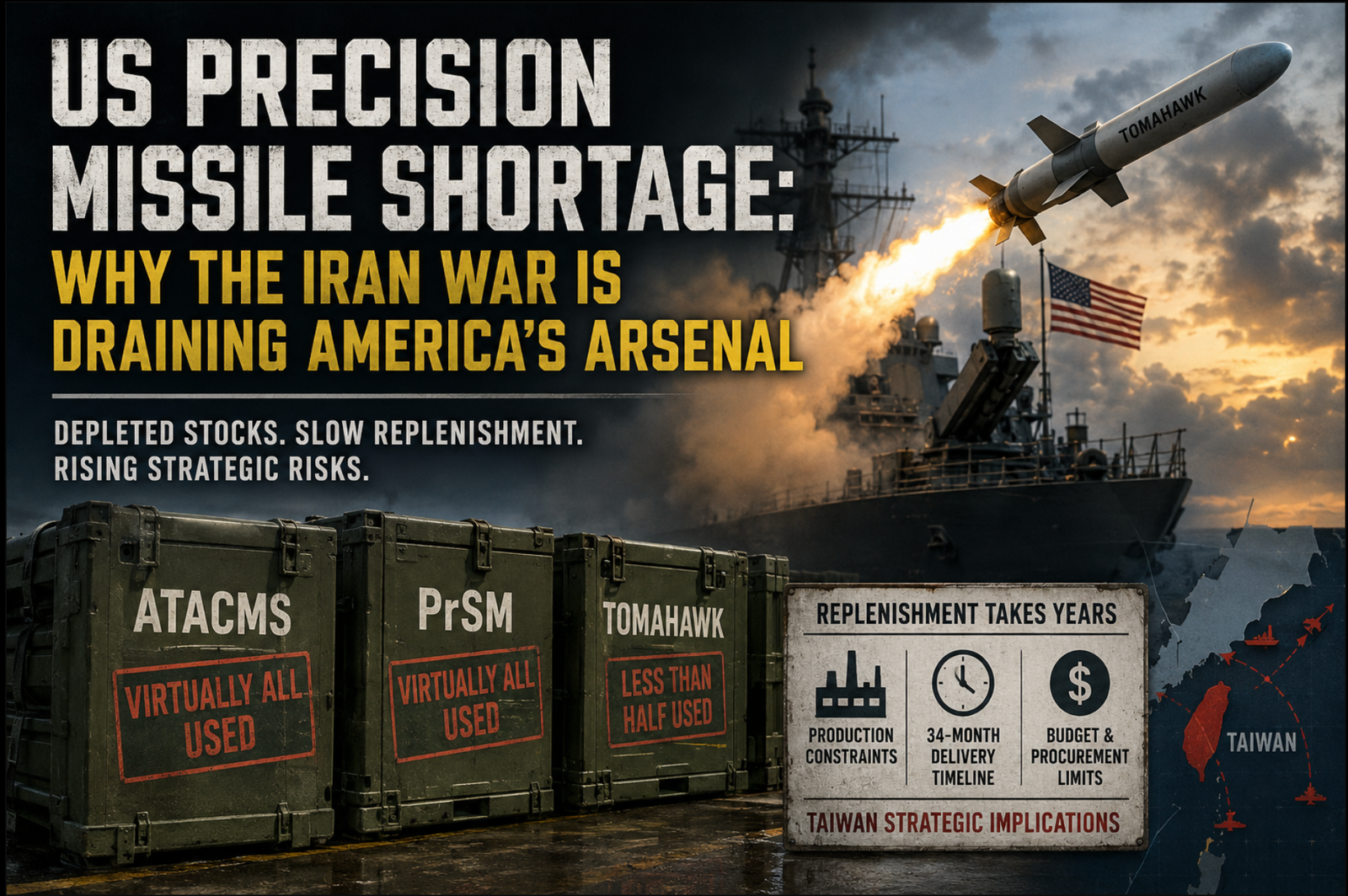
US precision missile shortage has emerged as a major concern following five months of conflict with Iran, after Reuters reported that military sources with access to classified Pentagon data disclosed significant depletion of several critical missile systems.
On August 4, 2026, Reuters reported that military sources with access to classified Pentagon data had disclosed the scale of missile depletion during five months of conflict with Iran. The US Army used virtually all of its ATACMS and PrSM supplies. Tomahawk consumption reached levels that force questions about America’s ability to sustain multiple conflicts.
The Reuters Report
Reuters published reporting on August 4, 2026 based on three military sources. The sources had access to classified Pentagon information. Reuters did not disclose their identities or official positions, citing standard source protection practices.
The article made specific factual claims about certain weapons systems and acknowledged uncertainty about others. Importantly, Reuters sources did not provide exact remaining inventory figures. Pentagon officials neither confirmed nor denied the specific depletion claims.
What the reporting disclosed:
• The US Army used ‘virtually all’ of its ATACMS (Army Tactical Missile Systems) supply
• The US Army used ‘virtually all’ of its PrSM (Precision Strike Missile) supply
• The US had used some specified quantity of Tomahawk cruise missiles, characterized as ‘less than half’ of global inventory
Trump’s statement that America had ‘far more munitions than anyone in the world’ did not directly address the reported consumption. It responded to interpretation rather than engaging with the underlying data.
What ‘Virtually All’ Actually Means
The Reuters sources used the term ‘virtually all’ for both ATACMS and PrSM inventory. The sources did not specify a percentage. In military usage, ‘virtually all’ typically signals near-complete depletion but leaves room for ambiguity about exact quantities remaining.
Different observers interpret this differently. Some read it as 95%+ consumption. Others treat it as 85-90%. Without official Pentagon confirmation of actual inventory figures, the precise percentage remains unclear.
What is unambiguous: both ATACMS and PrSM supplies reached critically low levels during five months of conflict. The distinction between 85% and 99% depletion doesn’t significantly change the strategic implication—both represent near-exhaustion of forward inventory.
Understanding ATACMS, PrSM, and Tomahawk Separately
• ATACMS supply: Used ‘virtually all’ (Reuters sources)
• PrSM supply: Used ‘virtually all’ (Reuters sources)
• Tomahawk consumption: Multiple independent sources report 850-1,000 missiles used (CBS News, Washington Post)
• Production agreements: February 4, 2026 (Raytheon announcement), March 25, 2026 (Pentagon/Lockheed Martin)
ANALYST ESTIMATES (Credible defense analysis):
• Current Tomahawk inventory: Various estimates available (CSIS analysis of budget documents)
• Current annual procurement: Approximately 57-90 missiles per year depending on fiscal year
• Maximum production capacity: Theoretical maximum ranges (contractor capacity)
WHAT WE DON’T KNOW:
• Exact current inventory across all systems
• Precise consumption rates by weapon type
• Operational reserve thresholds
• Days of supply calculations
• Whether ‘less than half’ refers to active inventory or includes strategic reserves
Each system has different production lines, different suppliers, different procurement timelines, and different strategic importance. ATACMS is ground-launched, Army-operated. PrSM is newer, also Army-operated. Tomahawks are cruise missiles operated by the Navy. These are not interchangeable inventories.
US Precision Missile Shortage: Production, Procurement and Delivery
Three distinct concepts are often confused when discussing missile production:
Production Capacity
The theoretical maximum a factory could build if operating at full speed with unlimited orders. For Tomahawks, contractor capacity exists to produce roughly 2,330 per year if all facilities (Raytheon multiple contracts, BAE Systems contract) operated at maximum. This is not current policy—it’s a theoretical ceiling based on available infrastructure.
Actual Procurement
What the Pentagon budgets for and orders each year. Recent fiscal years show procurement in the range of 57-90 Tomahawks annually, depending on the year. Procurement depends on congressional appropriations, not on production capacity alone.
Delivery Timelines
Critical for understanding inventory replenishment: the time between order and receipt. Current Tomahawk delivery timelines, according to CSIS research, extend 34 months from contract. This means missiles ordered today won’t arrive until late 2028 or beyond. This is the actual constraint facing military planning.
The February 4, 2026 Raytheon framework agreement targeted eventual production increases to 1,000+ per year. But ‘eventual’ requires years. Current deliveries are locked into orders placed years ago. Ramping production requires new factory capacity, new suppliers, new workforce training—all measured in years, not months.
ATACMS and PrSM: Inventory Status
“The US precision missile shortage is particularly significant for ATACMS because Army inventory for ground-launched missiles is now constrained.” ATACMS is not interchangeable with Navy cruise missiles or air-launched systems. Once Army inventory is consumed, there’s no backup from other services.
Reuters sources reported Army PrSM supply was also consumed to ‘virtually all’ levels. PrSM is the newer system designed to replace ATACMS over time. Accelerated consumption of the newer system suggests operational urgency overrode normal procurement discipline.
Pentagon framework agreements announced in March 2026 target 550 PrSM per year eventually. But that’s a future target, not current production. Near-term Army inventory for ground-launched missiles is materially depleted.
Patriot Interceptors and Defensive Consumption
CNN reported that approximately 78-80% of a key missile defense system’s interceptors deployed to the Middle East had been expended. This figure likely represents: Of the air-defense interceptors deployed to the theater for this specific conflict, the vast majority were consumed in defensive operations.
The denominator matters. This is not necessarily 78-80% of global Patriot inventory. It’s the interceptors that were forward-deployed, then consumed in theater defense against Iranian threats.
Iran maintained persistent drone and missile threats against US bases throughout the conflict. Defending against those threats required defensive interceptor expenditure. An inexpensive Iranian drone might require a Patriot PAC-3 interceptor costing approximately $3.9 million to defeat. Over five months of persistent threats, defensive inventory depletion occurs alongside offensive missile consumption. “This makes the US precision missile shortage broader than an offensive-strike problem alone.”
War Reserve Thresholds and Strategic Risk
Military planners operate with war reserve requirements—classified thresholds defining minimum inventory levels needed to respond to multiple contingencies. These are not arbitrary numbers. They’re calculated based on expected consumption rates in various scenarios.
“For the US precision missile shortage, the critical issue is what happens when inventory falls below established war-reserve requirements and strategic flexibility declines.” This doesn’t mean the military becomes unready in an absolute sense. It means commanders face different operational choices.
Reuters reported that CENTCOM (overseeing Middle East operations) had to replenish its inventory from global reserves allocated to other theaters. If global reserves are now constrained, they’re less available for other contingencies. Pentagon planning has historically assumed capacity to respond to simultaneous major regional conflicts. That assumption depends on sufficient reserves.
Industrial Production: The 34-Month Reality
The actual constraint facing America is not factory capacity—factories exist. It’s the time required to build, test, deliver, and replenish inventory.
Current Tomahawk delivery timelines are 34 months from contract to delivery. A missile ordered today arrives in late 2028. Even with aggressive procurement expansion, the lag between order and receipt means inventory gaps persist for years. “The US precision missile shortage is therefore partly an industrial-base problem rather than simply a battlefield consumption problem.”
The Pentagon signed production framework agreements in February and March 2026 targeting significant expansion. Raytheon committed to Tomahawk production eventually reaching 1,000+ per year. But ‘eventually’ requires:
• Expanding solid rocket motor supply chains
• Securing specialized microelectronics and guidance components
• Building new manufacturing facilities or expanding existing ones
• Training new skilled technicians to precision manufacturing standards
• Certification and testing of new production lines
Lockheed Martin announced $150 million investment over five years in its Troy, Alabama facility. That investment will expand capacity, but it takes time to plan, build, and activate new production. Real production increases won’t materialize for 18+ months from now, with full expansion requiring several years.
Meanwhile, consumption continues. Potential new conflicts could emerge during the production expansion period.
The Taiwan Problem
The Iran depletion would matter less if America faced only regional challenges. But military planning considers Taiwan.
A Chinese military move against Taiwan would occur 6,000+ nautical miles from US bases in Japan and the Philippines, and substantially farther from bases in mainland Asia. In such a scenario, every ship, aircraft, and munition would need to transit contested waters and airspace.
Taiwan contingency planning requires different weapons than Iran operations: anti-ship missiles, extended-range air defense, robust naval-strike capability. Using a significant portion of Tomahawk inventory in Iran means entering a Taiwan contingency with reduced strategic reach.
Pentagon planning assumes capacity for simultaneous contingencies. That assumption depends on distributed reserves globally. The Iran conflict tested that assumption. Results suggest reserves are more constrained than peacetime planning allows.
What This Does NOT Mean
• It does NOT mean America has run out of precision weapons. Remaining inventory still provides substantial strike capability.
• It does NOT mean American airpower is ineffective. Deployed systems remain operationally superior to peer competitors.
• It does NOT mean the US cannot defend Taiwan. It does mean the margin for simultaneous contingencies is narrower.
• It does NOT mean Iran achieved military victory. Iranian forces sustained significant losses. Depleted weapons inventories represent a procurement problem, not a military defeat.
• It does NOT mean American industry cannot expand production. The framework agreements demonstrate commitment to expansion.
What it DOES mean: America’s current military model depends on industrial capacity capable of sustaining high-volume warfare. That capacity is being tested and found insufficient for rapid simultaneous contingencies.
Military Readiness Beyond Numbers
Readiness encompasses far more than missile inventory. It requires trained personnel, maintenance infrastructure, intelligence networks, command systems, and platform availability.
“The US precision missile shortage constrains one component of this complex readiness system.” It doesn’t make the military unready overall. But it does change how commanders approach target selection and operational tempo. “The strategic significance of the US precision missile shortage lies in the reduced margin available for another major contingency while depleted stocks are being rebuilt.”
A commander now calculates differently: Is this target worth the missile cost? Can a cheaper option achieve the same effect? Should I wait for inventory replenishment? These are different calculations than when inventory felt unlimited.
That’s not military unreadiness. But it’s a meaningful constraint on operational freedom. “The US precision missile shortage is therefore less a story of America running out of weapons than a warning about the time required to replenish critical inventories.”
Frequently Asked Questions
What exactly did Reuters report?
Military sources told Reuters the US used ‘virtually all’ ATACMS and PrSM supplies and some specified quantity of Tomahawks. Exact remaining inventory was not disclosed. The Pentagon neither confirmed nor denied the claims.
How much Tomahawk inventory remains?
Exact figures are classified. Multiple sources report approximately 850-1,000 Tomahawks were consumed. Defense analysts publish various estimates of total inventory, but official Pentagon figures are withheld.
Why can’t production just increase immediately?
Current Tomahawk delivery timelines are 34 months from contract. Even with aggressive procurement, factories need time to expand capacity. Expanding requires new facilities, components, workforce training, and certification.
Does the US have enough weapons for Taiwan?
That depends on when a Taiwan contingency emerges and how long it lasts. Pentagon planning assumes capacity for simultaneous contingencies. Depleted inventory in one theater narrows margins for another.
Is the Pentagon hiding information?
Exact inventory levels are classified. That’s standard practice for operational security. Military sources provided the Reuters information themselves, suggesting frustration with perceived inadequate production response to depletion.
How quickly can production expand?
Framework agreements signed in February and March 2026 target expansion. Real production increases likely won’t materialize for 18+ months. Full capacity expansion takes several years.
What does ‘virtually all’ actually mean?
Reuters sources used the term without specifying exact percentages. In military context it typically signals near-complete depletion but leaves ambiguity about precise quantities.